
The 80% power lie
statmodeling.stat.columbia.edu/2026/02/19/t...
The 80% power lie
statmodeling.stat.columbia.edu/2026/02/19/t...
application for this phd closes on 10 Feb
07.02.2026 11:21 — 👍 38 🔁 39 💬 0 📌 0
Our results demonstrate how easily CV choices can distort conclusions, particularly for more complex models, and underscore the importance of transparency.
Thanks to Stephen Fairclough, Frederic Dehais, and Matt Richins for their guidance!
📄 Paper: doi.org/pt6h
#Neurotech #BCI #OpenScience #EEG
🔍 Takeaways for offline pBCI studies:
- Clearly document your data-splitting strategy — subtle choices can skew results
- If using blocks: keep them short, interleave conditions, and don’t split a block across train/test
- Trial-level randomisation is usually better to avoid time-based confounds
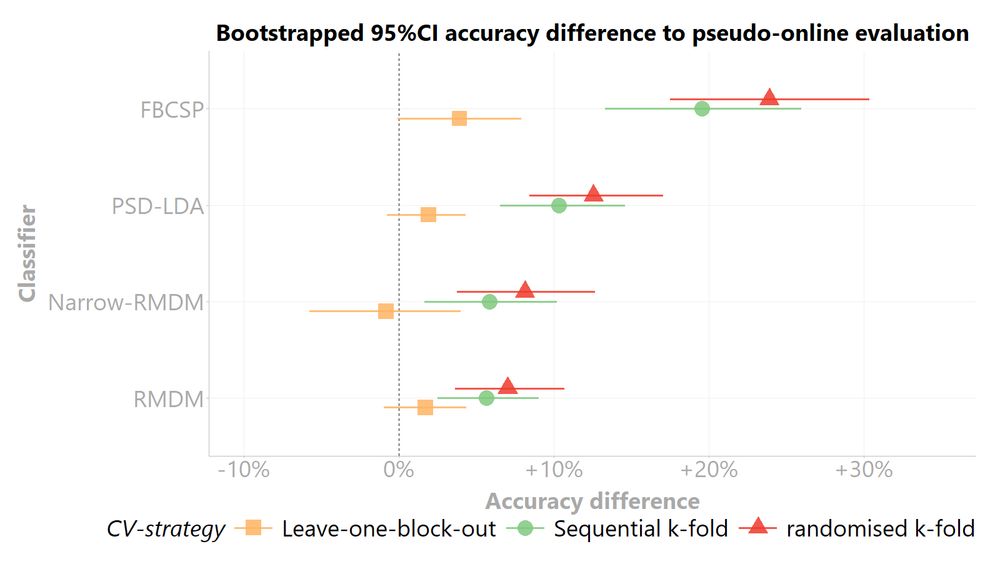
Differences in mental workload detection accuracy across various classifiers and cross-validation schemes. There is a trend that the more free parameters a model has, the greater the accuracy inflation in block-structure independent cross-validation schemes.
Cross-validation can seriously mislead passive Brain-Computer Interface (pBCI) evaluation.
🎉 New publication!
In our latest paper, we demonstrate how cross-validation choices can influence pBCI performance in mental workload detection and potentially mislead model comparisons.
(1/3)
It was probably this! datavizsp25.classes.andrewheiss.com/resource/ai-...
26.04.2025 23:42 — 👍 29 🔁 8 💬 1 📌 2