Our new paper showcasing molecular connectomics with pan-expansion microscopy is out in @natbiotech.nature.com! www.nature.com/articles/s41...
This wonderful collaboration with @bewersdorflab.bsky.social was led by Ons M'Saad (now founder/CEO of Panluminate) and @allisonphysics.bsky.social. (1/5)
27.11.2025 04:39 — 👍 61 🔁 24 💬 1 📌 0
Happy to share the first paper from my journey at @psich.bsky.social towards X-ray connectomics, now out in @natmethods.nature.com: www.nature.com/articles/s41...
27.11.2025 10:21 — 👍 39 🔁 15 💬 1 📌 0
Meet Wangchu and connectomics in the spinal cord this afternoon at LBP077.04 / LBP036 #SFN25
18.11.2025 16:15 — 👍 5 🔁 0 💬 0 📌 0

Stop by Wangchu's poster Tuesday (11/18) afternoon to learn about circuit motifs supporting touch processing in the spinal cord.
18.11.2025 06:07 — 👍 9 🔁 1 💬 0 📌 1

Male CNS Connectome
A team of researchers has unveiled the complete connectome of a male fruit fly central nervous system —a seamless map of all the neurons in the brain and nerve cord of a single male fruit fly and the ...
Exciting news for #drosophila #connectomics and #neuroscience enthusiasts: the Drosophila male central nervous system connectome is now live for exploration. Find out more at the landing page hosted by our Janelia FlyEM collaborators www.janelia.org/project-team....
05.10.2025 15:40 — 👍 144 🔁 69 💬 2 📌 8
It was a good experience to step back and briefly take stock of the amazing progress in connectomics since I started working on this stuff (20 years ago!)
thanks as well to @natrevneuro.nature.com for the constructive editorial interactions.
14.08.2025 19:40 — 👍 36 🔁 13 💬 0 📌 0
X-ray nanotomography can be your new friend for neuronal imaging. In our new #preprint (tinyurl.com/nanoXneuro) we present advances that push the spatial resolution limit for X-ray holographic nanotomography (XNH). We can now resolve synapses. 🧵
11.02.2025 18:25 — 👍 44 🔁 16 💬 1 📌 1
My PhD project is out as a preprint!
We combined 2P and synchrotron X-ray to understand mouse olfactory bulb circuits, linking physiology to structure in 3 animals!
doi.org/10.1101/2025...
🙌 @carlesbosch.bsky.social, @apacureanu.bsky.social, @andreas-t-schaefer.bsky.social, @esrf.fr, @crick.ac.uk
01.05.2025 12:19 — 👍 63 🔁 21 💬 4 📌 4
Couldn't agree more. There’s still so much to be uncovered in the dataset.
One thing that wasn’t emphasized before is how it enables access to specific circuit motifs down to identified cells. 12 examples are highlighted in the preprint, but again just the tip of the iceberg.
10.08.2025 21:14 — 👍 9 🔁 2 💬 0 📌 0
Key annotations from: Tony Azevedo, @tuthill.bsky.social , @zandawala.bsky.social, @hokuba.bsky.social, Steffi Hampel, @andrew-seeds.bsky.social, Kathi Eichler
@jefferis.bsky.social, Michael Pankratz, @fleyes.bsky.social, & Marie Suver.
Renderings by @amysterling.bsky.social and Arie Matsliah
03.08.2025 15:16 — 👍 9 🔁 0 💬 1 📌 0
Neurotransmitter predictions from Kevin Delgado, @adjavon.bsky.social, & @janfunkey.bsky.social . Key analysis from Mohammed Osman. @sdorkenw.bsky.social & Forrest Collman for CAVE. (cont'd 2)
03.08.2025 15:16 — 👍 5 🔁 0 💬 1 📌 0
Thanks and congratulations to others on the phenomenal team including: Arie Matsliah for Codex, its development, and integration of the BANC. Key technical work from @perlman.bsky.social & Zetta AI. Aelysia for specialist proofreading. (cont'd)
03.08.2025 15:16 — 👍 5 🔁 0 💬 1 📌 0
An incredible collaboration with Rachel Wilson & her lab, Zaki Ajabi & @jdrugowitsch.bsky.social @harvardmed.bsky.social; Mala Murthy, Sebastian Seung, & the FlyWire team @princetonneuro.bsky.social for their huge proofreading effort; and Ryan Maloney & @debivort.bsky.social for the specimen.
03.08.2025 15:16 — 👍 4 🔁 0 💬 2 📌 0
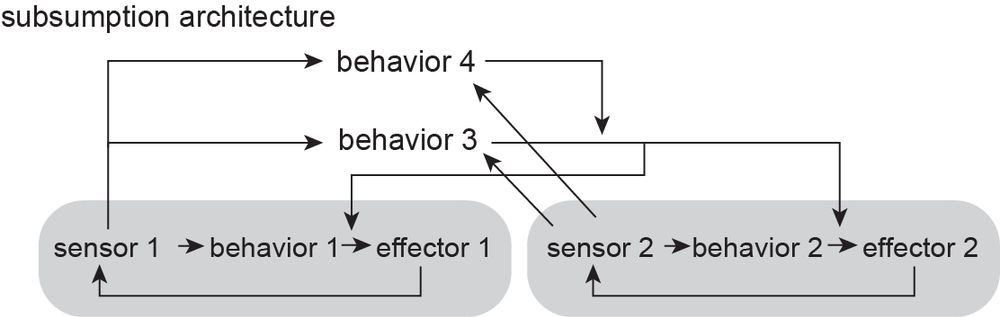
Schematic example of subsumption architecture. This example has two local loops (behavior 1 and behavior 2), corresponding e.g.
the control of individual legs. Behavior 3 is positioned to take control of both local loops (subsumption), contingent on some input from
both sensors. Behavior 4 is positioned to subsume all other behaviors, based on some other input from both sensors.
Our data support an architecture of distributed, parallelized, and embodied control, reminiscent of “subsumption architectures” from autonomous robotics, where behavior-centric feedback loops are organized s that they can be combined or subsumed to generate complex or resolve competing behaviors.
03.08.2025 15:16 — 👍 7 🔁 2 💬 1 📌 0
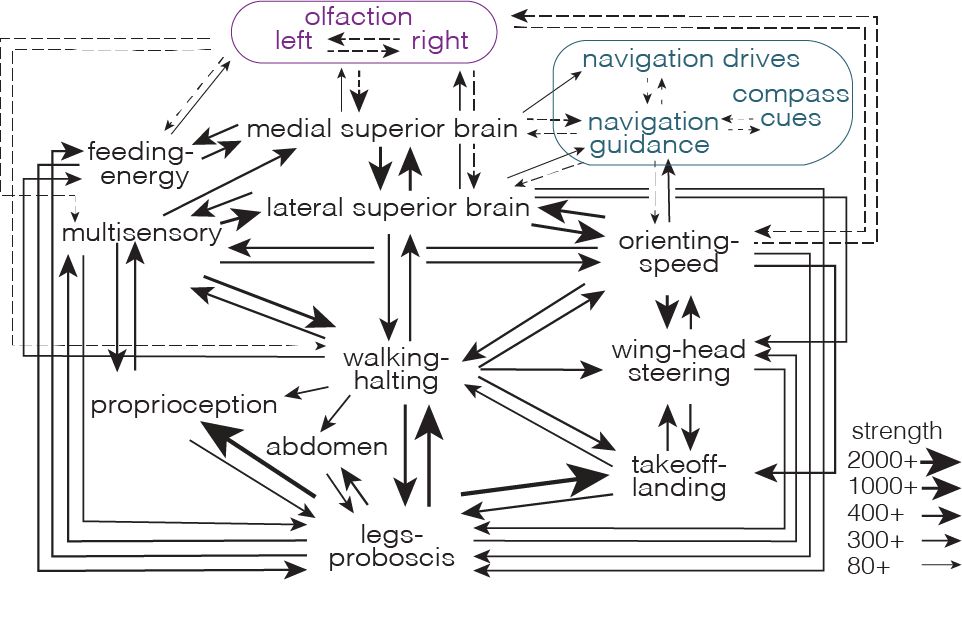
Strongest links between CNS networks. The size of each arrow represents the number of postsynaptic cells in that link.
* Brain regions involved in learning and navigation supervise these circuits.
03.08.2025 15:16 — 👍 7 🔁 1 💬 1 📌 0
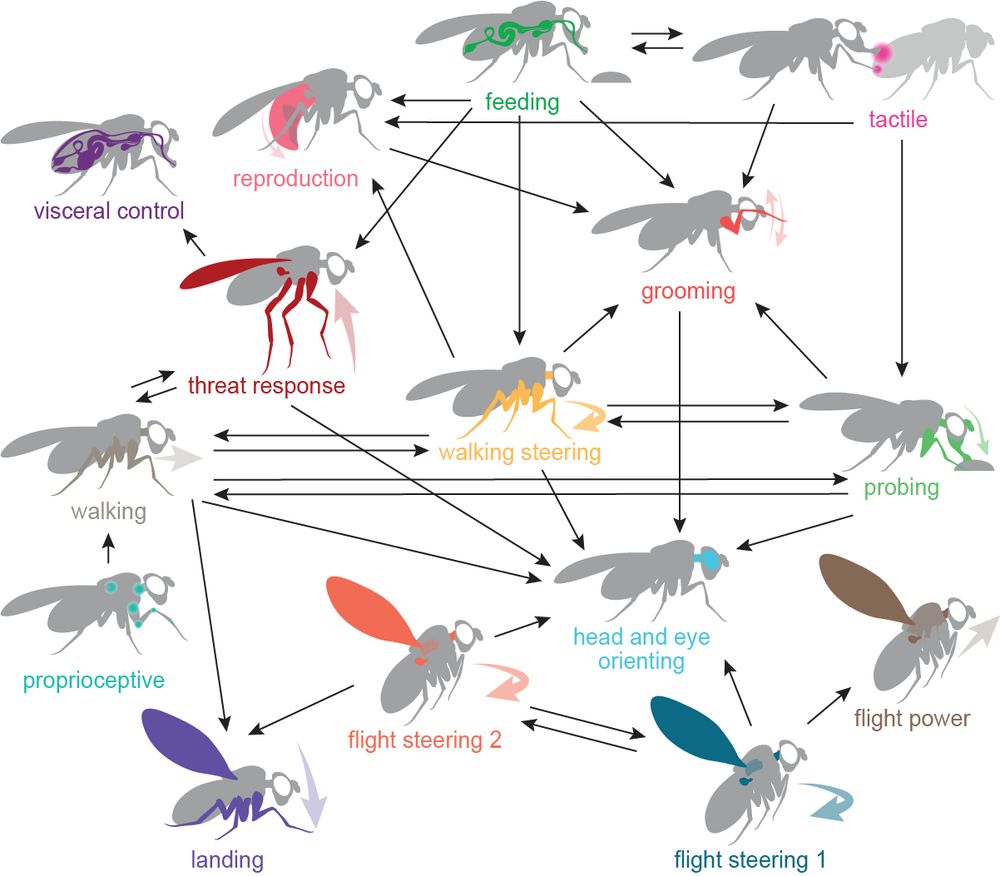
Summary of the strongest adjusted influences between behavioral modules as a network graph.
* Long-range pathways are organized to permit coordination within and across modules to fine-tune, prioritize, resolve conflicts, and link related behaviors in sequences. This may offer structural substrates for behavioral compositionality.
03.08.2025 15:16 — 👍 10 🔁 2 💬 1 📌 0
* Long-range ascending and descending neurons can combine local loops into behavioral modules.
bsky.app/profile/mott...
03.08.2025 15:16 — 👍 7 🔁 1 💬 1 📌 0
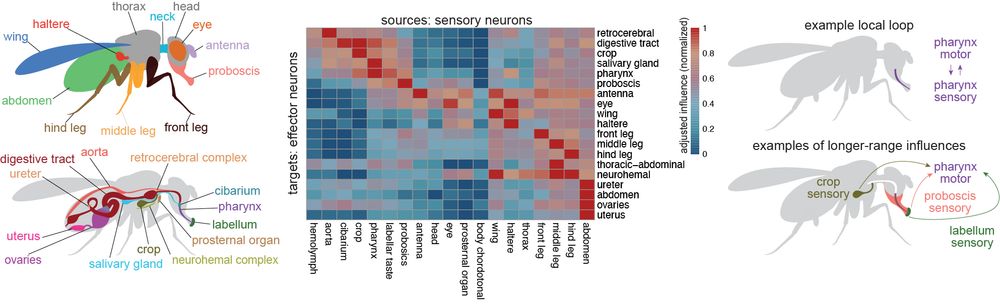
(left) Schematic of body parts associated with annotated effector cells in the BANC. (middle) Heatmap of mean adjusted influence of sensory cells (columns) on effector cells. Sensory and effector cells are pooled by body part. Each row is minmax normalized to the same range (0-1). (right) Schematic of an example local loop (top) that is also linked to specific sensors via long-range connections (bottom).
Using the this influence metric, we find:
* Local sensorimotor loops linking matched sensors and effectors are basic building blocks of behavioral control.
03.08.2025 15:16 — 👍 8 🔁 1 💬 1 📌 0
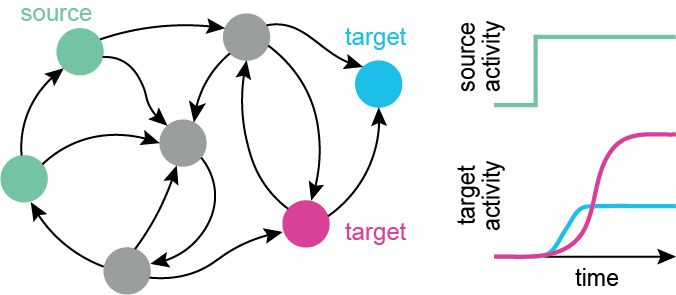
Cartoon of directed network graph and schematic depicting the influence of source cells on target cells is estimated via linear dynamical modeling.
Moreover, Zaki Ajabi developed a computationally efficient method for quantifying the “influence” any neuron has on any other neuron in the CNS. We applied this method to estimate the pairwise interactions between all cells in the CNS, amounting to more than 20 billion influence scores.
03.08.2025 15:16 — 👍 6 🔁 2 💬 1 📌 0
The dataset includes ~160,000 cells, segmented nuclei and mitochondria, synapses and neurotransmitter predictions, and annotations linking the CNS to peripheral sensory, motor, and visceral systems.
Info: banc.community
Data: codex.flywire.ai?dataset=banc
Viewer: ng.banc.community/view
03.08.2025 15:16 — 👍 8 🔁 4 💬 1 📌 0
The BANC is the first connectome that explicitly links the brain to the nerve cord, & through it, to the body. It offers a new “embodied” perspective for connectomes, one that changes how we think about neural networks for control, behavior, & even artificial intelligence.
bsky.app/profile/mott...
03.08.2025 15:16 — 👍 12 🔁 2 💬 1 📌 0
How is the nervous system organized to coordinate behavior? To approach this massive question, a team led by @asbates.bsky.social, @jasper-tms.bsky.social, @mindyisminsu.bsky.social, & Helen Yang present the BANC: a Brain and Nerve Cord connectome.
Preprint: doi.org/10.1101/2025...
🧪#Neuroskyence
03.08.2025 15:16 — 👍 130 🔁 59 💬 4 📌 6
Thanks to those that supported the work including: @wellcometrust.bsky.social, @klingensteinorg.bsky.social, @simonsfoundation.org, @sloanfoundation.bsky.social, Searle Scholars Program, the Smith Family Foundation, and the Pew Charitable Trusts.
03.08.2025 03:50 — 👍 0 🔁 0 💬 0 📌 0
These results offer a new view of how host cues are processed in the mosquito brain and comparative and evolutionary perspectives on neuronal circuits.
Congrats to the authors and collaborators including Jialu Bao and Wesley Alford who lead this effort!
03.08.2025 03:50 — 👍 0 🔁 0 💬 1 📌 0

(left) Model architecture. CO2 is processed by Glomerulus 1, which includes recurrent connections. Co-occurring odorants (‘background’) activate glomeruli which inhibit other glomeruli through inhibitory local neurons (LNs). (right) Plot of OSN to PN response curves for OSNs with and without recurrent connections, for two different background odor strengths.
Using a connectome-informed computational model, @briandepasquale.bsky.social showed that recurrent primary sensory connectivity boosts the downstream neurons output under realistic background odor conditions, meaning recurrent synapses make CO₂ detection robust, even in a noisy world.
03.08.2025 03:50 — 👍 0 🔁 0 💬 1 📌 0

(left) Schematic with reciprocal OSN-to-OSN connections highlighted. (right) Violin plot of total number of outgoing OSN-to-OSN synapses contained within each glomerulus comparing the >50 fruit fly to the Ae. aegypti CO2 sensitive Glomerulus 1 (red arrow).
Compared to recent fruit fly connectomes, this massive increase in recurrent connectivity and ribbon-like synapses was unique to CO₂ circuitry in the mosquito.
03.08.2025 03:50 — 👍 0 🔁 0 💬 1 📌 0

(left) EM micrograph of putative ribbon-like (red arrow) synapses. (right) Schematic of a putative ribbon-like synapse in Ae. aegypti Glomerulus 1. Scale bars 500 nm.
At some of these recurrent sensory neuron contacts, we found ribbon-like presynaptic structures, these had previously only been seen in vertebrates. In vertebrate neurons, ribbon synapses are thought to enable sustained or graded transmission. These could further enhance recurrent signaling.
03.08.2025 03:50 — 👍 1 🔁 0 💬 1 📌 0

(left) Plot of the ttal number of outgoing OSN-to-OSN synapses contained within Glomerulus 1, 2, and 3 for ten fully reconstructed OSNs. (right) Schematic of reciprocal connectivity with arrow thickness reflecting synapse number.
We find high recurrent connectivity between the sensory neurons that detect CO₂. Surprising because such neurons are thought to be independent sensors, averaged to reduce noise. Coupling them together could amplify noise, but could lead to higher sensitivity or longer signaling (more on this later).
03.08.2025 03:50 — 👍 0 🔁 0 💬 1 📌 0

(left) EM of an example olfactory sensory neuron (OSN) (orange) to OSN (blue) synapse (black arrowhead). Polyadic synapse (black arrowhead) in a Glomerulus 1 OSN (yellow). Red: postsynaptic multiglomerular cell. Blue: postsynaptic Glomerulus 1 uniglomerular projection neuron (uPN). Scale bar 1 μm. (right) Sagittal view of reconstructed maxillary palp nerve OSNs: Glomerulus 1 (pink), 2 (blue), and 3 (green). Scale bar 25 μm. a, anterior; d, dorsal; l, lateral; m, medial; p, posterior; v, ventral.
We used large-scale electron microscopy to reconstruct the wiring and connectivity of the CO₂-responsive microcircuit (Glomerulus 1) and its neighbors in a mosquito brain.
03.08.2025 03:50 — 👍 0 🔁 0 💬 1 📌 0

Schematic of CO2 activation and sensitization in Ae. aegypti host-seeking. (left) Quiescent adult female mosquitoes become activated upon CO2 detection. (right) Sensitization to additional
host cues (eg. odor, heat, etc.) drives host-seeking behavior.
Female Ae. aegypti mosquitoes track humans by sensing host cues including CO₂ humans release. CO₂ activates mosquitoes and sensitizes them to other cues like odor and heat, but how is this implemented in its brain?
03.08.2025 03:50 — 👍 0 🔁 0 💬 1 📌 0
Using Biophysics & Connectomics to explore how brain structure gives rise to function
A non-profit Focused Research Organization developing next-generation technology to accelerate neuroscience and improve human health. A part of Convergent Research.
machine learning, connectomics, comp neuro
Prof. @ucsantabarbara.bsky.social - Runs a lab slslab.org - Works on computation, neuroscience, behavior, vision, optics, imaging, 2p / multiphoton, optical computing, machine learning / AI - Blogs at labrigger.com - Founded @pacificoptica.bsky.social
Computational Neuroscientist & Neurotechnologist
https://www.scottcognitionlab.com/
Neuroscientist at Janelia Research Campus, President of the Brain Preservation Foundation. I am here to debate brain preservation with neuroscientists.
Neuroscientist @crick.ac.uk asking how information is processed in the brain.
Odours. Circuits. Neurotechnology. Synchrotrons. BCIs.
Co-founder Paradromics
Twitter: @AndreasTSchafer
Circuits & Manifolds in Development 🐭
Solberg Postdoc Fellow in the Moser Lab
~ Developmental Systems Neuroscience ~
Neuroscientist, both computational and experimental. Also, parent of a teenager :) . All posts and opinions are in my personal capacity.
professional website: https://brodylab.org
Postdoc Yale University | PhD Princeton University | Neuroscience, C. elegans, sensorimotor processing
🔬 & 👁️ & 🐟-News & Views by Fabian Voigt - Branco Weiss Fellow in
the Engert lab at MCB @harvard.edu. Previously at UZH Zurich with Fritjof Helmchen. #mesoSPIM developer
jingxuanf0214.github.io
Harvard Neuro PhD, Applied Math Master / MIT BCS ‘20 / Amazon intern / ex-Meta intern
PhD Candidate @ de Bivort lab, Harvard
Neuroscience PhD student in Michael Greenberg Lab @ HMS | Univ of Rochester URMC | Neuropeptide control of synaptic plasticity
A community of more than 250 MIT researchers dedicated to understanding the fundamental mechanisms of how the brain works and applying that insight to disease.
Reporter at The Transmitter | PhD, Neuroscience from UPenn 🧠 | Prev: Science, The Open Notebook & ‘21 AAAS Mass Media Fellow at STAT News | Boricua 🇵🇷
Crowdsourcing Neuroscience at Princeton University. amyneurons on twitter