This project has been a long time in the making, and I’m very happy to see it published.
Extra special: it’s my first single-author article in an international journal 🙌
23.01.2026 15:37 — 👍 0 🔁 0 💬 0 📌 0
As such, people can hold similar attitudinal stances while reasoning from very different underlying interpretations.
It also means that the same policy framing can resonate very differently across citizens.
23.01.2026 15:37 — 👍 0 🔁 0 💬 1 📌 0
Crucially, these distinct meanings are not randomly distributed.
Different social groups tend to endorse different meanings of deservingness, linked to socioeconomic position, education, and political preferences.
23.01.2026 15:37 — 👍 0 🔁 0 💬 1 📌 0
People understand deservingness as either:
1️⃣ an extension of a broader progressive vs. conservative worldview;
2️⃣ a matter of (dis)trust in ethnic others;
3️⃣ economic (anti-)chauvinism;
4️⃣ moralized redistribution;
5️⃣ traditional vs. inclusive solidarity.
23.01.2026 15:37 — 👍 0 🔁 0 💬 1 📌 0
Using an innovative statistical approach and a large, representative dataset of the Dutch population, I show that people attribute five distinct and fundamentally different meanings to welfare deservingness.
23.01.2026 15:37 — 👍 0 🔁 0 💬 1 📌 0
Most research on welfare deservingness implicitly assumes that people mean the same thing when they express these attitudes.
In this article, I challenge that assumption.
23.01.2026 15:37 — 👍 0 🔁 0 💬 1 📌 0
In plaats van een doembeeld over kiezers die gevoelig zijn voor populistisch moddergooien, laat ons onderzoek juist iets hoopvollers zien: burgers waarderen politici die verantwoordelijkheid nemen voor lastige besluiten, in plaats van de schuld af te schuiven op externe partijen zoals ‘Brussel’.
05.11.2025 13:41 — 👍 0 🔁 0 💬 1 📌 0

📣 We staan in de Volkskrant! 🎉
Op basis van ons recente onderzoek schreven we ook een bijdrage over hoe burgers reageren op politieke communicatie rond moeilijke beleidsbesluiten - een thema dat, met de lopende formatie en de komende coalitiefase, actueler is dan ooit.
05.11.2025 13:41 — 👍 1 🔁 1 💬 1 📌 0

Pijnlijke keuzes: Schuld afschuiven of verantwoordelijkheid nemen? - StukRoodVlees
Het kabinet-Schoof was in veel opzichten bijzonder. Coalitiepartners bleven kamerlid, de premier had geen eigen partijachterban, en samenwerken met een machtige coalitiepartner zonder interne democrat...
Deze inzichten hebben duidelijke implicaties voor politieke campagnes.
Schuld afschuiven lijkt aantrekkelijk – het beschadigt tegenstanders en verbergt eigen keuzes – maar verantwoordelijkheid nemen versterkt juist vertrouwen.
Zie de bijdrage voor de bevindingen en implicaties 👉 bit.ly/473Xyjp
13.10.2025 10:16 — 👍 0 🔁 0 💬 0 📌 0
Ons onderzoek laat zien dat politici die verantwoordelijkheid nemen, meer maatschappelijk draagvlak creëren dan zij die de schuld afschuiven.
Eerlijkheid over lastige besluiten blijkt effectiever dan verwijten richting andere partijen of organisaties. ⚖️
13.10.2025 10:16 — 👍 0 🔁 0 💬 1 📌 0
Tijdens verkiezingen en formaties draait het publieke debat vaak om de vraag: hoe leggen politici pijnlijke keuzes uit?
Schuld afschuiven voelt veilig (“we willen dit niet, maar het moet van Brussel”), maar wat doet dat met draagvlak?
13.10.2025 10:16 — 👍 0 🔁 0 💬 1 📌 0
Pijnlijke keuzes: Schuld afschuiven of verantwoordelijkheid nemen? - StukRoodVlees
Het kabinet-Schoof was in veel opzichten bijzonder. Coalitiepartners bleven kamerlid, de premier had geen eigen partijachterban, en samenwerken met een machtige coalitiepartner zonder interne democrat...
Pijnlijke politieke keuzes: neem je verantwoordelijkheid of schuif je de schuld af?
In ons nieuwe onderzoek laten we zien dat verantwoordelijkheid nemen effectiever is dan de schuld afschuiven – zelfs bij gevoelige dossiers.
Lees meer in onze bijdrage voor Stuk Rood Vlees 👉 bit.ly/473Xyjp
13.10.2025 10:16 — 👍 0 🔁 0 💬 1 📌 0

How can member states convince citizens to support #compliance with contested #EU policies? 🇪🇺
In our recent contribution to @govjournal.bsky.social ,
Asya Zhelyazkova, @thijslin.bsky.social, Agnieszka Kanas and I draw on a survey experiment to examine the effectiveness of different strategies👇
01.10.2025 08:33 — 👍 3 🔁 2 💬 1 📌 0

Uncovering Meanings in Survey Data Using Correlational Class Analysis, Monday 17 March, Online
ECPR Early Careers Lounge: Opportunities and Challenges of Social Science Research
👩💻 Introducing NEW #EarlyCareersLounge on Research Methodology
❇️ Opening session Mon 17 Mar, 13:00–14:00 GMT
🔎 Uncovering meanings in #SurveyData using correlational class analysis
🗣️ @thijslin.bsky.social & @elskevdhoogen.bsky.social
👇 Register FREE
#polisky #methodsky #datascience
07.03.2025 09:55 — 👍 7 🔁 7 💬 0 📌 0
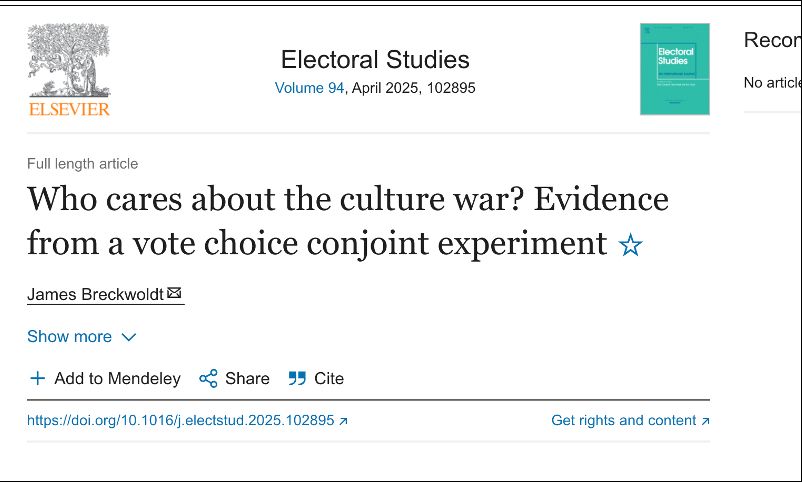
I have a new article in @electoralstudies.bsky.social 🎉
It uses conjoint experiment in the UK to test how important the culture war (statues, LGBT+ representation in pop culture, DEI, transwomen athletes, curriculum diversity, and university free speech) is to voters
Link👇 & results 🧵
03.02.2025 10:03 — 👍 84 🔁 36 💬 7 📌 6

Dissertation: ‘Understanding welfare attitudes: A cultural-sociological approach’
21.11.2024 15:03 — 👍 0 🔁 0 💬 0 📌 0
I would also like to thank @willemdekoster.bsky.social and Jeroen van der Waal for their dedicated and thorough guidance during the PhD process over the past few years and for the beautiful closing words at the end of the ceremony!
21.11.2024 15:03 — 👍 0 🔁 0 💬 1 📌 0

The day was made especially wonderful by my paranymphs, @elskevdhoogen.bsky.social and Tim van Meurs. Your support ensured great focus and provided distraction when needed, and above all, you organized an amazing gift with contributions from friends, family, and colleagues!
21.11.2024 15:03 — 👍 1 🔁 0 💬 1 📌 0
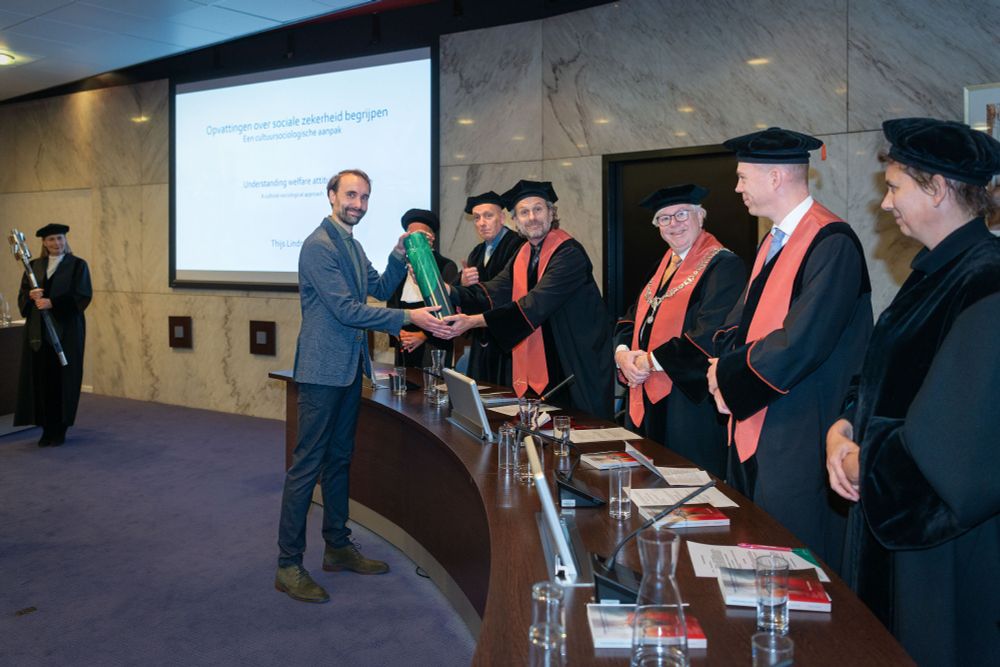
This led to an interesting exchange of ideas, and for that, I thank the committee members Bart Meuleman, @Femke Roosma, Monique Kremer, @peter8rberg.bsky.social, and Ferry Koster (and thank you also for the compliments!), and of course, the chair, Harry Geerlings.
21.11.2024 15:03 — 👍 0 🔁 0 💬 1 📌 0

Milestone reached! Last Friday, I defended my dissertation and received my doctorate. I presented my research from the past few years on welfare attitudes and was thoroughly questioned by the committee.
21.11.2024 15:03 — 👍 0 🔁 0 💬 1 📌 0

Hoe denken Nederlanders over sociale zekerheid en het basisinkomen?
Hoe denken Nederlanders over de sociale zekerheid? Dat bracht socioloog Thijs Lindner in kaart in zijn proefschrift.
Morgen om 13.00 is het zover: de verdediging van mijn proefschrift aan de EUR! In aanloop naar dit bijzondere moment ben ik geïnterviewd en kon ik mijn onderzoek naar opvattingen over sociale zekerheid in een notendop toelichten. Benieuwd hiernaar? Lees dan zeker het interview!
14.11.2024 08:43 — 👍 3 🔁 1 💬 1 📌 1
Looking forward to discussing my findings and answering questions from the committee — and hopefully sparking broad enthusiasm to understand attitudes towards welfare! 7/7
05.11.2024 19:42 — 👍 2 🔁 0 💬 0 📌 0
For those interested, there are copies of my dissertation available.
Feel free to reach out if you’d like one or if you want the link to follow the defense virtually. 6/7
05.11.2024 19:42 — 👍 3 🔁 0 💬 2 📌 0
Curious to learn more? I’ll be sharing these and other insights during my public defense on November 15th! The session will be held at Erasmus University and can also be followed online. 5/7
05.11.2024 19:42 — 👍 1 🔁 0 💬 1 📌 0
Interestingly, I also found that exposure to info about higher welfare dependency among ethnic minorities can reinforce negative stereotypes about welfare recipients. This highlights polarization: some citizens become more hostile to welfare recipients while others do not. 4/7
05.11.2024 19:42 — 👍 1 🔁 0 💬 1 📌 0
Another finding is that public opinion on whether immigrants should have access to benefits is much more nuanced than media or political debates suggest. 3/7
05.11.2024 19:42 — 👍 1 🔁 0 💬 1 📌 0
I have uncovered different understandings of welfare benefits among citizens in my research, and these involve contrasting notions about the function of benefits, their relationship to work and welfare deservingness. 2/7
05.11.2024 19:42 — 👍 1 🔁 0 💬 1 📌 0

The countdown has begun! ⏳
In just 10 days, I’ll be defending my dissertation at Erasmus University Rotterdam. I’m excited to dive into my research on how people perceive of welfare and how our different worldviews shape contrasting responses to salient issues. 1/7
05.11.2024 19:42 — 👍 18 🔁 3 💬 4 📌 0
Prof at Notre Dame (alexanderkustov.org). Author of "In Our Interest: How Democracies Can Make Immigration Popular" (http://tinyurl.com/4rwpr6dc). Writing at "Popular by Design" (http://tinyurl.com/b93bwr9j).
Chapel Hill Expert Survey of party positions
chesdata.eu
Postdoctoral researcher @HIVA @fwovlaanderen.bsky.social @kuleuvenuniversity.bsky.social
Working on Trust | Social Policy | Inequality | Democratic Engagement 🤿
Research Associate/Doctoral Researcher |
University of Bremen & German Center for Integration and Migration Research (DeZIM) & London School of Ecomics (LSE)|
Migration, Social Policy, and Civil Society.
👩🏾💻 A political science blog site from ECPR, the European Consortium for Political Research.
🔲 Showcasing political science at its best. Get your research noticed beyond the academy http://theloop.ecpr.eu
⬛ ...and follow ECPR @ecpr.bsky.social
Bestuurssocioloog | Universitair Hoofddocent EUR | Columnist De Volkskrant | Redacteur B&M | Jury De Sociologische Bril | VIDI Project ICONIC
PhD at KU Leuven | Intergroup Relations and Religious Tolerance
ECPR is an independent, scholarly association with a mission to advance political science ▪ https://ecpr.eu/ ▪ https://podcasters.spotify.com/pod/show/ecpr/ ▪ @ecprtheloop.bsky.social
Educational charity. Peer-reviewed sociology journal, public sociology magazine, podcasts, Connected Sociologies teaching resources, ECR opportunities.
https://www.thesociologicalreview.org
Sociological Science is a general interest, open access sociology journal committed to the highest standards of rigor and relevance. We aim to be the flagship journal for social scientists committed to advancing a general understanding of social processes.
The Sociological Quarterly is the official journal of the Midwest Sociological Society. Editor: Jonathan S. Coley. Publisher: Taylor & Francis.
Sociological Research Online is an international, peer-reviewed journal publishing high quality applied sociology.
Acta Sociologica is the international general interest journal of the Nordic Sociological Association and has published research from all areas of sociology since 1955.
https://journals.sagepub.com/home/asj
Demography publishes research drawing on several disciplines including the social sciences, geography, history, biology, statistics, epidemiology, and public health. Published bimonthly by Duke University Press. Subscribe to Open.
Since the launch of DEMOGRAPHIC RESEARCH in 1999, our journal has been emphasizing diversity and openness, encouraging submissions that employ a variety of methods and approaches.
Fondée en 1975 par Pierre Bourdieu et un groupe de chercheurs du centre de sociologie européenne, Actes de le recherche en sciences sociales publie les résultats de recherches, achevées ou en cours, en sociologie et dans les disciplines voisines.
Generalist Sociology Journal, founded 1972
Open Access: https://www.degruyter.com/journal/key/zfsoz/html?lang=de#issues
An International/Interdisciplinary Journal for Quality-of-Life Studies & Measurement.
https://link.springer.com/journal/11205
Editor: @dbartram.bsky.social
An International Journal of Social Research
JFR - Journal of Family Research | 🔗 journal-of-family-research.eu
💎open access (no fees) - non-profit - SSCI indexed