awesome, will use that for a new draft on indeterminism in LLMs!
06.02.2026 01:49 — 👍 1 🔁 1 💬 1 📌 0

table 1 extract from Guest, O., & van Rooij, I. (2025, October 4). Critical Artificial Intelligence Literacy for Psychologists. https://doi.org/10.31234/osf.io/dkrgj_v1
![5 Ghostwriter in the Machine
A unique selling point of these systems is conversing and writing in a human-like way. This is imminently understandable, although wrong-headed, when one realises these are systems that
essentially function as lossy2
content-addressable memory: when
input is given, the output generated by the model is text that
stochastically matches the input text. The reason text at the output looks novel is because by design the AI product performs
an automated version of what is known as mosaic or patchwork
plagiarism (Baždarić, 2013) — due to the nature of input masking and next token prediction, the output essentially uses similar words in similar orders to what it has been exposed to. This
makes the automated flagging of plagiarism unlikely, which is
also true when students or colleagues perform this type of copypaste and then thesaurus trick, and true when so-called AI plagiarism detectors falsely claim to detect AI-produced text (Edwards, 2023a). This aspect of LLM-based AI products can be
seen as an automation of plagiarism and especially of the research paper mill (Guest, 2025; Guest, Suarez, et al., 2025; van
Rooij, 2022): the “churn[ing] out [of] fake or poor-quality journal papers” (Sanderson, 2024; Committee on Publication Ethics,](https://cdn.bsky.app/img/feed_thumbnail/plain/did:plc:vsyj5jtayxcq5dw5mtja4xtb/bafkreifmac3sz5upxcmvhzbqfb3p2yt6cy7tkshv3ere7ttffsm6qmmboq@jpeg)
5 Ghostwriter in the Machine
A unique selling point of these systems is conversing and writing in a human-like way. This is imminently understandable, although wrong-headed, when one realises these are systems that
essentially function as lossy2
content-addressable memory: when
input is given, the output generated by the model is text that
stochastically matches the input text. The reason text at the output looks novel is because by design the AI product performs
an automated version of what is known as mosaic or patchwork
plagiarism (Baždarić, 2013) — due to the nature of input masking and next token prediction, the output essentially uses similar words in similar orders to what it has been exposed to. This
makes the automated flagging of plagiarism unlikely, which is
also true when students or colleagues perform this type of copypaste and then thesaurus trick, and true when so-called AI plagiarism detectors falsely claim to detect AI-produced text (Edwards, 2023a). This aspect of LLM-based AI products can be
seen as an automation of plagiarism and especially of the research paper mill (Guest, 2025; Guest, Suarez, et al., 2025; van
Rooij, 2022): the “churn[ing] out [of] fake or poor-quality journal papers” (Sanderson, 2024; Committee on Publication Ethics,
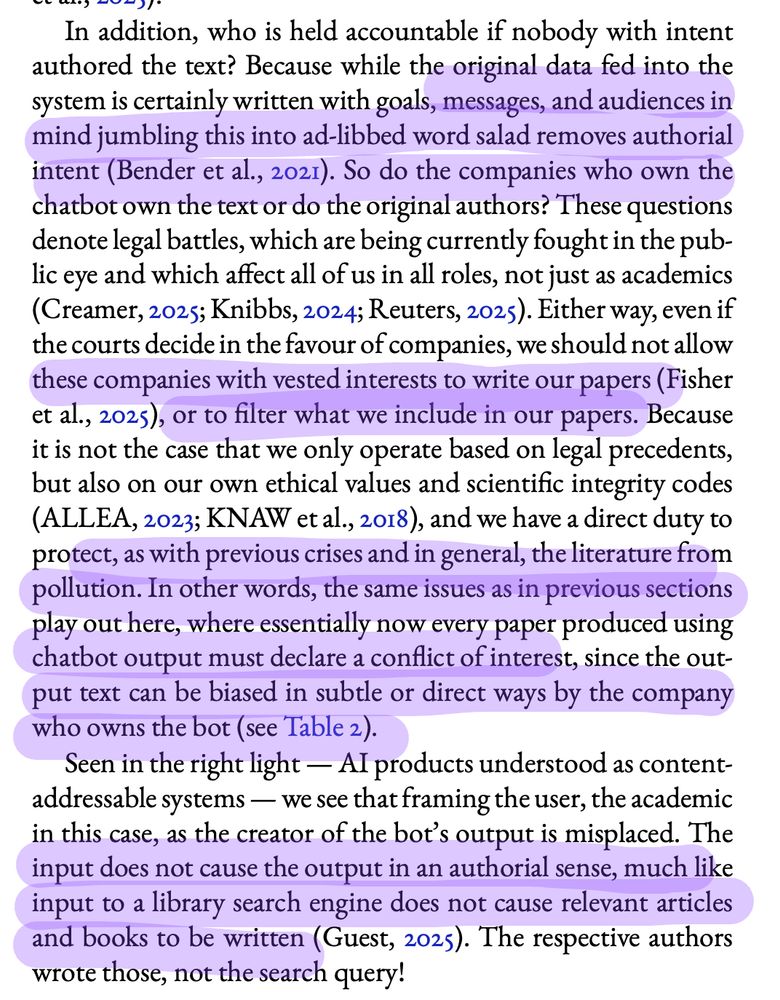
In addition, who is held accountable if nobody with intent
authored the text? Because while the original data fed into the
system is certainly written with goals, messages, and audiences in
mind jumbling this into ad-libbed word salad removes authorial
intent (Bender et al., 2021). So do the companies who own the
chatbot own the text or do the original authors? These questions
denote legal battles, which are being currently fought in the public eye and which affect all of us in all roles, not just as academics
(Creamer, 2025; Knibbs, 2024; Reuters, 2025). Either way, even if
the courts decide in the favour of companies, we should not allow
these companies with vested interests to write our papers (Fisher
et al., 2025), or to filter what we include in our papers. Because
it is not the case that we only operate based on legal precedents,
but also on our own ethical values and scientific integrity codes
(ALLEA, 2023; KNAW et al., 2018), and we have a direct duty to
protect, as with previous crises and in general, the literature from
pollution. In other words, the same issues as in previous sections
play out here, where essentially now every paper produced using
chatbot output must declare a conflict of interest, since the output text can be biased in subtle or direct ways by the company
who owns the bot (see Table 2).
Seen in the right light — AI products understood as contentaddressable systems — we see that framing the user, the academic
in this case, as the creator of the bot’s output is misplaced. The
input does not cause the output in an authorial sense, much like
input to a library search engine does not cause relevant articles
and books to be written (Guest, 2025). The respective authors
wrote those, not the search query!
Third, the peculiar idea that somehow we don't need to read, write, or perform literature reviews anymore; popping up like a satanic mushroom in almost all so-called OK uses of LLMs.
Companies writing our papers via their chatbots is not scientific at all. See section 5: doi.org/10.31234/osf...
7/
04.10.2025 06:16 — 👍 106 🔁 28 💬 2 📌 9
but I was asking for other approaches that use POMDPs
21.01.2026 04:46 — 👍 0 🔁 0 💬 0 📌 0
Mazviita chirimuuta in an interview on her book the brain abstracted outsidecolour.net/wp-content/u...
13.01.2026 02:11 — 👍 2 🔁 1 💬 0 📌 0
"The more important issue [...] is not that physics is more ‘mature’ but that it deals with inherently
simpler objects. [...] the brain and nervous system are exquisitely sensitive to surroundings – as they must be, for without this we could not perceive and respond to the world around us."
13.01.2026 02:09 — 👍 7 🔁 2 💬 1 📌 0
i love reading open peer review of papers. its like getting a deep dive into methodological issues in the format of academia gossip.
13.01.2026 01:31 — 👍 2 🔁 0 💬 0 📌 0
how is that connected to my question?
12.01.2026 01:32 — 👍 0 🔁 0 💬 1 📌 0
super interesting stuff, you should discuss it with @yoginho.spore.social.ap.brid.gy !
23.12.2025 05:21 — 👍 1 🔁 0 💬 1 📌 0
you can check out the full comment and the target article here:
authors.elsevier.com/a/1mDV85bD-s...
15.12.2025 02:36 — 👍 3 🔁 0 💬 0 📌 0

new commentary on embodiment in information systems with Tom Froese! we discuss Pitti et al.'s framework to formalise the embodied mind with information theory and sketch a way to cover the complementary perspective of the lived body and subjective experience as well
15.12.2025 02:35 — 👍 11 🔁 1 💬 2 📌 0
i know a couple of people working on AI coding interview data. do you think this could help with the criticism of interviewer bias? i am bit afraid that this will just introduce unexplainable LLM bias
28.11.2025 01:43 — 👍 3 🔁 0 💬 1 📌 0
could point me to some intro to neuroanthropology? sounds interesting!
28.11.2025 01:41 — 👍 2 🔁 0 💬 1 📌 0
yes, the seizure studies also got me interested in the methods at first. I think its a good motivation and I don't think we should adapt it to neuroscience, but a methodological pluralism can only be productive when there is some cross-perspectival assessment.
28.11.2025 01:39 — 👍 1 🔁 0 💬 1 📌 0
I think a way to get them to move beyond simple questionnaires would be a clear example of how it could be useful to them. do you have any favorite studies that used micropheno that could convince them to do the work?
27.11.2025 08:19 — 👍 1 🔁 0 💬 3 📌 0
i am very interested in experimental phenomenological methods but i am not sure what it takes to convince neuroscientists to pick it up. most neuroscientists i talked to seem to be strong reductionists that stick to exclusively third person methods
27.11.2025 06:40 — 👍 1 🔁 0 💬 1 📌 0
yeah but since varelas proposal 30 years ago not many neuroscientists have picked them up
27.11.2025 04:41 — 👍 1 🔁 0 💬 1 📌 0
great intersection, a while ago I shared a plot of how interest in phenomenology soared over the last two decades. we finally need that convergence of neuro and pheno methods!
27.11.2025 04:20 — 👍 2 🔁 0 💬 1 📌 0
you had good intuition as well ;)
27.11.2025 04:18 — 👍 1 🔁 0 💬 0 📌 0

I started my PhD on the philosophy and neuroscience of consciousness in 2022. Even though people advised against it, I think it was good timing.
26.11.2025 04:23 — 👍 19 🔁 1 💬 3 📌 1
imagine there would be a way to experimentally study subjective qualities 🤔
25.11.2025 01:09 — 👍 2 🔁 0 💬 0 📌 0
important point! that criticism applies to a lot of neuroscience of consciousness, most of the theories are more bundles of untested hypotheses
19.11.2025 02:00 — 👍 3 🔁 1 💬 0 📌 0
oh awesome, I have enough caffeinated drinks to keep me awake so please ask a question!
06.11.2025 11:14 — 👍 1 🔁 0 💬 0 📌 0
its about integrating incompatible models in climate science and consciousness research in case you want something fun in the night!
06.11.2025 09:53 — 👍 0 🔁 0 💬 1 📌 0
giving a talk at 2 am my time at the @philsci.bsky.social around the world online conference. japan time is the best...
06.11.2025 09:51 — 👍 4 🔁 0 💬 1 📌 0

paper: sensitivity to visual features in inattentional blindness
new evidence for phenomenal consciousness just dropped!
very interesting study by Makaela Natker, @chazfirestone.bsky.social, Howard Egeth, @ianbphillips.bsky.social
31.10.2025 01:47 — 👍 11 🔁 2 💬 0 📌 0
amazing study! would you interpret your findings as evidence for conscious awareness without access?
31.10.2025 01:41 — 👍 1 🔁 0 💬 1 📌 0
not bad! what did you think of the questions?
30.10.2025 06:06 — 👍 0 🔁 0 💬 1 📌 0
Canada Research Chair in Developmental Cognitive Neuroscience & Learning at Western University. CIFAR Fellow. Opinions are my own (he/him/his) 🇨🇦
Official account of the Models of Consciousness Conference 2026 at the University of Copenhagen #moc7
Cognitive💭 Computational🧑💻 Neuroscientist🧠
Physiology of neural selectivity, attention, decision-making
Swimming 🏊🏻 hiking ⛰️ ecology 🏞️ greenery 🌿 enthusiast
http://d-ferro.github.io; http://gin.g-node.org/56fe 🗣️it en es fr
@crmatematica.bsky.social; @upf.edu
PhD student Cognitive Neuroscience @ Vrije Universiteit Amsterdam, interested in goal-directed action, perception & decision-making
This is the Bluesky account of the philosophy department at the University of Nottingham. We like philosophy!!
Senior Lecturer in Philosophy at the University of Lancashire.
Avid writer and reader (#crimefiction); guitarist; snooker nut; nature lover (especially cats).
Doktor in Wien 🩺
Vienna, Austria 🇦🇹
Pictures are mine except reposts💡
Wine... Cognitive Science... Photography... tech stuff... former Aslin Lab (Master's) and Eppler Lab (with Jackie Gibson emeritus) so I'm a weird mix of Gibsonian affordances, visual statistical learning and anticipatory eye movements. Sometimes academic.
The Centre for Logic and Philosophy of Science (CLPS) at the Institute of Philosophy (@kuleuvenuniversity.bsky.social) focuses on #logic and #philsci, with a concentration on the philosophies of the special sciences • https://hiw.kuleuven.be/clps #philsky
Neurophilosopher. 🧠 🤔💡 Honorary Fellow at Durham University and Affiliate Faculty at the American Canadian School of Medicine. Previously at Ruhr University Bochum.
Postdoc @ Neural dynamics of visual cognition (Cichy lab) @ FU_Berlin @freieuniversitaet.bsky.social
interested in language🗣️📖 and its representations in the brain🧠
https://jiawei-liiiii.github.io/
I contain multitudes, today I am a glowering yet rocking realistic poser with a warm love of chaos
awrd wnning AGI rsrchr (2 awrds so far) | mtlhed | msician | fnishng CS PhD | optmst | opn src enthusiast | michaeltimothybennett.com/research
MD/PhD neuroscientist/psychiatrist, father of 3, Nak Muay, engineer at heart. mPFC-HPC interactions in addiction/schizophrenia, multi-region ephys and imaging in vivo, gene therapy, novel optical methods for spatial transcriptomics https://sjulsonlab.org
Sentientism, food policy for desired/anticipated consumption patterns, plant-based food for climate, consumption behaviour, history and reporting of global goals, framing.
Bryan William Jones
Neuroscientist
Vision Neuroscientist
Connectomics / VolumeEM
Photographer / #Leica
Professing at Pitt
In the data
bryanwjones.com
ORCID 0000-0001-5527-6643
Group Leader, Uni Tübingen | Humans, hominins, and apes | Evolution of human cultural evolution
-> When and how did we get from ape-like cultures to deep, broad & open-ended cultural evolution?
https://sites.google.com/view/claudiotennie
I study how to improve decisions and well-being at @GeisingerCollege.bsky.social.
🎓 gScholar: shorturl.at/uBDPW
▶️ youtube.com/@ByrdNick
👨💻 psychologytoday.com/us/blog/upon-reflection
📓 byrdnick.com/blog
🎙️ byrdnick.com/pod
Currently doing research on scientific discovery in AI-augmented labs. #ERCCoG TINT/UniHelsinki. #Philsci #Cogsci #Scisci / European Network for the Science of Science (www.euroscisci.net) / Institutional epistemology WS. Failed musician. 90s BBS sysop.