Tracing the thoughts of a large language model
Anthropic's latest interpretability research: a new microscope to understand Claude's internal mechanisms
Anthropic dropped some insights into how AI brains work with their circuit tracing method. Turns out LLMs are bad at math because they’re eyeballing it (“36+59? Eh, 40ish+60ish=95?”). It means we’re one step closer to understanding the inner workings of LLMs.
#LLMs #AI #Interpretability
31.03.2025 07:26 — 👍 5 🔁 1 💬 0 📌 0

*Automatically Interpreting Millions of Features in LLMs*
by @norabelrose.bsky.social et al.
An open-source pipeline for finding interpretable features in LLMs with sparse autoencoders and automated explainability methods from @eleutherai.bsky.social.
arxiv.org/abs/2410.13928
27.11.2024 14:58 — 👍 27 🔁 6 💬 0 📌 2

a bald man with a beard is smiling in front of a group of people
ALT: a bald man with a beard is smiling in front of a group of people
I am extremely honoured to receive the @ERC_Research
#ERCCoG award for #RUNES. For the next five years, I will be working on the mathematical, computational, and experimental (!!) sides to understand how higher-order interactions change how we think and coordinate.
03.12.2024 15:58 — 👍 60 🔁 9 💬 7 📌 0
Latest one out! 👇👇👇👇👇
30.11.2024 10:19 — 👍 18 🔁 4 💬 0 📌 0

A poster with a light blue background, featuring the paper with title: “A True-to-the-Model Axiomatic Benchmark for Graph-based Explainers”.
Authors: Corrado Monti, Paolo Bajardi, Francesco Bonchi, André Panisson, Alan Perotti
Background
Explainability in GNNs is crucial for enhancing trust understanding in machine learning models. Current benchmarks focus on data, ignoring the model’s actual decision logic, leading to gaps in understanding. Furthermore, existing methods often lack standardized benchmarks to measure their reliability and effectiveness.
Motivation
Reliable, standardised benchmarks are needed to ensure explainers reflect the internal logic of graph-based models, aiding in fairness, accountability, and regulatory compliance.
Research Question
If a model M is using a protected feature f , for instance using the gender of a user to classify whether their ads should gain more visibility, is a given explainer E able to detect it?
Core Idea
An explainer should detect if a model relies on specific features for node classification.
Implements a “true-to-the-model” rather than “truth-to-the-data” logic.
Key Components
White-Box Classifiers: Local, Neighborhood, and Two-Hop Models with hardcoded logic for feature importance.
Axioms: an explainer must assign higher scores to truly important features.
Findings:
Explainer Performance
Deconvolution: Perfect fidelity but limited to GNNs.
GraphLIME: Fails with non-local correlations and high sparsity.
LRP/Integrated Gradients: Struggle with zero-valued features.
GNNExplainer: Sensitive to sparsity and edge masking.
Real-World Insights: Facebook Dataset
Fidelity in detecting protected feature use in classification.
Results for different explainers, highlighting strengths and limitations.
Contributions:
Proposed a rigorous framework for benchmarking explainers
Demonstrated practical biases and flaws in popular explainers
Check out our poster at #LoG2024, based on our #TMLR paper:
📍 “A True-to-the-Model Axiomatic Benchmark for Graph-based Explainers”
🗓️ Tuesday 4–6 PM CET
📌 Poster Session 2, GatherTown
Join us to discuss graph ML explainability and benchmarks
#ExplainableAI #GraphML
openreview.net/forum?id=HSQTv3R8Iz
26.11.2024 17:27 — 👍 2 🔁 0 💬 0 📌 0

Article information
Title: Boosting human competences with interpretable and explainable artificial intelligence.
Full citation: Herzog, S. M., & Franklin, M. (2024). Boosting human competences with interpretable and explainable artificial intelligence. Decision, 11(4), 493–510. https://doi.org/10.1037/dec0000250
Abstract: Artificial intelligence (AI) is becoming integral to many areas of life, yet many—if not most—AI systems are opaque black boxes. This lack of transparency is a major source of concern, especially in high-stakes settings (e.g., medicine or criminal justice). The field of explainable AI (XAI) addresses this issue by explaining the decisions of opaque AI systems. However, such post hoc explanations are troubling because they cannot be faithful to what the original model computes—otherwise, there would be no need to use that black box model. A promising alternative is simple, inherently interpretable models (e.g., simple decision trees), which can match the performance of opaque AI systems. Because interpretable models represent—by design—faithful explanations of themselves, they empower informed decisions about whether to trust them. We connect research on XAI and inherently interpretable AI with that on behavioral science and boosts for competences. This perspective suggests that both interpretable AI and XAI could boost people’s competences to critically evaluate AI systems and their ability to make accurate judgments (e.g., medical diagnoses) in the absence of any AI support. Furthermore, we propose how to empirically assess whether and how AI support fosters such competences. Our theoretical analysis suggests that interpretable AI models are particularly promising and—because of XAI’s drawbacks—preferable. Finally, we argue that explaining large language models (LLMs) faces similar challenges as XAI for supervised machine learning and that the gist of our conjectures also holds for LLMs.
🌟🤖📝 **Boosting human competences with interpretable and explainable artificial intelligence**
How can AI *boost* human decision-making instead of replacing it? We talk about this in our new paper.
doi.org/10.1037/dec0...
#AI #XAI #InterpretableAI #IAI #boosting #competences
🧵👇
20.11.2024 12:25 — 👍 73 🔁 23 💬 4 📌 3
NeurIPS Conference is now Live on Bluesky!
-NeurIPS2024 Communication Chairs
22.11.2024 01:33 — 👍 278 🔁 68 💬 11 📌 6
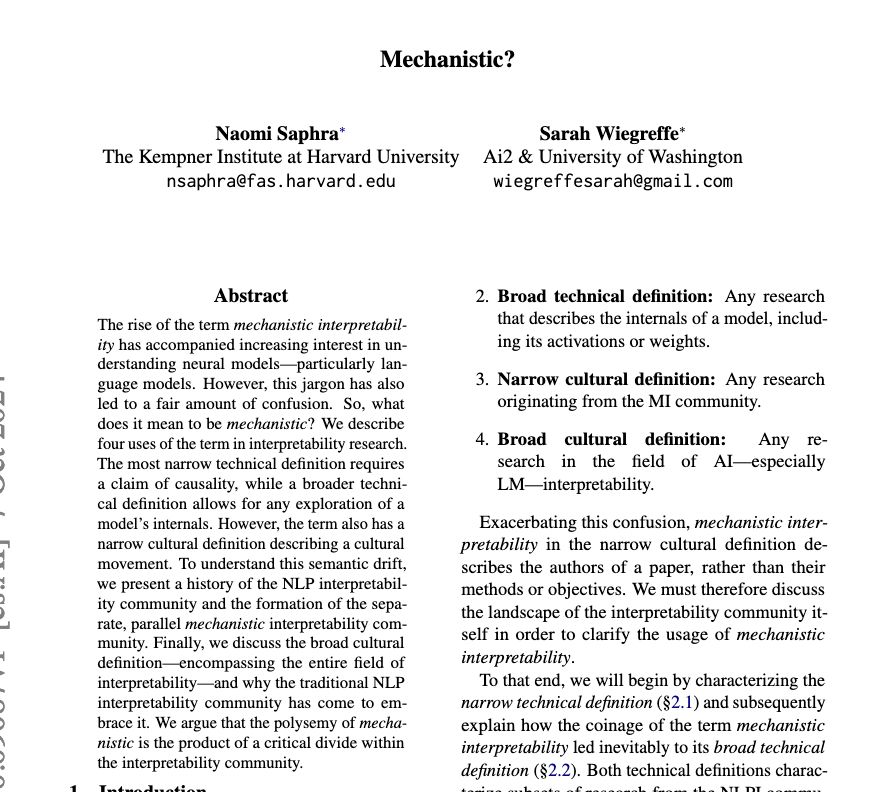
Screenshot of the paper.
Even as an interpretable ML researcher, I wasn't sure what to make of Mechanistic Interpretability, which seemed to come out of nowhere not too long ago.
But then I found the paper "Mechanistic?" by
@nsaphra.bsky.social and @sarah-nlp.bsky.social, which clarified things.
20.11.2024 08:00 — 👍 231 🔁 27 💬 7 📌 2
You might like the work from @aliciacurth.bsky.social. Fantastic contributions to understanding this effect.
19.11.2024 07:29 — 👍 4 🔁 0 💬 1 📌 0
👋 I do research on xAI for Graph ML and am starting to explore Mechanistic Interpretability. I'd love to be added!
17.11.2024 21:07 — 👍 0 🔁 0 💬 0 📌 0
18M + 1.
💙, Mar🐫
17.11.2024 02:58 — 👍 82888 🔁 7562 💬 6359 📌 1967
Since LLMs are essentially artefacts of human knowledge, we can use them as a lens to study human biases and behaviour patterns. Exploring their learned representations could unlock new insights. Got ideas or want to collaborate on this? Let’s connect!
16.11.2024 17:46 — 👍 0 🔁 0 💬 0 📌 0

Do I Know This Entity? Knowledge Awareness and Hallucinations in...
Hallucinations in large language models are a widespread problem, yet the mechanisms behind whether models will hallucinate are poorly understood, limiting our ability to solve this problem. Using...
In "Do I Know This Entity?", Sparse autoencoders reveal how LLMs recognize entities they ‘know’—and how this self-knowledge impacts hallucinations. These insights could help steer models to refuse or hallucinate less. Fascinating work on interpretability of LLMs!
openreview.net/forum?id=WCR...
16.11.2024 17:39 — 👍 5 🔁 0 💬 2 📌 0
Scaling and evaluating sparse autoencoders
Sparse autoencoders provide a promising unsupervised approach for extracting interpretable features from a language model by reconstructing activations from a sparse bottleneck layer. Since...
In Scaling and Evaluating Sparse Autoencoders, they extract 16M concepts (latents) from GPT-4 (guess the authors?).
They simplify tuning with k-sparse autoencoders and results show many improvements in explainability. Code, models (not all!) and visualizer included.
openreview.net/forum?id=tcs...
16.11.2024 17:37 — 👍 12 🔁 1 💬 1 📌 1
ICLR is a top AI conference, and while the 2025 papers aren’t officially out yet, reviews are open. I’m diving into the highest rated in Interpretability and Explainable AI. Interestingly, the top ones focus on Mechanistic Interpretability, a promising topic that our team is starting to explore.
16.11.2024 17:33 — 👍 4 🔁 0 💬 1 📌 0

The metaphors of artificial intelligence
A few months after ChatGPT was released, the neural network pioneer Terrence Sejnowski wrote about coming to grips with the shock of what large language models (LLMs) could do: “Something is beginning...
For Science Magazine, I wrote about "The Metaphors of Artificial Intelligence".
The way you conceptualize AI systems affects how you interact with them, do science on them, and create policy and apply laws to them.
Hope you will check it out!
www.science.org/doi/full/10....
14.11.2024 22:55 — 👍 440 🔁 151 💬 23 📌 26
Bluesky feels like traveling back to the golden age of Twitter: when the follow button meant something, and your feed wasn’t a dystopian lineup of blue-tagged bots. It’s refreshing to be somewhere I don’t need an AI to explain why I’m seeing a post. Let’s hope we don’t ruin it this time!
16.11.2024 11:22 — 👍 10 🔁 1 💬 0 📌 0
Chief Models Officer @ Stealth Startup; Inria & MVA - Ex: Llama @AIatMeta & Gemini and BYOL @GoogleDeepMind
Programme Director at Sitra. Coordinator of TEHDAS2 and VALO. #eHealth #healthdata #EHDS
https://ellis-jena.eu is developing+applying #AI #ML in #earth system, #climate & #environmental research.
Partner: @uni-jena.de, https://bgc-jena.mpg.de/en, @dlr-spaceagency.bsky.social, @carlzeissstiftung.bsky.social, https://aiforgood.itu.int
Assistant Professor UCLouvain.
Infectious diseases modelling, social contacts, network epidemiology.
Postdoctoral researcher @ Bocconi University - Centre for Research on Social Dynamics and Public Policy + BIDSA Bocconi Institute for Data Science + Covid Crisis Lab
Senior Data Scientist at BuzzFeed in San Francisco // AI content generation ethics and R&D // plotter of pretty charts
https://minimaxir.com
Professor a NYU; Chief AI Scientist at Meta.
Researcher in AI, Machine Learning, Robotics, etc.
ACM Turing Award Laureate.
http://yann.lecun.com
Writer (Julia, The Heavens, The Men, How Not to Write a Novel, etc.)
she/they
I read a lot of research.
Currently reading: https://dmarx.github.io/papers-feed/
Statistical Learning
Information Theory
Ontic Structural Realism
Morality As Cooperation
Epistemic Justice
YIMBY, UBI
Research MLE, CRWV
Frmr FireFighter
AI safety at Anthropic, on leave from a faculty job at NYU.
Views not employers'.
I think you should join Giving What We Can.
cims.nyu.edu/~sbowman
Author of Bea Wolf, A City on Mars, and the comic SMBC
Website: www.smbc-comics.com
Patreon: https://www.patreon.com/ZachWeinersmith?ty=h
New book: http://www.acityonmars.com/
The latest news and more from Rolling Stone magazine and http://RollingStone.com. Got a tip? Share it here: http://rol.st/tips
Associate Professor at informatics, IU Bloomington / Lifetime Citations 20k+ / http://soda-labo.github.io / computational social science + game analytics. https://scholar.google.com/citations?user=dcjrz5MAAAAJ&hl=ko
Scientist.
Infectious disease dynamics · outbreak response · control measures · host mobility and contacts · digital epidemiology.
www.epicx-lab.com
Cutting-edge research, news, commentary, and visuals from the Science family of journals. https://www.science.org
Senior Research Scientist at ISI Foundation, Infectious Disease Modeling, Data Science, Forecasting
Associate Professor of Public Policy, Politics, and Education @UVA.
I share social science.
We advance free thinking and promote humanism to create a tolerant society where rational thinking and kindness prevail.
Computer Science PhD Student @ Stanford | Geopolitics & Technology Fellow @ Harvard Kennedy School/Belfer | Vice Chair EU AI Code of Practice | Views are my own