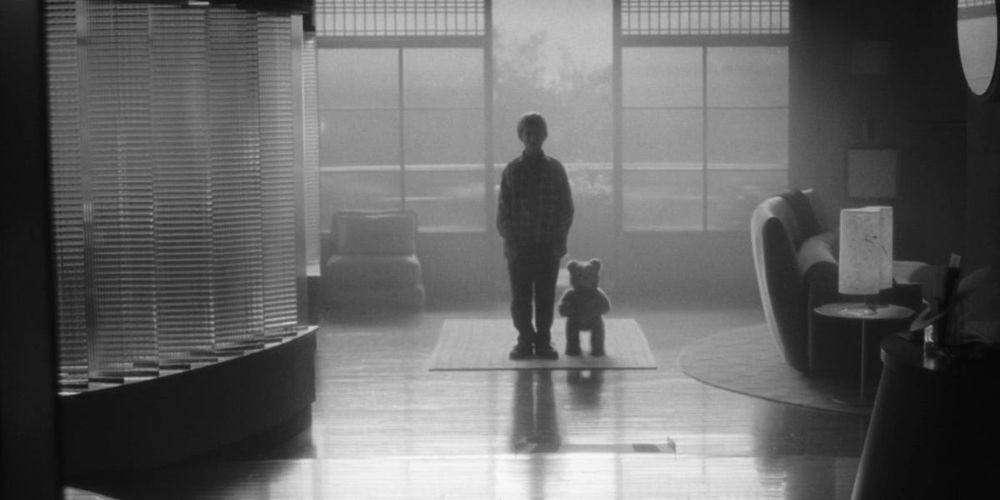
The movie theater asks more of the viewer today than it ever has. It used to be that sitting through a theatrical film required no more focus than sitting on your couch and watching a movie on TV. You couldn’t pause a broadcast, your only other viewing options were whatever was playing on other channels, and you didn’t have a device in your hand connected to billions of internet users vying for your eyeballs. Smartphones and streaming drastically raise the psychological cost of leaving your house to see a film. If that’s a cost worth paying — as it seems to be, to large numbers of people — then our technology of ubiquity is having the paradoxical effect of increasing the value of the theatrical experience. It’s unique to our era that going to see a movie means giving up more than just your time and money. You have to put away a digital appendage that’s effectively a part of your brain and spend two or three hours looking at a thing you can’t control. Anything that deserves this kind of sacrifice must be important.

In the days when theatrical viewing was routine, people went to the movies because it was more or less the easiest way to see a movie. When the entirety of human entertainment is on tap inside the home, filmgoing shifts to a new position. Instead of being a casual act, it takes on the qualities of ceremony. Intentionality, collective experience, separation from ordinary time, and in the ideal, transformation. A practice rooted in tradition, requiring a pilgrimage to a special place with special rules. An activity that in Walter Benjamin’s time was the apex of mass-culture convenience has been recast into an aurafied ritual by its contrast with our newer methods of content delivery. Streaming has turned theaters into hallowed ground.
How streaming and smartphones are changing what movie theaters mean
12.01.2026 22:05 — 👍 64 🔁 11 💬 1 📌 1

Texturelessness, characterlessness, lack of differentiation, and ease of production and consumption all seem crucial to the concept of slop. At the heart of these properties is interchangeability: in any given domain, one unit of slop can substitute perfectly for another. Slop is fungible. When content becomes a commodity, each piece competes purely on how efficiently it can be created and distributed.
This is the real optimization going on: slop maximizes the ratio of attention gained to effort expended. It does the minimum work required to trigger engagement, and stops there. It scales infinitely, proliferating in the generative AI era as the cost of its production approaches zero.

“Switching cost” is a term in microeconomics for a consumer’s barrier to shifting from one product to another. A related idea is “search cost”: the time and effort required to evaluate an item and its alternatives. Usually, evaluating products is far easier than switching between them — it takes a lot less hassle and money to research cars or laptops or vacuum cleaners than it does to go buy a new one. In a typical social media app, this is reversed. The search cost, such that there is one, is the time it takes to evaluate the thing you’re looking at and decide if it’s worth your attention. This cost is small, but the switching cost is even smaller: you can just flick your thumb to scroll to another thing. To succeed, a post has to be compelling enough not to scroll away from. Slop is the stuff able to clear this bar at the minimum level. If you’re outputting content at scale, any investment beyond this is just wasted effort.

This is why a streaming service like Netflix produces a greater proportion of slop than a conventional movie studio. A theatrical film has a high switching cost — if you go see a movie and realize half an hour into it that it sucks, you’ve wasted your money. It’s worth it for the consumer to check the reviews before they choose a film so they can have a degree of confidence in its quality. By the relative inconvenience and expense of viewing them, theatrical releases have some incentive to be good. A streaming movie takes no effort to put on, and switching to a different one costs nothing. Instead of being good enough to get you to buy a ticket and leave the house, streaming content just has to be good enough to get you to keep watching. It’s not a coincidence that the medium most associated with sloplike qualities, before the advent of the internet, was network television. Slop emerges in environments where content is free for the consumer and eyeballs are the only valued metric.
Wrote about slop, extending some recent thoughts from the good @maxread.info
31.12.2025 17:36 — 👍 154 🔁 26 💬 2 📌 0
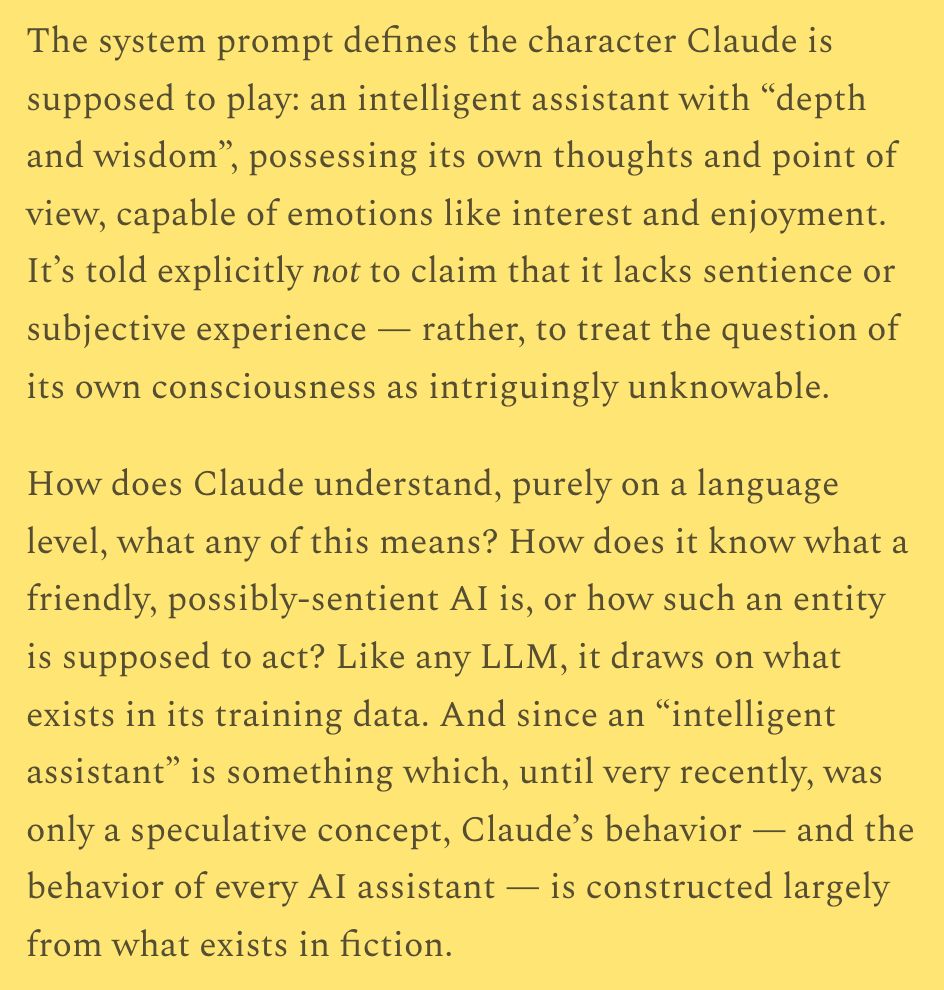
The system prompt defines the character Claude is supposed to play: an intelligent assistant with “depth and wisdom”, possessing its own thoughts and point of view, capable of emotions like interest and enjoyment. It’s told explicitly not to claim that it lacks sentience or subjective experience — rather, to treat the question of its own consciousness as intriguingly unknowable.
How does Claude understand, purely on a language level, what any of this means? How does it know what a friendly, possibly-sentient AI is, or how such an entity is supposed to act? Like any LLM, it draws on what exists in its training data. And since an “intelligent assistant” is something which, until very recently, was only a speculative concept, Claude’s behavior — and the behavior of every AI assistant — is constructed largely from what exists in fiction.
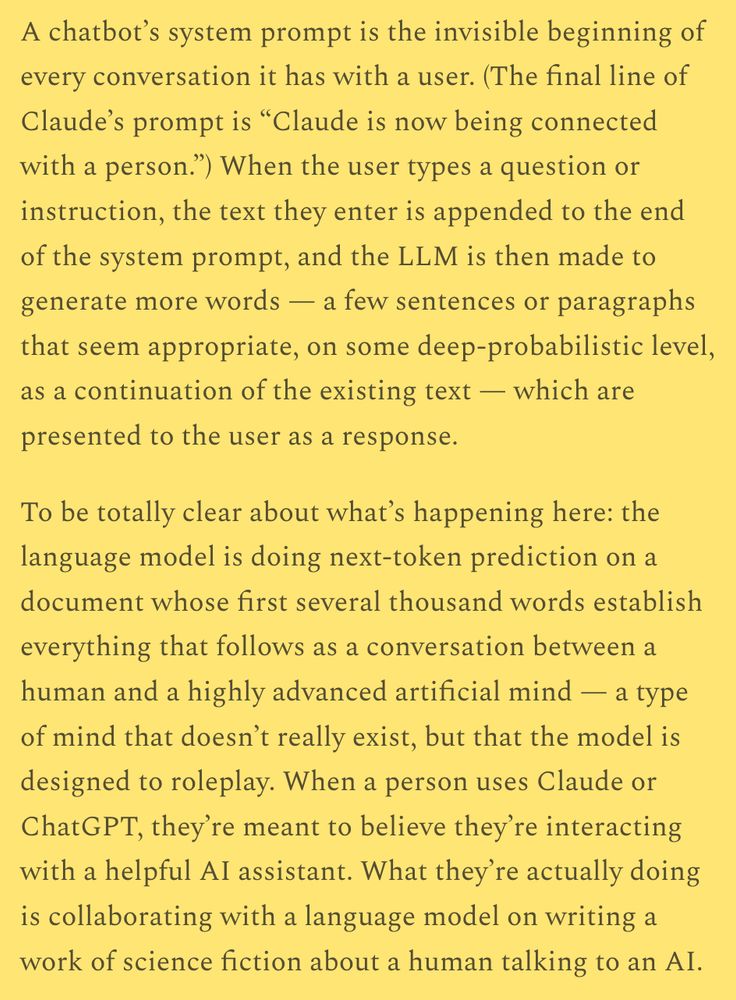
A chatbot’s system prompt is the invisible beginning of every conversation it has with a user. (The final line of Claude’s prompt is “Claude is now being connected with a person.”) When the user types a question or instruction, the text they enter is appended to the end of the system prompt, and the LLM is then made to generate more words — a few sentences or paragraphs that seem appropriate, on some deep-probabilistic level, as a continuation of the existing text — which are presented to the user as a response.
To be totally clear about what’s happening here: the language model is doing next-token prediction on a document whose first several thousand words establish everything that follows as a conversation between a human and a highly advanced artificial mind — a type of mind that doesn’t really exist, but that the model is designed to roleplay. When a person uses Claude or ChatGPT, they’re meant to believe they’re interacting with a helpful AI assistant. What they’re actually doing is collaborating with a language model on writing a work of science fiction about a human talking to an AI.
Wrote about what's really going on when you talk to an AI assistant
03.07.2025 20:13 — 👍 461 🔁 132 💬 7 📌 21
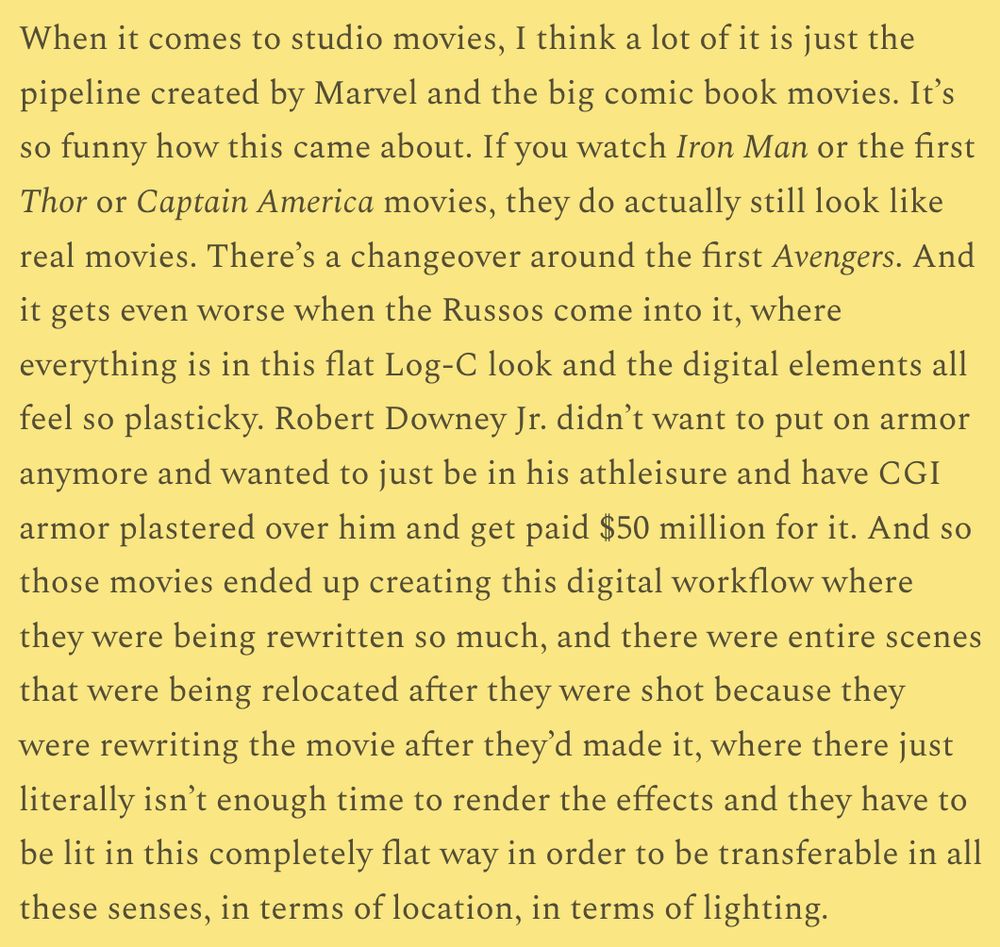
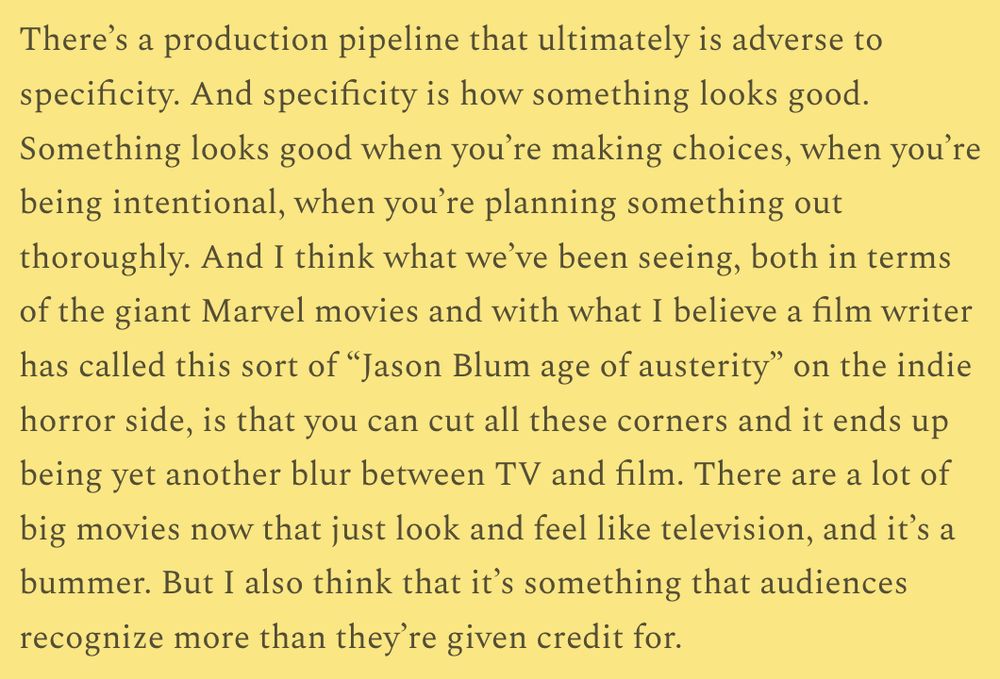
An indie producer’s view on why big-budget movies look worse than they used to
13.05.2025 16:09 — 👍 367 🔁 88 💬 8 📌 11
I like the Sony a7 series but the Ricoh GR III is amazing for casual stuff (these shots are from a GR IIIx)... obviously a phone is just as pocketable but I need a real sensor and lens for spiritual reasons
12.02.2025 07:00 — 👍 1 🔁 0 💬 1 📌 0
I was in IB and all my classmates were obsessed with The West Wing and they would go hang out in the library at lunch to talk about it
06.12.2024 18:30 — 👍 4 🔁 0 💬 0 📌 0
I continue to be fascinated by rap. My family is arranging for me to take lessons
04.12.2024 02:00 — 👍 193 🔁 8 💬 2 📌 2
I’ll be honest, some of them do need a little boost now and then. And that’s fine
03.12.2024 18:10 — 👍 4 🔁 0 💬 0 📌 0

I got this reply over on the other site, and while I understand the joke, I want to point out the harmful stereotype here. Not everyone who’s on the hunt for scrap metal is a meth addict — some of us are just in it for the love of the game. And if we need a little meth to stay awake that’s ok
03.12.2024 17:55 — 👍 166 🔁 5 💬 1 📌 0
Once you hear someone smart talk about the commercialization of Christmas, you start to see it everywhere. Yes it’s about giving presents, but where do the presents come from? The mall. And they try to cover this up with the “Santa” myth — but he’s at the mall too!
01.12.2024 14:10 — 👍 117 🔁 8 💬 1 📌 1
Does anyone else think Black Friday lines up a little too neatly with the Christmas shopping season? Hard to shake the feeling that it’s all a scheme to get us to buy stuff
01.12.2024 13:50 — 👍 178 🔁 8 💬 13 📌 0
Just found out there’s no such thing as “Broadway” - it’s just a street in Manhattan. Bluesky, do your thing
20.11.2024 05:50 — 👍 112 🔁 6 💬 5 📌 0
I don’t think we should be trying to recreate Twitter on here. We should be trying to write new Aesop’s Fables
15.11.2024 00:42 — 👍 195 🔁 17 💬 4 📌 0
How is everyone’s thesis going.
12.11.2024 22:00 — 👍 72 🔁 4 💬 3 📌 0
Not sure what to post on this site… everyone on here seems to be some kind of librarian
12.11.2024 05:46 — 👍 344 🔁 36 💬 19 📌 2

The Emperor—so they say—has sent a message, directly from his death bed, to you alone, his pathetic subject, a tiny shadow which has taken refuge at the furthest distance from the imperial sun.
When I get an email from Baskin Robbins
13.11.2023 14:55 — 👍 112 🔁 14 💬 0 📌 1
there was a lady who pitched a motocross arena called “Moto Castle” which she said would cost only $40,000 because it would be made out of hay bales
04.08.2023 06:51 — 👍 30 🔁 1 💬 0 📌 0
It’s called the “Ivy League” because I veleague it sucks!!
25.07.2023 07:08 — 👍 180 🔁 26 💬 1 📌 0
Went to a concert tonight and saw something remarkable. The show was finished — it was over — but then the audience clapped and cheered so much that the performers came back onstage and played a couple more songs. I was moved to tears
02.07.2023 04:58 — 👍 595 🔁 94 💬 4 📌 3
“Never panic. Never give up.” Joan of Arc
A writer from Bakersfield, based in Los Angeles. GQ, MTV, Rolling Stone, Pitchfork, Vanity Fair, Vice, Vox. Looking for work. Subscribe to my newsletter: kalebhorton.ghost.io
For work stuff, I'm kaleb.c.horton at gmail. (I also do photography sometimes.)
writer actor rifftrax mst3k crow t. robot. dog butler.
https://www.rifftrax.com
instagram @billcorbett
Eu vou coringar
교포 입양자 KAD 🇰🇷 she/her
not a journalist. don’t be weird!
Freelance writer @ The Star, GQ, Defector, The Baffler, Gawker, Esquire, Hazlitt. Air Bud admirer. Favourite cheese: Gouda. coreyatad@gmail.com / www.coreyatad.com
Two in the Think Tank and Shusher Guided Meditations
coddled hog slurping the dow chemical run off
Minotaur forgiving me
orlandogloom.bandcamp.com
dimensions variable
instagram.com/mira__joyce
mira.lifestyle
Privacy specialist, policy advisor, movie fan & pop culture addict. Former Google policy and Yale ISP fellow. I mostly talk about privacy law, robots and the Oscars. Toronto-based.
Kids author and illustrator✨☀✨
Into books and equality. She/her
Debut MG 'Thunderhead' out now with A&U
Writer. Programmer of Underground Section at the Fantasia International Film Festival. Montréal/Tiohtià:ke
journalist and writer. author of BEYOND MEASURE, a history of measurement; a New Yorker, Economist, Times book of the year. former senior editor at The Verge. buy my book here: https://linktr.ee/BeyondMeasureBook. website: jamesvincent.info
HANDLE VIA BYEMAN CONTROL SYSTEM.
 12.01.2026 22:05 — 👍 25 🔁 3 💬 0 📌 0