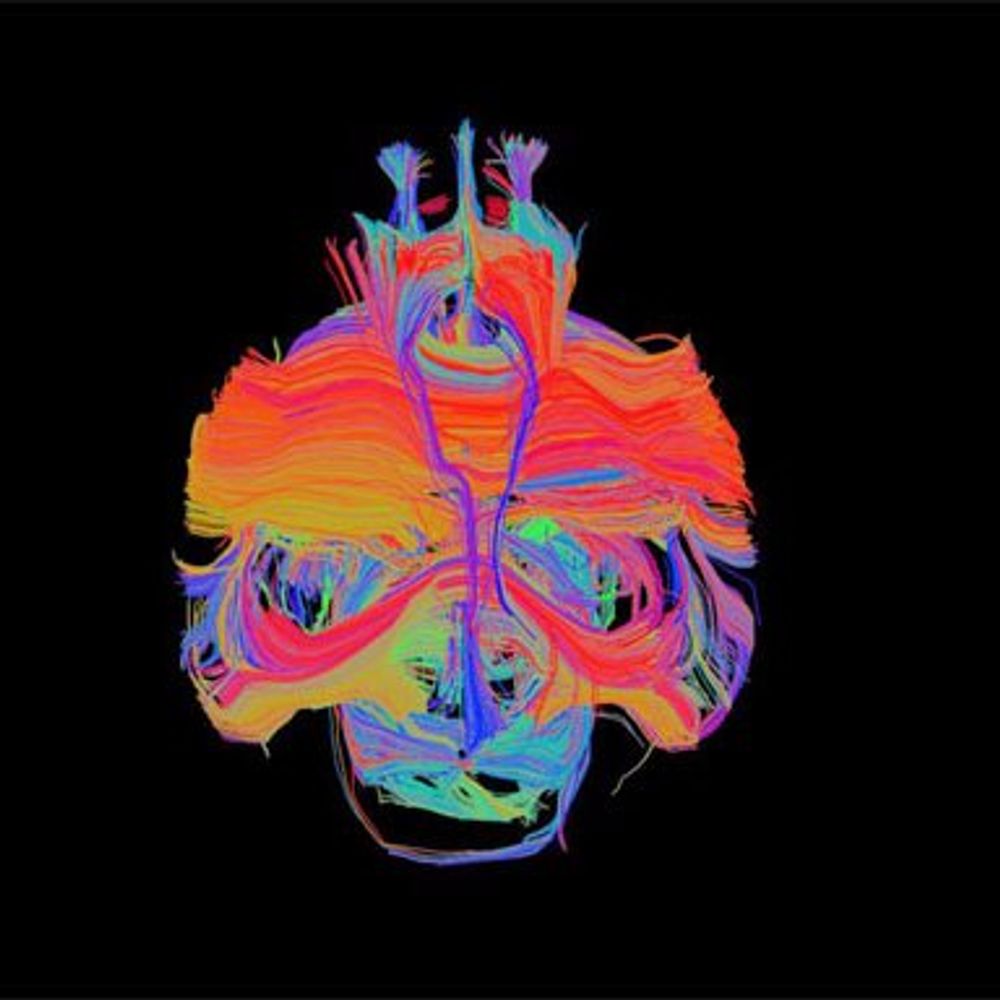
Spatial organization of AQP4 channels in the human brain: links with perfusion, edema, and disease vulnerability https://www.biorxiv.org/content/10.64898/2026.02.18.706679v1
20.02.2026 14:17 — 👍 1 🔁 2 💬 0 📌 0

🚨Do we need a large, expensive MRI scanner to map whole-brain networks in the mouse? Not necessarily!
In our new preprint ▶️ tinyurl.com/3a2h4r9f
we show that transcranial functional ultrasound (fUSI) can map connectome-scale networks with striking agreement to fMRI
🧵👇
17.02.2026 12:25 — 👍 39 🔁 16 💬 1 📌 1

We're hiring! This is a unique opportunity to translate our understanding of neural computation - from circuit-level mechanisms to computational principles - into the human brain, through the establishment of cutting-edge human neural recording capabilities with collaborators in London and abroad.
We’re hiring a Group Leader!
Join us to lead a transformative initiative in human systems neuroscience.
Find out more and apply ⤵️
www.sainsburywellcome.org/content/curr...
13.02.2026 13:41 — 👍 31 🔁 25 💬 1 📌 4

Inter-individual variability of neurotransmitter receptor and transporter density in the human brain | doi.org/10.1007/s004...
How do neuroreceptor distributions vary across people?
13.02.2026 15:14 — 👍 34 🔁 14 💬 1 📌 0

Left: Pathways involved in brain energy metabolism. Energy metabolism refers to processes involved in energy production from nutrient molecules. Glucose is the main energy source in the brain under normal physiological conditions. Glucose entering brain cells can be utilized in three parallel pathways. It can be processed through glycolysis to produce 2 ATP and 2 pyruvate molecules (blue). Lactate dehydrogenases catalyze the interconversion of lactate and pyruvate (purple). Pyruvate is transported into mitochondria, where it enters the TCA cycle to generate high-energy electron carriers NADH and FADH2 (green), driving the complete oxidation of glucose through the mitochondrial electron transport chain (red). Glucose entering the brain can also enter the PPP. PPP is an anabolic pathway that uses glucose to produce 5-carbon sugars and NADPH, an essential co-factor used in nucleotide and lipid biosynthesis (yellow). Glucose can also be stored in the form of glycogen via glycogen synthase, a process mainly active in astrocytes. Right: Energy pathway maps. Colors show z-scored mean expression values across all genes in each pathway. ppp, pentose phosphate pathway; tca, tricarboxylic acid cycle; oxphos, oxidative phosphorylation; lactate, lactate metabolism and transport.
How are energy #metabolism pathways distributed across the #cortex? @alaindagher.bsky.social &co map five pathways in the human #brain, linking metabolic organization with brain structural & functional properties, as well as developmental dynamics @plosbiology.org 🧪 plos.io/4c1JVp8
02.02.2026 13:55 — 👍 18 🔁 10 💬 0 📌 1

netneurotools: a trainee-oriented approach to network neuroscience | doi.org/10.1101/2025...
Our lab’s internal toolkit for accomplishing everyday tasks in brain imaging ⤵️
18.12.2025 14:58 — 👍 74 🔁 36 💬 1 📌 3

BOLD signal changes can oppose oxygen metabolism across the human cortex, Nature Neuroscience
fMRI signals “up,” but neural metabolism might be going “down.”
In our @natneuro.nature.com paper, we demonstrate that about 40% of voxels with robust BOLD responses exhibit opposite oxygen metabolism, revealing two distinct hemodynamic modes.
rdcu.be/eUPO8
funds @erc.europa.eu
#neuroskyence 🧵:
16.12.2025 15:43 — 👍 176 🔁 80 💬 4 📌 8
The Government of Canada introduces new programs for international researchers - Canada.ca
It's happening! Canada launched two programs to recruit international researchers.
Canada Impact+ Research Chairs (1 million/yr for 8 yrs +)
Canada Impact+ Emerging Leaders.
I will do my best to facilitate the process for those interested. Hit me up.
www.canada.ca/en/impact-pl...
09.12.2025 18:06 — 👍 198 🔁 115 💬 4 📌 20

The Transmitter’s Rising Stars of Neuroscience 2025
We recognize the outstanding achievements of 25 neuroscientists who stand to shape the field for years to come.
Truly honored to be recognized among @thetransmitter.bsky.social's Rising Stars of Neuroscience for 2025 next to trailblazers like @valeriejsydnor.bsky.social, @lindenmp.bsky.social, @elimuller.bsky.social & more!🌟🧠Check out everyone's full contributions at www.thetransmitter.org/early-career...
17.11.2025 10:34 — 👍 17 🔁 3 💬 2 📌 1
I am recruiting graduate students for the experimental side of my lab @mcgill.ca for admission in Fall 2026!
Get in touch if you're interested in how brain circuits implement distributed computation, including dopamine-based distributed RL and probabilistic representations.
19.11.2025 18:04 — 👍 37 🔁 30 💬 1 📌 0
Preprint -
Excited to present WHOLISTIC, which extends the concept of whole-brain functional imaging to the entire body. Pioneering work by incredibly talented Virginia Ruetten @vmsruetten.bsky.social, this platform reveals whole-organism cellular dynamics in vivo.
www.biorxiv.org/content/10.1...
08.09.2025 16:23 — 👍 194 🔁 70 💬 3 📌 6
Our recent work on spin tests is now published in Imaging Neuroscience🎉
As always, the code to reproduce our results and figures is available on github: github.com/netneurolab/...
10.09.2025 16:26 — 👍 15 🔁 5 💬 0 📌 0
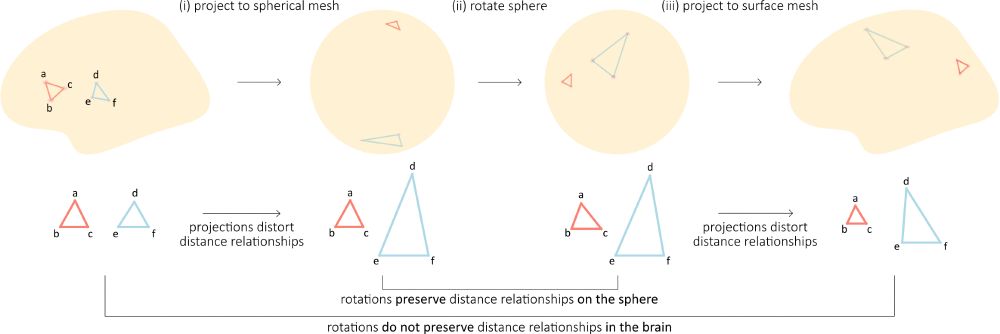
The effect of spherical projections on spin tests for brain maps | doi.org/10.1162/IMAG...
Spin tests are the de facto null model for map-to-map comparisons in brain imaging. Why don't they perfectly control false positives? @vincebaz.bsky.social explores ⤵️
10.09.2025 13:06 — 👍 25 🔁 14 💬 1 📌 1
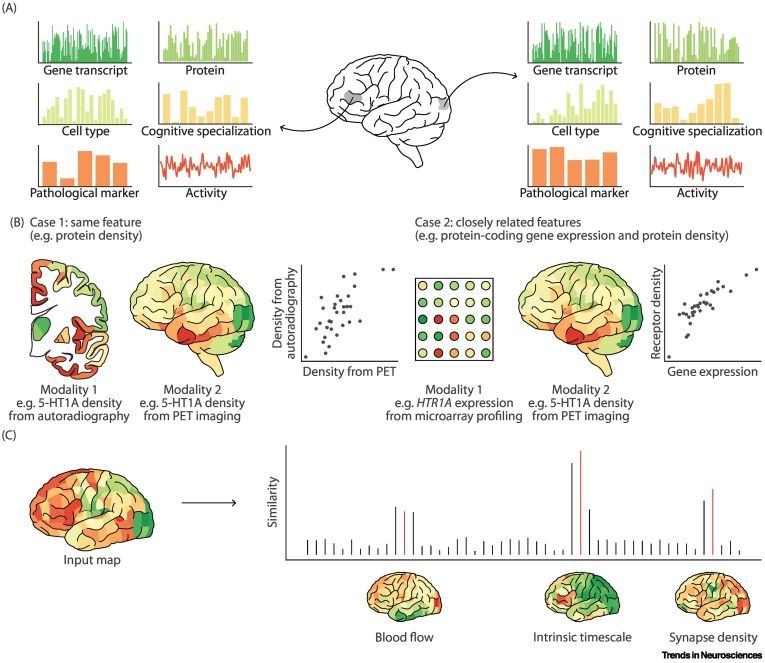
Integrating and interpreting brain maps | doi.org/10.1016/j.ti...
Imaging and recording technologies make it possible to map multiple biological features of the brain. How can these features be conceptually integrated into a coherent understanding of brain structure and function? ⤵️
04.08.2025 14:26 — 👍 74 🔁 42 💬 1 📌 0
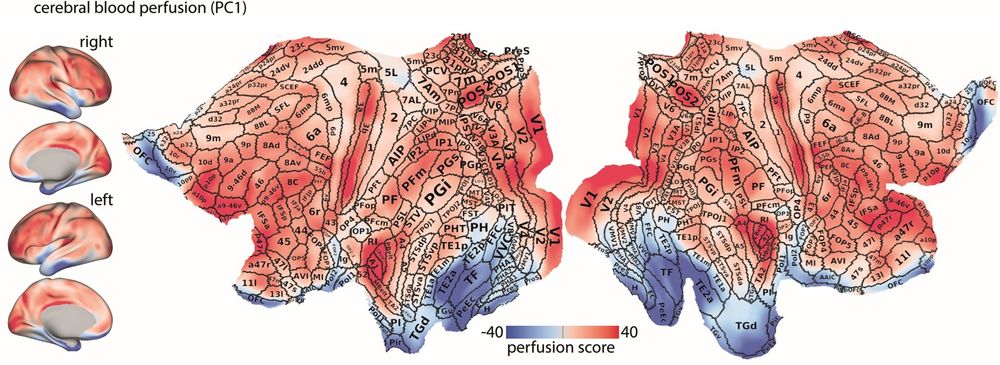
Normative blood perfusion map on lateral and medial views of the inflated and 2D flat cortical surfaces (fsLR). Borders and areal names of the multi-modal Glasser parcellation are overlaid on the flat surface. The figure highlights the non-uniform distribution of perfusion scores across the cortex, with areas that have sharp gradient compared to their underlying perfusion score levels (e.g., LIPv and MT/MST).
How does cerebral #BloodPerfusion map onto micro-, meso- & macro-scale brain structure? @asafarahani.bsky.social @misicbata.bsky.social &co characterize blood perfusion in the #HumanBrain, revealing how it changes with age & in #NeurodegenerativeDisease @plosbiology.org 🧪 plos.io/46AEURS
31.07.2025 17:09 — 👍 9 🔁 7 💬 0 📌 0
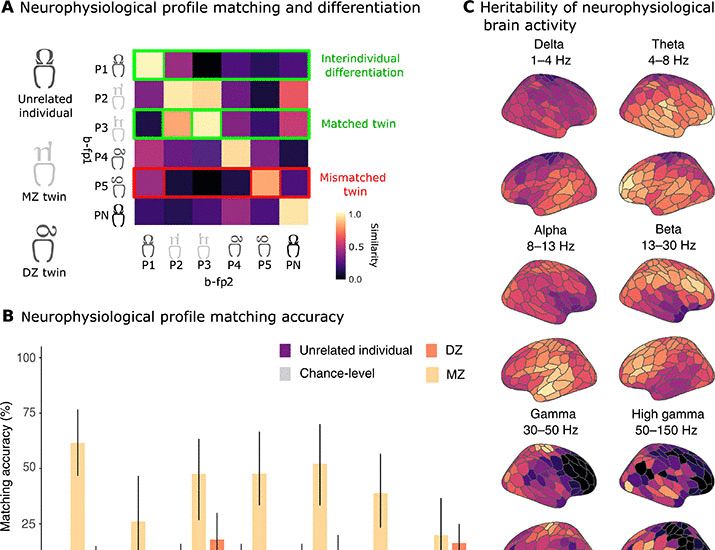
Genetic foundations of interindividual neurophysiological variability
Individual brain activity profiles are shaped by lifelong genetic influences.
🧬🧠 Our latest study shows that individual brain dynamics are partly written in our genes. We found that heritable neurophysiological traits align with adult cortical gene expression and psychological function.
www.science.org/doi/10.1126/...
@theneuro.bsky.social @mcgill.ca
23.07.2025 22:01 — 👍 54 🔁 13 💬 2 📌 0
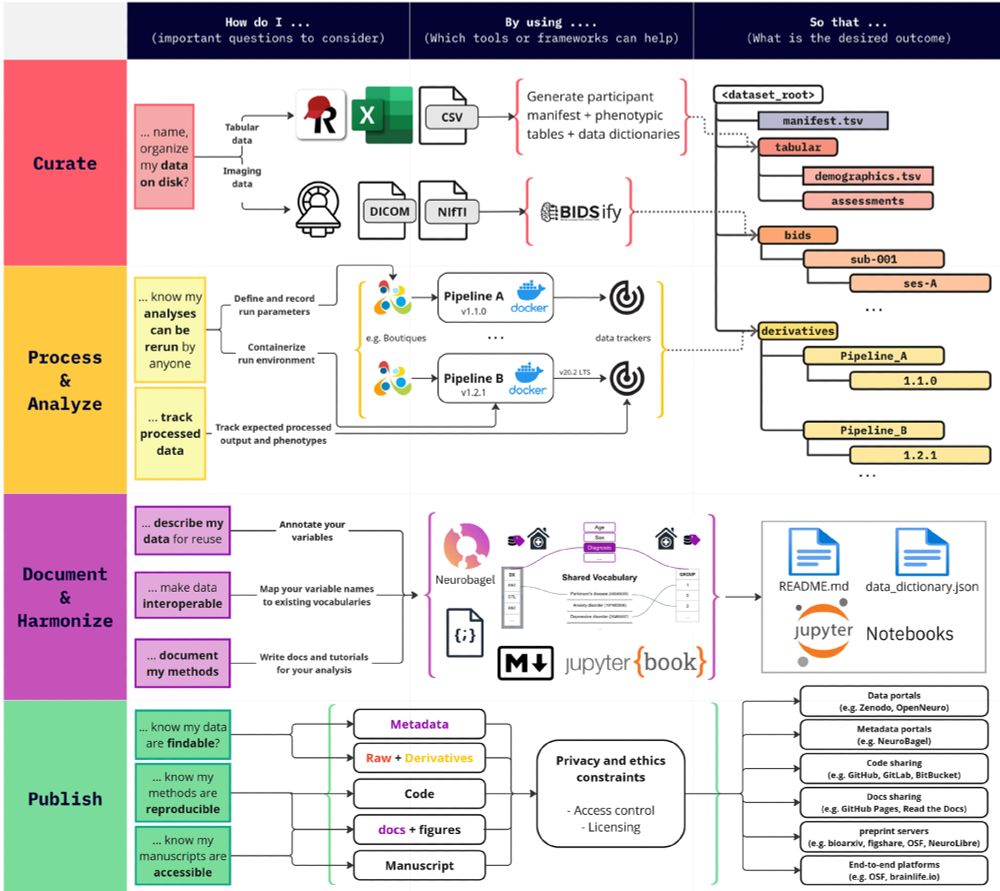
New paper in Imaging Neuroscience by Nikhil Bhagwat, Yu-Fang Yang, et al:
Challenging the status quo: A guide to open and reproducible neuroimaging for early career researchers
doi.org/10.1162/IMAG...
28.06.2025 05:06 — 👍 23 🔁 11 💬 0 📌 1

New: Energy use shapes brain organization and development. We use gene expression maps from the @alleninstitute.bsky.social Human Brain Atlas to map the main energy metabolism pathways in the brain. Led by @moohebatpe.bsky.social @misicbata.bsky.social @goliashf.bsky.social and Justine Hansen 🧵
18.03.2025 21:48 — 👍 45 🔁 20 💬 2 📌 1
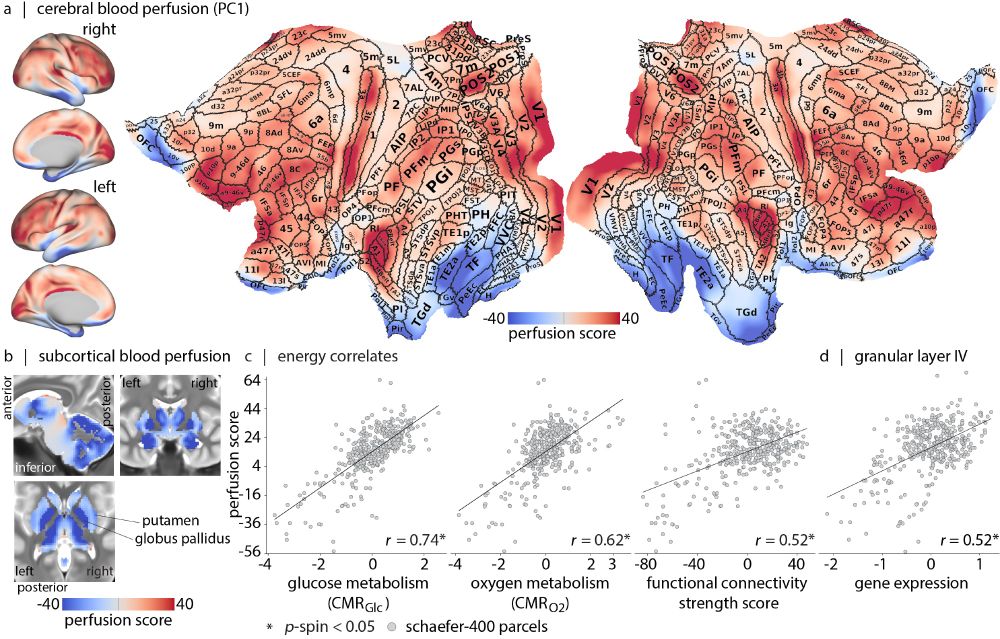
Cerebral blood perfusion across biological systems and the human lifespan | doi.org/10.1101/2025...
How does blood perfusion map onto canonical features of brain structure and function? @asafarahani.bsky.social investigates ⤵️
11.03.2025 15:01 — 👍 44 🔁 24 💬 3 📌 1
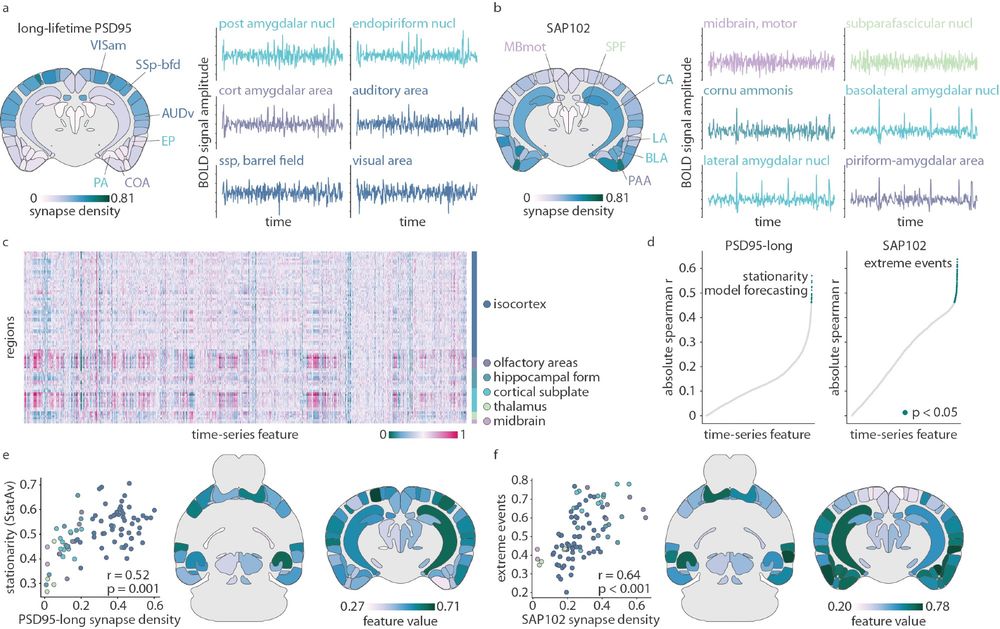
Synaptome architecture shapes regional dynamics in the mouse brain | www.biorxiv.org/content/10.1...
Led by Justine Hansen
Big news: there are all sorts of different synapse types in the brain 👀‼️⤵️
12.02.2025 18:23 — 👍 59 🔁 25 💬 2 📌 2
Previous work showed that in controlled simulated settings, the spin test does not perfectly control for false positives. In my recent pre-print, we explored why this is the case!
As always, the code to reproduce results + figures is available here: github.com/netneurolab/...
13.01.2025 15:09 — 👍 11 🔁 6 💬 0 📌 0
We find that neuropeptides act as a regulatory backbone of brain function through their slow, sustained scale of activity… also, we sample neuropeptide genes from sharks, frogs, chickens, and, my favourite, platypi!
Check it out if you’re looking for a read during the holiday break.
20.12.2024 16:43 — 👍 4 🔁 0 💬 0 📌 0
Hi Bluesky, my first PhD project is finally out!
Cells in our bodies can talk to each other in multiple chemical languages, one of the better known being neurotransmitters. Here, we extensively looked at a language that also has its origin in the nervous system — neuropeptides.
20.12.2024 16:43 — 👍 22 🔁 2 💬 2 📌 1
Test, test
17.12.2024 16:27 — 👍 5 🔁 1 💬 1 📌 0
A project highlighting the stories and careers of women in neuroscience 👩🏾🔬👩🔬👩🏿🔬👩🏻🔬
Podcast here http://linktr.ee/storiesofwin
Mood & Memory researcher with a computational bent. https://www.nicolecrust.com. Science advocate. Prof (UPenn Psych) - on leave as a Simons Pivot Fellow. Author: Elusive Cures. https://press.princeton.edu/books/hardcover/9780691243054/elusive-cures
Postdoc in Cognitive and Computational Neuroscience at the University of Leiden, former postdoc at Ecole Normale Supérieure (Paris, France) and PhD student at Université Paris Saclay, interested in how we make decisions.
Brain-Body interactions 🫀 🧠🔁 • Incoming Prof. @Stanford•Warren Alpert Scholar, Branco Weiss fellow, and Burroughs Wellcome CASI fellow @MCB_Harvard • @Harvard PhD 20'
Neuroscientist, PostDoc at FAU Nuremberg-Erlangen. Discovering quantitative hemodynamics and metabolism of the human brain.
Neuroscientist, Wellcome Early Career Fellow at Oxford Uni & MNI, and Fellow of St John's College, Cambridge
- exploring computation, complexity and consciousness in connectomes
Machine Learning tools for neuroscience @mackelab.bsky.social.
I lead the Dynamics and Neural Systems Group at the School of Physics, the University of Sydney.
We develop time series tools & physical models to understand the dynamics of complex (usually neural) systems.
Also: @bendfulcher@fediscience.org
Computational Neurobiologist from Sydney, Australia. https://shine-lab.org. Banner image from https://www.gregadunn.com.
W1 (Assistant) Professor of CS & Math at Goethe University Frankfurt.
AI x neuroscience.
🌊 https://www.gao-unit.com/
Professor, Department of Psychology and Center for Brain Science, Harvard University
https://gershmanlab.com/
Neuroscientist @Janelia, HHMI
www.ahrenslab.org
Assistant Professor of Physics & Neuroscience at Princeton University. Studying how C. elegans nervous system processes information to generate actions.
Asst Professor Psychology & Data Science @ NYU | Working on brains & climate, separately | Author of Models of the Mind: How physics, engineering, and mathematics have shaped our understanding of the brain https://shorturl.at/g23c5 | Personal account (duh)
Computational Neuroscientist at Trinity College Dublin and University of Oxford. PI of the Cognition, Anatomy & Neural Networks (CANN) lab.
Senior scientist at Istituto Italiano di Tecnologia (Rovereto, Italy)
🧠 🐁 Functional Neuroimaging, Brain (dys)connectivity and Autism
ERC Grantee
www.gozzilab.it
INSERM group leader @ Neuromodulation Institute and NeuroSpin (Paris) in computational neuroscience.
How and why are computations enabling cognition distributed across the brain?
Expect neuroscience and ML content.
jbarbosa.org
Postdoc in the Adaptive Dynamical Systems group led by @macshine.bsky.social at The University of Sydney 🧠
I'm probs either biking, hammocking, and/or caffeinating rn ☀️🌻
PhD student @ Harvard with Florian Engert and HHMI Janelia with Misha Ahrens. Searching for the molecular, cellular, and circuit underpinnings of behavior.