's Avatar

@robertomunita.bsky.social

Assistant Professor @UChile | RNA lover | Splicing, RNA modifications, ncRNAs, RT-LAMP

42 Followers  |  102 Following  |  1 Posts  |  Joined: 17.11.2024  |  1.5252

Latest posts by robertomunita.bsky.social on Bluesky

Preview
KATMAP infers splicing factor activity and regulatory targets from knockdown data - Nature Biotechnology A biophysical model uses knockdown or overexpression data to infer splicing factor activity.

KATMAP infers splicing factor activity and regulatory targets from knockdown data - @daspliceisright.bsky.social go.nature.com/47ycrMJ

04.11.2025 15:13 โ€” ๐Ÿ‘ 15    ๐Ÿ” 9    ๐Ÿ’ฌ 1    ๐Ÿ“Œ 1
a, Next-generation sequencing (NGS)-based methods require pretreatment or pre-labelling of the nucleic acid with antibodies (left), restriction enzymes or endonucleases (middle), or chemicals (right) before sequencing, so that modified and unmodified bases can be distinguished during NGS sequencing. b, Long-read sequencing (LRS)-based methods can directly detect modified bases. In single-molecule, real-time (SMRT) sequencing (left), a DNA polymerase (or reverse transcriptase for RNA) is bound within the zero-mode waveguide (ZMW). When a dNTP is incorporated at the polymerase active site, it will emit a fluorescent pulse in the corresponding colour channel. The order of pulses provides the read sequence and inter-pulse duration (IPD) between base incorporation events indicates the presence of a covalent modification in the DNA or RNA template. Nanopore sequencing (right) relies on engineered biological nanopores embedded in a lipid membrane to sequence single-stranded DNA (ssDNA) or RNA. The ionic current measured as DNA or RNA gets ratcheted through the nanopore depends on the precise set of nucleotides occupying the constriction point. Modified nucleotides in the ssDNA or RNA introduce distinct current patterns, making it possible to detect the existence of modified bases relative to non-modified nucleotides.

a, Next-generation sequencing (NGS)-based methods require pretreatment or pre-labelling of the nucleic acid with antibodies (left), restriction enzymes or endonucleases (middle), or chemicals (right) before sequencing, so that modified and unmodified bases can be distinguished during NGS sequencing. b, Long-read sequencing (LRS)-based methods can directly detect modified bases. In single-molecule, real-time (SMRT) sequencing (left), a DNA polymerase (or reverse transcriptase for RNA) is bound within the zero-mode waveguide (ZMW). When a dNTP is incorporated at the polymerase active site, it will emit a fluorescent pulse in the corresponding colour channel. The order of pulses provides the read sequence and inter-pulse duration (IPD) between base incorporation events indicates the presence of a covalent modification in the DNA or RNA template. Nanopore sequencing (right) relies on engineered biological nanopores embedded in a lipid membrane to sequence single-stranded DNA (ssDNA) or RNA. The ionic current measured as DNA or RNA gets ratcheted through the nanopore depends on the precise set of nucleotides occupying the constriction point. Modified nucleotides in the ssDNA or RNA introduce distinct current patterns, making it possible to detect the existence of modified bases relative to non-modified nucleotides.

DNA and RNA modification mapping methods based on next-generation sequencing and long-read sequencing technologies
go.nature.com/47yAbPc

31.10.2025 15:03 โ€” ๐Ÿ‘ 5    ๐Ÿ” 2    ๐Ÿ’ฌ 0    ๐Ÿ“Œ 0
Preview
Single-cell research in Latin America and the Caribbean builds genomics datasets for equitable AI-powered precision medicine Nature Reviews Molecular Cell Biology, Published online: 09 October 2025; doi:10.1038/s41580-025-00913-5Latin Americanโ€“Caribbean single-cell genomics initiatives are generating inclusive AI-ready data for precision medicine, and empowering the regionโ€™s scientists to become researcher leaders.

ICYMI: New Online! Single-cell research in Latin America and the Caribbean builds genomics datasets for equitable AI-powered precision medicine

12.10.2025 14:33 โ€” ๐Ÿ‘ 1    ๐Ÿ” 1    ๐Ÿ’ฌ 0    ๐Ÿ“Œ 0
Preview
The new era of single-molecule RNA modification detection through nanopore base-calling models Nature Reviews Molecular Cell Biology, Published online: 13 October 2025; doi:10.1038/s41580-025-00896-3Nanopore RNA sequencing is a potent technology for the detection of RNA modifications. Nanopore modification-aware base-calling models have been recently developed, and this Progress article discusses their limitations, including modification cross-reactivities, variability in false positive rates and modification-calling threshold choices.

ICYMI: New Online! The new era of single-molecule RNA modification detection through nanopore base-calling models

16.10.2025 12:22 โ€” ๐Ÿ‘ 4    ๐Ÿ” 3    ๐Ÿ’ฌ 0    ๐Ÿ“Œ 0
Preview
Revealing the hidden coding potential of the human genome Nature Reviews Molecular Cell Biology, Published online: 03 November 2025; doi:10.1038/s41580-025-00920-6The discovery of noncanonical short open reading frames that produce functional microproteins upended our perception of large parts of our genome as โ€˜noncodingโ€™.

New Online! Revealing the hidden coding potential of the human genome

03.11.2025 11:09 โ€” ๐Ÿ‘ 9    ๐Ÿ” 2    ๐Ÿ’ฌ 0    ๐Ÿ“Œ 0

Hello! Just checking in to see if there are any updates on the progress of the 2'Ome detection model. Is there an estimated release timeline? I'd love to start using it soon!

14.05.2025 00:45 โ€” ๐Ÿ‘ 0    ๐Ÿ” 0    ๐Ÿ’ฌ 0    ๐Ÿ“Œ 0
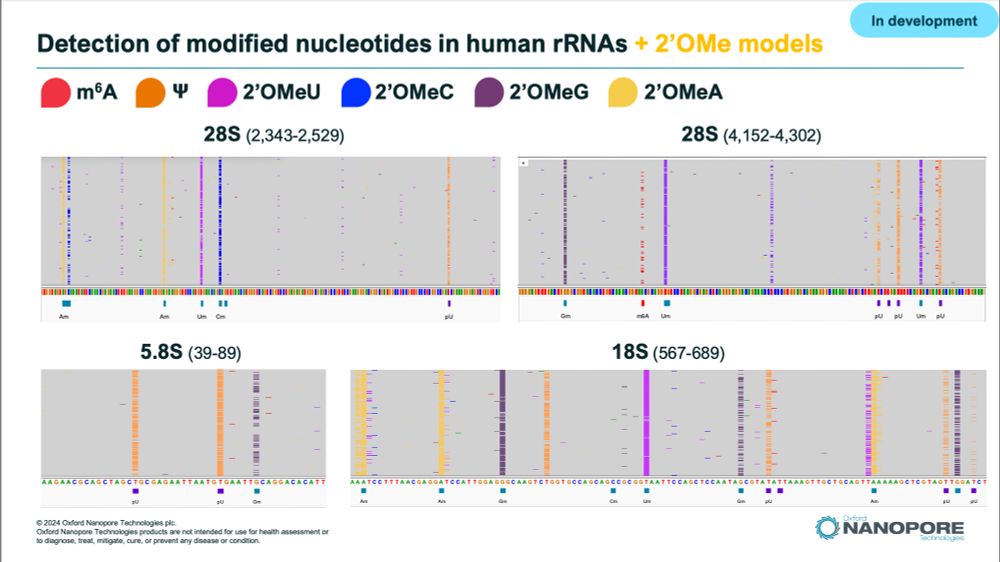
Selected areas of Human rRNAs showing modification calls in IGV. Samples sequenced by ONT direct RNA sequencing with experimental Remora models calling m6A, m5C, PseudoU, and all 4 2'Ome modifications.

Selected areas of Human rRNAs showing modification calls in IGV. Samples sequenced by ONT direct RNA sequencing with experimental Remora models calling m6A, m5C, PseudoU, and all 4 2'Ome modifications.

We have been busing working on models to detect all 2'Ome-RNA modified nucleotides on top of PseudoU, m6A, m5C and Inosine using @nanoporetech.com direct RNA sequencing.
This is still very preliminary but here are a few examples of what it looks like on Human #rRNA prepared with standard lib prep ๐Ÿคฉ

28.11.2024 12:11 โ€” ๐Ÿ‘ 32    ๐Ÿ” 12    ๐Ÿ’ฌ 3    ๐Ÿ“Œ 0

@robertomunita is following 20 prominent accounts