🌱 Ignoring spatial heterogeneity biases estimates of competition & leads to incorrect predictions of competitive exclusion instead of species coexistence.
🔍 Read: buff.ly/Wnpb4DO

@darmitage.bsky.social
Assistant prof at OIST in 🇯🇵 Community ecologist / ecosystem functioning / evolutionary ecology / stats / weird plants Come visit us 🏝️⛵️ https://www.oist.jp/research/research-units/ice
🌱 Ignoring spatial heterogeneity biases estimates of competition & leads to incorrect predictions of competitive exclusion instead of species coexistence.
🔍 Read: buff.ly/Wnpb4DO

Multiple signalling increases both prey response and diversity in a carnivorous pitcher plant - Martin‐Eberhardt - Functional Ecology - Wiley Online Library besjournals.onlinelibrary.wiley.com/doi/full/10....
13.01.2026 07:52 — 👍 2 🔁 1 💬 0 📌 0
A table showing profit margins of major publishers. A snippet of text related to this table is below. 1. The four-fold drain 1.1 Money Currently, academic publishing is dominated by profit-oriented, multinational companies for whom scientific knowledge is a commodity to be sold back to the academic community who created it. The dominant four are Elsevier, Springer Nature, Wiley and Taylor & Francis, which collectively generated over US$7.1 billion in revenue from journal publishing in 2024 alone, and over US$12 billion in profits between 2019 and 2024 (Table 1A). Their profit margins have always been over 30% in the last five years, and for the largest publisher (Elsevier) always over 37%. Against many comparators, across many sectors, scientific publishing is one of the most consistently profitable industries (Table S1). These financial arrangements make a substantial difference to science budgets. In 2024, 46% of Elsevier revenues and 53% of Taylor & Francis revenues were generated in North America, meaning that North American researchers were charged over US$2.27 billion by just two for-profit publishers. The Canadian research councils and the US National Science Foundation were allocated US$9.3 billion in that year.

A figure detailing the drain on researcher time. 1. The four-fold drain 1.2 Time The number of papers published each year is growing faster than the scientific workforce, with the number of papers per researcher almost doubling between 1996 and 2022 (Figure 1A). This reflects the fact that publishers’ commercial desire to publish (sell) more material has aligned well with the competitive prestige culture in which publications help secure jobs, grants, promotions, and awards. To the extent that this growth is driven by a pressure for profit, rather than scholarly imperatives, it distorts the way researchers spend their time. The publishing system depends on unpaid reviewer labour, estimated to be over 130 million unpaid hours annually in 2020 alone (9). Researchers have complained about the demands of peer-review for decades, but the scale of the problem is now worse, with editors reporting widespread difficulties recruiting reviewers. The growth in publications involves not only the authors’ time, but that of academic editors and reviewers who are dealing with so many review demands. Even more seriously, the imperative to produce ever more articles reshapes the nature of scientific inquiry. Evidence across multiple fields shows that more papers result in ‘ossification’, not new ideas (10). It may seem paradoxical that more papers can slow progress until one considers how it affects researchers’ time. While rewards remain tied to volume, prestige, and impact of publications, researchers will be nudged away from riskier, local, interdisciplinary, and long-term work. The result is a treadmill of constant activity with limited progress whereas core scholarly practices – such as reading, reflecting and engaging with others’ contributions – is de-prioritized. What looks like productivity often masks intellectual exhaustion built on a demoralizing, narrowing scientific vision.

A table of profit margins across industries. The section of text related to this table is below: 1. The four-fold drain 1.1 Money Currently, academic publishing is dominated by profit-oriented, multinational companies for whom scientific knowledge is a commodity to be sold back to the academic community who created it. The dominant four are Elsevier, Springer Nature, Wiley and Taylor & Francis, which collectively generated over US$7.1 billion in revenue from journal publishing in 2024 alone, and over US$12 billion in profits between 2019 and 2024 (Table 1A). Their profit margins have always been over 30% in the last five years, and for the largest publisher (Elsevier) always over 37%. Against many comparators, across many sectors, scientific publishing is one of the most consistently profitable industries (Table S1). These financial arrangements make a substantial difference to science budgets. In 2024, 46% of Elsevier revenues and 53% of Taylor & Francis revenues were generated in North America, meaning that North American researchers were charged over US$2.27 billion by just two for-profit publishers. The Canadian research councils and the US National Science Foundation were allocated US$9.3 billion in that year.

The costs of inaction are plain: wasted public funds, lost researcher time, compromised scientific integrity and eroded public trust. Today, the system rewards commercial publishers first, and science second. Without bold action from the funders we risk continuing to pour resources into a system that prioritizes profit over the advancement of scientific knowledge.
We wrote the Strain on scientific publishing to highlight the problems of time & trust. With a fantastic group of co-authors, we present The Drain of Scientific Publishing:
a 🧵 1/n
Drain: arxiv.org/abs/2511.04820
Strain: direct.mit.edu/qss/article/...
Oligopoly: direct.mit.edu/qss/article/...
Looking forward to the Modern Coexistence Theory workshop tomorrow.
Please repost :)

Join us this Thursday, Hiromi Uno (Tohoku University) will give our last seminar for the year:
Insects, shrimps and fishes; river animal migrations and their ecological consequences
Sign up to this google form to receive the zoom link and future seminar announcements forms.gle/H6YgMuAgDWYS...

A 🆕 Contribution in the ESA Bulletin: Thinking about grad school? Here are 15 questions that can help you find the right lab fit — and avoid surprises along the way
📄Fifteen Questions to Ask Before Attending Graduate School
doi.org/10.1002/bes2...

🌿 As well as strong research studies, Journal of Ecology also publishes Reviews & Mini-Reviews that promote discussion & offer new ideas & directions in plant ecology!
🌷 You can read all of our high-quality reviews on our website 👇
buff.ly/tki7aJ2


Finally settled in at OIST! Welcomed a wonderfully helpful lab technician and equally helpful administrative staff members, two enthusiastic rotation students (one of whom joined our unit as our first PhD student, yaaay!), a motivated internship student, and even a NEW BABY!!🙌✨
17.11.2025 07:55 — 👍 14 🔁 1 💬 1 📌 0
Independent researcher fellowships (non-tenure track) at OIST, with a focus on broadly defined theory www.oist.jp/research/bur...
30.10.2025 01:38 — 👍 6 🔁 8 💬 0 📌 0
🏔️ Using a novel source of abundance data, we forecast population spread across landscapes. Our results suggest that biotic processes likely play a critical, but often underappreciated role in driving range shifts over decadal time-scales🌏
📖 Read the article: buff.ly/Mf7sRRn

Meghna Krishnadas will present the next PopBio seminar:
The relative and interactive roles of abiotic and biotic drivers on demographic responses of plants
Join us online, Thursday Oct 30 1pm AEST.
Sign up to our mailing list to receive the zoom link: forms.gle/u7B1fyzRAwar...
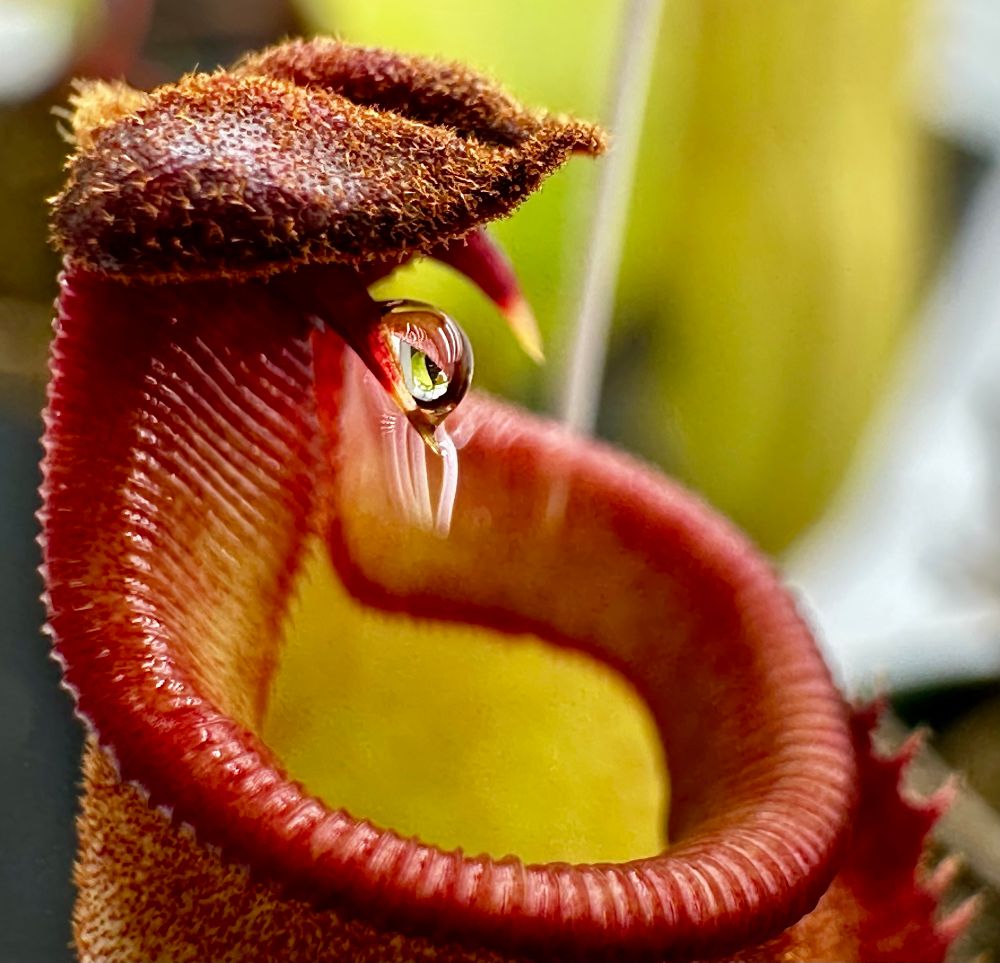
Other families of pitchers plants seem to do this too. For instance, the ant-feeding fangs of Nepenthes bicalcarata
18.10.2025 01:04 — 👍 0 🔁 0 💬 0 📌 0New preprint on reciprocal nutrient exchange between pitcher plants and their prey.
Enjoy this video of wasps having a blast inside pitcher leaves 🍭🐝
Having too much fun making 3D scans of pitcher plants
17.10.2025 08:42 — 👍 8 🔁 0 💬 0 📌 0
Major congrats to our lab’s first PhD recipient, Nonno Hasegawa. Her work on the population genetics of Darlingtonia will help us better manage and protect the objectively coolest plant on earth
01.10.2025 07:26 — 👍 6 🔁 0 💬 1 📌 0
Full article: Leaf litter capture in the carnivorous pitcher plant, Sarracenia purpurea: a preliminary study www.tandfonline.com/doi/full/10....
29.09.2025 03:30 — 👍 3 🔁 0 💬 0 📌 0
Linking Individual Performance to Density‐Dependent Population Dynamics to Understand Temperature‐Mediated Genotype Coexistence - Bruijning - 2025 - Ecology Letters - Wiley Online Library onlinelibrary.wiley.com/doi/full/10....
24.09.2025 03:14 — 👍 3 🔁 1 💬 0 📌 0
I-Ching Chen will present the next PopBio seminar:
Revisiting the Vulnerability of Mountain Biota under Rapid Warming
Join us online, Thursday Sep 25 1pm AEST. These seminars are open to all so please share widely.
Sign up to our mailing list to receive the zoom link: forms.gle/kb6aHitUsL5f...
Please consider applying to our open faculty position call that includes Ecology!
apply.interfolio.com/172075
Dynamic connectivities of plant metacommunities at a millennial time-scale: the Beringia testbed https://www.biorxiv.org/content/10.1101/2025.08.19.671027v1
24.08.2025 05:31 — 👍 2 🔁 1 💬 0 📌 0
⏰Time is running out to submit your proposal for our cross-journal Special Feature Novel communities in response to global change! 🌏
Proposal submissions close 31 August👉 buff.ly/2av5bBh

Understanding plant-microbe symbiosis is essential in tackling global challenges like food security and ecosystem restoration. In ISME Journal, OIST researchers describe the unique symbiosis between T. azollae cyanobacteria and Azolla ferns: www.oist.jp/news-center/...
18.08.2025 05:38 — 👍 5 🔁 2 💬 1 📌 0
Temporal beta diversity describes changes in community composition over time, yet its fundamental properties under neutral dynamics remain unclear. Using simulations, we demonstrate that temporal distance-decay patterns exhibit upper limits and are strongly influenced by four key parameters: the fundamental biodiversity number, local community size, mortality rate, and immigration rate. These findings highlight key differences between temporal and spatial beta diversity, emphasizing the need to account for species pool properties in macroecological studies.
#OpenAccess #SuzukiAward
Temporal beta-diversity patterns are highly dependent on fundamental parameters of neutral dynamics
Ryosuke Nakadai, the recipient of the 9th Young Scholar Award of The Ecological Society of Japan
doi.org/10.1111/1440...
community composition/ demography
Pleasantly surprised how my first attempt at scanning pitcher plant leaves turned out. Considering 3D printing it to wear as a bonnet
17.08.2025 11:39 — 👍 3 🔁 0 💬 0 📌 0
New visiting programs at OIST for experimentalists and domestic visitors! Application deadline: Sep 15, 2025.
www.oist.jp/visiting-pro...
👏👏👏
08.08.2025 10:05 — 👍 1 🔁 0 💬 0 📌 0
Imagine chilling inside this comfy leaf on a pillow of heterocysts
31.07.2025 00:57 — 👍 3 🔁 0 💬 0 📌 0
Our paper on the Azolla leaf pocket microbiome is out!
A very fun project to work on that I hope helps us understand the evolution of nitrogen fixation mutualisms by looking at one of the most extreme examples
academic.oup.com/ismej/advanc...

Berry
There is also the question of where the hundreds of negative google reviews disappeared to…
28.07.2025 13:45 — 👍 0 🔁 0 💬 0 📌 0