Six weeks left to apply: 16 fully funded Quantum Informatics PhDs
quantuminformatics-cdt.ac.uk
26.11.2025 07:13 — 👍 3 🔁 1 💬 0 📌 0

The number of low-quality or fraudulent publications is rising to hundreds of thousands per year. It is time to reevaluate current publishing models and outline a global plan. Read the 'Reformation of science publishing: the Stockholm Declaration': royalsocietypublishing.org/doi/10.1098/... #RSOS 🧪
11.11.2025 08:35 — 👍 371 🔁 102 💬 13 📌 13

The equations governing controlled circuits.
Our notation implicitly assumed one more equation, (h) below, now added. Thanks to Peter Selinger for catching this!
21.10.2025 19:00 — 👍 2 🔁 0 💬 0 📌 0
Sheaves over such causal coverages now describe how to assign data to your spacetime such that "past data evolves continuously and deterministically into future data". For much more, see Nesta's great PhD thesis, with many fun ideas and pictures: arxiv.org/abs/2406.15406.
21.10.2025 09:13 — 👍 0 🔁 0 💬 0 📌 0

Illustration of a path of points regarded as an infinitesimally thin approximation by sequences of opens that causally precede each other.
That means you need a way to think about paths in terms of open sets rather than points. The idea: approximate a path by finer and finer finite sequences of opens that are causally before each other.
21.10.2025 09:13 — 👍 0 🔁 0 💬 1 📌 0
Well, you don't need points to describe that, and can do it purely with open sets. This new paper with Nesta van der Schaaf describes how: arxiv.org/abs/2510.17417. The idea is in the picture: region U is covered by collection A of regions if any causal path that ends up in U must pass through A.
21.10.2025 09:13 — 👍 0 🔁 0 💬 1 📌 0

Illustration of causal coverage: region U is covered by regions A because any path that ends in U must pass through A.
Coverages, or Grothendieck topologies, describe when a collection of regions covers another region in a space. But what if your space is a spacetime? The topological space may have a causal order saying which (spacetime) points 'come before' which other points, for example.
21.10.2025 09:13 — 👍 2 🔁 0 💬 1 📌 0
Also about circuits: the physics Nobel prize just announced!
07.10.2025 10:35 — 👍 0 🔁 0 💬 0 📌 0
So much material for titles here, too! "If you liked it you shoulda put a rig on it", "The rig is up", "Taking back control". What's your favourite?
07.10.2025 09:10 — 👍 1 🔁 0 💬 1 📌 0
Theorem: these two ways to build a theory of controlled circuits are the same! Practically, this means the equations are complete, and we can use them to manipulate and optimise controlled circuits. Foundationally, this pins down what this not-quite-data-or-control-flow control really is about.
07.10.2025 09:00 — 👍 1 🔁 0 💬 0 📌 0
Another thing you can do is make a new theory where 'controlled gates' are, roughly, matrices of base gates. Technically, you freely adjoin sums to the base (tensor) prop, universally giving it rig structure.
07.10.2025 09:00 — 👍 1 🔁 0 💬 1 📌 0
The equations all have natural interpretations. For example, the complementarity equation (e) says that a gate on the target wire is the same as a positively controlled and then a negatively controlled version of it: the control bit is either on or off.
07.10.2025 09:00 — 👍 0 🔁 0 💬 1 📌 0

The equations governing controlled gates.
Start with any base circuit theory, in terms of tensors only; technically, as a prop. Build a new controlled circuit theory that has controlled versions of the base gates, subject to these equations.
07.10.2025 09:00 — 👍 0 🔁 0 💬 2 📌 0
The key is that circuits contain controlled gates. It's not quite data flow, nor control flow, in the usual computer science sense. But it is clearly important. Can we take back this control, and separate this control from a base theory of uncontrolled circuits? Yes we can!
07.10.2025 09:00 — 👍 0 🔁 0 💬 1 📌 0
Have you ever wondered why we describe circuits with matrices? I mean, circuits are about tensor products, while matrices are about direct sums. This new paper with Louis Lemonnier and @manchegobaby.bsky.social gives a practically useful explanation: arxiv.org/abs/2510.05032.
07.10.2025 09:00 — 👍 9 🔁 2 💬 3 📌 0

Quantum circuits are just a phase
Quantum programs today are written at a low level of abstraction - quantum circuits akin to assembly languages - and even advanced quantum programming languages essentially function as circuit descrip...
A new quantum programming construct: more abstract than circuits, capturing important examples elegantly and in fact universal, yet simple and intuitive. With prototype compiler and clean categorical semantics to boot!
With Alex Rice, Chris McNally, and Louis Lemonnier:
arxiv.org/abs/2507.11676
17.07.2025 11:15 — 👍 4 🔁 0 💬 0 📌 0

I presented a taster poster on our upcoming work in distributed quantum compilation at the Uni of Edinburgh’s Informatics internal research showcase this Tuesday.
Focus: our upcoming model/hardware-agnostic intermediate representation for compilation of quantum programs (quite a mouthful I know!)
12.06.2025 10:20 — 👍 14 🔁 2 💬 0 📌 0
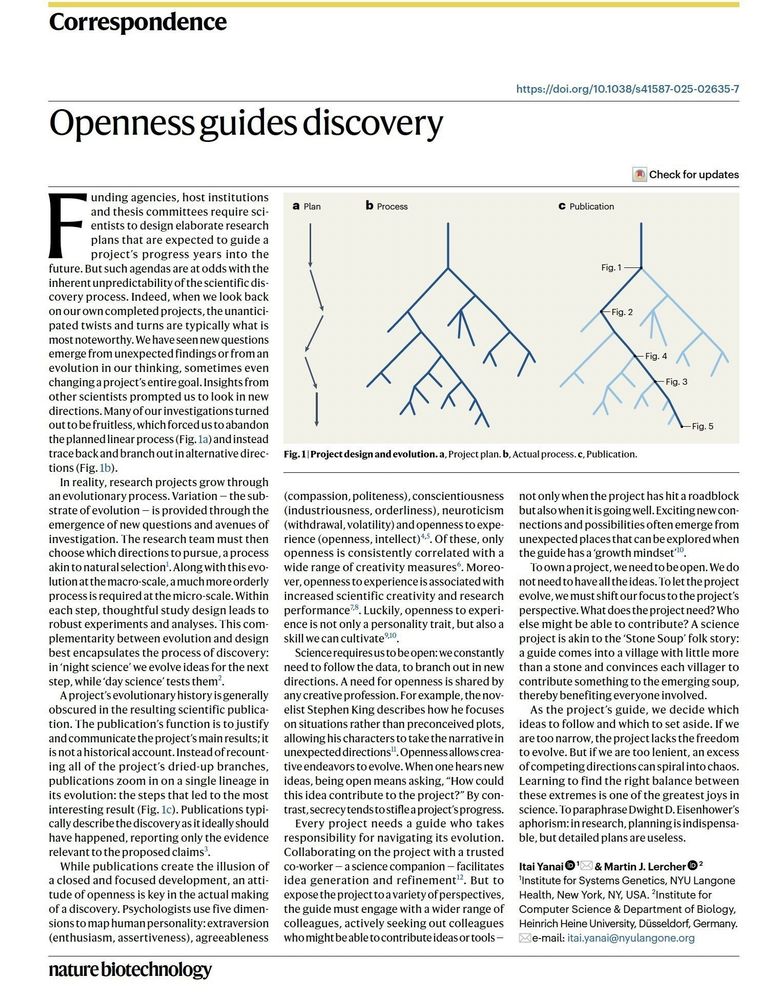
90% of doing science is being open to new ideas.
31.05.2025 18:14 — 👍 261 🔁 67 💬 2 📌 10
M*-categories: Where limits in analysis and category theory meet
This article introduces M*-categories: an abstraction of categories with similar algebraic and analytic properties to the categories of real, complex, and quaternionic Hilbert spaces and bounded linea...
🚨 New preprint alert 🚨
Always wanted to know the connection between analytic limits and categorical limits? Tired of having to establish directed colimits of contractions when directed colimits of isometries suffice? You're in luck!
Now on www.arxiv.org/abs/2505.17432. With Matt Di Meglio.
28.05.2025 09:28 — 👍 1 🔁 0 💬 0 📌 0

Edinburgh local curious about how physics is shaping computer science?
Come along to this light & fun Pint of science session, and hear me ramble about quantum computers. Perfect for the curious general public!
Register here: pintofscience.co.uk/event/subato...
25.04.2025 08:06 — 👍 7 🔁 1 💬 0 📌 0
Two more days to get your application in! Apply now at quantuminformatics-cdt.ac.uk.
13.01.2025 10:12 — 👍 2 🔁 3 💬 0 📌 0

Quantum Informatics logo
Applications are now open for September 2025 entry to the EPSRC Centre for Doctoral Training in Quantum Informatics. At least 16 fully-funded PhD studentships are available! Apply at quantuminformatics-cdt.ac.uk.
25.11.2024 19:09 — 👍 2 🔁 1 💬 0 📌 0
QI CDT – EPSRC Centre for Doctoral Training in Quantum Informatics
📢PhD Positions in Quantum Computing
Applications are now open for the new CDT in Quantum Informatics. We are recruiting 16 students to start Sept 2025. Positions are fully funded for 4 years. Apply now:
quantuminformatics-cdt.ac.uk
18.11.2024 14:08 — 👍 19 🔁 10 💬 1 📌 0
Double dumb-ass on you. (And so fourth)
#AltText enthusiast. Also on mastodon, currently dark on twitter. Other similar accounts are not me.
Quantum physicist | Professor of Theoretical Physics at University of Bristol | Author of Semidefinite Programming in Quantum Information Science (IOP ebooks) | linktr.ee/paul.skrzypczyk
Parody quantum computing startup from South London
https://dulwichquantum.github.io/
Scientist, professor of quantum physics at Freie Universität Berlin and affiliated with Helmholtz Center Berlin and the Fraunhofer Heinrich Hertz Institute. ERC Fellow.
Quantum Bullshit Detector.
Tag for a reading.
Research and education in physics with a focus on quantum computing, communication and sensing with team Qudev (https://qudev.phys.ethz.ch/) at ETH Zurich. Team lead at the ETHZ-PSI Quantum Computing Hub. Director of the Quantum Center at ETHZ.
Staff Software Engineer at IQM Quantum Computers. Home page: https://rakhim.org/
Building https://minifeed.net and https://exotext.com/
Based in southern Finland.
Quantum science and education at IBM.
And also in my free time.
I like quantum computing, science literacy and animals and dislike misinformation, pseudoscience, and goat cheese.
Work: quantum learning and control. Play: writing words and code.
#1 best-selling science author for kids.
https://csferrie.com
Theoretical ski bum. Former pseudo professor. Quantum bridge builder. Will math for food.
mastodon: @dabacon@tachyon.channel
https://dabacon.org
Misusing quantum computers for fun and/or science. Spock at Moth Quantum. Two Ts and no Es. All nonsense here is my own doing
Theoretical physicist (quantum information + quantum thermodynamics) at QuICS, author of Quantum Steampunk: The Physics of Yesterday's Tomorrow
EPSRC Open Fellow in quantum condensed matter theory at the University of Edinburgh. Former Research Scientist at IBM Research, Marie Sklodowska-Curie Fellow at FU Berlin, and postdocs at Collège de France, the Ecole Polytechnique and CEA Saclay. He/him.
Quantum physicist. Assistant Prof at EPFL. Climber.
Quantum computing educator and researcher. I like math, computer games, and dub techno.
Google Quantum AI | Ex-Team Lead, IBM Quantum | MIT TR35 | Founder, Open Labs | Board, Yale Alumni Assoc | Yale PhD
Lecturer (~asst prof) investigating quantum physics @univofstandrews.
My opinions belong to 28 highly trained monkeys and are not those of my employer.
Webpage: https://legg.wp.st-andrews.ac.uk/
Physics professor at San Jose State. Quantum Foundations. Big fan of space and time, and also many things therein.
Quantum compilation & open source software.
working on pennylane.ai
https://github.com/qottmann
free hot takes