Inclusive – not hostile – state policies promote linked fate among Latino immigrants finds @tntrummel.bsky.social of UC Santa Barbara blogs.lse.ac.uk/usappblog/20...
24.11.2025 16:23 — 👍 0 🔁 1 💬 0 📌 0
@tntrummel.bsky.social
PhD candidate at UC Santa Barbara. Immigration policy, attitudes, identity, experiments. Formerly: UCSD, SDSU tntrummel.com
Inclusive – not hostile – state policies promote linked fate among Latino immigrants finds @tntrummel.bsky.social of UC Santa Barbara blogs.lse.ac.uk/usappblog/20...
24.11.2025 16:23 — 👍 0 🔁 1 💬 0 📌 0
Asylum is not "illegal migration"
Let's start from here theconversation.com/asylum-is-no...
See the article here: doi.org/10.1080/2156...
20.11.2025 06:16 — 👍 0 🔁 0 💬 0 📌 0🎯 Overall, two key contributions are:
1. A different measurement approach to state immigrant policy climates than seen in some related work (and how results vary)
2. Evidence of immigrant linked fate, a nascent area of work
This finding is in tension with much prior work that shows that hostile policy climates provoke linked fate.
20.11.2025 06:16 — 👍 0 🔁 0 💬 1 📌 0I measure state immigrant policy inclusiveness using an additive index on policy issues spanning public benefits, law enforcement, and integration.
📌 Inclusive policies are associated with *increased* feelings of linked fate to other immigrants, but there is no effect on co-ethnic linked fate.

Over the summer I published the first article of my dissertation!
In this paper, I study how state immigrant policies affect Latino immigrant linked fate.
Drawing on a large sample of Latino immigrants (LINES 2016), I use co-ethnic and immigrant linked fate as the DVs.
See more⬇️🧵 (1/5)

In AP research:
1. Moral judgements and cultural values - perception of law and order is important, even to Dems
2. Concerns over criminality, being "unvetted"
3. Perception that undocumented = poor and more likely to use welfare (untrue)
A good place to start: link.springer.com/article/10.1...

Had a great time presenting a snippet of my JMP at @ucriverside.bsky.social for @priec.bsky.social yesterday! Thanks to the organizers and for the thoughtful feedback from the audience. #UCRPRIEC20
04.10.2025 18:50 — 👍 8 🔁 0 💬 0 📌 0
If you’re interested in American immigration attitudes and unique ways of assessing different dimensions of fairness, come see me this Thursday at 8:00 am at #APSA2025.
The evidence comes from a large original survey and conjoint experiment I fielded this year (n=3,000+).

Kirill Zhirkov & Robert H. Brehm find that calling immigrants “illegal” or “undocumented” doesn’t affect perceptions in experiments. However, people’s preferences for these terms do reflect their broader attitudes toward immigration policy.
Read more here: journals.sagepub.com/doi/full/10....

📢 Chan & Landgrave find that many Americans hold an immigrant identity—distinct from race or origin—and that its strength varies by race and generation.
🔗 Read more: www.tandfonline.com/doi/full/10....

🎉We're celebrating another successful Research Transparency & Reproducibility Training (RT2)! Last week, we hosted 28 early-career researchers for a course exploring preregistration, evidence aggregation, and other topics. Feeling inspired by scholars making open science happen!
28.05.2025 22:55 — 👍 7 🔁 3 💬 1 📌 1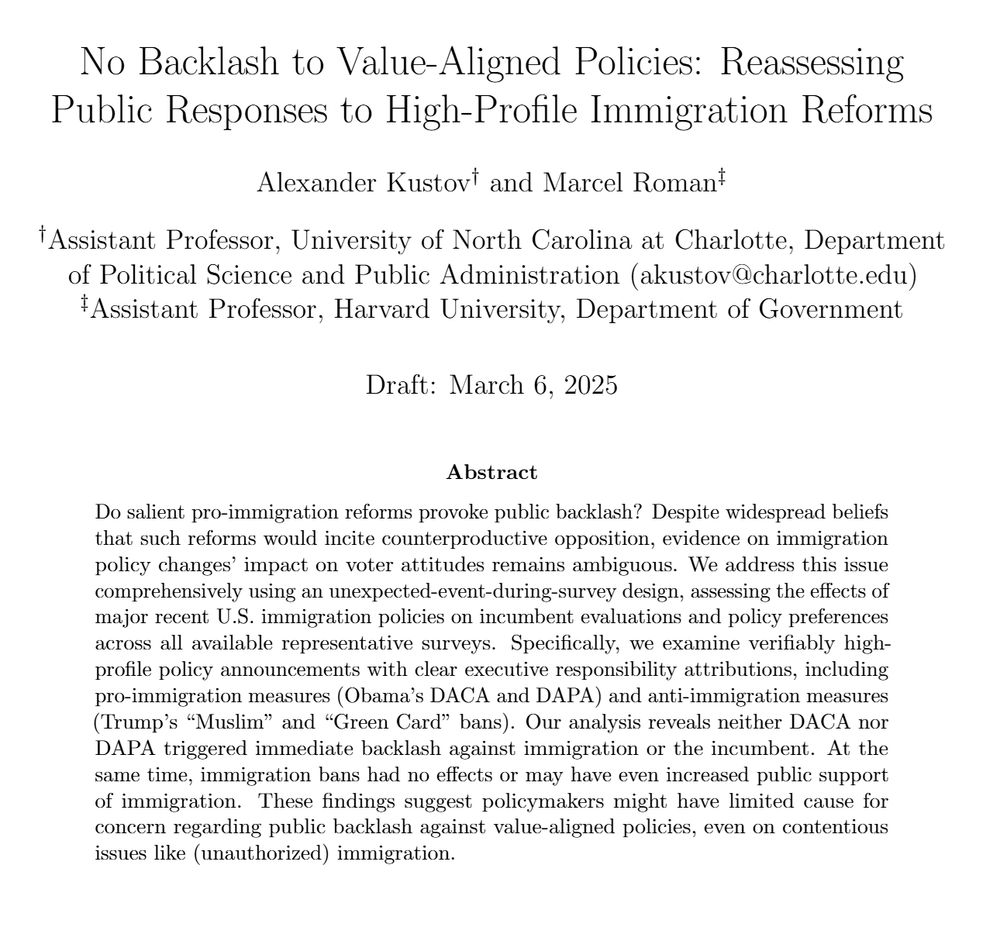
🚨Do pro-immigration reforms trigger backlash?🚨
In our new paper, we examine how Americans reacted to high-profile immigration reforms using an unexpected-event design and all possible daily surveys. In short: no backlash to DACA—but potential backlash to Trump’s Muslim Ban.
doi.org/10.31219/osf...

Immigrants of just about all statuses in the US face significant restrictions on access to federally funded public benefits. Even when eligible, they tend to use welfare at much lower rates than the US born.
Check out our new explainer for all the details: www.migrationpolicy.org/content/immi...

1. When a country turns authoritarian, democracy often bounce back. A recent article shows that this happens in more than half (52%) of all episode - this is what they call U-Turns. The statistics look even better in recent years; here democracy has made a comeback in 73% of the cases.
23.02.2025 20:39 — 👍 9 🔁 2 💬 2 📌 0
How Americans really feel about deporting immigrants – why forcing a choice between deportation and legalization matters for the results
17.02.2025 22:31 — 👍 5 🔁 1 💬 0 📌 0Wooo! Very proud alumna! 🎉
13.02.2025 22:43 — 👍 4 🔁 0 💬 0 📌 0
@aegutierrez.bsky.social and I have a new article on accurately accounting for Latino racial identities and how these affect feelings of closeness and solidarity with different racial groups. www.tandfonline.com/doi/full/10....
11.02.2025 20:40 — 👍 31 🔁 11 💬 0 📌 0Let's talk about the history and present of Temporary Protected Status (TPS). It was introduced in the 90s as part of the Immigration Act of 1990 -- the last time Congress did a major reform of immigration.
🧵
This is finally out. journals.sagepub.com/doi/10.1177/...
20.01.2025 15:39 — 👍 23 🔁 4 💬 2 📌 2
Sharing an incredible resource for people looking to follow the legal changes on immigration under Trump. A law professor and numerous students at Yale Law and Stanford Law will be tracking and summarizing every change in immigration policy. immpolicytracking.org/home/
19.01.2025 02:45 — 👍 1080 🔁 627 💬 65 📌 35My new piece in @pspolisci.bsky.social: % of gender & LGBTQIA+ articles in 6 polisci journals. Takeaway: gender articles abt ~6%; LGBTQIA+ articles, <1%. Nearly all use quant methods & men are greater % authors than their % membership in respective APSA sections. www.cambridge.org/core/journal...
13.01.2025 13:21 — 👍 42 🔁 16 💬 1 📌 2Young female scholars’ citation rates lag behind those of young men but the good news is on average women reduce the gap over the duration of their career.
17.01.2025 17:17 — 👍 1 🔁 0 💬 0 📌 0Great panels and discussions at the Borders and Migration CwC at #SPSA2025. Plus, this incredible spot
12.01.2025 18:25 — 👍 8 🔁 0 💬 0 📌 0