You too, Lily! Hope all is going well 😊
09.12.2025 16:45 — 👍 0 🔁 0 💬 0 📌 0
Congratulations, Lily! 🎊
08.12.2025 16:27 — 👍 1 🔁 0 💬 1 📌 0
University of Toronto Press
This has been in the works for a while so it's great to see it out! It's part of a special issue on Language, Gender, and Health Inequalities, edited by Laura Coffey-Glover for the Journal of Language and Discrimination.
You can see the full issue here: utppublishing.com/toc/jld/curr...
08.12.2025 16:25 — 👍 0 🔁 0 💬 0 📌 0

Image shows the front page of our new article, entitled: “We No Longer Recognized Her as a Human Being”: A Critical Discourse Analysis of AI-Generated Character Descriptions of Men and Women
With Dementia.
ABSTRACT: Motivated by the gender inequalities observed in relation both to dementia and generative artificial intelligence (GenAI), this article takes a critical discourse analysis approach to explore how gender and dementia intersect in 52 AI-generated character descriptions of men and women with dementia. Using “woman/man”as entry points through which to explore discursive constructions masculinities and femininities in the data, we find gendered distinctions in how characters’ bodies are evaluated, social roles attributed, and
violence presented. We also find that a deficit approach to dementia dominates, emphasizing suffering, loss, and hopelessness. Characters with dementia are stereotyped as older and frail, either near death or already dead in body and/or mind. Overall, the AI-generated texts
recycle (and potentially amplify) pervasive discourses regarding both dementia and gender. Our findings therefore reinforce the need for further critical engagement with GenAI, from design to use, to interrogate and challenge its capacity to perpetuate inequalities.
Out now: 'A Critical Discourse Analysis of AI-Generated Character Descriptions of Men and Women With Dementia', with Chris Chikodzore-Paterson and @gavinbrookes.bsky.social:
📑Journal article: utppublishing.com/doi/epdf/10....
📝Author copy (open access): eprints.lancs.ac.uk/id/eprint/22...
08.12.2025 16:25 — 👍 13 🔁 6 💬 1 📌 0
Such amazing news, congratulations!! 🎊
17.09.2025 10:46 — 👍 1 🔁 0 💬 0 📌 0

Health and Science Communication SIG
The Health and Science Communication BAAL Special Interest Group
@baal-health-sig.bsky.social are now looking for a SIG Secretary. This post offers a great opportunity to get involved with the linguistics health and science communication community, BAAL more broadly and to help steer the direction of the SIG. For info, please go to baalhealthsci.wordpress.com
17.09.2025 08:01 — 👍 2 🔁 2 💬 0 📌 0
Thank you to all contributors to this @corpussocialsci.bsky.social event: two days of thought-provoking presentations on different issues in health communication, using different methodologies and with data from Europe, Africa, Asia and the US. See you all at the next @ic4ch.bsky.social event!
12.09.2025 20:26 — 👍 9 🔁 2 💬 0 📌 0

The words we use to talk about nature are disappearing. Here’s why that matters.
We’ll need to do more than ‘touch grass’ to revive them.
"Since 1800, there’s been a sharp decline in nature-related words in English language books. It closely matches a simulation of nature–human interactions." A new piece in @grist.org by Kate Yoder, with some #ecolinguistics input from @repoole.bsky.social grist.org/language/nat...
06.09.2025 16:48 — 👍 17 🔁 7 💬 1 📌 2
5. There's so much more than can be put into a post! During the book prize panel, an editor asked a question that is one of many that I'm still seriously thinking about: 'who does our research serve?'
I've had many wonderful conversations with colleagues and look forward to the rest of #baal2025!
05.09.2025 08:21 — 👍 5 🔁 0 💬 0 📌 0

Image summarises principles of intersectional sociocultural linguistic analysis:
1. Intra-categorical in outlook
2. Considers both oppression and privilege
3. Takes a thick approach to account for individual social locations
4. Understands speakers to be agentive
5. Is reflexive
4. Another highlight was @lucyjones.bsky.social's plenary in the afternoon - as ever from Lucy, it was both thought-provoking and inspiring. I learnt a lot from her discussion of the different aspects of taking an intersectional lens and enjoyed her openness about learning from mistakes!
05.09.2025 08:21 — 👍 4 🔁 0 💬 1 📌 0
3. I loved attending the @baal-health-sig.bsky.social panel, featuring Olivia Knapton's great work with people with insect/bug phobias, Esranur Efeoglu-Ozcan's innovative comparative study of climate crisis framings, and Mimi Huang's important work with volunteer waterside responders.
05.09.2025 08:21 — 👍 3 🔁 1 💬 1 📌 1
2. It was a pleasure to follow Run Li when I presented on representations of dementia and generative AI. I loved hearing about his work with Xiang Huang on multimodal discursive strategies in public health communication. We were lucky to have great questions from the audience!
05.09.2025 08:21 — 👍 1 🔁 0 💬 1 📌 0

Image shows a slide discussing pharmakon as both remedy and posion.
Quote from Derrida (1981: 70/72)"This medicine, this philter which acts as both remedy and poison...permitted the rendering of the same word by 'remedy', 'recipe', 'poison', 'drug', 'philter' etc"
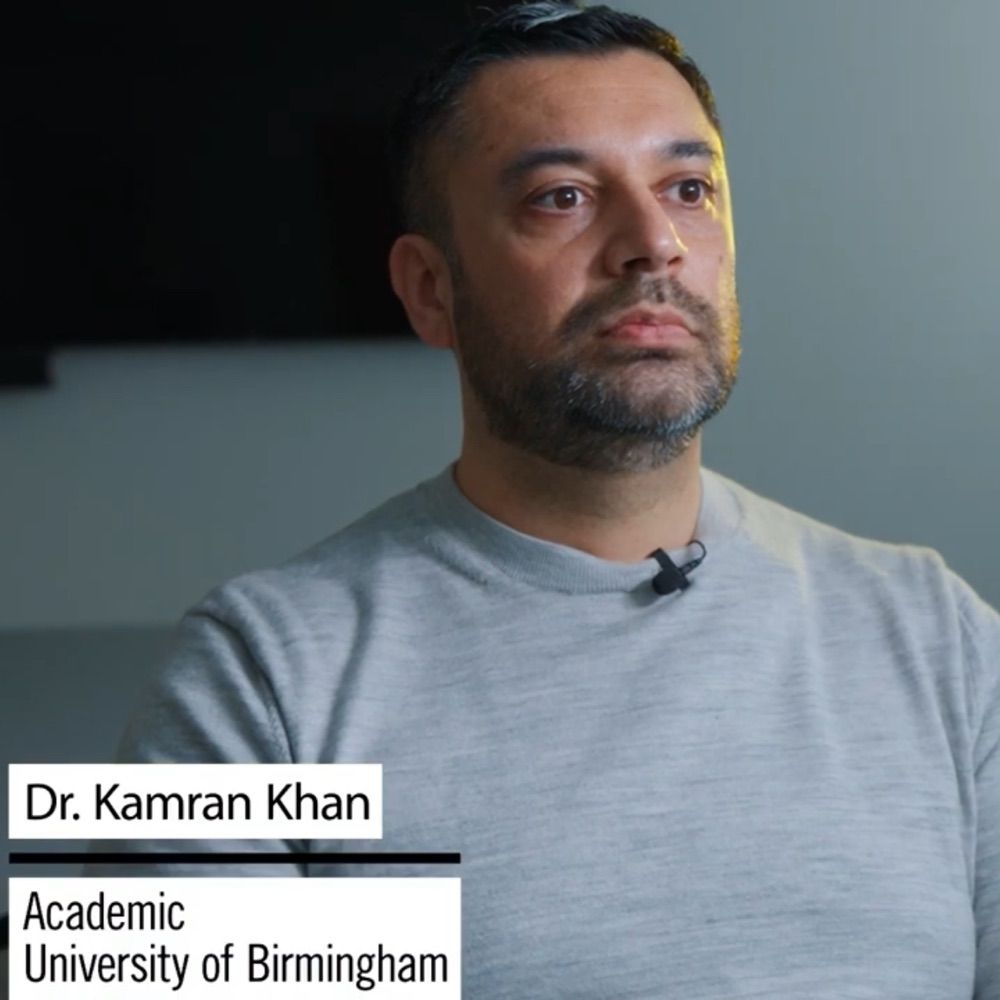
1. Kamran Khan's fantastic opening plenary titled Language, Security and Governance through Terror. This talk made me reflect on many things but especially the concept of a pharmakon (meaning both a remedy and a poison, with the degree of each varying according to the context).
05.09.2025 08:21 — 👍 2 🔁 0 💬 1 📌 0

Image shows Glasgow Main building.

Image shows a rainbow at the end of a street in Glasgow.

Image shows a marble staircase in Glasgow City Chambers.

Image shows a grand hallway in Glasgow City Chambers.
As we enter day 2 of #baal2025, I'm reflecting on all of the thoughtful talks, plenaries and conversations from yesterday. Some of my personal highlights include:
05.09.2025 08:21 — 👍 6 🔁 0 💬 1 📌 0
Thank you so much to @stephenpihlaja.bsky.social for your summary and response to my talk at #baal2025 - there are some impressive speed typing skills on display there and it's really interesting to read your thoughts and experiment with a prompt that aims to avoid dementia stereotypes!
05.09.2025 05:51 — 👍 4 🔁 0 💬 0 📌 0
Thank you so much for attending and for sharing your thoughtful comments and questions, @lucyjones.bsky.social!
05.09.2025 05:49 — 👍 1 🔁 0 💬 0 📌 0

Fantastic and fascinating talk on the reductive, limited representations of dementia in generative AI from @uonenglish.bsky.social alumnus @emma-putland.bsky.social #BAAL2025
04.09.2025 12:00 — 👍 15 🔁 1 💬 2 📌 0
Call for Papers – Corpora & Discourse International Conference 2026
🚨 Call for Papers! 🚨 we are excited to launch the Call for Papers for the Corpora and Discourse International Conference 2026. Deadline 16 November 2025. Submit your abstracts here: wp.lancs.ac.uk/cad-2026/cal.... Please share widely! #CADS2026
02.09.2025 11:19 — 👍 30 🔁 31 💬 0 📌 3
Corpora & Discourse International Conference 2026 – 23-25 June 2026
Diaries at the ready... the next Corpora & Discourse International Conference will take place from 23-25 June 2026, at Lancaster University. We are also very excited to launch our website, with plenary speaker info, key dates, and much more besides: wp.lancs.ac.uk/cad-2026/. Please share widely!
31.07.2025 10:04 — 👍 32 🔁 22 💬 1 📌 1
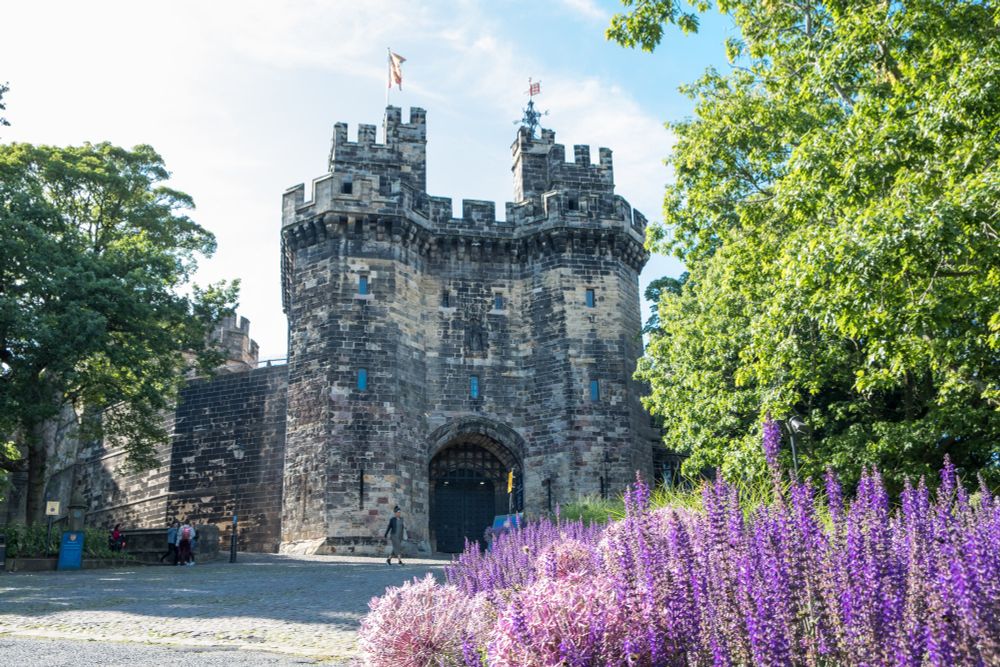
Photo shows Lancaster Castle in spring.
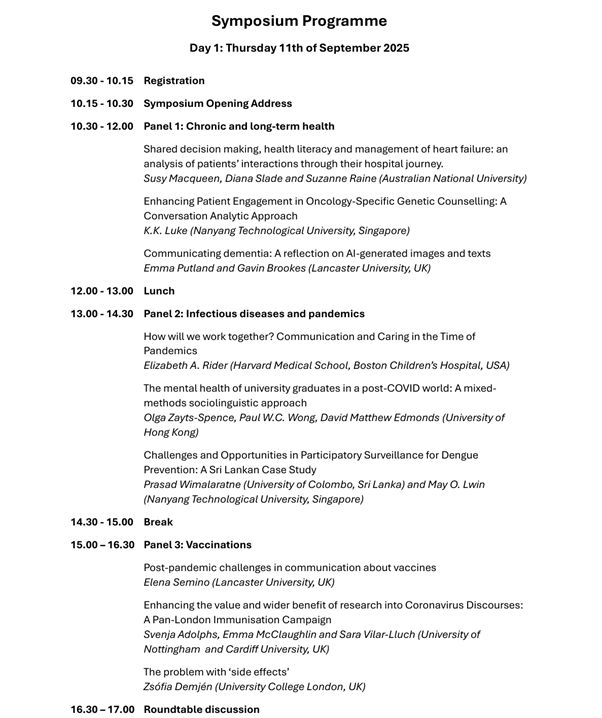
Day 1: Thursday 11th of September 2025
09.30 - 10.15 Registration
10.15 - 10.30 Symposium Opening Address
10.30 - 12.00 Panel 1: Chronic and long-term health
Shared decision making, health literacy and management of heart failure: an analysis of patients’ interactions through their hospital journey.
Susy Macqueen, Diana Slade and Suzanne Raine (Australian National University)
Enhancing Patient Engagement in Oncology-Specific Genetic Counselling: A
Conversation Analytic Approach
K.K. Luke (Nanyang Technological University, Singapore)
Communicating dementia: A reflection on AI-generated images and texts
Emma Putland and Gavin Brookes (Lancaster University, UK)
12.00 - 13.00 Lunch
13.00 - 14.30 Panel 2: Infectious diseases and pandemics
How will we work together? Communication and Caring in the Time of
Pandemics
Elizabeth A. Rider (Harvard Medical School, Boston Children’s Hospital, USA)
The mental health of university graduates in a post-COVID world: A mixed methods sociolinguistic approach
Olga Zayts-Spence, Paul W.C. Wong, David Matthew Edmonds (University of
Hong Kong)
Challenges and Opportunities in Participatory Surveillance for Dengue
Prevention: A Sri Lankan Case Study
Prasad Wimalaratne (University of Colombo, Sri Lanka) and May O. Lwin
(Nanyang Technological University, Singapore)
14.30 - 15.00 Break
15.00 – 16.30 Panel 3: Vaccinations
Post-pandemic challenges in communication about vaccines
Elena Semino (Lancaster University, UK)
Enhancing the value and wider benefit of research into Coronavirus Discourses: A Pan-London Immunisation Campaign
Svenja Adolphs, Emma McClaughlin and Sara Vilar-Lluch (University of
Nottingham and Cardiff University, UK)
The problem with ‘side effects’
Zsófia Demjén (University College London, UK)
16.30 – 17.00 Roundtable discussion
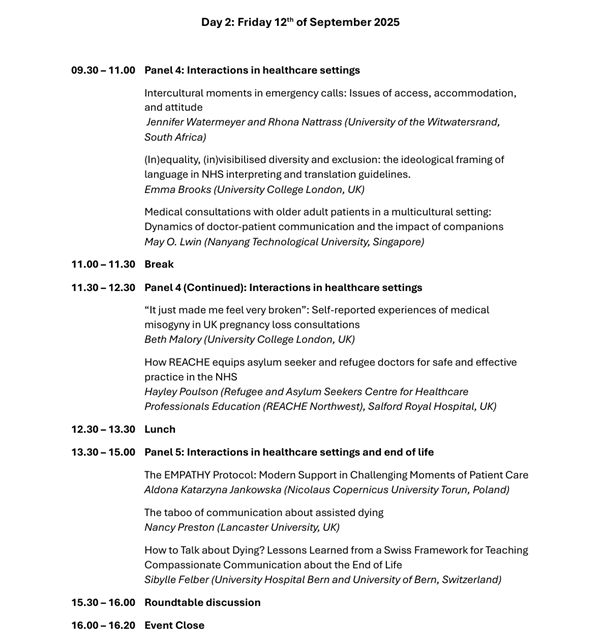
Day 2: Friday 12th of September 2025
09.30 – 11.00 Panel 4: Interactions in healthcare settings
Intercultural moments in emergency calls: Issues of access, accommodation, and attitude
Jennifer Watermeyer and Rhona Nattrass (University of the Witwatersrand, South Africa)
(In)equality, (in)visibilised diversity and exclusion: the ideological framing of language in NHS interpreting and translation guidelines.
Emma Brooks (University College London, UK)
Medical consultations with older adult patients in a multicultural setting: Dynamics of doctor-patient communication and the impact of companions
May O. Lwin (Nanyang Technological University, Singapore)
11.00 – 11.30 Break
11.30 – 12.30 Panel 4 (Continued): Interactions in healthcare settings
“It just made me feel very broken”: Self-reported experiences of medical misogyny in UK pregnancy loss consultations
Beth Malory (University College London, UK)
How REACHE equips asylum seeker and refugee doctors for safe and effective practice in the NHS
Hayley Poulson (Refugee and Asylum Seekers Centre for Healthcare
Professionals Education (REACHE Northwest), Salford Royal Hospital, UK)
12.30 – 13.30 Lunch
13.30 – 15.00 Panel 5: Interactions in healthcare settings and end of life
The EMPATHY Protocol: Modern Support in Challenging Moments of Patient Care
Aldona Katarzyna Jankowska (Nicolaus Copernicus University Torun, Poland)
The taboo of communication about assisted dying
Nancy Preston (Lancaster University, UK)
How to Talk about Dying? Lessons Learned from a Swiss Framework for Teaching Compassionate Communication about the End of Life
Sibylle Felber (University Hospital Bern and University of Bern, Switzerland)
15.30 – 16.00 Roundtable discussion
16.00 – 16.20 Event Close
It's less than two months until our 5th Symposium of the International Consortium for Communication in Health Care!
📆When: 11-12 September 2025
📍At: Lancaster University, UK (in person) or Microsoft Teams (free online)
For more info and to register, see: ic4ch.wordpress.com/activities/
16.07.2025 14:27 — 👍 3 🔁 2 💬 1 📌 0
Preparations for the 2026 Corpora and Discourse International Conference at Lancaster University are under way! We will be sharing information on dates for your calendars, plenary speakers, and the upcoming call for papers very soon. Follow here for updates, and please share widely! #CADS2026
13.07.2025 18:29 — 👍 49 🔁 33 💬 1 📌 0
Really enjoying being part of the CASS Lancaster Summer Schools this week! It's great getting to meet so many fantastic people during a week dedicated to corpus linguistics! 😊✨️ #LancsSS25
17.06.2025 14:43 — 👍 3 🔁 1 💬 0 📌 0
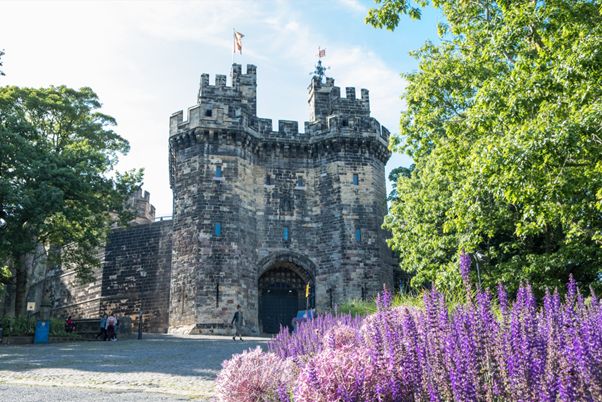
Image shows the entrance of Lancaster Castle in spring.
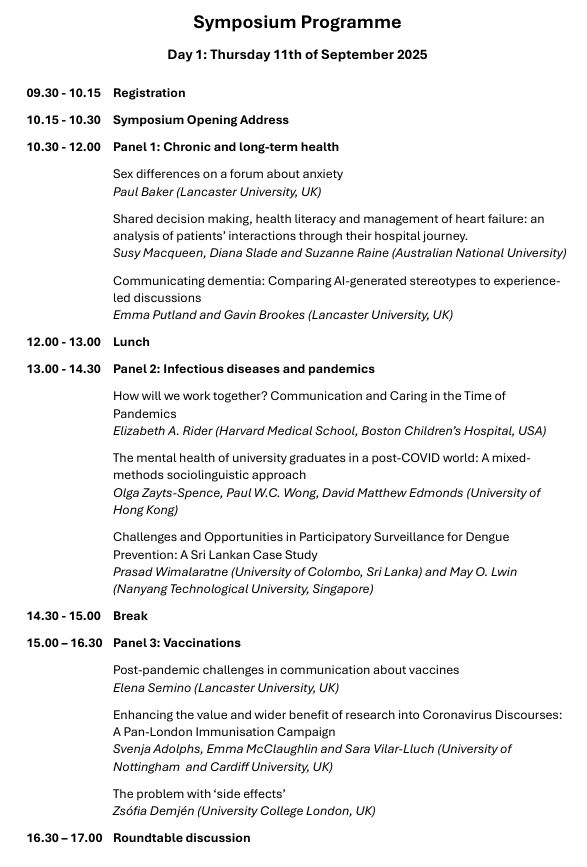
Image shows day 1 of the programme, which can be read in full as a PDF at https://ic4ch.wordpress.com/activities/
Day 1: Thursday 11th of September 2025
09.30 - 10.15 Registration
10.15 - 10.30 Symposium Opening Address
10.30 - 12.00 Panel 1: Chronic and long-term health
12.00 - 13.00 Lunch
13.00 - 14.30 Panel 2: Infectious diseases and pandemics
How will we work together? Communication and Caring in the Time of Pandemics
14.30 - 15.00 Break
15.00 – 16.30 Panel 3: Vaccinations
16.30 – 17.00 Roundtable discussion
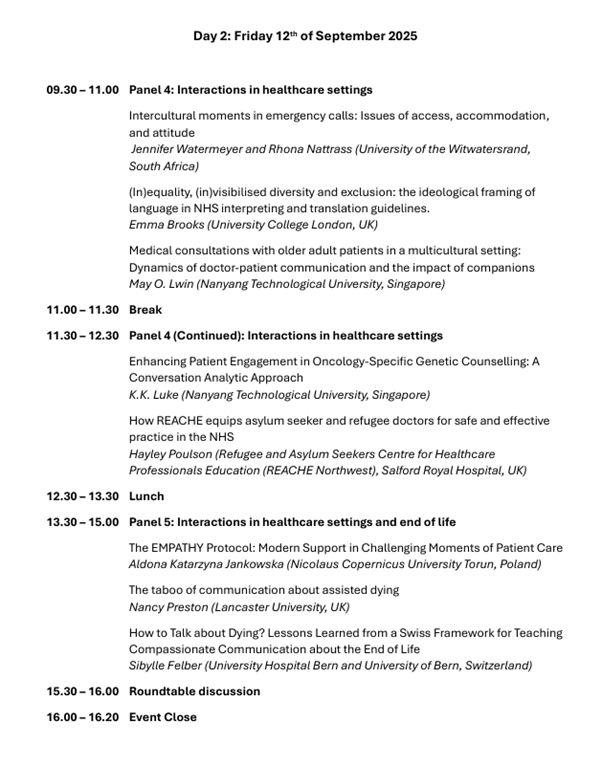
Image shows day 2 of the programme, which can be read in full as a PDF at https://ic4ch.wordpress.com/activities/
Day 2: Friday 12th of September 2025
09.30 – 11.00 Panel 4: Interactions in healthcare settings
11.00 – 11.30 Break
11.30 – 12.30 Panel 4 (Continued): Interactions in healthcare settings
12.30 – 13.30 Lunch
13.30 – 15.00 Panel 5: Interactions in healthcare settings and end of life
15.30 – 16.00 Roundtable discussion
16.00 – 16.20 Event Close
Join us for our 5th Symposium of the International Consortium for Communication in Health Care!
📆When: 11-12 September 2025
📍At: Lancaster University, UK
Early bird registration is open until June 15th registration.lancaster.ac.uk/Registration...
More info: ic4ch.wordpress.com/activities/
04.06.2025 18:06 — 👍 6 🔁 4 💬 1 📌 1

Enjoyed giving a plenary talk at the CIRLAM conference today, and sharing work on generative AI, discourse and ideology with @emma-putland.bsky.social & Chris Chikodzore-Paterson. Great questions and discussion afterwards, too! @pubdiscdementia.bsky.social @lancslinguistics.bsky.social
23.05.2025 16:36 — 👍 15 🔁 5 💬 0 📌 0
Image shows day 1 of the programme, which can be read as a PDF at https://ic4ch.wordpress.com/activities/
Symposium Programme
Day 1: Thursday 11th of September 2025
09.30 - 10.15 Registration
10.15 - 10.30 Symposium Opening Address
10.30 - 12.00 Panel 1: Chronic and long-term health
Sex differences on a forum about anxiety
Paul Baker (Lancaster University, UK)
Shared decision making, health literacy and management of heart failure: an analysis of patients’ interactions through their hospital journey.
Susy Macqueen, Diana Slade and Suzanne Raine (Australian National University)
Communicating dementia: Comparing AI-generated stereotypes to experience-led discussions
Emma Putland and Gavin Brookes (Lancaster University, UK)
12.00 - 13.00 Lunch
13.00 - 14.30 Panel 2: Infectious diseases and pandemics
How will we work together? Communication and Caring in the Time of Pandemics
Elizabeth A. Rider (Harvard Medical School, Boston Children’s Hospital, USA)
The mental health of university graduates in a post-COVID world: A mixed-methods sociolinguistic approach
Olga Zayts-Spence, Paul W.C. Wong, David Matthew Edmonds (University of Hong Kong)
Challenges and Opportunities in Participatory Surveillance for Dengue Prevention: A Sri Lankan Case Study
Prasad Wimalaratne (University of Colombo, Sri Lanka) and May O. Lwin (Nanyang Technological University, Singapore)
14.30 - 15.00 Break
15.00 – 16.30 Panel 3: Vaccinations
Post-pandemic challenges in communication about vaccines
Elena Semino (Lancaster University, UK)
Enhancing the value and wider benefit of research into Coronavirus Discourses: A Pan-London Immunisation Campaign
Svenja Adolphs, Emma McClaughlin and Sara Vilar-Lluch (University of Nottingham and Cardiff University, UK)
The problem with ‘side effects’
Zsófia Demjén (University College London, UK)
16.30 – 17.00 Roundtable discussion
Image shows day 2 of the programme, which can be read as a PDF at https://ic4ch.wordpress.com/activities/
Day 2: Friday 12th of September 2025
09.30 – 11.00 Panel 4: Interactions in healthcare settings
Intercultural moments in emergency calls: Issues of access, accommodation, and attitude
Jennifer Watermeyer and Rhona Nattrass (University of the Witwatersrand, South Africa)
(In)equality, (in)visibilised diversity and exclusion: the ideological framing of language in NHS interpreting and translation guidelines.
Emma Brooks (University College London, UK)
Medical consultations with older adult patients in a multicultural setting: Dynamics of doctor-patient communication and the impact of companions
May O. Lwin (Nanyang Technological University, Singapore)
11.00 – 11.30 Break
11.30 – 12.30 Panel 4 (Continued): Interactions in healthcare settings
Enhancing Patient Engagement in Oncology-Specific Genetic Counselling: A Conversation Analytic Approach
K.K. Luke (Nanyang Technological University, Singapore)
How REACHE equips asylum seeker and refugee doctors for safe and effective practice in the NHS
Hayley Poulson (Refugee and Asylum Seekers Centre for Healthcare Professionals Education (REACHE Northwest), Salford Royal Hospital, UK)
12.30 – 13.30 Lunch
13.30 – 15.00 Panel 5: Interactions in healthcare settings and end of life
The EMPATHY Protocol: Modern Support in Challenging Moments of Patient Care
Aldona Katarzyna Jankowska (Nicolaus Copernicus University Torun, Poland)
The taboo of communication about assisted dying
Nancy Preston (Lancaster University, UK)
How to Talk about Dying? Lessons Learned from a Swiss Framework for Teaching Compassionate Communication about the End of Life
Sibylle Felber (University Hospital Bern and University of Bern, Switzerland)
15.30 – 16.00 Roundtable discussion
16.00 – 16.20 Event Close
📬Registration is now open for the 5th Symposium of the International Consortium for Communication in Health Care (IC4CH)!
📆When: 11-12 September 2025
📍At: Lancaster University, UK
For more event information (registration, programme, speakers, abstracts, etc.) see ic4ch.wordpress.com/activities/
28.04.2025 14:16 — 👍 6 🔁 5 💬 0 📌 0

Text bubbles say New blog post! Football, traumatic brain injury and dementia in UK news.
We have a new blog post!
Here, @emma-putland.bsky.social, @fliss-slocombe.bsky.social, Hannah Thompson-Radford and @gavinbrookes.bsky.social explore how football, traumatic brain injury and dementia are represented in the British Press:
wp.lancs.ac.uk/public-disco...
01.04.2025 08:40 — 👍 5 🔁 4 💬 0 📌 0
We now have a Bluesky account for the Public Discourses of Dementia project! Check out what we're doing, and what we've been up to, below! 👇 #dementia #appliedlinguistics #discourse #corpuslinguistics
26.03.2025 16:21 — 👍 27 🔁 9 💬 0 📌 0
Challenging Stigma and Promoting Personhood – Lancaster University
Hello!
At the Public Discourses of Dementia Project, we aim to identify and challenge stigma around #dementia by analysing how people and organisations communicate about the syndrome in public.
You can find out more on our website: wp.lancs.ac.uk/public-disco... and in this thread 😊
25.03.2025 20:15 — 👍 9 🔁 2 💬 1 📌 2
Linguist at Uni of Oslo | my research focuses on metaphor, multimodality, creativity, and environmental communication
Senior researcher at the Centre for Applied Language Studies of the University of Jyväskylä.
PhD Candidate in Sociology •• Researching: US immigration, media, emotions, voice, racism •• critical discourse analysis •• linguistics •• photography 🏳️🌈
Scholar in Translation Studies.
A bit too obsessed in “seeing Translation Studies as the intellectual centre of the universe”, as I was warned.
Psycholinguist, professor of L2 education, former EuroSLA president.
Author & Linguist. MOTHER TONGUE TIED: On Language, Motherhood & Multilingualism (Footnote Press, 2024); PhD researcher: emotions of mothers raising multilingual children; language & emotion. Motherlingual on Substack & Instagram. malwinagudowska.com
Former Postdoc @kingscollegelondon.bsky.social
Co-founder & co-convener @discore.bsky.social
corpus-assisted discourse studies
youth language, metaphor, crisis discourses
🪄 https://linktr.ee/esranureo
Director of MOSAIC research at the University of Birmingham | Borders, CVE, surveillance and multilingualism | Security, Citizenship Testing, Race and Language
Professor of Sociolinguistics at the University of Edinburgh. Anti-racist, pro-trans, pro-housing, adoption-critical, Gàidhlig learner, BSL learner, musician, Trekkie, dysthymic, bleeding-heart cynic. She/her.
Books. Music. Language. Science. Theology. Family. Talk. Think.
#FBPE #NHS 🩵 #KTTO
Remarried widower. Retd pilot. PhD research (applied linguistics)
British Association of Applied Linguistics (BAAL) is a professional association and charity (264800), based in the UK, which provides a forum for people interested in language and applied linguistics. Account managed @melevans.bsky.social
I am a Lecturer in Applied Linguistics at UCL. I’m a Sociolinguist interested in: Language Policy; Ethnography; Placemaking; Future Making; Memory; Migration; (S)Exile; Queer Theory; All Things Colombian.
https://makingspacesformemory.wordpress.com
Labour Candidate for Moseley Ward 🌹
Also: Language Linguistics Religion Education Aston University Birmingham Community Organising Running Immigration Veganism bit.ly/m/SPihlaja
Professor of Literary Linguistics
At: University of Nottingham
In: Sheffield
Of: the Boro
PhD Candidate in Applied Linguistics at @QMUL
Léachtóir / Ollamh Cúnta le @fsg-dcu.
Taighde in éineacht @gaois_ie & @corpas_ie (Corpas Náisiúnta na Gaeilge / National Corpus of Irish).
Teangeolaíocht, NLP, L10n GA & GA-ie.
PhD candidate & Teaching Associate at Sheffield Hallam University. Cognitive stylistician. Children's Lit & YA Fiction for mental & emotional health. Fandom discourses.
Bluesky account for the Corpora & Discourse International Conference 2026, hosted by Lancaster University.