
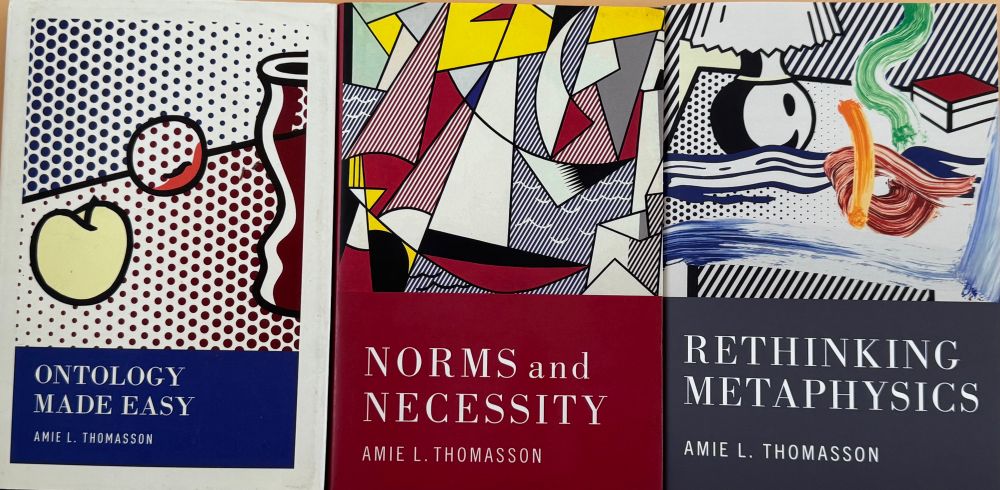
Rethinking Metaphysics has now arrived in print (discount code below). The trilogy is complete.
12.04.2025 18:48 — 👍 54 🔁 13 💬 2 📌 1
@sekowski.bsky.social
Philosopher at the University of Warsaw. Interested in metaphilosophy, methodology of philosophy, conceptual engineering, epistemology of modality, and x-phi—all through the lens of cultural impact on cognition. www.sekowski.weebly.com
Rethinking Metaphysics has now arrived in print (discount code below). The trilogy is complete.
12.04.2025 18:48 — 👍 54 🔁 13 💬 2 📌 1
Page 12

Page 13
Some arguments and evidence suggests that intuitions about some philosophical thought experiments are remarkably stable.
Wu et al replicate this for one case (Exp 1), but find arguments changed people's conclusions about 10 cases (Exp 2).
doi.org/10.1080/0951...
#xPhi #CogSci
Since undergrad I've been convinced that persistent pretending is impossible. If you act a certain way regularly, that’s just who you are. But that's unintuitive. People think behavior is more "real" in *natural*, in-person environment than online. My less-true-online self recommends this cool study
18.03.2025 10:38 — 👍 1 🔁 0 💬 0 📌 0
Finally, a co-authored paper exploring various ways in which we can think that conceptual engineering is nothing new. In particular, we argue that many past papers can justifiably be seen as part of conceptual engineering, among others on the examples of the use of thought experiments. 11/11
11.03.2025 10:17 — 👍 1 🔁 0 💬 0 📌 0
A short piece where I discuss how adopting the conceptual engineering view (here tied to a neo-pragmatic approach) for thought experiments helps avoid modal skepticism, and why we don't have to be afraid of becoming anti-realists after adopting this approach. 10/11
11.03.2025 10:17 — 👍 0 🔁 0 💬 1 📌 0
Here I argue that while interpreting thought experiments through conceptual engineering applies to most philosophical methodology, the theory of reference is an exception due to its unique view on intuitions, where they serve as data to be explained. 9/11
11.03.2025 10:17 — 👍 1 🔁 0 💬 1 📌 0First paper: Using Gettier case, I show that thought experiments are justified by arguments which in turn are justified by intuitions on concepts' general features. Moreover, if we interpret them as normative arguments, we can address concerns about the reliability raised by the negative x-phi. 8/11
11.03.2025 10:17 — 👍 1 🔁 0 💬 1 📌 0This is part of my bigger project on the role of intuitions in thought experiments and conceptual engineering. If you're interested in other works, I'd take the opportunity, and I post links below to relevant papers with short descriptions. 7/11
11.03.2025 10:17 — 👍 1 🔁 0 💬 1 📌 0Additionally, the paper provides more data for those interested in intuition-talk in the theory of reference and corpus studies. I raise issues with selecting intuition-talk indicators, analyse what philosophers usually call intuitive, and discuss further corpus studies methodological problems. 6/11
11.03.2025 10:17 — 👍 0 🔁 0 💬 1 📌 0Ad 2. The paper is a case study of how studying original texts can support "unpopular" readings of philosophical methods. It contributes to the debate on whether we should focus on original texts in philosophical methodology or just their reception, as suggested by @ethanlandes.bsky.social. 5/11
11.03.2025 10:17 — 👍 1 🔁 0 💬 1 📌 0These results might simply suggest that thought experiments are justified by arguments, not intuitions. However, building on my other work, I argue that this also opens the way to viewing TEs as a method of conceptual engineering, addressing concerns about their reliability. 4/11
11.03.2025 10:17 — 👍 0 🔁 0 💬 1 📌 0In the paper, I present data supporting this view. First, intuition-talk in the studied literature more often concerns general features of concepts than judgments about cases (or uses). Second, in about half of the studied examples, intuitive claims were justified by further arguments. 3/11
11.03.2025 10:17 — 👍 1 🔁 0 💬 1 📌 0Ad 1. Do intuitions justify philosophers' claims? In several papers (see later posts), I argue that in thought experiments, intuitions about cases aren’t crucial since they’re justified by arguments. However, these arguments stem from intuitions about general features of concepts. 2/11
11.03.2025 10:17 — 👍 0 🔁 0 💬 1 📌 0
Officially out! A corpus study on intuition-talk in the theory of reference. 1. It provides empirical evidence for the arguments & conceptual-engineering-oriented take on thought experiments that I’ve been developing. 2. It argues for studying original texts in metaphilosophy. 1/11
11.03.2025 10:17 — 👍 10 🔁 3 💬 1 📌 2
I like the fact that the rise of conceptual engineering is methodologically very self-aware. Despite the name, it's not just about why CE should be empirical (I’d disagree that it should be exclusively, but hey), but also about actual hints for specific methods that help make CE’s aim more doable
07.03.2025 11:32 — 👍 1 🔁 1 💬 0 📌 0If it’s an accept or RR, it feels like a good move. But sometimes, you draw the 'query → looking for 2nd reviewer → query → still looking → query → screw the 2nd, reject' loop in the review lottery. So be careful.
Hope you’ve got the better one
Does anyone know of papers in the field of conceptual engineering where thought experiments are used? Self-promotions highly welcome!
28.01.2025 13:27 — 👍 1 🔁 0 💬 0 📌 0
After more than 80 EXTRA talks, the series comes to an (happy) end this Wednesday 🥲
Everyone welcome, just send me a DM/Email.
Went off Twitter a while ago, but let’s give Bluesky a shot!
27.01.2025 10:00 — 👍 5 🔁 0 💬 1 📌 0