Opening slide of my presentation on Quantum Error Correction at Durham Uninversity. Slide features a picture of the Durham student union and Kingsgate bridge, famously designed by legendary North Eastern arcitect Ove Arup and considered to be one of the world's finest examples of brutalist architecture.

A slide from my presentation comparing surface codes to QLDPC codes. Background: surface codes are a leading approach to QEC, favoured for their local connectivity and straightforward ability to scale to arbitrary distance. However, from a coding theory perspective, they are far from optimal codes, owing to the fact that only a single logical qubit is encoded per patch. In practice, it is estimated that ~1000 qubits will be required per logical qubit in a surface code architecture, making them much less efficient than classical LDPC codes (of the type used in 5G and WiFi) where encoding ratios can be as low as 2-to-1. Quantum LDPC are modelled on classical codes, and it is has been shown (through simulation) that they code achieve encoding densities as low as 50-to-1 (some 20x improvement than surface codes). The tradeoff is that QLDPC codes are much less structured than surface codes, requiring long-range interactions between qubits. The QLDPC Tanner graph shown on the slide depicts a naive layout that I usefully refer to as the "spaghetti connectivity".

Language is redundant by design. The town of Llanfairpwllgwyngyllgogerychwyrndrobwllllantysiliogogogoch in Anglesey Wales is probably the best error corrected placename in the world!
Great day back in Durham visiting @durhamqlm.bsky.social to give a seminar on QEC and our recent work at Quantum Software Lab. Also fun to discuss the fault-tolerance of the Welsh towname Llanfairpwllgwyngyllgogerychwyrndrobwllllantysiliogogogoch w/ @ifanghughes.bsky.social @tobifranzen.bsky.social
04.02.2026 15:55 — 👍 15 🔁 4 💬 1 📌 0
I was one of the 17 other projects. I am recruiting for a PhD student in quantum technologies! If you (or anyone you know) likes semiconductors, photons and/or cavities and wants to do a PhD in Durham then let me know!
This is a fully funded 3.5 year studentship.
26.11.2025 23:26 — 👍 5 🔁 1 💬 0 📌 0
I’m recruiting my first PhD student! If you’re interested is solid-state quantum optics or know someone who is then let me know!
In this project we are setting up a new activity to look at strongly interacting Rydberg exciton polaritons.
27.10.2025 18:39 — 👍 9 🔁 3 💬 0 📌 1

PhD applications are open! We'd love to have you visit Durham Physics to find out more about the(currently!) 17 available projects we have for October 2026 start.
Our open day is November 26th, we hope to see you there!
Find project descriptions and open day sign up links below.
24.10.2025 15:38 — 👍 8 🔁 6 💬 1 📌 3

Liam stands in front of his title slide "Rydberg excitons: beyond cuprous oxide" in a seminar room

Liam stands in front of an introductory slide describing his journey from undergraduate to fellow

Liams slide describing the self-Kerr effect
Homegrown fellow @lapgallagher.bsky.social describes his fellowship plans to investigate rydberg excitons in zinc diphosphide.
22.10.2025 11:43 — 👍 7 🔁 2 💬 0 📌 0

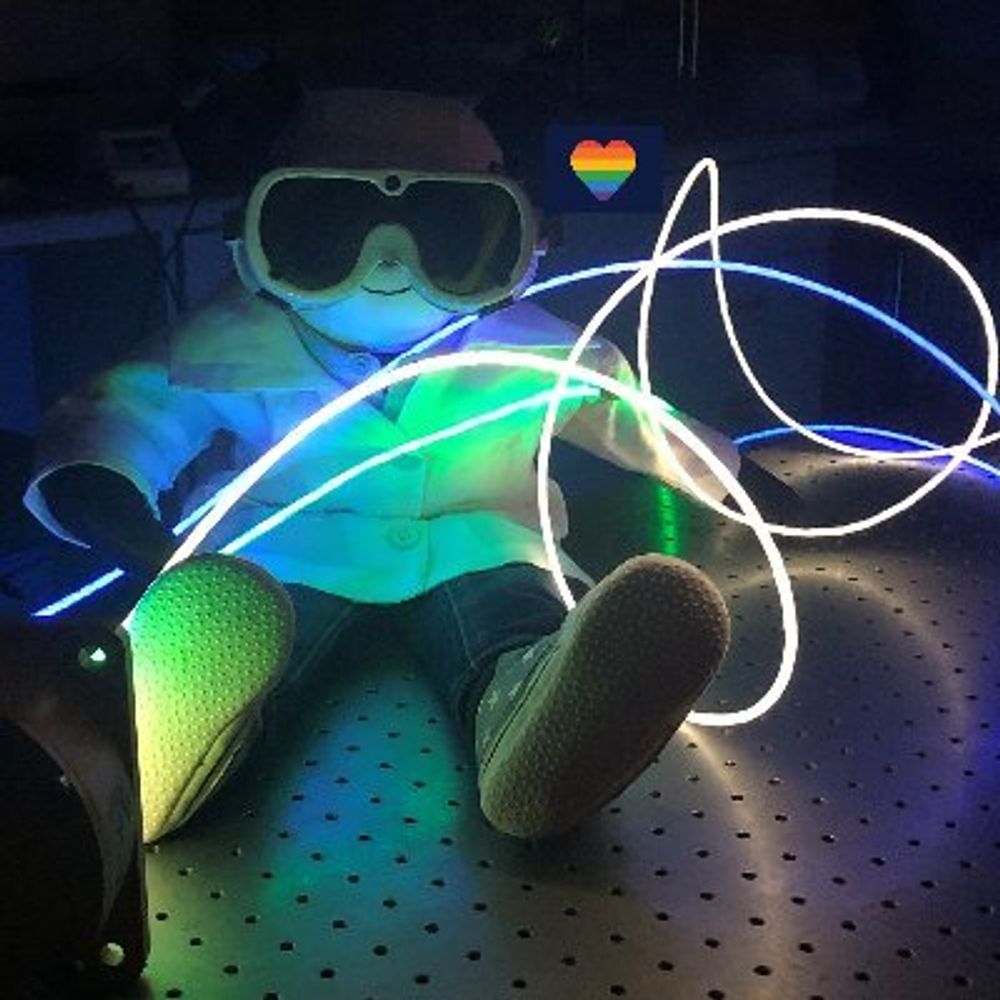
A blue and black box on a metallic table with a coiled optical fibre.
Excited to set up my first laser for my new lab!
16.10.2025 22:14 — 👍 7 🔁 0 💬 1 📌 0

A photo of the QLM group stood outside the main physics building on campus, featuring staff and PhD students.

Durham QLM logo, an interpretation of an atom interacting with light.
QLM is hiring! We're looking for a new Assistant Professor in QLM. This position is a theory position. Please find the job description below in this thread.
For any academia-related queries, please contact Ifan Hughes (i.g.hughes@durham.ac.uk). We look forward to receiving your application!
01.10.2025 11:58 — 👍 7 🔁 5 💬 1 📌 0

Two photos of scientists that have been awarded fellowships. On the left Dr Tobias Franzen is seen in a laser laboratory. On the right Dr Liam Gallagher next to a dilution refrigerator.
Two of my @durhamqlm.bsky.social colleagues have been awarded prestigious quantum fellowships.
Congratulations @lapgallagher.bsky.social and Tobias!
More details here:
www.durham.ac.uk/news-events/...
16.04.2025 14:26 — 👍 14 🔁 2 💬 0 📌 0
Two of our scientists awarded prestigious quantum fellowships - Durham University
Very excited to share I’ve been awarded an EPSRC quantum technologies fellowship! This will give me the opportunity to start my own research activity in @durhamqlm.bsky.social looking at semiconductor Rydberg physics.
Read more about it here: durham.ac.uk/news-events/...
15.04.2025 16:48 — 👍 16 🔁 1 💬 0 📌 0

Photo of a thermometer monitor reading 0.3K on one input and 0.9K on a second.
Ultracold this Christmas!
We got our new cryostat up and running this week, and managed to reach 300 mK for the first time in our lab!
18.12.2024 16:17 — 👍 11 🔁 1 💬 0 📌 0
Very cool! Why these atoms? Why pick chromium?
29.11.2024 23:19 — 👍 0 🔁 0 💬 0 📌 0

Plot showing the Rydberg states involved as the microwave field strength is increased. As the field strength grows, more and more states are coupled together. Higher energy states reach the ultrastrong driving regime (green line) at lower microwave field strengths due to microwave coupling being larger for higher energy states.
💡 Check out our new paper on microwave-optical spectroscopy of Rydberg excitons in the ultrastrong driving regime!
Due to the dipole moment associated with Rydberg states the coupling strength can be larger than the driving frequency!
iopscience.iop.org/article/10.1...
29.11.2024 00:17 — 👍 5 🔁 1 💬 0 📌 0
We have openings for theory and experimental students. Topics include: quantum sensing, ultracold polar molecules, 3D atomic arrays for quantum computing, Rydberg quantum optics and vector light.
26.11.2024 22:33 — 👍 2 🔁 0 💬 0 📌 0
Come join us at QLM in Durham! We have multiple funded PhD studentships for 2025! Please share with potential applicants.
26.11.2024 22:29 — 👍 7 🔁 3 💬 1 📌 0

Liam A. P. Gallagher
Durham University - Cited by 93 - excitons - atomic physics - Rydberg systems - optics
Hi, I’m Liam, a physicist at Durham University in the UK working on photonics and quantum optics. Could I be added to the feed?
scholar.google.com/citations?us...
17.11.2024 12:24 — 👍 2 🔁 0 💬 1 📌 0
Hi, I’m a researcher working on semiconductor quantum optics and microwave-optical conversion. Could I be added to the feed please?
17.11.2024 11:59 — 👍 1 🔁 0 💬 1 📌 0
The cooling works in a similar way to a conventional fridge (expansion of gas). The difference is we use helium, which has the lowest boiling point of any gas. To get to temperatures below 1 K we use helium-3, a rare isotope with an even lower boiling point.
17.11.2024 00:16 — 👍 0 🔁 0 💬 0 📌 0
MilliKelvin. 300 mK is 0.3 degrees above absolute zero, so pretty cold!
16.11.2024 23:26 — 👍 1 🔁 0 💬 1 📌 0
All good science relies on tin foil!
16.11.2024 22:13 — 👍 2 🔁 0 💬 0 📌 0

Picture of the internals of a cryostat showing copper supports, gold plated stages and wiring.
Got a new cryostat installed in the lab this week. As well as being shiny and looking nice it should be able to reach 300 mK!
16.11.2024 21:44 — 👍 15 🔁 1 💬 3 📌 0

An image advertising the Rochester lecture given by Anne L'Huillier at the department of physics, Durham University. 27 November 2024.
Very much looking forward to the Rochester lecture later this month.
#physics #optics 🧪💡
10.11.2024 22:24 — 👍 24 🔁 5 💬 2 📌 1
Durham is one of the best Physics Departments in the UK for research, as recognised in repeated assessments and league tables.
Student Researcher @Google Quantum AI 🇺🇸
PhD Candidate in Physics @EPFL 🇨🇭
I like simulating quantum computers 💻
ECE PhD candidate, working on quantum nanophotonics @UIUC
Scientist and Maker. Research Fellow at Tyndall National Institute and Munster Technology University. Alumni of BHU, IITD, TU Berlin, University of Exeter.
Experimental physicist working on Rydberg atom quantum technologies at Durham University. Likes animals more than was previously thought possible (she/her)
Postdoctoral Research Associate at @durham.ac.uk (Prev. @unisouthampton.bsky.social)
Quantum Physics, Condensed Matter, Photonics
http://ksawicki.com
Experimental physicist interested in quantum science and technology with ultracold atoms and molecules. See www.cornishlabs.uk
We educate future leaders in HPC | eumaster4hpc.uni.lu
Funded by EuroHPC JU, the EUMaster4HPC consortium aims to define the body of knowledge in High-Performance Computing. Learn more about the project at eumaster4hpc.uni.lu
THE NUCLEAR QUANTUM GRAVITY ☢️
https://www.researchgate.net/publication/371896737
Interest Score over 99%, 2023 in Researchgate
Find out about the latest news from the Institute for Computational Cosmology, Department of Physics, Durham University.
Lecturer (Asst Prof) in Weird Quantum Stuff at Newcastle University (they/he) | queer, autistic academic | http://jontehance.com
The official Bluesky account for all things quantum with IOP Publishing.
Join our community and stay connected with the latest research, news, and updates in quantum science and technology.
Explore our quantum hub here: https://shorturl.at/0kYxX
Physicist, very professional
The Durham Quantum Light and Matter (QLM) research section encompasses several research groups sharing a common interest in the study of the quantum properties of atoms, molecules and solids and their interactions with light. Website: https://durham-qlm.uk
Saving up to buy a home on Wistera Lane 🍎