Today we kick off Inside Data Journalism, a spring talk series where leading practitioners share insights into their work and the future of data-driven storytelling.
Join @laurabronner.bsky.social for an inspiring talk on skepticism in data storytelling.
ℹ️👉 www.hertie-school.org/en/datascien...
09.03.2026 08:08 —
👍 9
🔁 2
💬 0
📌 0
Super interesting - and mirrors what we find for hate speech, as well:
bsky.app/profile/laur...
08.03.2026 18:26 —
👍 9
🔁 0
💬 0
📌 0
Very happy to have done this work with @gloriagennaro.bsky.social, Laurenz Derksen, @maelkubli.bsky.social, Ana Kotarcic, Selina Kurer, Philip Grech, @karstendonnay.bsky.social, @fgilardi.bsky.social and Dominik Hangartner!
06.03.2026 13:21 —
👍 6
🔁 0
💬 0
📌 0
These findings suggest that content moderation may be most effective on users who only occasionally post hate, while the most hateful users – who produce almost all the hate posted online – are largely resistant, at least to the kind of pressure tested here, and may need more targeted interventions.
06.03.2026 13:21 —
👍 4
🔁 0
💬 1
📌 0

This matters for how hate speech can be countered. In a field experiment on Twitter in 2021-2, we found that replying to hateful tweets with counterspeech worked to reduce users’ future hate tweet propensity – but only for less hateful users. For more hateful users, counterspeech was ineffective.
06.03.2026 13:21 —
👍 6
🔁 0
💬 1
📌 0


Who produces hate speech? And how does that matter for content moderation?
We show that across different countries and platforms, a relatively small share of users are responsible for a very large share of hate - overall, 5% write 83-100% of hateful content.
www.cambridge.org/core/journal...
06.03.2026 13:21 —
👍 50
🔁 21
💬 1
📌 3

The Data Science Lab presents Inside Data Journalism, a spring talk series featuring leading practitioners who share practical insights into their work and the evolving field of data journalism.
More ℹ️👉 www.hertie-school.org/en/datascien...
04.03.2026 13:40 —
👍 7
🔁 3
💬 2
📌 0

🚨My first preprint is out on @socarxiv.bsky.social!
How do AI-generated content labels shape what people see as authentic on social media — and do labels have unintended side effects? osf.io/preprints/so...
A thread 🧵
12.02.2026 14:06 —
👍 17
🔁 7
💬 7
📌 0
Going forward, we're planning to add additional annotations and analyses to help us better understand trends in online commenting behavior. Let me know if there's anything you're particularly interested in!
17.02.2026 15:26 —
👍 2
🔁 0
💬 0
📌 0


(2) What else can we learn about online behavior? We find that a small minority - 5% of users - is responsible for 78% of the hateful comments submitted to these platforms. But they're active in general, with lots of innocuous posts as well.
www.public-discourse.org/en/articles/...
17.02.2026 15:26 —
👍 3
🔁 0
💬 1
📌 0

By tracking how discourse on major Swiss platforms is evolving, we can answer the question: Is it true that online discourse is getting worse?
In this data, in this period, on these platforms, on these measures: no. There are spikes in toxicity and hate, but no overall trend - up or down.
17.02.2026 15:26 —
👍 3
🔁 0
💬 1
📌 0

(1) Basic description: what's happening? How many comments are submitted to these platforms every week, and what share is toxic/hateful? @nicolaiberk.bsky.social built classifiers to measure toxicity and hate, and scores are debiased every week using LLMs to avoid drift in the models.
17.02.2026 15:26 —
👍 2
🔁 0
💬 1
📌 0

Is online discourse getting worse?
To bring actual data to bear on this question, we launched the Public Discourse Indicator, a dashboard tracking online comments submitted to several major Swiss newspapers. Our aim here is twofold:
www.public-discourse.org/en/public-di...
17.02.2026 15:26 —
👍 9
🔁 4
💬 2
📌 0


✖️Who produces most online hate speech and how effective is counterspeech?
➡️ @gloriagennaro.bsky.social et al. find that hate speech is concentrated among a few users and that counterspeech on X mostly fails to curb prolific offenders www.cambridge.org/core/journal... #FirstView
30.12.2025 08:14 —
👍 63
🔁 25
💬 3
📌 4
I assume not? Would also be interesting
02.01.2026 03:39 —
👍 0
🔁 0
💬 0
📌 0

These average solve times don't seem to account for out-selection as the puzzles get harder... Mondays/Tuesdays probably include a bunch of people who never do the rest of the week. It'd be interesting to show the average number of solvers per day, for context.
02.01.2026 03:02 —
👍 7
🔁 0
💬 1
📌 0
This is so cool, congrats!!
16.09.2025 17:17 —
👍 1
🔁 0
💬 0
📌 0

Seminars and lectures at IAS
Welcome to IAS public lectures and seminars.
Join us on Thursday, 18 Sept, at 14:30 CET for the International Roundtable on Computational Social Science with Laura Bronner @laurabronner.bsky.social 🔹Tackling harmful online comments on news platforms: three field experiments 🔹More info: liu.se/en/article/s...
15.09.2025 18:23 —
👍 4
🔁 2
💬 0
📌 0
Wow, thank you for helping to keep this alive. I get so many notes from people using this in their coursework.
21.03.2025 01:57 —
👍 47
🔁 11
💬 0
📌 1
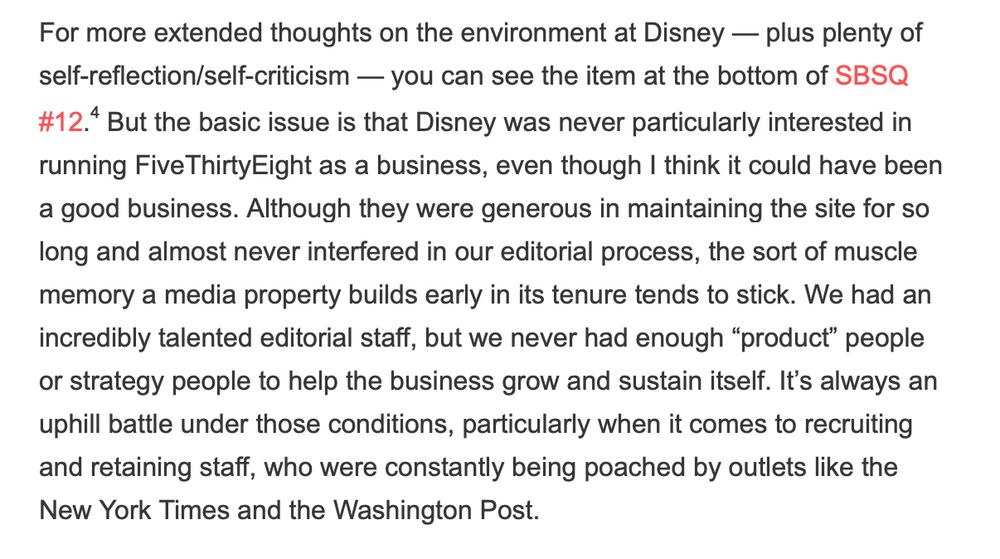
It seems that Disney never really knew what to do with 538 (Nate's take below), which feels like a real missed opportunity. I hope other outlets will take up the mantle, hire those laid off yesterday, and really invest in data and rigor in journalism - which is more important now than ever.
06.03.2025 17:19 —
👍 3
🔁 1
💬 0
📌 0
This is a huge loss. I feel awful for everyone who was laid off, but I'm also just really sad that ABC News didn't appreciate the special blend of reporting chops, data skills, talent, and kindness they managed to amass. I think the *wrong* lesson to draw is that this blend isn't profitable -
06.03.2025 17:19 —
👍 3
🔁 0
💬 1
📌 0
6) That said, 538 was also special for journalism - exemplified, perhaps, by the decision to have someone on staff whose entire purpose was to slow stuff down: work through code, question analyses, and be annoying about causal claims. They cared about getting stuff right, even if it took longer.
06.03.2025 17:19 —
👍 3
🔁 0
💬 1
📌 0
5) At its best, journalism at 538 blended qualitative (reporting, deep understanding of the substance) with quantitative (data, advanced methods). Academics often think that good research is only done in academia. I think a lot of fantastic research is done in journalism.
06.03.2025 17:19 —
👍 2
🔁 0
💬 1
📌 0
4) Understanding what kind of effort gets you 90% of the way to answering something - and whether those 90% are enough to say something meaningful - is something I should remind myself of over and over. Academia spends an inordinate amount of time on those last 10%. Often, it's not worth it.
06.03.2025 17:19 —
👍 5
🔁 2
💬 1
📌 0
3) Good data is everything, and understanding data sources and their downsides is crucial for anyone who works with data. So much work went into collecting and auditing the data 538 used - it's a resource for people across (and beyond!) journalism.
bsky.app/profile/base...
06.03.2025 17:19 —
👍 3
🔁 0
💬 1
📌 0
2) At the same time, data-centric doesn't necessarily mean complex. Many of the most interesting analyses (e.g. differences in means) are simple; the difficulty is in understanding the data and the substance well enough to ensure those analyses and comparisons are meaningful.
06.03.2025 17:19 —
👍 1
🔁 0
💬 1
📌 0
1) Quantitative description and comparison is key to understanding what's going on. Some of 538's most important work was descriptive (e.g. poll trackers, geographic mapping), and much of their contribution to political journalism was in normalizing a much more data-centric type of reporting.
06.03.2025 17:19 —
👍 3
🔁 0
💬 1
📌 0
The end of 538 is a huge shame - both for the incredible people who worked there, and for political and data journalism as a whole.
I was lucky enough to work beside them for a few years and want to say a bit about what I think was so valuable that I hope doesn't vanish from the media landscape: 🧵
06.03.2025 17:19 —
👍 14
🔁 3
💬 1
📌 0