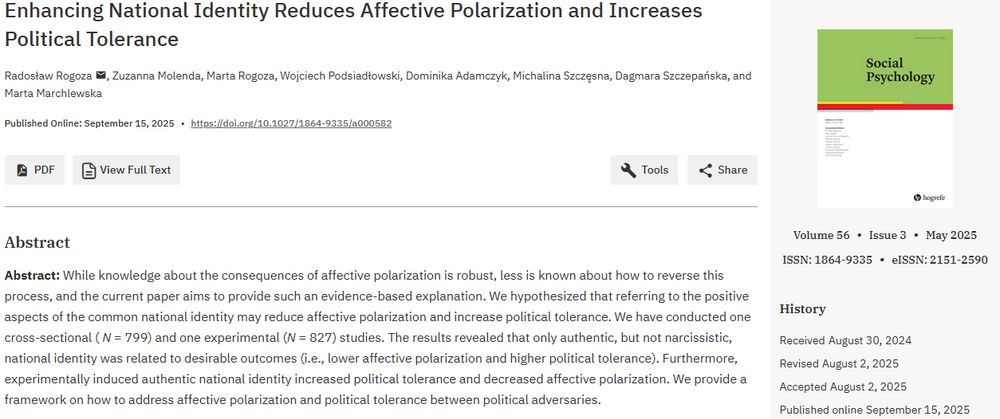
Enhancing National Identity Reduces Affective Polarization and Increases Political Tolerance
Radosław Rogoza, Zuzanna Molenda, Marta Rogoza, Wojciech Podsiadłowski, Dominika Adamczyk, Michalina Szczęsna, Dagmara Szczepańska, and Marta Marchlewska
Abstract: While knowledge about the consequences of affective polarization is robust, less is known about how to reverse this process, and the current paper aims to provide such an evidence-based explanation. We hypothesized that referring to the positive aspects of the common national identity may reduce affective polarization and increase political tolerance. We have conducted one cross-sectional (N = 799) and one experimental (N = 827) studies. The results revealed that only authentic, but not narcissistic, national identity was related to desirable outcomes (i.e., lower affective polarization and higher political tolerance). Furthermore, experimentally induced authentic national identity increased political tolerance and decreased affective polarization. We provide a framework on how to address affective polarization and political tolerance between political adversaries.
New:
Rogoza et al. find, in 1 correlational & 1 experimental study, that enhancing authentic (vs. narcissistic) national identity can reduce affective polarization & increase political tolerance.
doi.org/10.1027/1864...
#SocialPsych #AcademicSky #SocialPsychology #ResearchPublishing #Psychology
24.09.2025 17:57 — 👍 7 🔁 0 💬 0 📌 0
@lucaskohler.bsky.social
16.09.2025 07:12 — 👍 0 🔁 0 💬 0 📌 0

Is Political System Justification (Counter-) Normative?
A Comparison Between France and Germany
Marie Mancassola
, Melanie Steffens
, and Eva Louvet
Abstract: The present research examined the normativity of political system justification comparing France and Germany, two Western countries that substantially differ in their level of system justification. We conducted two studies, in France (N = 177) and Germany (N = 202), respectively, using the self-presentation paradigm. Participants were asked to answer a political system justification scale to present a good versus bad image of themselves either to a potential employer (context social utility) or a potential friend (context social desirability). Results indicated that political system justification appeared to be counter-normative in France regarding social desirability, but normative in Germany regarding social utility. We relate these results to frequent protest against the political system in France.

New:
Mancassola et al. find that system justification is counter-normative in France, but normative in Germany, using a self-presentation paradigm. This highlights the importance of political protest in France.
doi.org/10.1027/1864...
#SocialPsych #AcademicSky #SocialPsychology #Psychology
10.09.2025 14:30 — 👍 7 🔁 1 💬 0 📌 0
![Biased Social Comparison in the Moment of Crisis
The Better-Than-Average Effect and COVID-19
Wojciech Kulesza
, Dariusz Dolinski
, Paweł Muniak
, Daisy Winner
, Kamil Izydorczak
, Ali Derakhshan
, and Aidana Rizulla
Abstract. The better-than-average effect (BTAE) is a mechanism where people perceive oneself as better than others. The BTAE could be one of the phenomena explaining why people follow – in the moment of a global health crisis – guidelines (“I am superior to others, and I [will]) take extra precautions, e.g., a vaccine shot”). In this paper, we investigate the BTAE with 3,066 respondents. In Study 1, in all countries, across two measurements in time, the BTAE was present: Participants rated their involvement in self-protection as greater in comparison to others. Study 2 replicated this effect, proving its robustness. Participants estimated their willingness to vaccinate as higher than others. The BTAE was a significant predictor of willingness to vaccinate.](https://cdn.bsky.app/img/feed_thumbnail/plain/did:plc:4tahzk5xwsehr5uwb6fbkr4f/bafkreibcpxzatdt2rt42jvwx3w72dcwhdanl7vyh3n4lxhjxv7ciwfzroa@jpeg)
Biased Social Comparison in the Moment of Crisis
The Better-Than-Average Effect and COVID-19
Wojciech Kulesza
, Dariusz Dolinski
, Paweł Muniak
, Daisy Winner
, Kamil Izydorczak
, Ali Derakhshan
, and Aidana Rizulla
Abstract. The better-than-average effect (BTAE) is a mechanism where people perceive oneself as better than others. The BTAE could be one of the phenomena explaining why people follow – in the moment of a global health crisis – guidelines (“I am superior to others, and I [will]) take extra precautions, e.g., a vaccine shot”). In this paper, we investigate the BTAE with 3,066 respondents. In Study 1, in all countries, across two measurements in time, the BTAE was present: Participants rated their involvement in self-protection as greater in comparison to others. Study 2 replicated this effect, proving its robustness. Participants estimated their willingness to vaccinate as higher than others. The BTAE was a significant predictor of willingness to vaccinate.

Figure 1 BTAE: comparative adherence to government recommendations in Wave 1 and Wave 2. The bold center line shows the median with notches for the 95% confidence interval. The top and bottom of the box show 1 and 3 quartiles. The whiskers represent ± 1.5*IQR. The partly transparent cluster of points represents the relative frequency of results along value ranges.
Flashback Friday:
Kulesza et al. (2023) found the Better-Than-Average effect amidst the COVID-19 pandemic. Participants thought they were more self-protective than others during the pandemic.
#SocialPsych #AcademicSky #SocialPsychology #Psychology
Open access: doi.org/10.1027/1864...
29.08.2025 13:44 — 👍 4 🔁 0 💬 0 📌 0
#SocialPsych #AcademicSky #SocialPsychology #ResearchPublishing #Psychology
27.08.2025 15:22 — 👍 0 🔁 0 💬 1 📌 0

Combining Moral Foundations and Justice Sensitivity Perspectives to Understand Political Orientation
Lucas J. E. Köhler
, Ulf Steinberg
, Maxim Egorov
, Claudia Peus
, and Mario Gollwitzer
Abstract: Political orientation is systematically related to individuals’ endorsement of different moral domains. Yet, current findings suggest that differences between conservatives and liberals can also be explained by a sensitivity to self-oriented or other-oriented moral transgressions. We argue that conceptualizing moral foundations as perspective-specific advances our understanding of differences in moral judgments across the political spectrum. We test a new instrument measuring perspective-specific moral foundations in a nationally representative German sample (N = 2,042). Our findings indicate that (a) an Integrated Foundations × Perspective Model fits the data better than models only representing moral foundations or moral perspectives and (b) a self-oriented moral sensitivity is related to right-wing political orientation, while an other-oriented moral sensitivity is related to left-wing political orientation across all moral foundations.
New:
Köhler et al. (incl. @mariogollwitzer.bsky.social) developed the "Moral Perspectives & Foundations Scale" & found that perspective-specific moral foundations do a better job at predicting political outcomes than perspectives or MFTs alone.
Open Access: doi.org/10.1027/1864...
27.08.2025 15:14 — 👍 10 🔁 4 💬 1 📌 1

Relinquishing Control Associates With Prosociality and Provides Agency and Positive Affect in Adolescents
Weicong Chen
, Heya Lei
, Wenxin Huang
, Yonghui Chen
, Jiayi Zhang
, and Liang Huang
Abstract: Across two studies with adolescent samples, we investigated whether expressing abdication could be classified as a form of prosocial behavior. Specifically, Study 1 investigated the link between expressing abdication and the initiator’s prosociality. The results demonstrated a positive correlation between the frequency of abdication and well-established indicators of prosociality, such as social mindfulness, agreeableness, empathic concern, and social value orientation. Study 2 investigated whether expressing abdication provides positive consequences – regarding agency and positive affect – for the receivers. The results revealed that participants experienced a significantly stronger sense of agency and positive affect after receiving high-frequency abdication compared to low-frequency abdication. Our findings provide support for the idea that expressing abdication can be classified as a prosocial behavior.
New!
Is abdication a prosocial behavior? Chen et al. suggest "yes." Adolescents who abdicate tend to be more prosocial, and abdication receivers tend to feel more agency & positive emotion.
doi.org/10.1027/1864...
#SocialPsych #AcademicSky #SocialPsychology #ResearchPublishing #Psychology
31.07.2025 14:53 — 👍 2 🔁 0 💬 0 📌 0

Call for Social Psychology Special Issue Proposals
Adam K. Fetterman
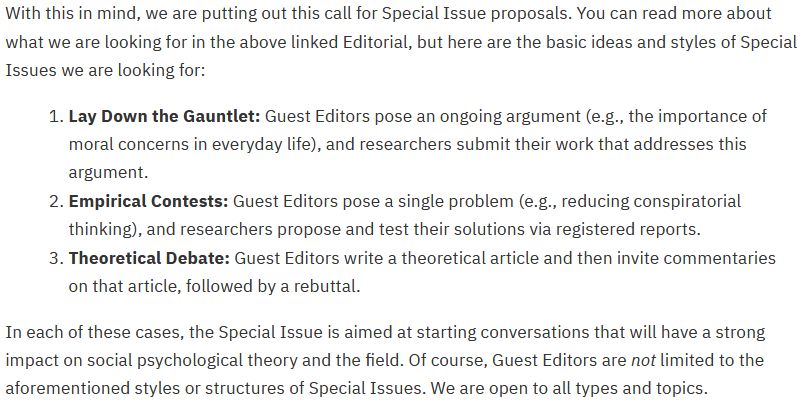
With this in mind, we are putting out this call for Special Issue proposals. You can read more about what we are looking for in the above linked Editorial, but here are the basic ideas and styles of Special Issues we are looking for:
1.
Lay Down the Gauntlet: Guest Editors pose an ongoing argument (e.g., the importance of moral concerns in everyday life), and researchers submit their work that addresses this argument.
2.
Empirical Contests: Guest Editors pose a single problem (e.g., reducing conspiratorial thinking), and researchers propose and test their solutions via registered reports.
3.
Theoretical Debate: Guest Editors write a theoretical article and then invite commentaries on that article, followed by a rebuttal.
In each of these cases, the Special Issue is aimed at starting conversations that will have a strong impact on social psychological theory and the field. Of course, Guest Editors are not limited to the aforementioned styles or structures of Special Issues. We are open to all types and topics.
A reminder:
Call for Special Issue proposals is live!
econtent.hogrefe.com/doi/10.1027/...
#SocialPsych #AcademicSky #SocialPsychology #ResearchPublishing #Psychology
18.07.2025 14:15 — 👍 4 🔁 3 💬 0 📌 0

Highlighting the Old in the “New Normal”
Appealing to Conservatives’ Focus on the Past Decreases Opposition to COVID-19 Measures
Anna Schulte, Matthew Baldwin, and Joris Lammers
Abstract: During the COVID-19 pandemic, a wide ideological gap frustrated an effective response to the health crisis. Whereas most liberals supported protective measures, many conservatives opposed them. Five studies (Ntotal = 3,090) demonstrate that American and German conservatives’ opposition to COVID-19 measures arose partially from nostalgic emotions. We show that framing COVID-19 measures as a return to the past reduces conservatives’ opposition to face masks and vaccinations. An internal meta-analysis shows that although the overall effect of temporal framing is significant, it is small. This research identifies conservatives’ focus on the past as a theoretically relevant antecedent to their opposition to COVID-19 measures and introduces temporal framing as a small but practically feasible strategy to reduce such opposition.

Figure 2 Study 3: Conservatives (high values on the x-axis) show lower endorsement of a pro-face masks statement than liberals, but this difference is attenuated if face masks are framed as a return to the past compared to a move toward the future. The dashed vertical line indicates the Johnson–Neyman significance region; differences between condition to the right of the dashed line are significant at p < .05. Data are jittered to avoid overplotting.
"Flashback" Friday:
Schulte et al. (incl. @jorislammers.bsky.social) found that while nostalgia was related to their opposition, framing COVID measures as a return to the past reduced conservatives' opposition to such measures.
Open: doi.org/10.1027/1864...
#SocialPsych #AcademicSky #Psychology
11.07.2025 13:56 — 👍 5 🔁 3 💬 0 📌 0

Authority Knows No Gender – Gender Effects in Exerting Obedience in Milgram’s Experiment
Tomasz Grzyb, Dariusz Dolinski, and Katarzyna Cantarero
Abstract: Previous studies employing Milgram’s paradigm have reported no gender differences between “learners” and “teachers” in the administration and receipt of punishment. However, the potential influence of the experimenter’s gender on obedience remains underexplored. To address this gap, we conducted two studies. Study 1 was a laboratory experiment (N = 80) using the obedience lite paradigm. The results revealed no significant effect of the experimenter’s gender on compliance rates: 88% of participants complied with a female experimenter, compared to 90% with a male experimenter. Study 2 was an online experiment (N = 793) in which participants were asked to imagine receiving instructions from either a male or female professor to administer electric shocks. As in the laboratory study, the imagined gender of the authority figure had no significant impact on participants' reported willingness to obey. Across both studies, obedience levels were statistically equivalent regardless of the experimenter’s gender. These findings suggest that gender does not meaningfully influence obedience – whether in actual or hypothetical contexts – thus enriching our understanding of the gender dynamics underlying responses to authority.
New!
Grzyb et al. (2025) used different versions of the Milgram experiment & found that the gender of the experimenter had no impact on obedience.
Open access: doi.org/10.1027/1864...
#SocialPsych #AcademicSky #SocialPsychology #ResearchPublishing #Psychology
02.07.2025 14:54 — 👍 7 🔁 2 💬 0 📌 0

How to Translate a Verbal Theory Into a Formal Model
Paul E. Smaldino
Abstract: Turning verbal theories into formal models is an essential business of a mature science. Here I elaborate on taxonomies of models,
provide ten lessons for translating a verbal theory into a formal model, and discuss the specific challenges involved in collaborations between
modelers and non-modelers. It’s a start.
Flashback Friday:
@psmaldino.bsky.social provides a tutorial for "How to Translate a Verbal Theory Into a Formal Model." Check out the 10 lessons here:
doi.org/10.1027/1864...
#SocialPsych #AcademicSky #SocialPsychology #ResearchPublishing #Psychology
27.06.2025 15:01 — 👍 21 🔁 1 💬 0 📌 1

Pluralistic Ignorance for Automatic and Controlled Expressions of Prejudice: People Believe That Others Can Correct Their Automatic Biases, But Still Overestimate Others' Prejudice
Abstract: Previous research shows clear evidence of pluralistic ignorance regarding prejudice: People believe that others are more prejudiced than they are. However, it is not clear whether these inferences pertain to automatic or controlled prejudice. In this study, participants completed automatic and controlled attitudinal measures regarding several groups, and they estimated how other people would respond to those measures. Participants underestimated how positive other people’s attitudes are, particularly for automatic responses. Still, participants believed that other people can correct and revise these automatic responses and produce more positive controlled responses. However, the presumed controlled responses of others are more negative than participants’ own automatic responses.
Open Access:
André Mata finds that people overestimate other people's automatic prejudices, but believe that others can control & improve these attitudes. Yet, they still believe that people's controlled attitudes are more negative than their own.
doi.org/10.1027/1864...
#SocialPsych
20.06.2025 15:12 — 👍 5 🔁 0 💬 0 📌 0

If Not Democracy, Then What? On the Relationships Between National Identification Versus National Narcissism and Support for Different Visions of the Political World
Dominika Adamczyk
, Michalina Szczęsna
, Zuzanna Molenda
, Dagmara Szczepańska
, Marta Rogoza
, Radosław Rogoza
, Dominika Maison
, and Marta Marchlewska
Abstract: The current paper examines the relationships between different types of national identity and democracy, anarchism, and pacifism. In two studies (UK, N = 402; Poland, N = 799), national narcissism was negatively related to pacifism and, in Study 2, to democracy, while positively linked to anarchism. National identification, however, was related to lower support for anarchism but higher support for democracy and pacifism (only in Study 2). Additionally, national narcissism was negatively linked to voting intentions, whereas national identification was positively associated with them, mediated by support for democracy. Our research showed that national identity is linked to support for different political visions of the world, which have distinct effects on the functioning of society.
New:
Adamczyk & colleagues compared national identification to national narcissism & found that the former is related to support for democracy & voting intentions, while the latter was associated with anarchism & lower voting intentions.
doi.org/10.1027/1864...
12.06.2025 14:00 — 👍 9 🔁 4 💬 0 📌 0
Social Psychology is calling for Special Issue proposals. We will be reviewing proposals on a rolling basis & foresee multiple Special Issues over the next year or more. For more information about what we are looking for, please see the call here:
osf.io/2f3vp
#socialpsych
06.06.2025 16:28 — 👍 6 🔁 7 💬 0 📌 0
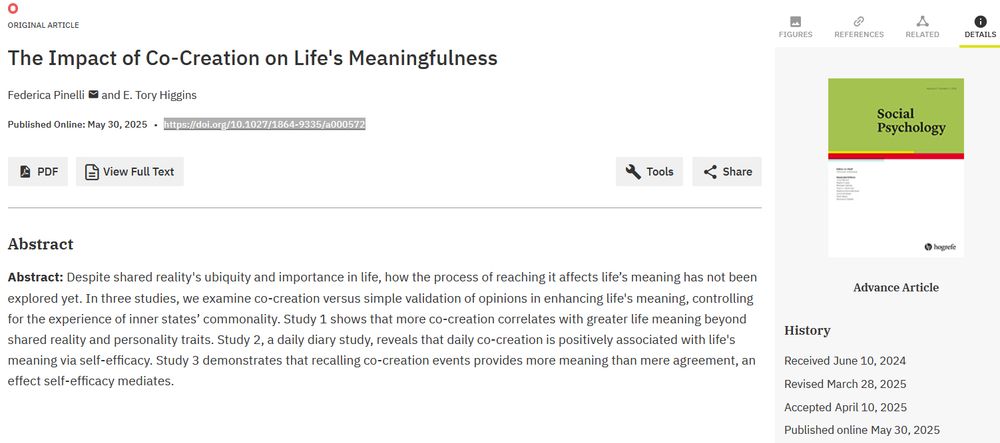
The Impact of Co-Creation on Life's Meaningfulness
Federica Pinelli and E. Tory Higgins
Abstract: Despite shared reality's ubiquity and importance in life, how the process of reaching it affects life’s meaning has not been explored yet. In three studies, we examine co-creation versus simple validation of opinions in enhancing life's meaning, controlling for the experience of inner states’ commonality. Study 1 shows that more co-creation correlates with greater life meaning beyond shared reality and personality traits. Study 2, a daily diary study, reveals that daily co-creation is positively associated with life's meaning via self-efficacy. Study 3 demonstrates that recalling co-creation events provides more meaning than mere agreement, an effect self-efficacy mediates.
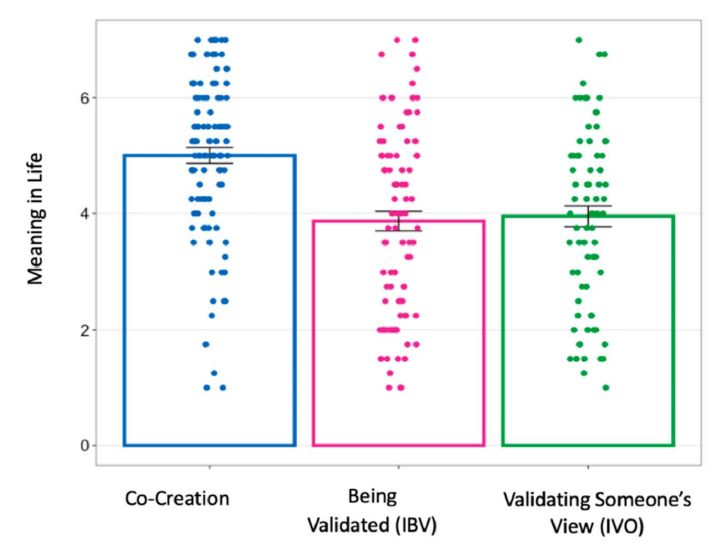
Figure 2. Perceived Meaning in Life across conditions.
This figure displays the average perceived
meaning in life across various conditions each
representing a condition’s mean. Error bars indicate
confidence intervals.
Hot of the Press:
Pinelli & Higgins investigate the impact of co-creation on meaning in life. Those who co-create reality have higher meaning in life than those who are simply validated.
doi.org/10.1027/1864...
06.06.2025 13:46 — 👍 3 🔁 0 💬 0 📌 0

The Switch to Daylight Saving Time and the Perceived Inappropriateness of Norm Violations
Emma Halfmann, Joachim Hüffmeier, Nadira S. Faber, and Jan A. Häusse
Abstract: Social norms serve as efficient guidelines that specify which behavior is adequate in a given social context. Building on Conservation of Resources Theory, we argue that this is specifically the case under disruptive states and hypothesized that switching to daylight saving time result in harsher evaluations of norm violations. In a quasiexperimental study (N = 724), individuals rated norm violations on the Monday following the switch to daylight saving time more inappropriate than on a regular Monday. Because this finding was not robust, we conducted a direct replication with more rigorous exclusion criteria, a larger sample size (N = 986), and additional exploratory sleep-related indices. No effect of switching to daylight saving time on perceived inappropriateness was found.
New:
Halfmann & colleagues (inc. @nadirafaber.bsky.social) investigated the impact of Daylight Savings on norm violation judgments. In one study, judgments were harsher on the Monday after DST, but there was no difference in Study 2.
Open Access: doi.org/10.1027/1864...
04.06.2025 14:37 — 👍 2 🔁 1 💬 0 📌 0

Volume 56, Issue 1 of Social Psychology is now available.
econtent.hogrefe.com/toc/zsp/curr...
02.06.2025 13:44 — 👍 2 🔁 0 💬 0 📌 0
Niceness Fosters Cooperativeness Through
Social Connectedness
Olga Bialobrzeska, Ilan Roziner, and Aleksandra Cislak
Abstract: Cooperation is critical for successfully functioning close relationships, workplaces, local communities, and civil
society. In this research, we examined whether people’s cooperativeness is fostered by their acting nicely in everyday social
interactions. In cross-sectional correlational Study 1 involving an online sample (N = 463), we found that the propensity for
niceness was positively correlated with cooperativeness, and this relationship was partially explained by social connectedness.
Next, in a field multilevel experiment involving students working in teams (N = 164), we confirmed the causal positive effect of
acting nicely toward teammates on teamwork satisfaction and attitudes toward cooperation through a sense of connect-
edness. Our findings could be used across various domains of life to enhance cooperation by promoting and training niceness.

Figure 2. Simplified structural equation
model of Niceness Manipulation effect
upon Teamwork Satisfaction and Atti-
tudes toward Cooperation Mediated by
Social Connectedness (standardized path
coefficients). χ2(104) = 1,511.66, p < .001;
TLI = 0.986; CFI = 0.989; RMSEA = 0.034
(90%CI = 0.000; 0.058); and SRMR = .042.
All paths are significant at p < .01. Omitted
from the Figure are correlations between
the dependent variables (all ps < .05) and
the path from the subjective feeling of
knowing the hypothesis to teamwork
satisfaction, β = �.10, p = .034.
Hot of the Press:
Bialobrzeska & colleagues find, in 2 studies, that niceness leads to cooperation through feelings of social connectedness. "Our findings could be used across various domains of life to enhance cooperation by promoting and training niceness."
doi.org/10.1027/1864...
24.04.2025 17:06 — 👍 4 🔁 0 💬 0 📌 0

Evidence of a Processing
Advantage for Deservingness-
Relevant Information
Carolyn L. Hafer, Caroline E. Drolet, Emily E. Davis, Sidney J. Segalowitz,
and Elizabeth P. Shulman
Abstract: We investigated processing speed for deservingness-relevant versus deservingness-irrelevant information. Female students read
stories involving deserved, undeserved, or neutral outcomes. We recorded participants’ reaction time (RT) in processing the outcomes. We also
measured individual differences in “belief in a just world” as a proxy for deservingness schematicity. RTs for deserved and undeserved
outcomes were faster than for neutral outcomes, B = �8.45, p = .011, an effect that increased the stronger the belief in a just world (e.g.,
B = �3.18, p = .006). These findings provide novel evidence that the construct of deservingness is central in human social relations, and
suggest both universal and particularistic schemas for deservingness.
Flashback Friday:
Carolyn Hafer et al. (2020) found that deservingness-relevant info was processed more quickly than neutral info & particularly for those scoring high on belief in a just world. They conclude that deservingness is a central construct in our social lives.
doi.org/10.1027/1864...
14.03.2025 14:13 — 👍 5 🔁 1 💬 0 📌 0
Social Psychology now, officially, accepts Registered Reports. For more info on submitting reports and new submission requirements for all articles, please see the updated "Instructions to Authors."
tinyurl.com/bdh82ner
13.03.2025 20:00 — 👍 8 🔁 0 💬 0 📌 0

Women's Snap Judgments for Incompatible Facial and Vocal Cues
Mehmet Harma and Elif Deniz Kuru
Abstract: There has been a paucity of studies exploring the combined impact of facial and vocal cues on attractiveness and trustworthiness evaluations. We examined the concurrent evaluation of attractiveness and trustworthiness when facial and vocal cues were incompatible, such as attractive faces with unattractive voices. We collected data from women participants aged between 20 and 33 years (N = 127, M = 22.19, SD = 2.34). Results revealed that participants evaluated attractive faces with unattractive voices as more attractive, compared to unattractive faces with attractive voice combinations. Moreover, trustworthiness evaluations showed different patterns; participants rated untrustworthy faces with trustworthy voices higher on trustworthiness than trustworthy faces with untrustworthy voice combinations. These findings support the notion that different cues (facial and vocal) play divergent roles in snap judgments.
Hot of the Press:
Harma & Kuru investigate snap judgements of mismatched facial & vocal cues. Unattractive voices + attractive faces are more attractive than vice versa. Untrustworthy faces + trustworthy voices are more trustworthy.
doi.org/10.1027/1864...
18.02.2025 14:43 — 👍 3 🔁 0 💬 1 📌 0
Of course, this speed & quality also depends on you - the reviewers & authors. Therefore, we ask for your help in regaining the journal's reputation by:
1. Submit your awesome work!
2. Accept our review requests.
3. Propose Special Issues.
Let's do this!
31.01.2025 14:23 — 👍 2 🔁 0 💬 0 📌 0
In recent years, the journal has seen some struggles, which led to long editing/review times & other issues. As a result, we are seeing fewer quality submissions. However, the journal is back on track & the editorial team is focused on rapid turnarounds & improving communication with its authors.
31.01.2025 14:23 — 👍 3 🔁 0 💬 1 📌 0
While the standard submissions are still welcome, he specifically lays out the types of submissions & special issues that will be prioritized at the journal, as well as his policies surrounding transparency.
31.01.2025 14:23 — 👍 2 🔁 1 💬 1 📌 0
Out today! Our Editor (@akfetterman.bsky.social) lays out his vision for the journal. Specifically, he calls for daring research that refocuses on the human experience, tackles real-world issues, & causes (good) trouble in the field.
Free Access: econtent.hogrefe.com/doi/10.1027/...
31.01.2025 14:23 — 👍 25 🔁 8 💬 3 📌 2
Exploring Negative Beliefs About Power: The Role of Autonomy and Influence
Abstract. “The powerful are immoral”! Across four preregistered studies (total N = 2,744), we explored the role of perceived autonomy (control over own resources) and perceived influence (control over others’ resources) for this belief. In Study 1, perceived autonomy and influence mediated the effect of power on expected immorality. Likewise, directly manipulating perceived autonomy and influence led to increased expected immorality, increased perceived intentionality of a transgression, and consequently to harsher punishment recommendations (Studies 3 and 4). Interestingly, Study 2 revealed an interaction between autonomy and influence, which we however could not replicate in Study 4. Overall, our findings suggest that both autonomy and influence are associated with immorality and thus likely drive the belief that the powerful are immoral.
Flashback Friday:
What drives beliefs that the powerful are immoral? @wingentobias.bsky.social & Dohle (2021) found that perceived autonomy & influence mediated the effect of power on expected immorality.
Open Access: doi.org/10.1027/1864...
24.01.2025 14:48 — 👍 2 🔁 0 💬 0 📌 1

Friday Flashback:
In 2023, Schneider, Burgmer, @tmerle.bsky.social, & Ferguson published their Special Issue on "Understanding Others in Moments of Crisis".
Their Editorial: doi.org/10.1027/1864...
Open Access Articles:
econtent.hogrefe.com/toc/zsp/54/1-2
#SocPsyc
17.01.2025 15:07 — 👍 7 🔁 2 💬 0 📌 0

Great and Lonely? Assessing the Bidirectional Relations Between National Narcissism and Loneliness
Marta Rogoza, Marta Marchlewska, Radosław Rogoza, Zuzanna Molenda, Dagmara Szczepańska, Dominika Adamczyk, Michalina Szczęsna, and Dominika Witke
Abstract: Past research suggests that national narcissism goes hand in hand with negative intergroup and intragroup outcomes. We contend that national narcissism can be also linked to maladaptive intra-individual concomitants. Across two studies, we examined the relationship between national narcissism and loneliness, using representative samples from Poland. Study 1 (N = 633) demonstrated a positive correlation between national narcissism and loneliness. Study 2 (N = 811) employed a two-wave design to test bidirectional effect of national narcissism and loneliness. The results confirmed that both cross-lagged paths between national narcissism and loneliness were significant over the 6-month period, reinforcing the findings from Study 1.

Figure 2. The relationship between national narcissism, national identification and loneliness across time (Study 2,N= 811). We present only thestandardized coefficients. All of the factor loadings were significant atp< .001. ***p< .001. **p<.01.*p<.05.
Hot off the Press:
Rogoza et al. find that national narcissism is positively linked to loneliness in cross-sectionally & longitudinally. "...individuals high on national narcissism...despite a declared attachment to their nation, actually feel lonely.
#SocialPsyc
doi.org/10.1027/1864...
08.01.2025 15:44 — 👍 5 🔁 2 💬 0 📌 1

Feeling Bad and Doing GoodForgivability Through the Lens of Uninvolved Third Parties
Shoko Watanabe and Sean M. Laurent
Abstract: Previous forgiveness research has mostly focused on victims’ forgiveness of transgressors, and offenders’ post-transgression efforts intended to promote victim forgiveness have been collectively branded as apology. However, decisions concerning forgiveness frequently occur outside of dyadic contexts, and the unique roles of repentance and atonement in determining forgivability of offenders, despite their preeminence in theology and law, have received little empirical attention. Across five experiments (N = 938), we show that repentance and atonement independently influence third-party perception of forgivability for a variety of harms, even in disinterested contexts. Our findings provide a systematic examination of decisions about forgivability disentangled from direct personal involvement, demonstrating that components of apology known to facilitate forgiveness in victims also increase perceived forgivability from unharmed observers.
Keywords: third-party, forgivability, repentance, atonement, moral judgment, cooperation
Flashback Friday:
Watanabe & Laurent (2020) showed that perp apologies influence, not only the victims', but also the forgiving of unharmed observers. Moreover, they show that repentance & atonement are independent predictors of forgiving.
Open Access:
doi.org/10.1027/1864...
03.01.2025 16:52 — 👍 2 🔁 0 💬 0 📌 0

Bullshitting and Bullibility – Conditions and Consequences
John V. Petrocelli, Yanying Li, Enhui Wang, and Joseph M. Curran
Abstract
Abstract: Bullshitting involves communicating with little to no regard for truth, established knowledge, or genuine evidence in a way that helps people impress, persuade, influence, or confuse others, or to embellish or explain things in an area in which their obligations to provide opinions exceed their actual knowledge in those domains. Put another way, bullshitting encompasses a set of rhetorical strategies employed to help a person sound like they know what they are talking about when they really do not. Although bullshit can be useful to individual bullshitters as a persuasive tool, it can have considerable negative consequences for learning, memory, attitudes, opinions, and beliefs about what is believed to be true. Deeper understanding of the conditions under which bullshitting and general bullibility (i.e., consistent failure to discern bullshit from nonbullshit despite social cues signaling something is bullshit) are likely to emerge should position observers with a more successful vantage point to detect this deceptive behavior in others.

Figure 2 Empirically supported conditions and consequences of bullshitting and bullibility.
Hot off the Press:
@johnvpetro.bsky.social & colleagues review the conditions & consequences of bullshitting & bullibility. They dive deep into the roles of personality, judgment & decision-making, persuasion, & cognitive abilities, as well as behavioral outcomes.
dx.doi.org/10.1027/1864...
20.12.2024 16:03 — 👍 2 🔁 0 💬 0 📌 0