Are you interested in cutting edge #Biochemistry and #ChemBio?
Check out our #Biochemistry2026 meeting in Würzburg from March 16th to 18th.
Deadlines for reduced early bird registration fee and abstracts have been extended to January 28th.
veranstaltungen.gdch.de/microsite/in...
26.01.2026 20:18 — 👍 4 🔁 3 💬 0 📌 1
Congrats!! 👏
03.12.2025 19:15 — 👍 1 🔁 0 💬 0 📌 0

📢 Open Call! The Max Perutz Labs invite applications for a Full Professorship in Integrative Structure Biology with a focus on in situ structural biology using cryo-electron tomography (cryo-ET) and related methods. More details ➡️ tinyurl.com/brswbymu
31.10.2025 09:24 — 👍 27 🔁 43 💬 0 📌 3
How selective is your favourite electrophile? 🤔 🧪 🧫 🎯
Check out this thorough study from the @stephanhacker2.bsky.social lab, now published in Nature Chemistry!
Many congrats to everyone. We are thrilled to have contributed a little! Many congrats to @klanglab.bsky.social alumni Kristina and Marko!
30.10.2025 14:39 — 👍 9 🔁 4 💬 2 📌 0
Thanks so much Michal! And congrats to your recent story 👏!!
22.10.2025 17:59 — 👍 1 🔁 0 💬 0 📌 0
Thanks so much for the nice comment! Much appreciated! 😊
22.10.2025 17:58 — 👍 1 🔁 0 💬 0 📌 0
Thank you Yogesh! Hope all is well in Dundee!
22.10.2025 17:57 — 👍 0 🔁 0 💬 0 📌 0
Thanks Felix !
22.10.2025 17:55 — 👍 0 🔁 0 💬 0 📌 0
😅 many thanks for the nice words!
22.10.2025 17:54 — 👍 1 🔁 0 💬 0 📌 0
Thanks Jim!
22.10.2025 17:53 — 👍 0 🔁 0 💬 0 📌 0
Thank you!
22.10.2025 17:52 — 👍 0 🔁 0 💬 0 📌 0
Thanks Yael! 😊
22.10.2025 17:52 — 👍 1 🔁 0 💬 0 📌 0
Thank you!
22.10.2025 17:51 — 👍 1 🔁 0 💬 0 📌 0
Many thanks Tim! 😊
17.10.2025 07:00 — 👍 0 🔁 0 💬 0 📌 0
Thanks Marcin!
16.10.2025 21:56 — 👍 1 🔁 0 💬 0 📌 0
Thank you Leo!
16.10.2025 21:55 — 👍 1 🔁 0 💬 0 📌 0
Thanks Julian!
16.10.2025 21:55 — 👍 0 🔁 0 💬 0 📌 0
Many thanks Stefan 😊
16.10.2025 21:55 — 👍 0 🔁 0 💬 0 📌 0
Thanks André! Congrats to your recent amazing (multi-year) story!
16.10.2025 21:54 — 👍 1 🔁 0 💬 1 📌 0
Thank you Matt!
16.10.2025 21:40 — 👍 0 🔁 0 💬 0 📌 0
Super proud of this story! ☺️ Huge thanks to @taruniype.bsky.social for the amazing work - and to @klanglab.bsky.social for the constant support! The first time we saw that phenomenon actually goes all the way back to my Master’s thesis in 2016 🫣 Every now and then, persistence pays off 🤞
16.10.2025 15:20 — 👍 12 🔁 2 💬 0 📌 0
In short:
What began as a confusing cleavage artifact became a strategy for programmable import of synthetic building blocks and efficient GCE.
It’s a whole new layer of control over ncAA encoding.
Curiosity turned a failed experiment into a new principle! Very proud of the whole team’s work 🙌 9/9
16.10.2025 14:06 — 👍 13 🔁 2 💬 1 📌 0

Next, we asked if the system can be generalized.
By varying the N-terminal residue, we created Z-XisoK tripeptides and evolved transporters for otherwise impermeable Z ncAAs, using GCE as readout for their delivery!
Z-XisoKs even enable co-delivery and co-encoding of two distinct ncAAs! 8/9
16.10.2025 14:06 — 👍 2 🔁 0 💬 1 📌 0

However, in nutrient-rich media (like 2-YT), uptake was less efficient – tryptic peptides present in such media competed for OppA binding.
So we evolved OppA to prefer our substrates.
Through FACS screening, we found OppA-iso and made the E. coli strain IsoK12, which thrives in complex media 💪 7/9
16.10.2025 14:06 — 👍 4 🔁 0 💬 1 📌 0
With this insight, we built a G-XisoK toolbox.
These tripeptides act as trojan horses 🐴, importing high levels of XisoK into cells.
This enables efficient encoding of bioorthogonal, photocrosslinking, and PTM-mimicking ncAAs – all at wild-type expression levels! 6/9
16.10.2025 14:06 — 👍 2 🔁 0 💬 1 📌 0

This revealed how the transporter recognizes and delivers our substrates.
What started as ‘unwanted cleavage’ turned into a transport system we could hijack.
Opp imports G-XisoKs, peptidases remove G, accumulating high concentrations of XisoKs for efficient incorporation via aaRS/tRNA pairs. 5/9
16.10.2025 14:06 — 👍 4 🔁 0 💬 1 📌 0

We discovered that E. coli actively imports G-XisoK peptides via the Opp ABC transporter that shuttles small peptides into cells in an ATP-driven manner.
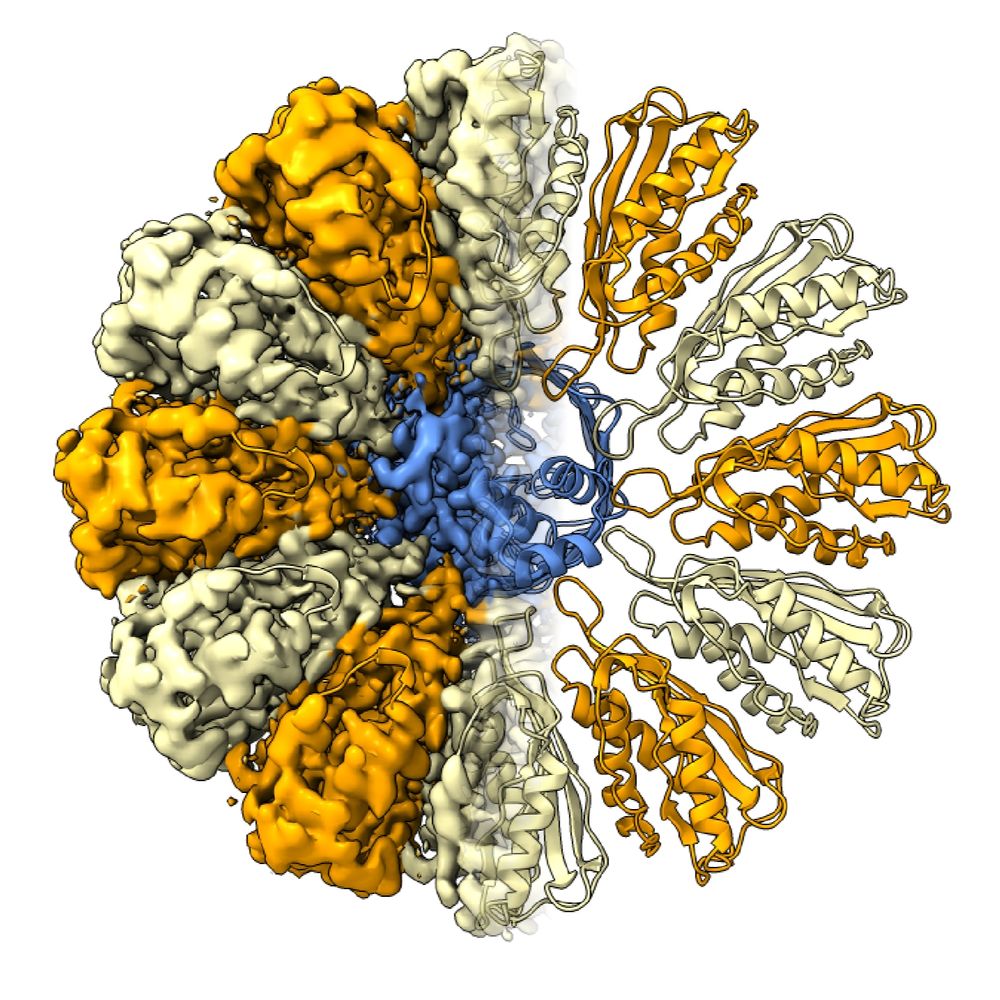
We mapped the uptake mechanism, identified the peptidases removing the N-terminal G and solved the OppA:G-SisoK structure with Michael Groll. 4/9
16.10.2025 14:06 — 👍 6 🔁 1 💬 1 📌 0
We spent months designing and synthesizing analogues that wouldn’t be cleaved and be incorporated as G-XisoKs – none worked.
Eventually curiosity won: why were XisoK derivatives incorporated so efficiently, better than any other ncAA? 🤔
That’s when things got exciting 3/9
16.10.2025 14:06 — 👍 3 🔁 0 💬 2 📌 0

Building on previous work from our lab on ubiquitin-protein conjugates, we aimed to incorporate G-XisoK ncAAs.
Unexpectedly, the glycine was consistently cleaved off, leaving XisoK efficiently incorporated into proteins via GCE.
A setback at first - we needed G-XisoK modified proteins. 2/9
16.10.2025 14:06 — 👍 3 🔁 0 💬 1 📌 0
Professor of Agricultural Economics and Policy at ETH Zürich.
Website https://sites.google.com/view/fingerrobert/home
Google Scholar https://scholar.google.ca/citations?user=V7yA_rcAAAAJ&hl=en
🧫 ↔️ 🧫 cell communication, 🧬 mol tools, 🧠 🪰computational anatomy. PhD @Karolinska ➡️ postdoc @CSHL ➡️ PI @scilifelab/@UU_University
https://www.furthlab.xyz/
Postdoc researching ubiquitin biology @fletcherlab.bsky.social @CVR in the context of viral infection. Equality, Diversity, and Inclusion (EDI) Advocate. What I say here is my personal opinion.
X: UbcH_Alice
thefletcherlab.co.uk
PhD student in systems biology in the Picotti lab at ETH Zurich.
NCCR AntiResist fellow
Senior Research Scientist @ Microsoft Research | PhD and postdoctoral studies @ ETH Zurich.
PhD student in F.U.Hartl group - MPI of Biochemistry | Molecular cell biology | Single particle tracking | Proteostasis | Chaperone mediated protein folding
The official Bluesky account of the Picotti lab at the IMSB at ETH Zürich
At the Department of Biochemistry, University of Oxford, UK. Structural biology. Ubiquitination pathways. elliottlab.web.ox.ac.uk
Biochemist fascinated by visualizing biological processes with the finest spatiotemporal detail; Understand the human immune system to guide novel approaches for combating viral infections and cancer; Postdoc at Cissé Lab / MPI-IE
Group Leader, MRC Laboratory of Molecular Biology & Joint Head of the Division of Protein & Nucleic Acid Chemistry. Senior Executive Editor, Nucleic Acids Research.
Senior Research Scientist at Stanford Bioengineering | Taking apart and building biology.🧪
Proteostasis and gene regulation research with high-throughput genetics. Incoming Group Leader at MPI-CBG.
PhD student @UZH @LOCBP
Interested in research in Chemical Biology
PhD student in the lab of Kai Johnsson
Chemical Biology Department of the Max Planck Institute for Medical Research, Heidelberg, Germany
Official account of The Australian Ubiquitin Summit.
LinkedIn - The Australian Ubiquitin Summit
Twitter - @AUSUbiquitin
https://www.lorneubiquitin.org/
PhD candidate in chemical biology, glycobiology, genetic code expansion
Nitrogenase, Biotic and Artificial Metalloenzymes, CO2 and N2 Fixation, Emmy Noether Research Group Leader at the Max Planck Institute for Terrestrial Microbiology: https://www.mpi-marburg.mpg.de/859249/Johannes-Rebelein
"Synthetic Membrane Systems" group
Biochemistry, University of Düsseldorf
Membrane proteins, Good spirit and some Anarchy