what's missing in Chicago's budget talks?
the short answer is "growing the tax base".
Steffany describes what City Council is not addressing in City That Works.

@rsday.bsky.social
what's missing in Chicago's budget talks?
the short answer is "growing the tax base".
Steffany describes what City Council is not addressing in City That Works.
The good news is that all the BlueSky criticism is just conjecture by amateurs, imagine if there was a monumental station just around the block from State/Lake that was constructed less than a decade ago for a quarter of the cost even inflation-adjusted, wouldn’t that be embarrassing for the city
05.12.2025 02:12 — 👍 33 🔁 6 💬 2 📌 1
what I'm reading today...
1. lessons [for Chicago?] from the New York City election, specifically the referenda to update the city charter to make it easier to get new housing approved
citythatworks.substack.com/p/lessons-fr...

Per @davidstruett.bsky.social @chicagocta.bsky.social is purchasing hybrid buses with federal grant money. Should NITA prioritize future capital $$$ on zero emissions vehicles or should other needs take priority—e.g., BRT, station/bus stop accessibility? chicago.suntimes.com/transportati...
22.11.2025 13:41 — 👍 4 🔁 1 💬 1 📌 0
Over at A City That Works, I took a look at what Chicago (and other cities) can learn from New York's effort to speed housing development and weaken aldermanic prerogative. citythatworks.substack.com/p/lessons-fr...
20.11.2025 16:42 — 👍 6 🔁 1 💬 0 📌 0"CTA keeps using federal funding to pay debt service, which negatively impacts the agency's ability to execute new projects. By the way, we're going to add another $1.5 billion in debt over the next five years, but don't worry, we'll pay it back with federal funding."
19.11.2025 22:02 — 👍 29 🔁 4 💬 1 📌 0Also how many in this town have evaluated every Super Bowl result since ‘85
02.11.2025 04:02 — 👍 1 🔁 0 💬 0 📌 0To the charge that it doesn't fit in: I don't think it's supposed to. Sometimes we should add new idiosyncratic, monumental buildings/spaces
01.11.2025 19:59 — 👍 34 🔁 3 💬 5 📌 1Oh this would be fun
24.10.2025 00:11 — 👍 0 🔁 0 💬 0 📌 0
Over at A City That Works, Conor's got a great new piece looking at the Mayor's new budget proposal: citythatworks.substack.com/p/budget-sea...
22.10.2025 23:24 — 👍 3 🔁 0 💬 0 📌 0The good news is that a new workforce allocation study *could* shift the Department's approach to provide more coverage, and consistent community-oriented policing in the neighborhoods that need it most. Much more at the link: t.co/QkWiwYkOqC
20.10.2025 19:40 — 👍 0 🔁 0 💬 0 📌 0
This is only the tip of the iceberg - less tenured officers work the most violent parts of the city. CPD also understaffs districts during the most violent hours of the night, and doesn't give officers consistent supervision or support. That also makes accountability and oversight harder. (3/4)
20.10.2025 19:40 — 👍 0 🔁 0 💬 1 📌 0In fact, the safest North Side police district (the 20th District, which covers Uptown and Lincoln Square), has *17 times* more officers per homicide than the South Side's 3rd District, which covers Grand Crossing. (2/4)
20.10.2025 19:40 — 👍 0 🔁 0 💬 1 📌 0
Over at A City That Works: Police are far more effective when deployed to the hotspots where violence is most likely to occur. But Chicago's deployments are heavily skewed towards the least-violent parts of the city. (1/4) citythatworks.substack.com/p/put-police...
20.10.2025 19:40 — 👍 3 🔁 1 💬 1 📌 0And a full blown @chicagocta.bsky.social meltdown getting out, sadly.
18.10.2025 19:52 — 👍 5 🔁 0 💬 0 📌 0 18.10.2025 18:43 — 👍 5 🔁 0 💬 0 📌 1

Chicagoland’s transit agencies can’t afford to go it alone. Real reform means Metra, Pace, and CTA working together, with unified planning, fares, and goals, to build a system that truly serves the whole region. 🚇 🚂 🚍
citythatworks.substack.com/p/the-suburb...

Wrote about the Trump administration’s power grab unfolding in Chicago, and the most effective tools we have to respond.
10.10.2025 16:26 — 👍 1 🔁 0 💬 0 📌 0
Humpty Dumpty keeps falling off the wall, and while we’ve gotten very efficient at putting him back together each time, it’s time to start thinking about the wall as the real problem.
New from me on A City That Works: The Suburban Case for Transit Reform

In Minneapolis’s downtown, development must be 10 stories tall with a 4.0 FAR, while different transit-adjacent areas have minimum heights ranging from 2 to 10 stories. This policy has come into play a couple of times in the past few years. For example, in 2023, a developer wanted to build a seven-story, 135-unit building next to Minneapolis’s Prospect Park Green Line stop. However, the lot was zoned for a 10-story height minimum and city staff refused to grant a variance for a seven-story building. The development was rejected, and no new construction has occurred on the lot.
IMO @zyudhishthu.bsky.social nails it on mandatory minimum densities: you CAN do them right, but the benefits are so minimal & the risks so inevitable that they're not worth the trouble pencillingout.substack.com/p/can-we-boo...
05.10.2025 00:39 — 👍 31 🔁 6 💬 0 📌 0
City That Works author Richard Day is out with a great write-up of the current accessory dwelling unit (ADU) situation. 🏘️
His conclusion is alarming: Ald. Quinn's ADU ordinance will kill ADU construction citywide, even in current ADU pilot areas. 😠
citythatworks.substack.com/p/there-is-o...
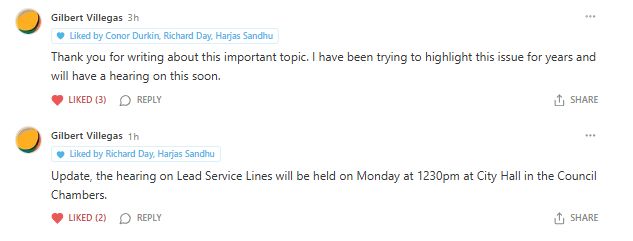
Anyway, we've got the best comment section in town.
18.09.2025 19:53 — 👍 5 🔁 0 💬 0 📌 0
Over at A City That Works: Harjas Sandhu has a great piece breaking down Chicago's lead pipe problem. And I think it may have already helped trigger a City Council hearing next week?
citythatworks.substack.com/p/solving-ch...

A good new post about NITA in A City That Works today: citythatworks.substack.com/p/the-northe...
12.09.2025 12:42 — 👍 16 🔁 2 💬 1 📌 0Come on out!
06.09.2025 19:16 — 👍 1 🔁 0 💬 0 📌 0The design is still a customer experience nightmare, but at least it’s more than twice as expensive now than it was four years ago
20.08.2025 17:44 — 👍 73 🔁 7 💬 5 📌 3It’s a really fun piece. airmail.news/issues/2025-...
17.08.2025 01:18 — 👍 1 🔁 0 💬 0 📌 0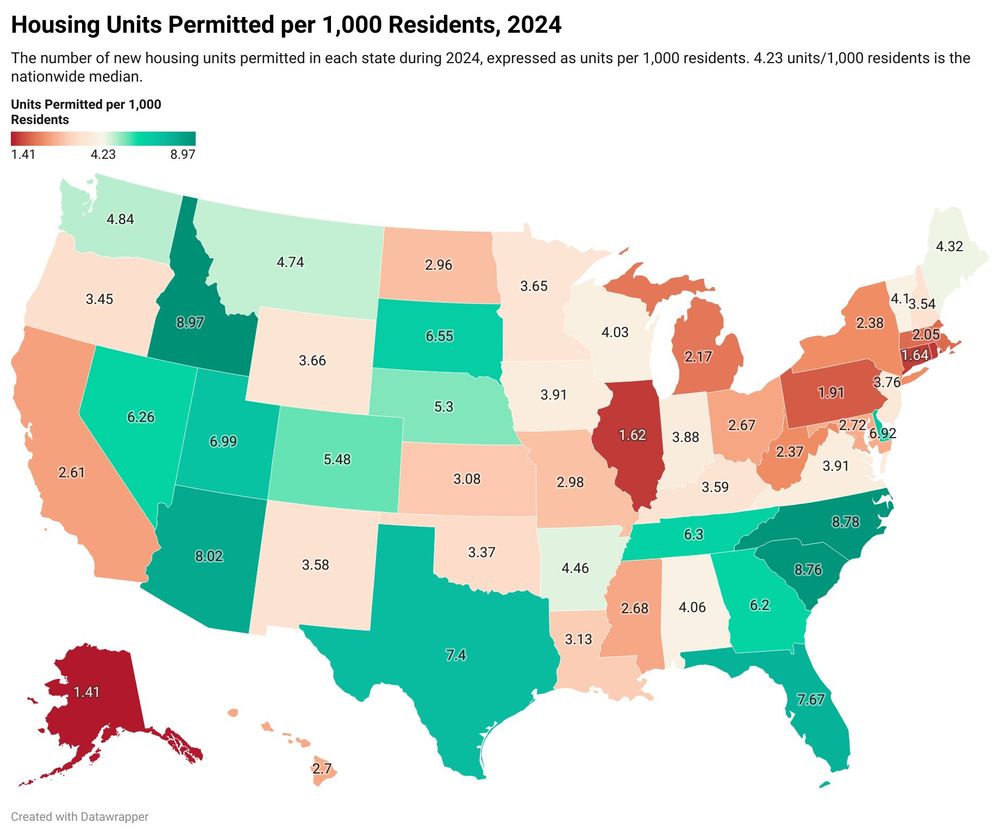
Map Description: Housing Units Permitted per 1,000 Residents by State, 2024 This choropleth map of the United States displays housing permit rates across all 50 states using a color scale from dark red (lowest) to dark green (highest). The national median is 4.23 units per 1,000 residents. Highest permit rates (dark green, 7+ units/1,000): Idaho: 8.97 (highest) South Carolina: 8.78 North Carolina: 8.76 Florida: 7.67 Texas: 7.4 Above-average rates (medium green, 5-7 units/1,000): Arizona: 8.02 Nevada: 6.99 Colorado: 6.55 Tennessee: 6.3 Georgia: 6.2 Utah: 6.26 Montana: 5.48 Nebraska: 5.3 Near median (light green/beige, 3-5 units/1,000): Most states fall in this range, including Washington (4.84), Montana (4.74), Wisconsin (4.03), and others scattered across regions. Below average (orange/light red, 2-3 units/1,000): Michigan: 2.17 Pennsylvania: 2.37 California: 2.61 New York: 2.38 And several others primarily in the Northeast and Midwest Lowest rates (dark red, under 2 units/1,000): Alaska: 1.41 (lowest) Illinois: 1.62 Massachusetts: 1.64 Pennsylvania: 1.91 The map reveals that southern and western states generally have higher housing permit rates, while northeastern and some midwestern states have lower rates relative to their populations.
In 2024, Illinois was almost dead-last for new housing permits on a per capita basis
14.08.2025 03:18 — 👍 36 🔁 8 💬 1 📌 2
It seems like every week I see Chicago reject more residents and lower property taxes by saying no to development. Would hope for more from 1st ward @aldermanlaspata.bsky.social
13.08.2025 02:42 — 👍 27 🔁 4 💬 3 📌 2