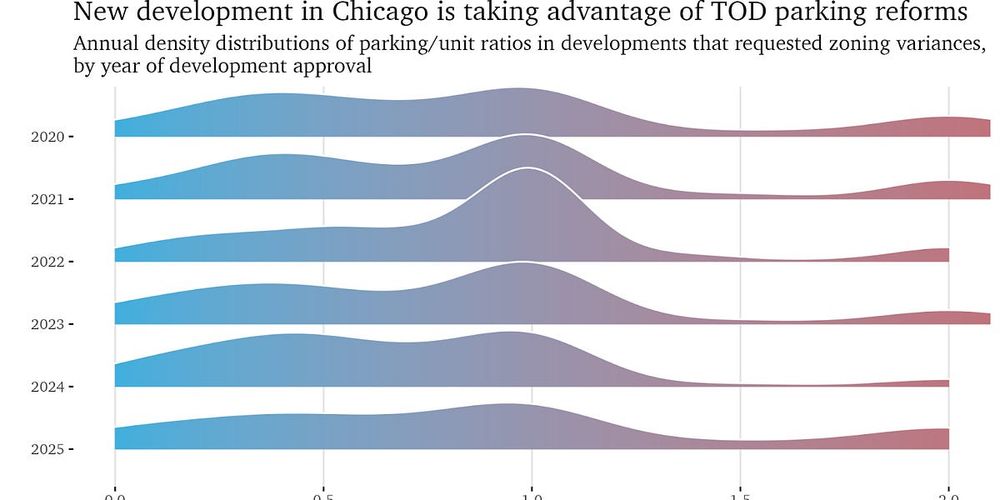
Add another one to the pile
citythatworks.substack.com/p/chicago-ha...

@zyudhishthu.bsky.social
Sidewalk enthusiast and former St. Paulite. I like to write about housing policy, especially in the Twin Cities. Nowadays I’m an economics research assistant in Chicago https://pencillingout.substack.com/
Add another one to the pile
citythatworks.substack.com/p/chicago-ha...
50 new units on a long-vacant lot, 11 parking spots, three storefronts 😀
12.12.2025 00:30 — 👍 8 🔁 0 💬 2 📌 0
Still, some caveats that the productivity data isn't perfect, since it's a tricky thing to measure
www.construction-physics.com/p/stagnant-c...

"The US has a lot to learn... to catch up to the efficient frontier, especially for certain types of construction (ie: transit) and certain places in the country (ie: expensive coastal metros). But this data suggests that driving that frontier forward is a much thornier problem."
12.12.2025 00:28 — 👍 2 🔁 0 💬 1 📌 0
A bit pessimistic from Brian Potter: we know construction productivity growth has been awful in the US the past couple decades.
However, there's not really any rich, large country that has seen strong growth in construction productivity the past 20 years (except Belgium?)
I’ve got a couple dozen
04.12.2025 02:45 — 👍 1 🔁 0 💬 0 📌 0Now we just need Chance to tell people to take off their backpacks during rush hour...
04.12.2025 02:33 — 👍 11 🔁 0 💬 0 📌 0
It was a great year everybody
04.12.2025 01:03 — 👍 2 🔁 0 💬 0 📌 0
As someone whose spent a decade-plus covering social services in NY and TX, let me say this has nothing to do with immigration — and everything to do with government outsourcing delivery of key services to non-profits it cannot properly supervise and politics: www.nytimes.com/2025/11/29/u...
29.11.2025 15:28 — 👍 221 🔁 57 💬 10 📌 7True! But then there are also places (like California) that make it extremely difficult to price that risk into insurance, too
30.11.2025 17:27 — 👍 3 🔁 0 💬 0 📌 0If the climate models are inaccurate for some properties, that’s one thing (and should require some evidence in support!)
But the real estate industry is gonna need better arguments than “when people see the underlying climate risk of a property, they are less interested in buying it”
Thanks for pointing this out!
28.11.2025 14:55 — 👍 2 🔁 0 💬 0 📌 0
A gray painted one-story stone clad house, a half-size version of a vernacular Chicago two-flat, with its windows boarded up and parts of the lawn in front dug up and surrounded by caution tape. A banner for a new railway extension hangs over the front door.

A big banner saying "Ready, Set, Soon!" hangs on a metal fence in front of a set of boarded up wood frame houses, with utilities markings painted on the sidewalk beside it.

A view of the back of two boarded up two story wood frame homes, seen through a metal fence encircling the property.

A one-story wood frame workers cottage with aluminum awnings sits surrounded by a green construction fence.
Back in spring, I made final images of some of the buildings slated for demolition along the path of the Red Line Extension.
These were captured over a monthlong span when demolition permits were getting greenlit, wrecking crews finally dispatching after asbestos remediation and utility shutoffs.
i always flip through to see if there are any recent debates about housing development (often yes)
25.11.2025 03:02 — 👍 1 🔁 1 💬 1 📌 0Oh god, I had no idea!! I’m crushed I missed my chance.
25.11.2025 02:40 — 👍 2 🔁 0 💬 0 📌 0


Went to Boston. Saw the building
24.11.2025 20:55 — 👍 49 🔁 2 💬 3 📌 0I agree with the Fed team on this and am pretty skeptical of a couple recent econ working papers that attempted to interpret these results as primarily driven by supply
21.11.2025 19:10 — 👍 1 🔁 0 💬 0 📌 0
More interesting stuff from @tonydamiano.bsky.social (ACS data I think? I feel like I've seen similar graphs of his using CoStar too), but again it would be valuable to pull these different sources together to clarify the convo
21.11.2025 18:38 — 👍 2 🔁 0 💬 2 📌 0so much great info here, it would be nice to open up the convo on these different sources. you should write an article about it!
21.11.2025 18:37 — 👍 2 🔁 0 💬 1 📌 0
Reminds me of this @danielkayhertz.bsky.social read southsideweekly.com/beyond-the-l...
21.11.2025 04:39 — 👍 4 🔁 0 💬 1 📌 0Weird request: anybody in Minneapolis want to take a field trip and look at a stairway for me? 630 Cedar Ave. S. had a big fire, and has scissor stairs. The state report about the fire implies that the stairways were open to one another (no wall separating them) – I'd like to confirm that was true.
14.11.2025 22:16 — 👍 18 🔁 5 💬 1 📌 0what does that mean?
12.11.2025 01:17 — 👍 1 🔁 0 💬 1 📌 0But I do think that downtown Chicago pushes against a hypothesis — I've it seen floated by Stone, Tyler Cowen, and
@urbancourtyard.bsky.social — that dense development can be actively unfriendly toward families, discouraging childbirth or pushing away families.
Overall growth is important, too.
I like and support Stone and Fijan's agenda of investigating how housing can better accommodate families! It's a worthwhile effort and I agree that there are probably many ways we could improve urban living for families.
11.11.2025 18:57 — 👍 2 🔁 0 💬 1 📌 0
That's all before we consider the second-order benefits of building more housing, which broadly benefits housing affordability and increases access throughout the "housing ladder" — which also helps families, as @ebwhamilton.bsky.social recently wrote.
www.governing.com/urban/to-sup...

Here's the key thing: even if a small share of housing (both previously existing and new-built) is 2, 3, or more bedrooms, being a small portion of a large increase still means significant growth!
A rising tide to lift all boats, regardless of family status

Most of this new housing has been in huge buildings with studios and 1 beds. In other words, the housing booms of the Loop, River North, and South and West Loop haven't been particularly family friendly.
But it's still supported major first-order growth in the # of families!


Look at the incredible number of housing permits in Chicago's 4 core community areas, while most neighborhoods stagnated.
The population in these areas has grown commensurately, but it's not just childless yuppies — in 2020, they had thousands more children than in 2010.
New research from Lyman Stone and @bobbyfijan.bsky.social shows how families value extra bedrooms (frequently lacking in new apartments).
But in Chicago's core, building *a ton* of housing has been enough to swamp its relatively un-familial characteristics.
ifstudies.org/report-brief...