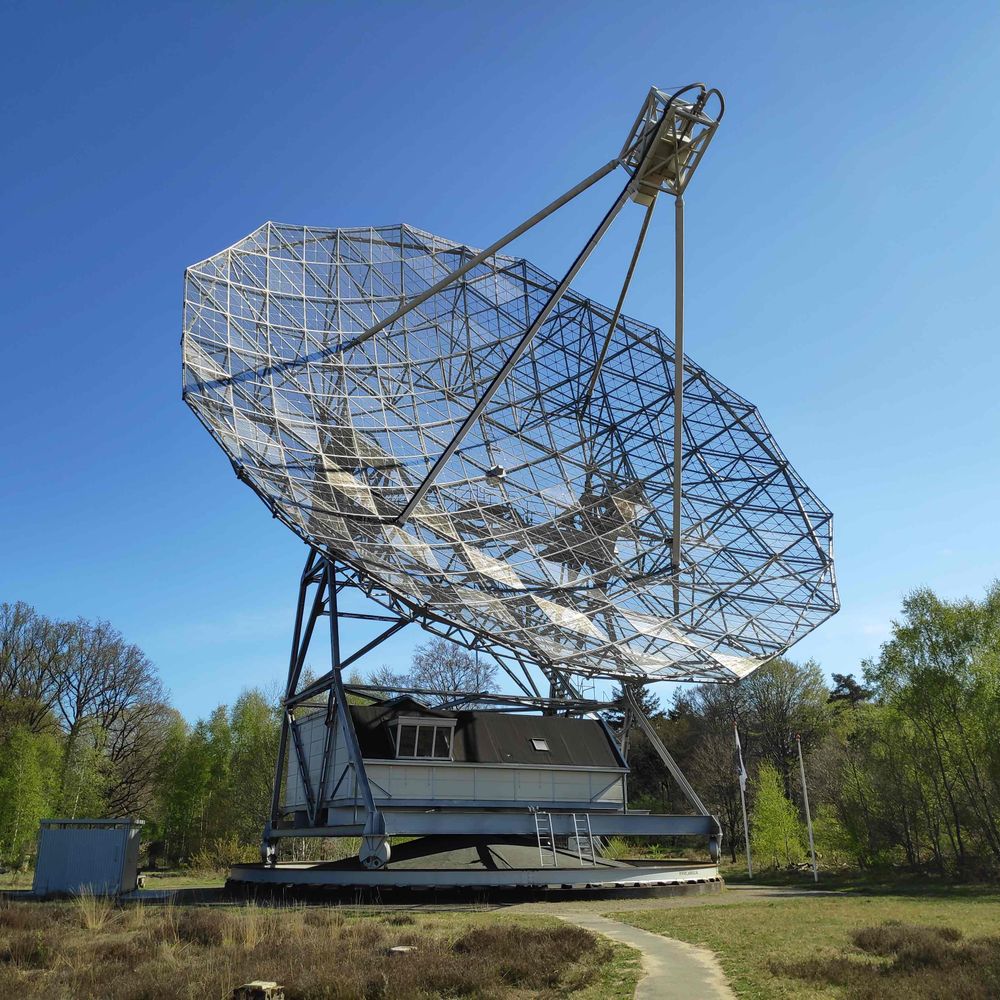
Aurora above the Dwingeloo radio telescope
Great aurora visible in Dwingeloo yesterday!
20.01.2026 10:08 — 👍 261 🔁 54 💬 2 📌 5
@cbassa.bsky.social
Astronomer at ASTRON in the Netherlands, working with the LOFAR low frequency radio telescope.
Aurora above the Dwingeloo radio telescope
Great aurora visible in Dwingeloo yesterday!
20.01.2026 10:08 — 👍 261 🔁 54 💬 2 📌 5An absolutely awesome display of Northern Lights over the Netherlands during the past hour! Red glow in the North and a green curtain passing over whose motion was very obvious with the naked eye. This is 1 hour worth of 15 second exposures with my all sky camera from 21to 22UTC. #auroraBorealis
19.01.2026 22:27 — 👍 30 🔁 7 💬 0 📌 0Yes, this is caused by the Doppler effect.
11.01.2026 17:24 — 👍 2 🔁 0 💬 0 📌 0
CarbSAR on S-band.

CONNECTA IOT on S-band.

CONNECTA IOT on 401.5MHz.
Picking up the old hobby of catching radio signals from newly launched satellites. These are 5 satellites from the Space X launch that happened less than 3 hours ago. Signals from 4 CONNECTA IOT satellites on 401.5MHz and 2240MHz, as well as CarbSAR at 2243.333MHz.
11.01.2026 16:53 — 👍 11 🔁 0 💬 1 📌 0
Graph titled "Dwingeloo Radio telescope detection of FRB 20251229A". Horizontal time (1 seconds total), vertical observing frequency 1300-1400MHz. A faint vertical line is visible around 210.1 seconds.
Last Thursday, a group of European radio telescopes (HyperFlash / ÉCLAT) detected a flash from the repeating Fast Radio Burst discovered end of December. We also detected this burst!
Our detection came in too late to be included in the telegram, but here it is!
www.astronomerstelegram.org?read=17588
Yes, here it is. Tracking the motion of the planets is a bit tricky, but the motion of the Sun and Moon is very obvious.
08.01.2026 15:47 — 👍 1 🔁 0 💬 0 📌 0You are absolutely right, there are many many ways of visualizing this dataset. I've played a bit to try to visualize the motion of the planets, but nothing good enough yet to share. Hopefully in the future.
08.01.2026 15:46 — 👍 0 🔁 0 💬 0 📌 0
A zoom of the 2025 keogram on the end of January, beginning of February, showing the motion of stars and planets.
Indeed, the keogram is the observed version of the S&T almanac. In the high resolution zoomable version at astron.nl/~dijkema/keo... you can even see the motion of the stars and planets. This part of the keogram shows Mars (left) and Jupiter (center) moving earlier in the sky.
06.01.2026 17:21 — 👍 4 🔁 0 💬 0 📌 0Thanks! I hope you were able to capture some cool shots over Christmas! Having an all sky camera is very useful in checking if it is clear enough or not, I can just look at my phone instead of having to go outside and possibly have my eyes dark adapt. If patchy clouds, it tells me where it is clear.
06.01.2026 17:15 — 👍 2 🔁 0 💬 0 📌 0It basically boils down to that while the Moon moves 13deg East every day, it doesn't rise and set about an hour later every day. When it is moving to higher declinations, the rises bunch in time of day and the moonsets spread, while the opposite occurs when the Moon is moving to lower declinations.
06.01.2026 17:11 — 👍 6 🔁 0 💬 1 📌 0Excellent question, and your answer is correct. The keogram is mapped to the 24h schedule of the Sun which shows this hourglass shape over a year. For the Moon this hourglass shape happens every 29 days or so, so this hourglass shape is stretched diagonally.
06.01.2026 17:09 — 👍 5 🔁 0 💬 1 📌 0Ah, I see what you mean now. Yes, that might indeed be possible. I don't know enough about HDR how to make that work though. On the other hand, the camera does support RGGB output as 16 bit integers, so there certainly is room for more dynamic range already in the images.
06.01.2026 17:01 — 👍 3 🔁 0 💬 0 📌 0Unfortunately, taking these observations in HDR would be impractical given the factor 500000 difference in exposure times between day and night time.
06.01.2026 15:55 — 👍 2 🔁 0 💬 1 📌 0No, the gain and exposure are determined from the preceding image, where the exposure time is adjusted first, and gain second. This ensures that 15 second exposure times are used for most of the night and twilight shots, increasing the chance of detecting satellites and meteors etc.
06.01.2026 15:53 — 👍 3 🔁 0 💬 1 📌 0I have tried to explain it in this thread. Let me know if there are questions that aren't answered by it.
bsky.app/profile/cbas...

Show on the Dwingeloo Radio Telescope, against a blue sky.
Snow in Dwingeloo. #bluesky
06.01.2026 12:52 — 👍 19 🔁 3 💬 0 📌 1
Well spotted! That is because the Earth's orbit around the Sun is elliptical and the inclination of the Earth with respect to its orbit, resulting in the Sun passing through the Southern meridian early/late depending on the time of year (see the yellow line at 12h). en.wikipedia.org/wiki/Equatio...
06.01.2026 13:34 — 👍 2 🔁 0 💬 1 📌 0A high resolution zoomable version of the 2025 keogram was made by @tammo80.bsky.social, which also shows the motion of clouds, stars and planets from day to day. astron.nl/~dijkema/keo...
06.01.2026 13:28 — 👍 12 🔁 1 💬 2 📌 0See this thread that I just posted, that explains how the 2.1 million images make up the year-long keogram. bsky.app/profile/cbas...
Also check this high resolution zoomable version of the 2025 keogram, made by @tammo80.bsky.social astron.nl/~dijkema/keo...
See also this high resolution zoomable version made by @tammo80.bsky.social for the 2025 year-long keogram. There you can also see planets and the stars in the daily keograms, as well as the direction of cloud movement. astron.nl/~dijkema/keo...
06.01.2026 13:25 — 👍 4 🔁 0 💬 0 📌 1I've tried to explain this in this thread bsky.app/profile/cbas... For each image pixels along a vertical line from (approximately) South to North are taken and concatenated. The 15 seconds cadence is then averaged to once a minute. In the yearlong keogram each daily keogram is averaged to 4 pixels.
06.01.2026 13:23 — 👍 6 🔁 0 💬 2 📌 0
This plot shows the exposure time and gain (camera sensitivity) used by the camera for one night, when compared to the keogram for that night. Sunset and sunrise are at the red lines. The camera remains sensitive to colors during evening and morning twilight.
06.01.2026 13:18 — 👍 11 🔁 0 💬 2 📌 0
A comparison of the 2024 keogram with predictions for set (dash-dotted line) and set (dotted line) of the Sun (in yellow) and the Moon (in red). The solid yellow line is when the Sun culminates in the South.
For the 2024 keogram I compared the observed keogram with predictions, where the yellow lines show sunset (dash-dotted), sunrise (dotted) and when the Sun is in the South (solid line), while the red lines show the same for the Moon. They match though the camera is sensitive to color into twilight.
06.01.2026 13:18 — 👍 13 🔁 0 💬 2 📌 0
The year-long keogram for 2021.

The year-long keogram for 2022.

The year-long keogram for 2023.

The year-long keogram for 2024.
This is the 5th year that the all sky camera has been running 24/7/365, and hence the 5th year-long keogram I've been able to make. These are the keograms from 2021, 2022, 2023 and 2024. The hourglass shape is the same, but the diagonal bands of the Moon shift from year to year.
06.01.2026 13:18 — 👍 17 🔁 0 💬 1 📌 0
The year long keogram on the right hand side is made up of 365 daily keograms, of which three on the right show differences throughout the year.
In the year-long keogram, 365 of these daily keograms are concatenated vertically to make up the full keogram. This image shows the 2021 keogram and daily keograms and separate all sky images for 3 separate days spread throughout the year.
06.01.2026 13:18 — 👍 10 🔁 0 💬 1 📌 0In a keogram, the pixel values along a line running (approximately) from South to North are extracted from each image and concatenated in time. This video shows 24 hours of images, and the resulting keogram. It shows the colors of the night and day and the passage of the Sun, Moon and stars.
06.01.2026 13:18 — 👍 16 🔁 1 💬 1 📌 0
Northern lights showing a red to green curtain high in the sky.

The long luminous trail of an Earth grazing meteor. These only graze the atmosphere and don't completely burn up, resulting in these long trails.

The atmospheric re-entry and breakup of a Space X Falcon 9 rocket.
Sometimes can camera captures rare events, such as Aurora borealis (Northern lights), an Earth grazing meteor, or even the atmospheric re-entry of a Space X rocket.
06.01.2026 13:18 — 👍 9 🔁 0 💬 1 📌 0
A daytime view from the camera, showing the Sun, blue sky and clouds.

A night time image showing thin clouds, the Moon with a halo around it, and a satellite passing to the right of the Moon.

On clear moonless nights, many stars are visible. You can make out the constellation Orion in the bottom right, and Ursa Major (the big dipper) in just left and above the center. The Milky way is faintly visible on the right hand side of the image.
Every 15 seconds, the camera takes a picture of the entire sky such as these, showing the Sun, Moon, stars and their constellations, but being in the Netherlands, lots of clouds. The exposure & gain of the camera are automatically adjusted, to 15 seconds at night, and 32 microseconds during daytime.
06.01.2026 13:18 — 👍 11 🔁 1 💬 1 📌 0
The all sky camera consists of a 6 mega pixel astronomical color camera from ZWO with a fish-eye lens that is controled by a Raspberry Pi mini computer and housed in a weather proof enclosure with an acrylic dome. The computer also controls a relay to enable a fan and a dew-heater against moisture.
06.01.2026 13:18 — 👍 15 🔁 1 💬 1 📌 0
The image shows the hourglass shape of the length of the day and night over the 365 days in 2025. Diagonal bands indicate when the Moon was up in the night sky.
Since posting this 2025 year-long keogram, there have been quite a few questions asking how it was created and what is visible. In this thread I'll try to explain how it all works.
06.01.2026 13:18 — 👍 60 🔁 16 💬 5 📌 17