The Data Quartet Challenge.pdf
We are excited to launch The Data Quartet Challenge, recognizing student contributions to projects that integrate data from at least 2 of 4 FRQ supported Quebec Alzheimer’s and Aging cohorts (PREVENT-AD, CIMA-Q, NuAge, TRIAD), with 3 prizes of 5000$ tinyurl.com/3dy899xn
02.09.2025 21:54 — 👍 6 🔁 5 💬 0 📌 0
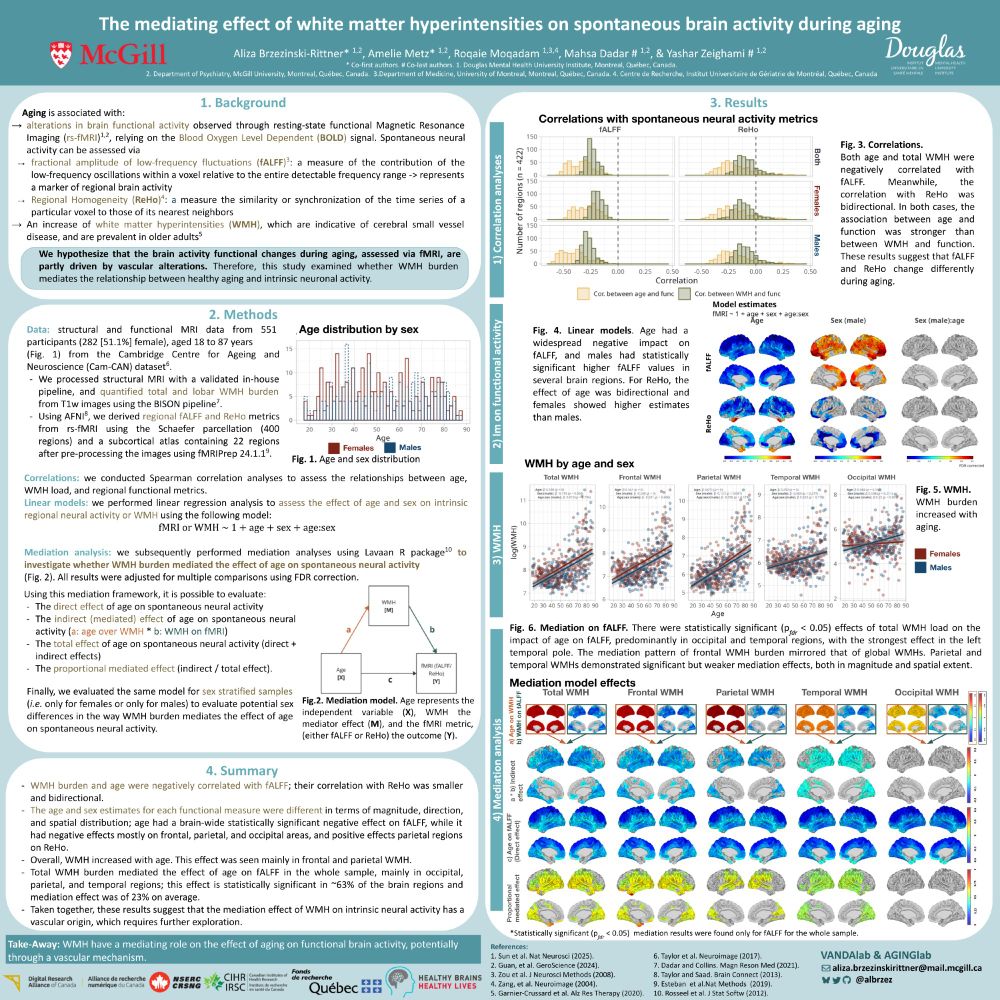
Hey #AAIC25 !
Today I'll be sharing our research on the mediating effect of WMH on spontaneous brain activity during aging! 🧠
Join me on poster 430!
@ameliemetz.bsky.social @dadarmahsa.bsky.social @yasharneuro.bsky.social @roqamoqa.bsky.social
28.07.2025 14:11 — 👍 6 🔁 4 💬 0 📌 0
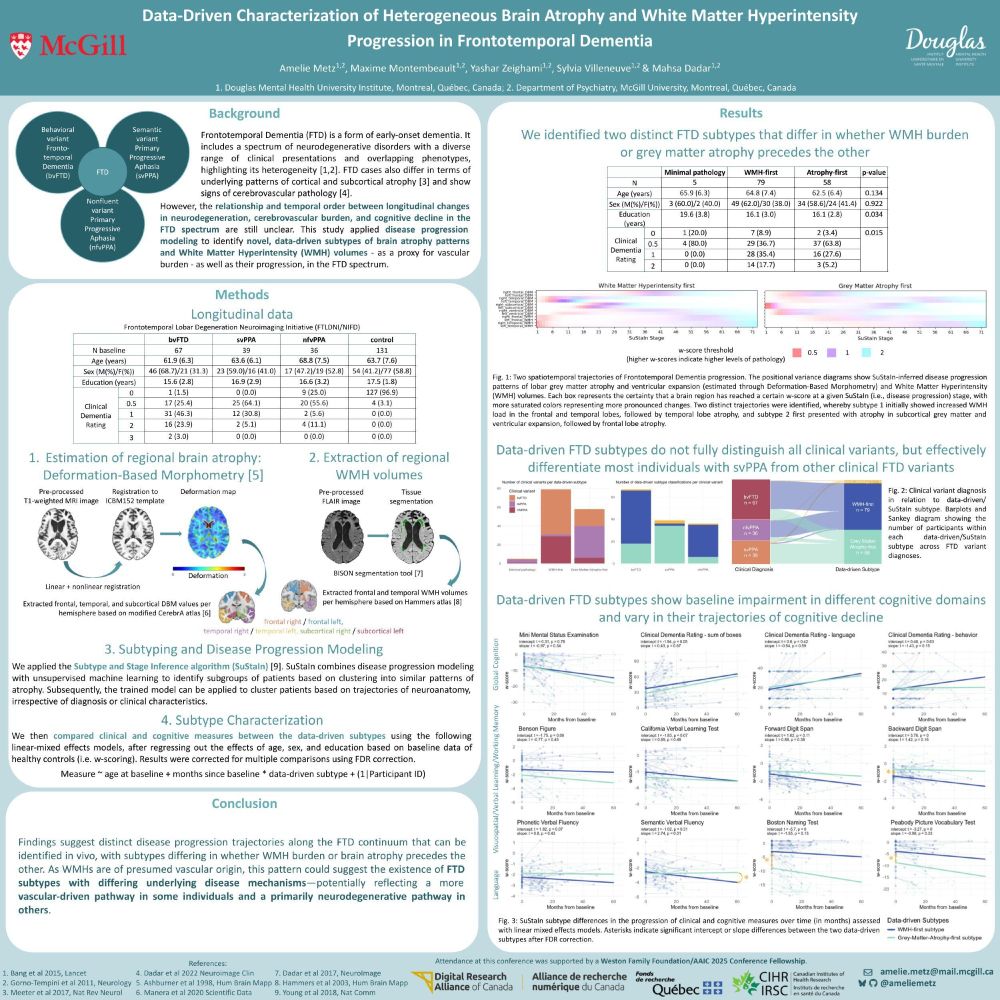
🧾 Poster #487
Data-Driven Characterization of Heterogeneous Brain Atrophy and White Matter Hyperintensity Progression in FTD (Amelie Metz @ameliemetz.bsky.social )
Tuesday, July 29
22.07.2025 22:34 — 👍 4 🔁 2 💬 1 📌 0
📣 Don't miss the CIC lecture by Yara Yakoub on April 30 @2pm!
douglas.research.mcgill.ca/event/yara-y...
📣 Venez participer le 30 avril au séminaire du CIC avec Yara Yakoub @14h!
douglas.research.mcgill.ca/fr/event/yar...
23.04.2025 12:03 — 👍 2 🔁 1 💬 0 📌 0
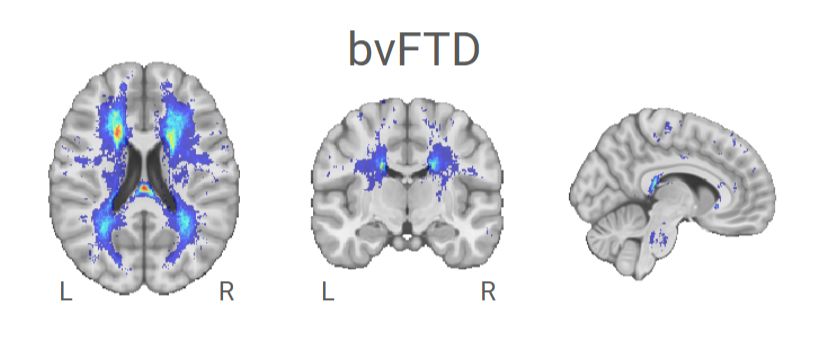
Hey #ADPD2025 , I'm happy to present our work on characterizing brain atrophy and cerebrovascular pathology in Frontotemporal Dementia subtypes!
Tomorrow, April 5, 9:40am, Hall F2, session: Mechanisms and Clinical Trials in FTD, ALS, and Neurodegeneration 02
04.04.2025 10:24 — 👍 6 🔁 2 💬 0 📌 0
😋
@dadarmahsa.bsky.social @yasharneuro.bsky.social @sylviavilleneuve.bsky.social
22.03.2025 13:43 — 👍 4 🔁 1 💬 0 📌 0
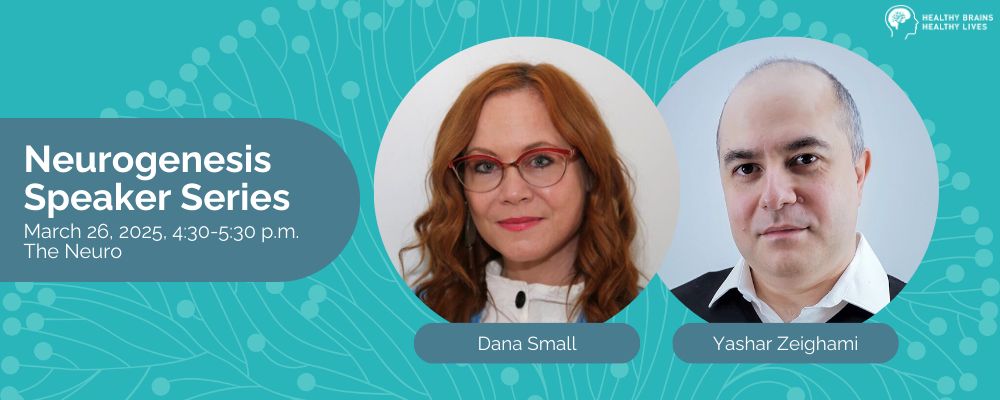
Neurogenesis Speaker Series. March 26, 2025, 4:30-5:30 p.m. at the Neuro ft. Dana Small and Yashar Zeighami
Join us for the next edition of Neurogenesis on March 26 at @theneuro.bsky.social, featuring @danasmall.bsky.social & @yasharneuro.bsky.social!
Learn about their research on gut-brain connections and the aging brain & network with peers at the post-event reception.🧠
Register now: mcgill.ca/x/iw5
12.03.2025 17:56 — 👍 7 🔁 7 💬 0 📌 0
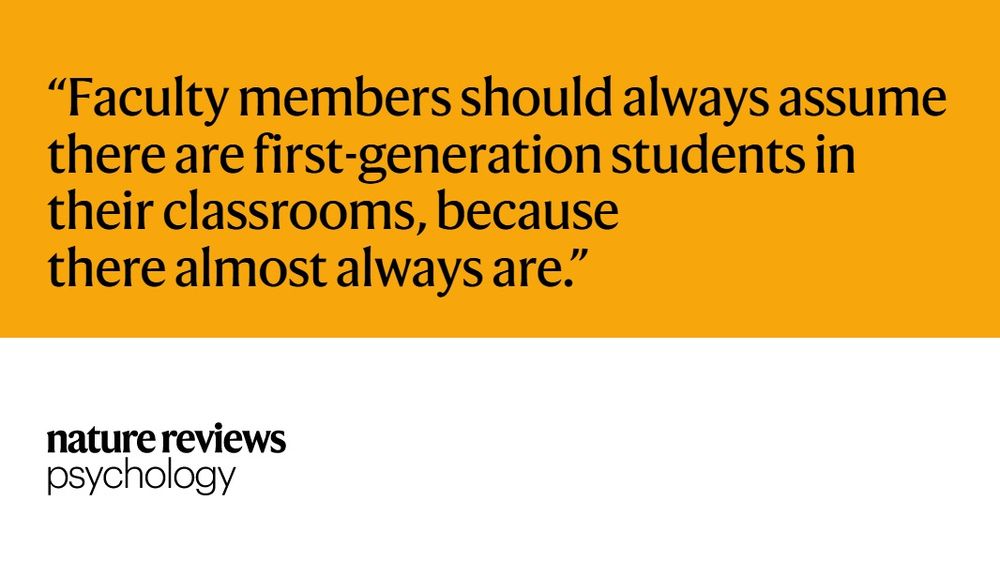
Faculty members should always assume there are first-generation students in their classrooms, because there almost always are.
First-generation students have unique needs, which can be amplified when they enter graduate programmes. A Comment article in Nature Reviews Psychology argues that faculty members need to be aware of the needs of this population and how to support them. https://go.nature.com/3FkQDs1 #Academicsky 🧪
11.03.2025 19:32 — 👍 51 🔁 26 💬 0 📌 2
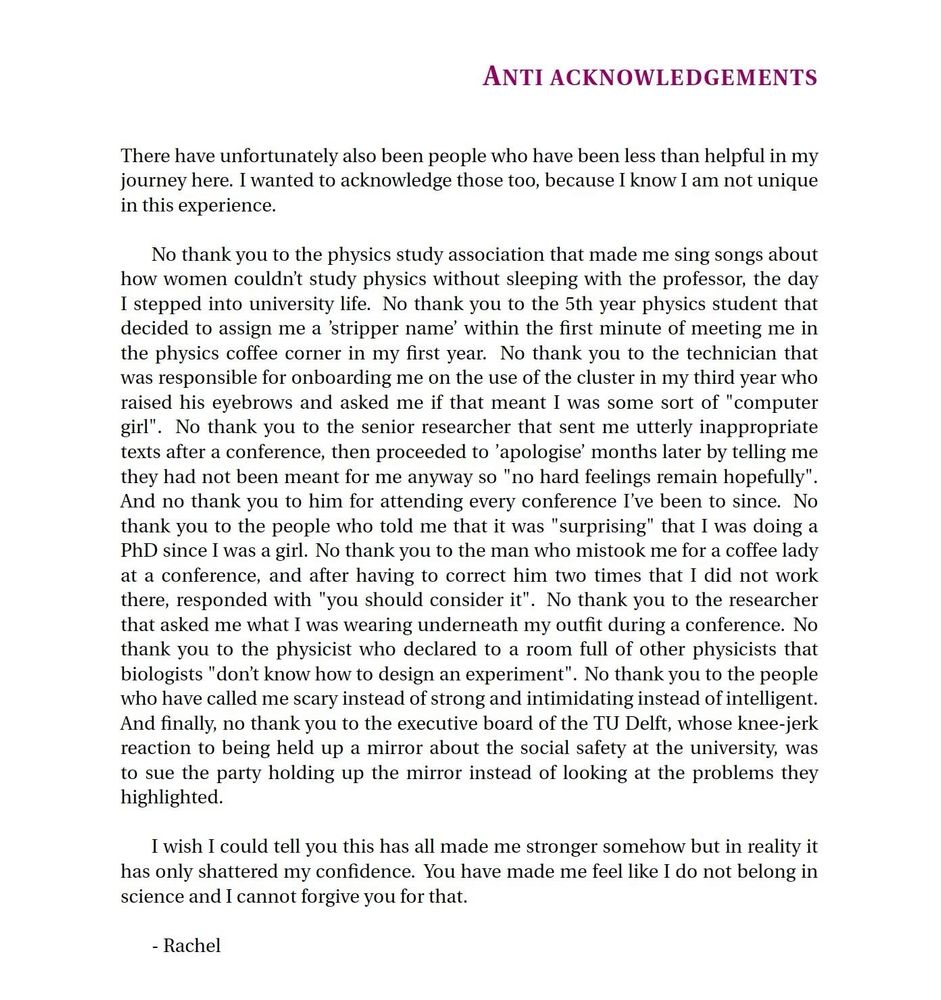
There have been people less than helpful in my journey here. I wanted to acknowledge those too, bc I know I am not unique in this experience.
No thank you to the physics study assoc that made me sing songs about how women couldn't study physics without sleeping with the professor, the day I stepped into university life. No thank you to the 5th year physics student that decided to assign me a stripper name within the first minute of meeting me in the physics coffee corner in my first year. No thank you to the technician that was responsible for onboarding me on the use of the cluster in my third year who raised his eyebrows and asked me if that meant I was some sort of computer girl. No thank you to the senior researcher that sent me utterly inappropriate texts after a conference, then proceeded to apologise months later by telling me they had not been meant for me anyway so no hard feelings remain hopefully And no thank you to him for attending every conference I've been to since. No thank you to the people who told me that it was surprising that I was doing a PhD since I was a girl. No thank you to the man who mistook me for a coffee lady at a conference, and after having to correct him two times that I did not work there, responded with you should consider it. No thank you to the researcher that asked me what I was wearing underneath my outfit during a conference. No thank you to the physicist who declared to a room full of other physicists that biologists don't know how to design an experiment. No thank you to the people who have called me scary instead of strong and intimidating instead of intelligent.
And finally, no thank you to the exec board of the TU Delft, whose knee-jerk reaction to being held up a mirror about the social safety at the university, was to sue the party holding up the mirror instead of looking at the problems they highlighted.
... You have made me feel like I do not belong in science & I cannot forgive you for that.
A friend included this anti-acknowledgement section on her PhD thesis. She also added the proposition: “Systematic bullying and undermining of girls and women in STEM starts early on and is the reason why they do not stay in science and related fields.”
Absurd we still need to go through this
🧪👩🔬
06.03.2025 16:40 — 👍 6563 🔁 2349 💬 122 📌 331
10/ Big THANK YOU to my advisors @dadarmahsa.bsky.social and @sylviavilleneuve.bsky.social and everyone who contributed to this work (aka @yasharneuro.bsky.social
and Simon Ducharme) for the ideas, feedback, and encouragement that made this possible!
Make sure to check out the full paper 😄
24.02.2025 21:12 — 👍 3 🔁 0 💬 0 📌 0
9/ TAKEAWAY
🧠We can use the mapping between neurodegeneration and cognitive manifestations of the core FTD subtypes for phenotyping patients according to clinical variants.
🧠The inclusion of DBM measures adds to the classification precision in the absence of extensive clinical testing.
24.02.2025 21:12 — 👍 2 🔁 0 💬 1 📌 0
8/ To test the reliability of our approach, we validated our model in subsets of the data that were matched for disease severity, age, and scanner type, as well as in the longitudinal data of the same cohort, with similar results.
24.02.2025 21:12 — 👍 1 🔁 0 💬 1 📌 0
7/ With minimal clinical input, the combination of atrophy and clinical measures was crucial. Using only the two cognitive scores in the classification, accuracy was reduced to 76.38% but notably, sensitivity and balanced accuracies highly increased when MRI values were added to the model.
24.02.2025 21:12 — 👍 2 🔁 0 💬 1 📌 0

6/ To assess whether our model was adaptable for a clinical setting, we repeated our analyses while only including the CDR scales and one language test in the PLS and our classification model. Using these minimal variables, our model still achieved an accurate FTD subtype classification of 83.62!
24.02.2025 21:12 — 👍 2 🔁 1 💬 1 📌 0
5/ We ran our machine learning classifier with a 10-fold cross-validation loop on 100 randomized train and test splits, with PLS-based brain and cognition scores (including 16 cognitive scores) as inputs. The resulting three-class mean prediction accuracy over all repetitions was ‼️89.12%‼️
24.02.2025 21:12 — 👍 1 🔁 0 💬 1 📌 0

4/ Linear regression models assessing the relationship between atrophy and cognition patterns in each participant confirmed that the association between the two differs between FTD subtypes (bvFTD, svPPA, and nfvPPA), allowing us to use these profiles in a machine learning classification algorithm 👍
24.02.2025 21:12 — 👍 2 🔁 1 💬 1 📌 0

3/ PLS results highlighted the involvement of frontal and temporal lobes and subcortical structures and linked atrophy in these regions to a decline in global cognitive function, language, and executive function.
24.02.2025 21:12 — 👍 1 🔁 0 💬 1 📌 0

2/ We analyzed MRI and cognitive data from 136 participants in the NIFD cohort. (Sub)cortical atrophy 🧠was assessed using deformation-based morphometry. We then applied partial least squares, using resulting atrophy/cognition patterns to determine the most likely FTD subtype of each participant.
24.02.2025 21:12 — 👍 1 🔁 0 💬 1 📌 0

Excited to share that the first project of my PhD was published in 🧠 @braincomms.bsky.social 🧠 !!
We showed that machine learning can effectively differentiate frontotemporal dementia subtypes combining brain atrophy and cognition 🎉
doi.org/10.1093/brai... (1/10)
24.02.2025 21:12 — 👍 10 🔁 6 💬 1 📌 0

collage of students at HBHL Symposium
Trainees: Showcase your research on brain health at #HBHLSymposium2025 with a poster or flash talk! 🏆
Open to grad students at @mcgill.ca, @umontreal.ca, @polymtl.bsky.social, @westernu.bsky.social & UBC whose research aligns with HBHL's themes. 🧠
Apply by March 21, 2025: mcgill.ca/x/ikv
17.02.2025 22:01 — 👍 4 🔁 4 💬 0 📌 0
PhD, Postdoctoral fellow at the Douglas Research Center and McGill University. Olfactory neuroscience and neuropathology of aging and neurodegenerative diseases
🧠 Neuroscience simplified
🎨 Brain Colouring and Learning book
✍️ by Maria Zamfir, PhD & Marion Van Horn, PhD 🇨🇦 #neuroscience
https://www.thebraincolouringbook.com/
Postdoc @uzh | studying aging and Alzheimer‘s disease
PhD student @ DZNE Magdeburg | Finding smart ways to use neuroimaging in neurodegenerative diseases
Associate Professor at WashU interested in neuroimaging, computational methods, mental health, big data, and open science.
Learn more about the Personomics Lab: https://www.mir.wustl.edu/research/research-centers/computational-imaging-research-center-cir
Clinical neuropsychologist. Drummer.
#neuroskyence #neuropsychology #neuroscience #brainimaging #neuroimaging #fMRI
Open Access sister journal to Brain. 🧠🧠🧠
Proceeds go to Guarantors of Brain Charity to support the translational neuroscience community.
Join our community of authors, reviewers, prize winners!
The Alzheimer's Association International Society to Advance Alzheimer's Research and Treatment
Canada’s top medical/doctoral school @mcgill.ca, in #MTL, is home to a diverse faculty and student body focusing on research, education and service to society.
Cutting-edge research, news, commentary, and visuals from the Science family of journals. https://www.science.org
Aperture Neuro is the official journal of the Organization for Human Brain Mapping, offering open access and low-cost publishing of high-quality peer-reviewed research in all areas of brain imaging and assessment.
Interdisciplinary virtual network of >1,000 neuroscientists at the University of Cambridge and affiliated Institutes.
www.neuroscience.cam.ac.uk
The funder-researcher collaboration and open-access publisher for research in the life and biomedical sciences.
Follow @eLifeCommunity.bsky.social
Neurology and brain imaging.
ORCID: 0000-0002-0945-5779
Brain imaging, machine learning, neuroscience, mental disorders
https://sites.google.com/view/yeolab
Scientist studying neural dynamics in Parkinson's disease at SFU.
Tryhard home cook | sci-fi nerd | movie buff. Views my own.