University College Cork Vacancies
🚨Job claxon 🚨
University College Cork is looking to appoint a lecturer in Medical Microbiology into a permanent, non-clinical post
A great opportunity in a microbiology powerhouse
For details go to my.corehr.com/pls/uccrecru... and enter reference number 092153
18.11.2025 22:55 — 👍 11 🔁 22 💬 0 📌 0

A table showing profit margins of major publishers. A snippet of text related to this table is below.
1. The four-fold drain
1.1 Money
Currently, academic publishing is dominated by profit-oriented, multinational companies for
whom scientific knowledge is a commodity to be sold back to the academic community who
created it. The dominant four are Elsevier, Springer Nature, Wiley and Taylor & Francis,
which collectively generated over US$7.1 billion in revenue from journal publishing in 2024
alone, and over US$12 billion in profits between 2019 and 2024 (Table 1A). Their profit
margins have always been over 30% in the last five years, and for the largest publisher
(Elsevier) always over 37%.
Against many comparators, across many sectors, scientific publishing is one of the most
consistently profitable industries (Table S1). These financial arrangements make a substantial
difference to science budgets. In 2024, 46% of Elsevier revenues and 53% of Taylor &
Francis revenues were generated in North America, meaning that North American
researchers were charged over US$2.27 billion by just two for-profit publishers. The
Canadian research councils and the US National Science Foundation were allocated US$9.3
billion in that year.

A figure detailing the drain on researcher time.
1. The four-fold drain
1.2 Time
The number of papers published each year is growing faster than the scientific workforce,
with the number of papers per researcher almost doubling between 1996 and 2022 (Figure
1A). This reflects the fact that publishers’ commercial desire to publish (sell) more material
has aligned well with the competitive prestige culture in which publications help secure jobs,
grants, promotions, and awards. To the extent that this growth is driven by a pressure for
profit, rather than scholarly imperatives, it distorts the way researchers spend their time.
The publishing system depends on unpaid reviewer labour, estimated to be over 130 million
unpaid hours annually in 2020 alone (9). Researchers have complained about the demands of
peer-review for decades, but the scale of the problem is now worse, with editors reporting
widespread difficulties recruiting reviewers. The growth in publications involves not only the
authors’ time, but that of academic editors and reviewers who are dealing with so many
review demands.
Even more seriously, the imperative to produce ever more articles reshapes the nature of
scientific inquiry. Evidence across multiple fields shows that more papers result in
‘ossification’, not new ideas (10). It may seem paradoxical that more papers can slow
progress until one considers how it affects researchers’ time. While rewards remain tied to
volume, prestige, and impact of publications, researchers will be nudged away from riskier,
local, interdisciplinary, and long-term work. The result is a treadmill of constant activity with
limited progress whereas core scholarly practices – such as reading, reflecting and engaging
with others’ contributions – is de-prioritized. What looks like productivity often masks
intellectual exhaustion built on a demoralizing, narrowing scientific vision.

A table of profit margins across industries. The section of text related to this table is below:
1. The four-fold drain
1.1 Money
Currently, academic publishing is dominated by profit-oriented, multinational companies for
whom scientific knowledge is a commodity to be sold back to the academic community who
created it. The dominant four are Elsevier, Springer Nature, Wiley and Taylor & Francis,
which collectively generated over US$7.1 billion in revenue from journal publishing in 2024
alone, and over US$12 billion in profits between 2019 and 2024 (Table 1A). Their profit
margins have always been over 30% in the last five years, and for the largest publisher
(Elsevier) always over 37%.
Against many comparators, across many sectors, scientific publishing is one of the most
consistently profitable industries (Table S1). These financial arrangements make a substantial
difference to science budgets. In 2024, 46% of Elsevier revenues and 53% of Taylor &
Francis revenues were generated in North America, meaning that North American
researchers were charged over US$2.27 billion by just two for-profit publishers. The
Canadian research councils and the US National Science Foundation were allocated US$9.3
billion in that year.

The costs of inaction are plain: wasted public funds, lost researcher time, compromised
scientific integrity and eroded public trust. Today, the system rewards commercial publishers
first, and science second. Without bold action from the funders we risk continuing to pour
resources into a system that prioritizes profit over the advancement of scientific knowledge.
We wrote the Strain on scientific publishing to highlight the problems of time & trust. With a fantastic group of co-authors, we present The Drain of Scientific Publishing:
a 🧵 1/n
Drain: arxiv.org/abs/2511.04820
Strain: direct.mit.edu/qss/article/...
Oligopoly: direct.mit.edu/qss/article/...
11.11.2025 11:52 — 👍 609 🔁 435 💬 8 📌 62
This is a small snow plow for sidewalks
If your city plows the roads but leaves sidewalks up to property owners, your city hates pedestrians.
11.11.2025 19:44 — 👍 645 🔁 103 💬 39 📌 35

James Watson, dead at 97, was a scientific legend and a pariah among his peers
James Watson, the co-discoverer of the structure of DNA who died Thursday at 97, was a scientific legend and a pariah among his peers.
A Sharon Begley byline, almost 5 years after her death.
Upon hearing the news James Watson had died, a STAT reporter said in our Slack, "I wish I could read what Sharon would have written."
Incredible news: Sharon in fact did pre-write a Watson obit. And it is masterful and excoriating.
🧪🧬🧫
08.11.2025 13:39 — 👍 6061 🔁 1997 💬 113 📌 345

Newly expanded version of my guide to scientific writing -- known as the “15 steps” -- published in PLOS Computational Biology. Special thanks to Éric Marty for creating a fantastic visualization.
Check it out: journals.plos.org/ploscompbiol...
#ScientificWriting #PLOSComputationalBiology
24.09.2025 17:54 — 👍 43 🔁 26 💬 1 📌 2

The Simpsons old man sitting on a stump telling a story but all the kids have been replaced with headstones
me telling my grandkids what it was like to have vaccines
22.09.2025 20:55 — 👍 7956 🔁 2012 💬 42 📌 55

Female labour force participation increasing in Quebec (relative to the rest of Canada or the US) after the introduction of subsidized daycare
Quebec introduced subsidized daycare in 1997 (initially $5 a day, now $9).
Afterwards, female labour force participation rose quite dramatically relative to the rest of Canada and the US.
28.08.2025 14:48 — 👍 117 🔁 22 💬 5 📌 1
Assistant Professor (Biochemistry)
Assistant Professor (Biochemistry)
MCB @ U of Guelph is hiring (again)! 🎉
Tenure-track Assistant Professor in Biochemistry
Part of our strategic cluster hire.
Apply now 👉 careers.uoguelph.ca/job/Guelph-A...
#Biochemistry #FacultyJobs #AcademicTwitter #MolBio
26.08.2025 15:28 — 👍 6 🔁 6 💬 0 📌 0
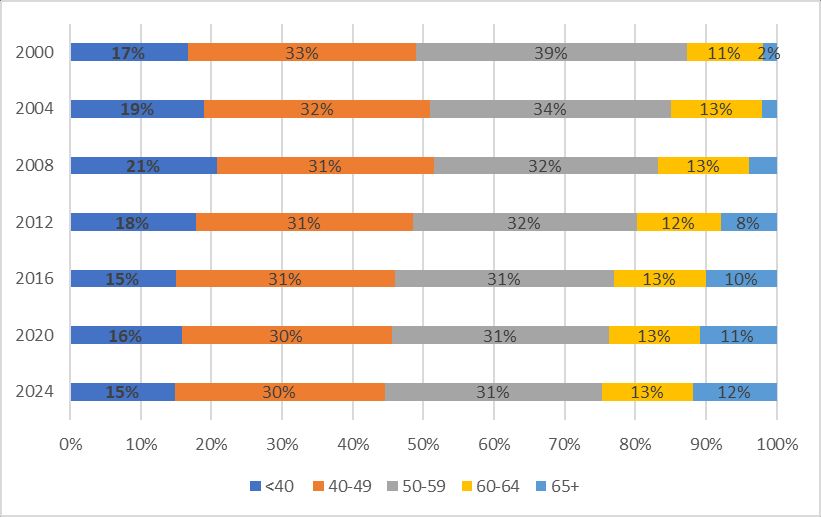
Evolution of the Age Profile of Canadian Professoriate, 2000 to the present. Number of profs over 65 is up from roughly 800 in 2000 to around 6000 today.
05.08.2025 15:34 — 👍 14 🔁 6 💬 5 📌 1
No one disputes that students deserve to learn. But there is literally decades of research on learning that shows that students aren’t able to assess if they have learned within the time span of a course. Using testing over time to show if students retain knowledge. 1/
31.07.2025 15:13 — 👍 35 🔁 6 💬 1 📌 4
Evaluation is important and we have good ways of evaluating instructors (observations, audits, mentoring). But the evidence is clear that asking students to Yelp review their instructors the week before exams yields no valuable information on teaching or learning--just customer satisfaction.
31.07.2025 00:45 — 👍 316 🔁 34 💬 8 📌 10
If you work in higher ed, you need to get your folks together and end the use of course evals or at least bar their consideration in evaluation, promotion, and hiring. This needed to happen yesterday because they don't measure learning, they measure instructor gender, but now it's a snitch pool.
31.07.2025 00:41 — 👍 1112 🔁 321 💬 22 📌 29
In case you’re wondering, the “caterpillars are hybrid worms” paper at PNAS remains alive (and guessing won’t be retracted ever)
www.pnas.org/doi/10.1073/...
25.07.2025 12:15 — 👍 15 🔁 8 💬 1 📌 2
Likewise the ability of water to remember solutes www.nature.com/articles/333...
Background: en.wikipedia.org/wiki/Water_m...
25.07.2025 13:31 — 👍 8 🔁 3 💬 3 📌 0

Planning Your Publication: Pathways to Success Webinar details social card.
Missed the webinar? The recording is now available!
Learn how to plan your publication, select the right journal, write clear titles and abstracts, and navigate Open Access publishing.
📽️▶️ buff.ly/iYbfBsA
#ResearchSkills #OpenAccess #ECRs #AcademicWriting
16.07.2025 20:43 — 👍 0 🔁 1 💬 0 📌 0

Close-up of pink agar plate with bacterial colonies, promoting a call for papers on microbiology education perspectives.
What does innovation in microbiology teaching look like?
We invite papers on pedagogy, tech, curriculum, and student engagement in microbiology education.
More information ▶️ buff.ly/OMVT8xk
#SciComm #MicrobiologyEducation #AcademicSky #SciComm 🧪 #AcWri #PHDSky #ScholComms #OpenScience #SciPol
16.07.2025 21:05 — 👍 6 🔁 5 💬 1 📌 0

A framework for values-based assessment in promotion, tenure, and other academic evaluations
🎓 Today we publish another evaluation for an article whose authors present a novel method—developed through a series of workshops—for assessing academics.
🙏 Thanks to the authors, reviewers & editors!
👇 Read the full text, reviews & editorial assessment on MetaROR metaror.org/kotahi/artic...
20.06.2025 09:03 — 👍 8 🔁 5 💬 0 📌 2

Social card for the Canadian Journal of Microbiology Call for Papers: Nurturing Minds, Culturing Microbes: Perspectives on Microbiology Education
New #callforpapers! This collection will explore how #microbiology is taught, learned, and communicated both inside and outside the classroom!
Submit your research to @canjmicrobio.bsky.social ▶️ buff.ly/G9kA9rl
19.06.2025 13:09 — 👍 1 🔁 1 💬 0 📌 0
it seems like a real problem for colleges that some large percentage of the students don't see any value in learning the stuff they're ostensibly there to learn.
or at least, they see the assignments as pointless hoops with no relationship to learning anything. 1
08.05.2025 06:05 — 👍 136 🔁 27 💬 7 📌 8
This dude has flopped every single time Anderson has closed in on him, what a bitch
26.04.2025 01:02 — 👍 40 🔁 5 💬 2 📌 1
This is entirely on the officials for managing exactly 0% of this series well
26.04.2025 00:53 — 👍 60 🔁 11 💬 1 📌 2
If professors had actual brainwashing power, we wouldn't see gender and racial bias in student evals.
28.02.2025 15:57 — 👍 162 🔁 22 💬 4 📌 4
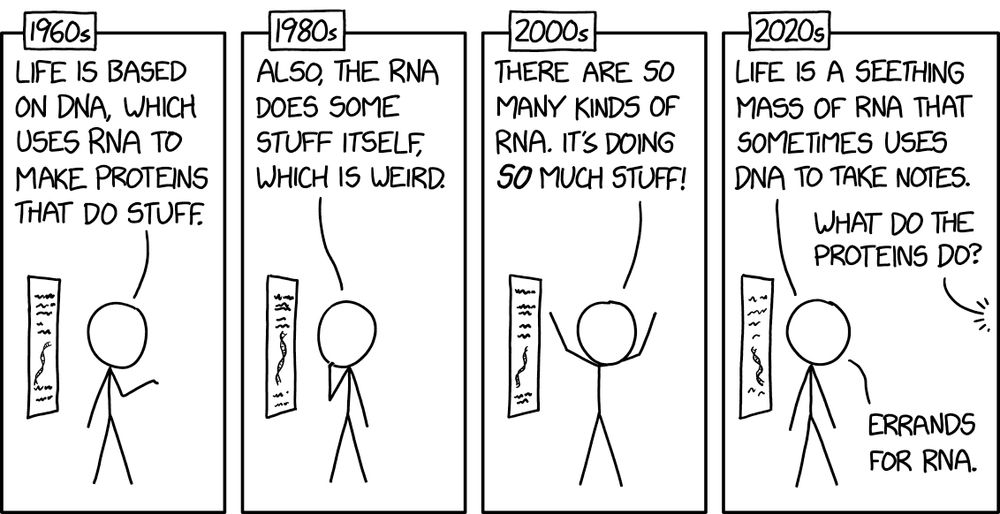
RNA xkcd.com/3056
26.02.2025 14:58 — 👍 17903 🔁 2568 💬 155 📌 171
Hi everyone, I am selecting landmark papers in bacterial physiology for a course. I have a few favorites in mind, but was wondering if people would be willing to share theirs.
12.01.2025 20:34 — 👍 0 🔁 2 💬 0 📌 0
Excited to share my first paper on an educational activity developed in a class I co-teach with @yannickdntremblay.bsky.social
08.01.2025 15:27 — 👍 0 🔁 1 💬 0 📌 0
Elmer R. Pfefferkorn, PhD, Professor of Microbiology & Immunology at the Geisel School of Medicine, EiC of the Journal of Bacteriology; Bacterial Biofilms, Surface Sensing, c-di-GMP Signaling, Polymicrobial Communities & Gut Microbiota in Cystic Fibrosis
(she/her) Studying microbes & microbiomes at U of Saskatchewan
co-Editor in Chief ISME Communications
Posts by @saskajanet.bsky.social (who posts about birds)
Welcome to the prairies! In my day job I'm a microbiology prof in Saskatoon @hilllabsask.bsky.social, and weekends are for the birds (literally).
🇨🇦 Citizen scientist. Volunteer for birds. Photos by me.
Medhist = medieval + medical history (https://hcommons.org/members/mhgreen2/). Daughter #2 of Marlon & Eleanor Green. Focusing on Global Health. Latest: https://www.history21.com/owit-module/the-black-death-the-medieval-plague-pandemic/
President of Game Over Network. Check out https://thegameovernetwork.com
Habs fan, leftist, parent, & partner.
A @cdnsciencepub.com journal reporting peer-reviewed research from all areas of microbiology, from molecular biology to microbial ecology.
More housing, bikes, and transit.
https://youtube.com/@ohtheurbanity
📍 Montreal, Quebec
Professor of Life Sciences & Director Global Health Institute @EPFL_en. Passionate about science 🤩 Views are my own.
Journaliste politique/CBC At Issue/Les Coulisses du pouvoir et C est bien meilleur le matin-SRC/Good Talk-Sirius XM & YouTube
PubPeer is a platform for post-publication peer review, offering an additional layer of evaluation beyond journal names. Empowering the scientific community to assess science and scientists transparently. pubpeer.com
The best and most comprehensive #Habs news source and website
Habs EOTP Contributor | Friendly Neighborhood Beer Guy | If you get confused, listen to the music play
Trends in Biotechnology publishes reviews and original research in biobased technology. https://www.cell.com/trends/biotechnology/home
Gold Open Access journal for the diverse field on Biofilm
Co-Editors-in-Chief: Tom Coenye, Darla Goeres, Birthe Veno Kjellerup and Ákos T. Kovács
https://www.sciencedirect.com/journal/biofilm
All views and opinions expressed are my own.
Associate Professor of Biophysics and Physics at UM (Michigan). We study microbial dynamics with models and experiments inspired by physics. Papa, husband, IPA drinker, NBA and KY bball fan. Order may vary. he/him
Group Leader @ JIC. Natural products. Streptomyces, plants & insects. Bearsuit drummer, dad to two deaf boys, Norwich City FC
www.jic.ac.uk/people/matt-hutchings
http://streptomyces.org.uk for strains & resources
Engagement @sawtrust.bsky.social
Professor at Cornell Univ. Bacillus subtilis physiology and stress responses (metal homeostasis, redox stress, antibiotic resistance & cell envelope). EIC of Mol Microbiol.
Professor, University of Geneva. We study Enterococcal biofilms, pathogenesis, and AMR. Formerly @KimInSingapore 🌴.
https://kimberlyklinelab.com/