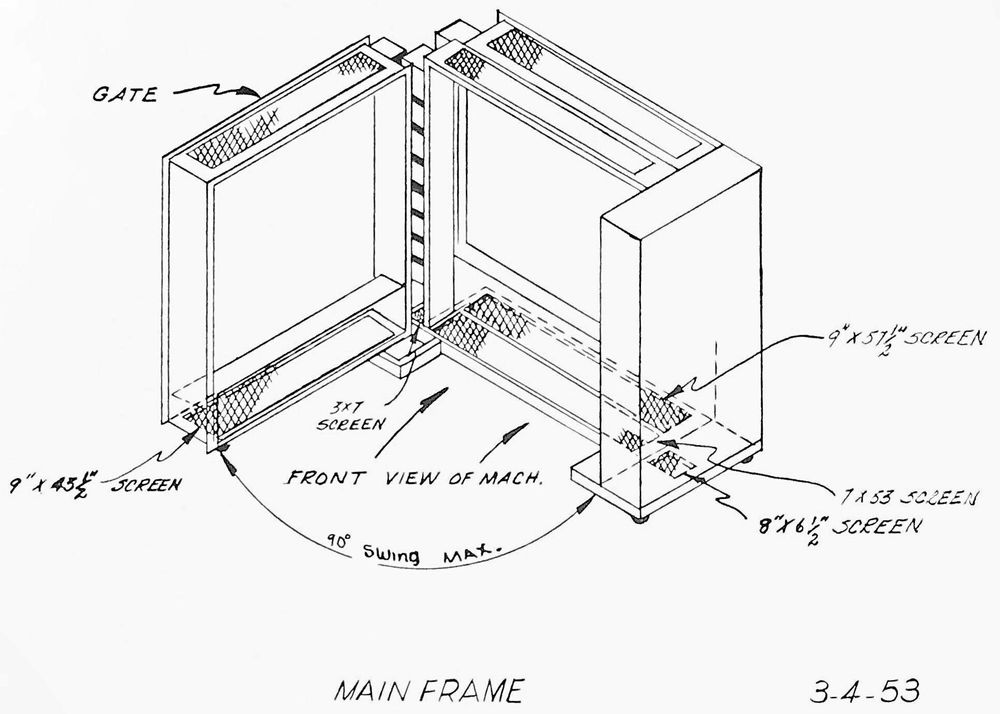
A line drawing of the IBM 701's "main frame", showing its physical dimensions and how the frame swings open. The drawing is dated 3-4-53. The drawing is from the document "Type 701 EDPM Installation Manual", obtained from the Computer History Museum archives.
What is the origin of the word "mainframe"? Digging through archives, I traced it back to 1953. The IBM 701 computer was built from "frames": power frames, a storage frame, a drum frame, and the main frame. This 1953 drawing from the Installation Manual shows the dimensions of the "main frame". 1/n
01.02.2025 18:54 — 👍 310 🔁 98 💬 9 📌 8

"If there is nothing but what we make in this world, brothers...let us make good."-Beta Ray Bill, Marvel Comics
surprisingly deep quote
08.02.2025 03:08 — 👍 137 🔁 30 💬 6 📌 2
So, folks on here have probably caught a whole bunch of lawyers and law professors (correctly) lashing out at a law professor (Ilan Wurman) for suggesting there's some meaningful "literature" supporting Trump's attack on birthright citizenship that the courts didn't "engage with"
It's worth taking
26.01.2025 15:41 — 👍 411 🔁 123 💬 15 📌 27
Towns + Brunson = Messier + Leetch
24.01.2025 02:55 — 👍 0 🔁 0 💬 0 📌 0
In the 2020’s, knowledge workers comprised half of the American workforce. Within a few decades, less than 5% of Americans used knowledge at work as information retention and retrieval became mechanized. Yet employment has remained robust as workers migrated to new occupations.
24.01.2025 00:39 — 👍 0 🔁 0 💬 0 📌 0
This chart from the Financial Times was really striking to me. Democrats take power in eras where unemployment is more salient and Republicans take over when inflation is more salient is a pretty good heuristic.
22.01.2025 14:47 — 👍 112 🔁 28 💬 5 📌 3
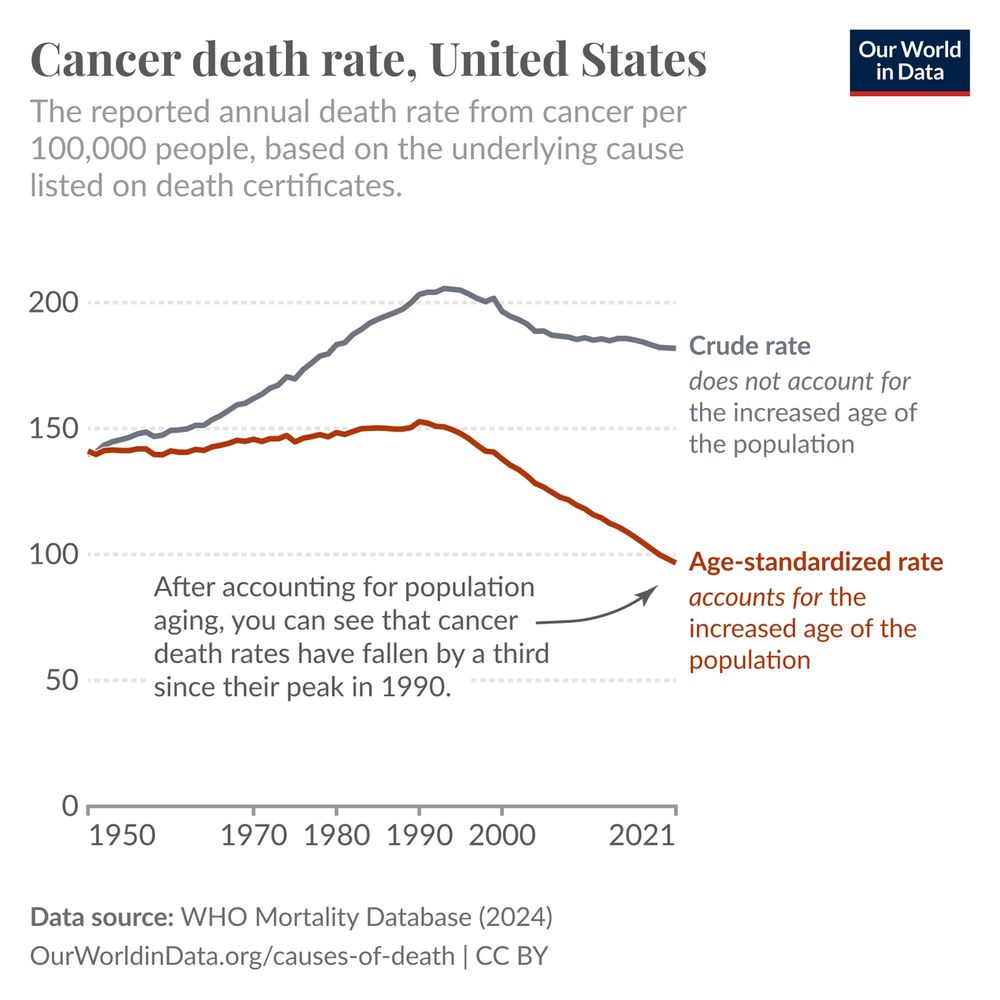
How has the risk of dying from cancer changed in the United States?
To understand this, we can look at national cancer death rates in the United States.
The gray line shows the crude rate, which is the rate of deaths from cancer per 100,000 people. It has risen between 1950 and 1990 and has fallen slightly since then.
However, cancer death rates rise sharply with age, and the age of the US population has increased since 1950, so we would expect cancer death rates to rise for that reason alone.
What if we adjust for the increased age of the US population?
The red line, the age-standardized rate, shows this. It shows the cancer death rate if the age structure of the US population was held constant throughout.
This shows a slight rise until 1990 and then a significant decline; rates have fallen by one-third.
This means Americans are now one-third less likely to die from cancer at the same ages as Americans in 1990.
This comes from several factors: better screening and earlier diagnosis, medical advances in cancer treatments, and public health efforts to reduce risk factors like smoking and exposure to carcinogens.
Americans are now one-third less likely to die from cancer at the same ages as Americans in 1990
09.12.2024 10:02 — 👍 1161 🔁 256 💬 32 📌 37
24.11.2024 00:27 — 👍 21 🔁 2 💬 0 📌 0
Retired, Jewish, anti-Zionist, pro peace, pro worker. One husband, 2 kids, 1 dog. I am weighing my options.
Orlando #Magic beat reporter for @orlandosentinel.com.
#NBASky. PBWA member. UCF alum. Key West native. jbeede@orlandosentinel.com
www.orlandosentinel.com/sports/nba/orlando-magic/
timberwolvespilled
he/him
Former Site Manager at @SLCDunk, part of @SBNationNBA. Biz Dev - Affiliates, ClickBank. Posts are my own.
Pelicans & NBA stuff for the In the NO podcast
Tulanian 🌊 and Longhorn 🤘🏻
Digital Media Web Developer and Consultant. Opinionated #NBA enthusiast. Houston #Rockets, Tenn #Titans, SC #Gamecocks. Web: http://fyrebear.com
Senior NBA Editor @RotoWire
Co-host of the RotoWire NBA Show on Sirius XM NBA + the RotoWire Fantasy Basketball Podcast
NBA Data and Visualization | Linux | Cycling
Twitter: @sradjoker
blog.sradjoker.cc
Indiana Pacers, Fever beat writer: Fieldhouse Files | Podcast Host l Play-by-play announcer | fieldhousefiles@gmail.com
Senior writer at Orlando Magic Daily | Host of Locked On Magic | Occasional college football writer | Watches Movies
valančiūnas enjoyer / 22 / 🇵🇸 / 18+ https://linktr.ee/milxluvr
#rstats #NBASky | Born & raised in Maine, live in Chicago | Chicago Bulls and Sky partisan, unfortunately | Box score production chauvinist | Member of the Church of Kirilenkology 🏀| Free Palestine 🇵🇸
nbacouchside.net
NBA 🏀 & sports business 💵 data viz 📊 for Sportico
All opinions are my own
Radio voice of #UtahJazz. Creator of Locked on Podcast Network. Named #NBA must follow by SI. Jordan Clarkson calls him "Big Dog"
1/3 of the @nopantscrunch.bsky.social podcast crew
Head of the Naz Reid Game Committee
NOT a doctor
Coffee shop owner
Lover of basketball
Illinois WBB reporting
Raptors/NBA columnist with Rogers Sportsnet, based in Toronto. Have won awards, and covered NBA games at Maple Leaf Gardens. Family guy, golf guy, dog guy, I will happily give you my blood. @michaelgrange on X.
🐺 Covering the Timberwolves and Lynx for Canis Hoopus | 🎙️ Co-Host of Two Words: Wolves Pod
Milwaukee Bucks Radio Network host/analyst
Locked on Bucks host
I also like Hockey, Wrestling and the Grateful Dead
NBA content at theScore
https://www.thescore.com/author/joseph-casciaro
https://youtube.com/playlist?list=PLwkOTHonVMKaQFtLECpXUFEmwD0AMHV0i&si=VWOmeHLsyw9tFXum
https://youtube.com/playlist?list=PLwkOTHonVMKZPsCaY-JR1QiojYviap-ya&si=UktWA-e1asS3gmGw