A microscopy image of a daisy with white ligules that are purple at their base, and a centre full of deep blue/purple disc florets. The outer circle of disc florets is starting to flower and are expulsing bright yellow pollen.

A microscopy image of a daisy with white ligules that are purple at their base, and a centre full of deep blue/purple disc florets. The ligules are covered in many clear hairs at their bases. The outer circle of disc florets is starting to flower and are expulsing bright yellow pollen.

A closeup of the base of the ligulate florets, showing how hairy they are.

A closeup of a disc floret, showing its five purple petals and the sex organs at the centre of the flower expelling bright yellow pollen.
This weeks features #Dimorphotheca ecklonis (Asteraceae)! This is a species of #daisy from South Africa that’s commonly grown in gardens here. Their ligules (what appear as petals) can be white to purple, while the centre disc florets are a deep blue/purple. They’re quite striking flowers up close!
24.11.2025 05:55 — 👍 1 🔁 0 💬 0 📌 0

A smiling person with glasses and shoulder-length brown and blue/green hair is standing in front of a fig tree holding a hardcover book titled "Ecology Matters".

A zoomed-in photo of an open book, looking at a photo of manuka flowers buds.

The original Manuka buds photo, showcasing two pink flower buds against green needle-like leaves and a pink background.
Excited to share that I'm one of the lucky photographers to get one of my photos published in Ecology Matters by @ecolsocaus.bsky.social! It's incredibly surreal seeing something you made printed in a book. You can spot Manuka buds on page 12! ❤️
19.11.2025 00:55 — 👍 5 🔁 2 💬 1 📌 0

A white flower with 5 pink-tipped petals looking like a star, the insides of which are covered in dense white hairs.

A branch of developing flowers (almost bullet-shaped, they're long and pointed at the tip and are white and pink) and deep green leaves on a hairy brown stem.
#Styphelia ericoides (Ericaceae), aka the pink beard heath! This is a widespread shrub to 2m high that has typical beard-heath flowers: tubular and densly hairy (bearded) on the inside. The flowers are very small (1-1.5mm long), creamy-white with pink tips.
#plants #photography
18.11.2025 02:22 — 👍 6 🔁 1 💬 0 📌 0

A green succulent-looking plant covered in cottony white hairs with a inflorescence with white 'petals' in the middle.

A green succulent-looking plant covered in cottony white hairs, peering down into the inflorecense in the middle.

A cross-section of the same plant showing inflorescence structure. Florets are long and yellow-green with a pale ovary (where the seed will form) at their base.
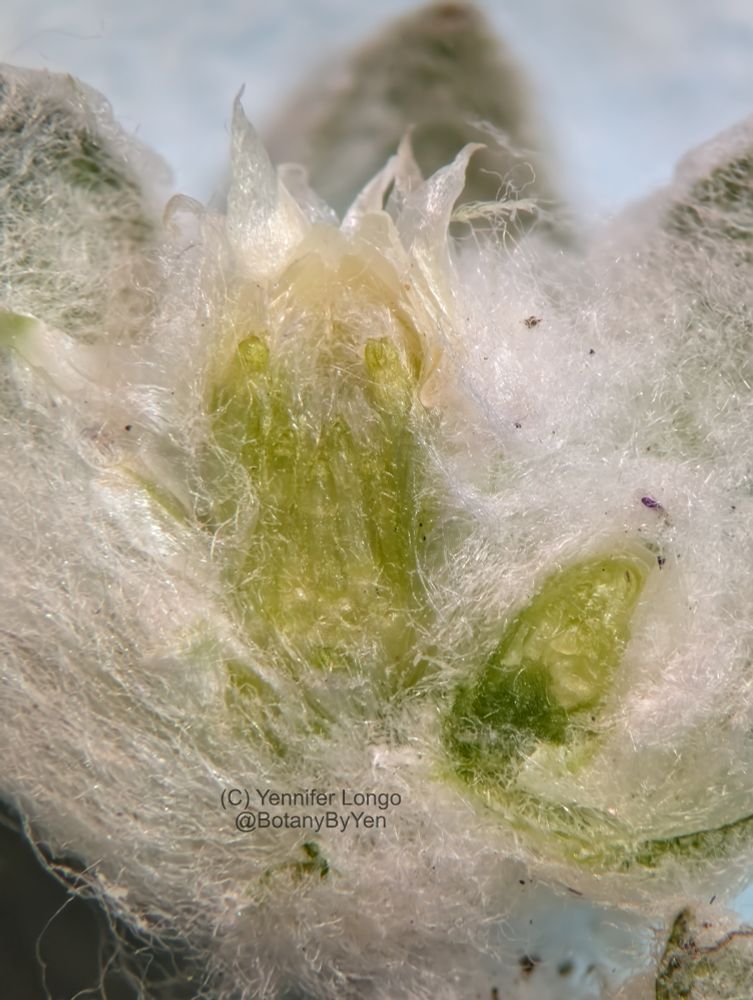
A cross-section of the same plant showing inflorescence structure. This plant has two inflorescences forming, one in the centre which is more developed than one to the right.
Lets get back into it: weeks microscopy features #Actinobole uliginosum! This plant is so tiny, only a few cm high, that you’d need to be on your hands and knees in the dirt to really notice it exists. It’s an #Asteraceae with cottony leaves and white-creamy coloured flowers.
17.11.2025 03:11 — 👍 1 🔁 0 💬 0 📌 0


Wrapped up my field work this past weekend by visiting Acacia daviesii (FFG listed critically endangered)!! Very bittersweet. I'm looking forward to the break but kind of sad I won't see my species for a bit.
22.10.2025 04:20 — 👍 4 🔁 0 💬 0 📌 0

A thrips peeking out from a floret of a daisy. The petals are a deep violet and there is bright yellow pollen everywhere.
#Thrips! Thrips are thrips both singular and plural, and if you do any sort of floral morphology or pollen work you'll come across a million of them. This guy was hiding out in an Osterospermum floret.
#inverts #photography
12.10.2025 23:54 — 👍 2 🔁 0 💬 0 📌 0

A photo of the ground with dirt, plants and a very metallic blue ant-looking wasp. She has bright red legs.

A photo of the ground with sand, plants and a very metallic blue ant-looking wasp. She has bright red legs.
A blue ant (Diamma bicolor)! She's not actually an ant, she's a wasp (though they're both Hymenoptera). A species I've always wanted to see. 🥹
07.10.2025 01:14 — 👍 4 🔁 0 💬 0 📌 0
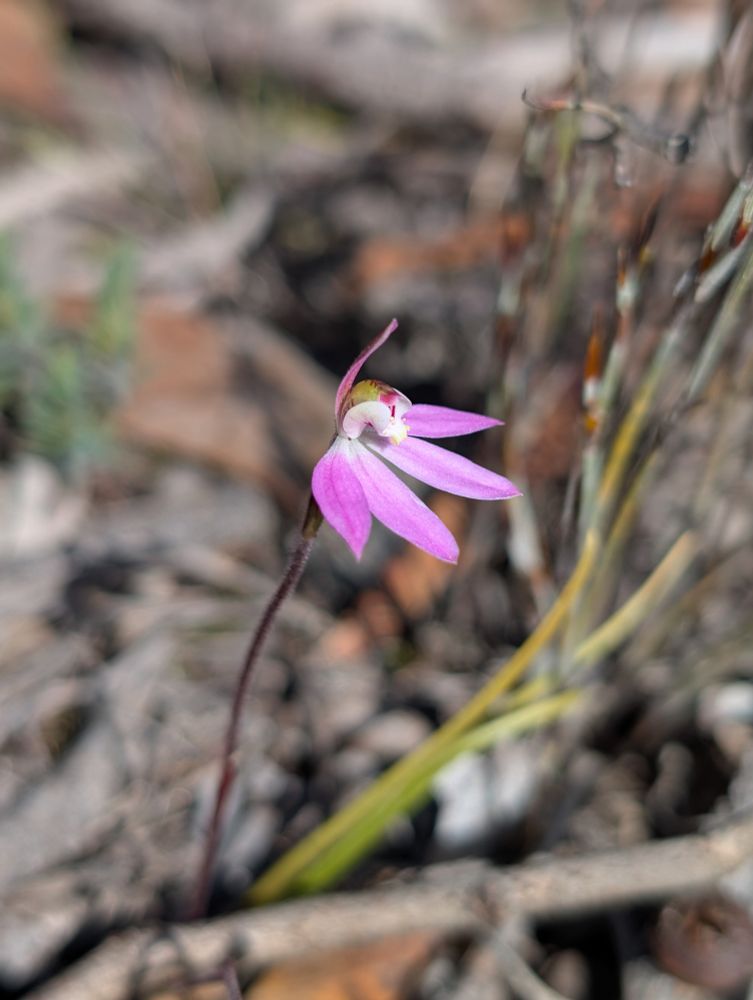
A very hot pink Caladenia carnea flower.

A light pink Caladenia carnea flower.

Caladenia carnea flower with just a faint blush of pink

Completely white Caladenia carnea flower
Colour spectrum of Caladenia carnea (pink fingers). They range from hot pink, light pink, a faint blush of pink to totally white. Found out in western Vic. ❤️🩷🤍
02.10.2025 00:33 — 👍 2 🔁 0 💬 0 📌 0

My hands holding a small green inch flora, Halosperma demisium.

Caladenia tentaculata flower hidden within a dead shrub.

Two Chamaescilla corymbosa flowers.

A Glossodia flower covered in drops of rain.
Last week I had the most amazing time demonstrating LTU BOT2PDE students out in Natimuk, far western Victoria. Got my hands dirty with inch flora and saw some good flowers. 🌸
29.09.2025 00:27 — 👍 5 🔁 0 💬 0 📌 0

Nodding greenhood with my index finger for scale (it's maybe 3cm high).

Dusky fingers against a blurry rock background.

Early nancies

Climbing sundew flowers.
A few flowers from the weekend, celebrating wrapping up work at one of my field sites. Not my target species but so lovely to see. ❤️
16.09.2025 06:33 — 👍 2 🔁 0 💬 0 📌 0

A bin chicken eating out of a rubbish bin in the Sydney CBD.
Had a brief trip to Sydney and saw some very Sydney things.
#binchicken
09.09.2025 02:10 — 👍 3 🔁 1 💬 0 📌 0

Grevillea alpina?

Hovea

Drosera
A few snaps of what's growing at one of my field sites that aren't my target species (I did not take enough time to photograph non-study species 😞)
03.09.2025 01:09 — 👍 1 🔁 0 💬 0 📌 0

A scrubby box ironbark woodland with a dark brown Swamp Wallaby in the center, partially obscured by a small shrub.
Swamp wallaby supervising my field work. 🥹
25.08.2025 08:30 — 👍 0 🔁 0 💬 0 📌 0

An individual branch of Zoopsis leitgebiana stretching out off the soil. It tapers at its tip and is bright green.

A green mat of liverworts growing on top of soil.
Zoopsis leitgebiana, a leafy #liverwort in the family Lepidoziaceae found in wet rainforests here in Vic. This was my first time spotting the species, so what a treat to photo it! It's leaves are bi-lobed and made of just a few individual cells. Very tiny species.
#bryophytes
22.08.2025 11:45 — 👍 0 🔁 0 💬 0 📌 0

A microscopy image highly zoomed in on a flattened green shoot of Zoopsis argentea, against a backdrop of brown substrate. You can clearly see the individual cells making up the plant. Its 'stem' is made up of rectangular cells (2 wide) and its 'leaves' are also made of two cells, coming out each side of the 'stem'.

A microscopy image of a large mat of flattened green shoots of Zoopsis argentea, against a backdrop of brown substrate. You can clearly see the individual cells making up the plant. Its 'stem' is made up of rectangular cells (2 wide) and its 'leaves' are also made of two cells, coming out each side of the 'stem'.

A microscopy image highly zoomed in on a flattened green shoot of Zoopsis argentea, against a backdrop of brown substrate. You can clearly see the individual cells making up the plant. Its 'stem' is made up of rectangular cells (2 wide) and its 'leaves' are also made of two cells, coming out each side of the 'stem'.

A microscopy image highly zoomed in on a mat of flattened green shoots of Zoopsis argentea, against a backdrop of brown substrate. You can clearly see the individual cells making up the plant. Its 'stem' is made up of rectangular cells (2 wide) and its 'leaves' are also made of two cells, coming out each side of the 'stem'.
#Zoopsis argentea! One of the smallest liverworts in Vic. This leafy liverwort's leaves are recuded to only two single cells (others in the genus don't have such reduced leaves). It's very common on logs and tree ferns in rainforests here.
#bryophytes #liverworts
08.08.2025 05:16 — 👍 1 🔁 0 💬 0 📌 0

Fun little shot down the microscope of an Acacia polyad (pollen cluster) surrounded my bacteria after sitting in out in avsucrose solution for a few days. Trialing protocol for pollen tube germination. 😊
06.08.2025 07:37 — 👍 0 🔁 0 💬 0 📌 0

A view of a rainforest creek, which is more like a seepage here. The ground is wet and muddy and littered with rocks and fallen logs covered in bryophytes. Tree ferns are all around.

A view of a rocky hill deep in a rainforest. The ground is wet and muddy and littered with rocks and fallen logs covered in bryophytes. Tree ferns are all around.

A view of a dense rainforest. The ground is wet and muddy and tree ferns are everywhere, taller than a human stands.

A close up of a rock covered in the moss Cyathophorum bulbosum.
I got to go trudge through the muddy rainforests of eastern Vic recently, searching for threatened bryophytes. My favourite place. ❤️
05.08.2025 06:10 — 👍 2 🔁 0 💬 0 📌 0

BotanyByYen Shop | Redbubble
BotanyByYen is an independent artist creating amazing designs for great products such as t-shirts, stickers, posters, and phone cases.
I've been hard at work in the background setting up a new Redbubble account. 🎉🎉If you've ever wanted a print or sticker of my photography and art, this is the place! I'll be slowly adding more prints, let me know if there's one you want that I'm missing. 😊
BotanyByYen.redbubble.com
22.07.2025 09:32 — 👍 0 🔁 0 💬 0 📌 0

A macro photo looking down on a bunch of Hardenbergia violacea flowers from above. The flowers are a bright violet with some magenta in places. They have two bright yellow-green dots at the point where the standard petal meets the keels.

A macro photo looking up at a bunch of Hardenbergia violacea flowers from beneath. The flowers are a bright violet with some magenta in places. The underside of their keels are whitish.

A macro photo looking at reproductive organs within a Hardenbergia flower, with the wing and keel petals removed. The stigma pokes up from a ring of anthers. The anthers have dehisced and specks of pollen are all over the plant.
#Hardenbergia violacea! I've shared one of these photos before, but here's two new ones at different angles (including a look at the reproductive organs!). These will be blooming all over Melbourne soon.
20.07.2025 03:10 — 👍 2 🔁 0 💬 0 📌 0

A diagram overtop a cross-section of an Oxalis pes-caprae flower. Each part of the flower has a label. On the left says "Anthers" and points to two layers of anthers (one at the top of the flowe and one at the bottom). On the right it says "petals", "stigmas" "style" and "sepals".

A series of three photos showing cross-sections of Oxalis pes-caprae flowers. The first image shows the short-styled morph. The middle is the mid-style morph and the last is the long-styled morph.
#Oxalis pes-caprae, a plant with a unique feature called #heterostyly. This is a floral polymorphism where individuals in a species have variation in the position of their reproductive organs (specifically stigma and stamen). Oxalis pes-caprae is #tristylous, meaning it has three floral morphs.
08.07.2025 06:52 — 👍 1 🔁 0 💬 0 📌 0

A Drosera plant photographed on the forest floor. It's leaves are just unfurling. There's chunks of white quartz at the bottom of the image.

A Drosera plant photographed on the forest floor. It's leaves are just unfurling. There's chunks of white quartz at the bottom of the image. My pointer finger is here for scale, and it's much smaller than my finger.

A Drosera plant photographed on the forest floor. This one is much more red than it's typical green. It's leaves are just unfurling.
Little Drosera.
04.07.2025 12:23 — 👍 2 🔁 1 💬 0 📌 0

A blurry photo of leafy liverworts growing on eucalyptus bark. It has the appearance of hispid, densely packed balls of plants.

A more close up photo if these liverworts among mosses. They are hispid, covered in dense cilia and rosette-like.

A very blurry macro photo of the liverworts, showing their cilia covered leaves.
Went to go check how far off my target species is from flowering and I couldn't help but look for #liverworts. This is #Chaetophyllopsis whiteleggei, a leafy liverwort absolutely covered in cilia. One of my favourites but rare to see.
30.06.2025 01:52 — 👍 1 🔁 0 💬 0 📌 0

Had a wedge-tail land right in front of us as we were driving into my field site yesterday. And, of course, this was RIGHT after I realised I'd forgotten my binoculars.
29.06.2025 03:58 — 👍 1 🔁 0 💬 0 📌 0

A photo down the middle of a dried up creek bed. The bed is wide (maybe 5-10m) and the sides are rocky. There's eucalyptus trees around, and scrubby vegetation. Some trees have fallen into the creek bed.

A photo down the middle of a dried up creek bed. This part is narrower than the last photo, at most 5m wide. The sides are steep but irregular and not rocky. The creek bed is full of dried leaves. There's eucalyptus trees around, and scrubby vegetation.
Some bits in Fryers Range State Forest, western Vic.
29.06.2025 03:52 — 👍 2 🔁 0 💬 0 📌 0
My cat also sleeps like this! How is contorting their leg like that even comfortable?? Crazy.
27.06.2025 13:03 — 👍 1 🔁 0 💬 0 📌 0
I would assume so, and making sure your pollen gets deposited on the right pollinator!
25.06.2025 03:50 — 👍 2 🔁 0 💬 0 📌 0

A macro photo looking into a Prostanthera incisa flower. The flower is open and has a long, curved style coming out from down the corolla. Its four anthers are clasped together in the middle of the flower.

A macro photo looking deeper into a Prostanthera incisa flower. The flower has a long, curved style coming out from down the corolla. Its four anthers are clasped together in the middle of the flower. The filaments and connective parts of the anther are white-pink, while the theca of the anther are a vibrant purple. They're speckled with pollen grains that look like rice.

A macro photo looking at the four anthers of a Prostanthera incisa flower from the side. The filaments and connective parts of the anther are white-pink, while the theca of the anther are a vibrant purple. They're speckled with pollen grains that look like rice.
This week's feature- Prostanthera incisa. Their anthers are often clasped together and only seperate after being disurbed by a pollinator. Here the filaments and connective parts are white/pink while the theca are a vibrant purple. They are speckled with pollen that look like grains of rice.
25.06.2025 01:06 — 👍 4 🔁 1 💬 1 📌 1
Oryx—The International Journal of Conservation publishes leading research on biodiversity, conservation practice & the socio-economic dimensions of conservation 🌎 https://linktr.ee/oryxthejournal
The Threatened Species Index tracks changes in the abundance of Australia's imperilled species. Part of @tern-aus.bsky.social at the University of Queensland.
https://tsx.org.au
Rivers, wetlands, coasts, fish: Australia, Africa, Denmark. Uni of Newcastle. Adjunct at Uni of Botswana, & Bahir Dar Uni, Ethiopia. #otoliths, #BlueNile, #OkavangoDelta, #SciOnCountry
Some video creativity at https://www.youtube.com/@unravellingfish5954
The La Trobe Institute for Molecular Science (LIMS) is committed to solving global problems and improving the welfare of human societies.
Threatened plant conservation, breeding systems, plant translocation, conservation genomics and of course.... Storytelling
https://www.plant-heroes.com
Botanic Gardens of Sydney | University of New South Wales
Award-winning science communicator, bestselling author, TV personality & co-founder of Scientists for XR - making STEM fun, fighting misinformation & advocating for diversity.
AuDHD, she/her
2x TEDx speaker, 4x cat lover
www.emilygrossman.co.uk
Australia's leading publisher of science news, journals and books.
Not-for-profit, editorially independent and proudly part of the research community.
About us + print books: publishing.csiro.au
Digital content (news, journals and eBooks): connectsci.au
An international journal publishing original contributions to the field of plant science with relevance to Southern Hemisphere ecosystems. #AusJBotany https://connectsci.au/bt
Plant ecologist at The University of Queensland. Rainforest lover and co-fur-parent of Rosalind and Barbara.
Biology PhD student 🌱 video game player 👾 book reader 📚 greenhouse grower 🪴
twitch.tv/dedscreen
YouTube.com/@dedscreen
🐝Native Bee Nerd 🤓
📍Narmm 🇦🇺
🌱Wattle fellowship Alum
🦅Blackbird foundation Protostar
🦋Australian Wildlife Society Dr Williams Scholar 🌸
Professor and Behavioural Ecologist at Monash University
https://www.bobwonglab.org
Author (The Fault in Our Stars, The Anthropocene Reviewed, etc.)
YouTuber (vlogbrothers, Crash Course, etc.)
Football Fan (co-owner of AFC Wimbledon, longtime Liverpool fan)
Opposed to Tuberculosis
A trusted expert voice communicating accurate information on Australia’s most pressing biodiversity issues to the community, businesses and governments, to motivate effective evidence-based action to ensure biodiversity and Country prosper.
Official account of Internet jackass
i get wicked cold bros. mad sleepy 🧦🪡 she+they
Australian artist / Landscape painter
Lives and works in Finland
www.laurenguymer.com
Scientist, writer, human.
PhD Neurophysiologist, NIH specialist, researcher, game designer, and artist.
Views are my own. DFTBA
#NIH #NINDS #NIMH #BRAIN #neuro #neuroscience #science #research #neurons #SciFi #cognition
Interested in evolutionary ecology, plant-soil interactions and global change. Led by Prof. Marina Semchenko @Uni Tartu
PhD candidate | QAEco group, University of Melbourne | Plant ecologist | Exploring long-term alpine plant community dynamics | She/her