Oh cool, thanks for sharing, It does seem like we see very similar things! We should definitely chat 😀
27.06.2025 14:32 — 👍 1 🔁 0 💬 1 📌 0
In conclusion: Studying the cognitive computations behind rapid learning requires a broader hypothesis space of planning than standard RL. In both tasks, strategies use intermediate computations cached in memory tokens-- episodic memory itself can be a computational workspace!
26.06.2025 19:01 — 👍 2 🔁 0 💬 0 📌 0

In tree mazes, we find a strategy where in-context experience is stitched together to label a critical path from root to goal. If a query state is on this path, an action is chosen to traverse deeper into the tree. If not, the action to go to parent node is optimal. (8/9)
26.06.2025 19:01 — 👍 2 🔁 0 💬 1 📌 0

Instead, our analysis of the model in gridworld suggests the following strategy: (1) Use in-context experience to align representations to Euclidean space, (2) Given a query state, calculate the angle in Euclidean space to goal, (3) Use the angle to select an action. (7/9)
26.06.2025 19:01 — 👍 3 🔁 0 💬 1 📌 0
Interestingly, when we examine the mechanisms used by the model for decision making, we do not see signatures expected from standard model-free and model-based learning-- the model doesn't use value learning or path planning/state tracking at decision time. (6/9)
26.06.2025 19:01 — 👍 3 🔁 0 💬 1 📌 0


We find a few representation learning strategies: (1) in-context structure learning to form a map of the environment and (2) alignment of representations across contexts with the same structure. These connect to computations suggested in hippocampal-entorhinal cortex. (5/9)
26.06.2025 19:01 — 👍 2 🔁 0 💬 1 📌 0

As expected, these meta-learned models learn more efficiently in new environments than standard RL since they have useful priors over the task distribution. For instance, models can take shortcut paths in gridworld. So what RL strategies emerged to support this? (4/9)
26.06.2025 19:01 — 👍 2 🔁 0 💬 1 📌 0

We train transformers to in-context RL (via decision-pretraining from Lee et al 2023) in planning tasks: gridworld and tree mazes (inspired by labyrinth mazes: elifesciences.org/articles/66175). Importantly, each new task has novel sensory observations. (3/9)
26.06.2025 19:01 — 👍 2 🔁 0 💬 1 📌 0
Barcode activity in a recurrent network model of the hippocampus enables efficient memory binding
Transformers are a useful setting for studying these questions because they can learn rapidly in-context. But also, key-value architectures have been connected to episodic memory systems in the brain! e.g. see our previous work (of many others) (2/9): elifesciences.org/reviewed-pre...
26.06.2025 19:01 — 👍 1 🔁 0 💬 1 📌 0
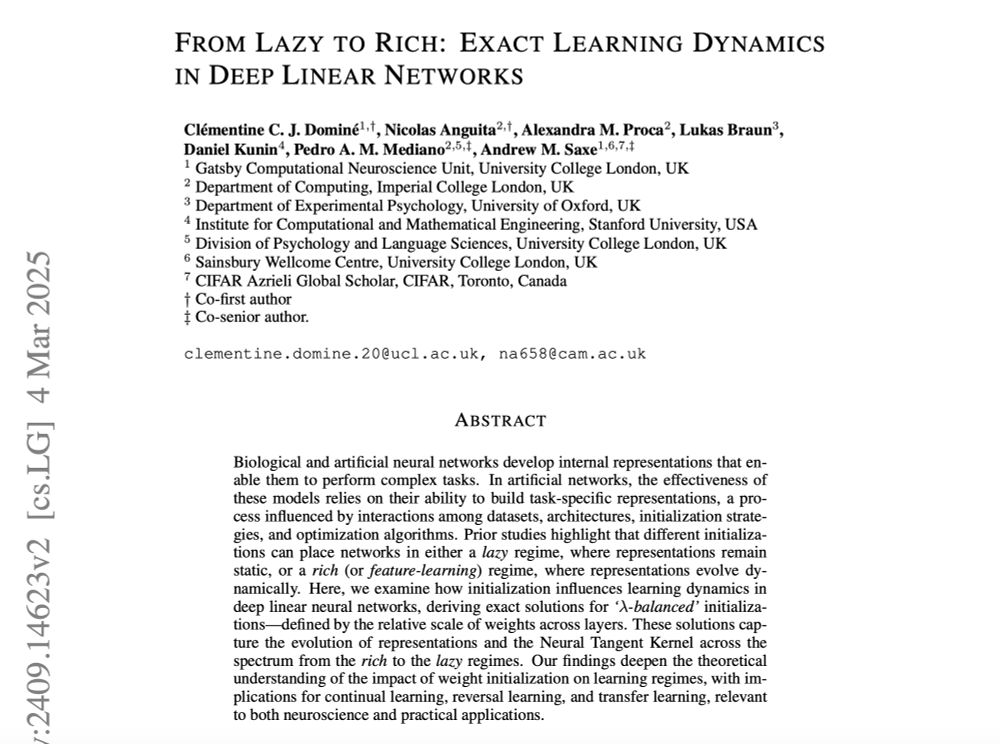
🚀 An other Exciting news! Our paper "From Lazy to Rich: Exact Learning Dynamics in Deep Linear Networks" has been accepted at ICLR 2025!
arxiv.org/abs/2409.14623
A thread on how relative weight initialization shapes learning dynamics in deep networks. 🧵 (1/9)
04.04.2025 14:45 — 👍 29 🔁 9 💬 1 📌 0
Already feeling #cosyne2025 withdrawal? Apply to the Flatiron Institute Junior Theoretical Neuroscience Workshop! Applications due April 14th
jtnworkshop2025.flatironinstitute.org
02.04.2025 16:49 — 👍 9 🔁 8 💬 0 📌 0
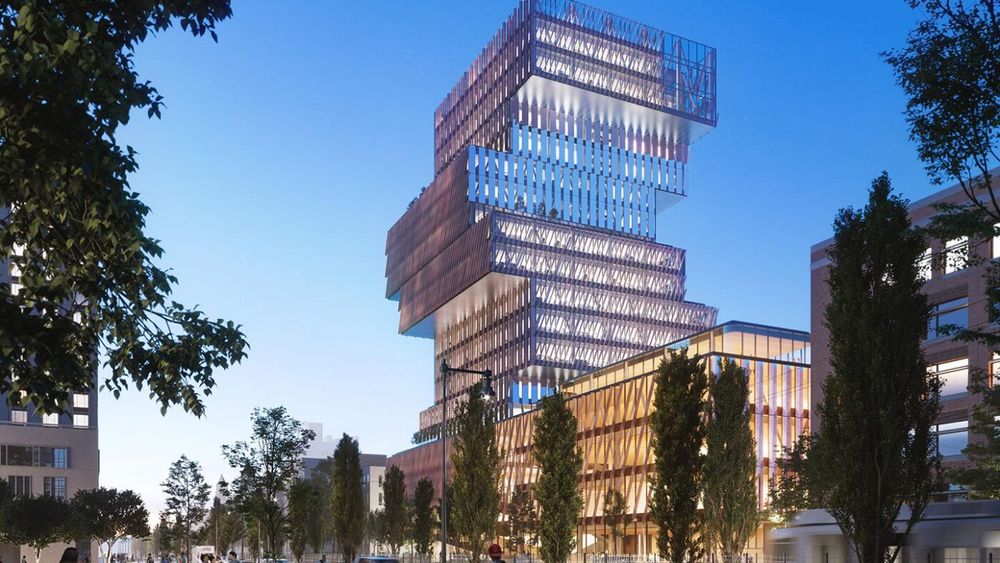
CDS building which looks like a jenga tower
Life update: I'm starting as faculty at Boston University
@bucds.bsky.social in 2026! BU has SCHEMES for LM interpretability & analysis, I couldn't be more pumped to join a burgeoning supergroup w/ @najoung.bsky.social @amuuueller.bsky.social. Looking for my first students, so apply and reach out!
27.03.2025 02:24 — 👍 244 🔁 13 💬 35 📌 7

About — Hands Off!
What are you plans for April 5th? Decide now which event you'll attend and who you'll bring along. See you in the streets!
handsoff2025.com/about
26.03.2025 18:13 — 👍 14 🔁 6 💬 1 📌 1
I'll be presenting this at #cosyne2025 (poster 3-50)!
I'll also be giving a talk at the "Collectively Emerged Timescales" workshop on this work, plus other projects on emergent dynamics in neural circuits.
Looking forward to seeing everyone in 🇨🇦!
26.03.2025 18:54 — 👍 12 🔁 2 💬 1 📌 0

Our paper, “A Theory of Initialization’s Impact on Specialization,” has been accepted to ICLR 2025!
openreview.net/forum?id=RQz...
We shows how neural network can build specialized and shared representation depending on initialization, this has consequences in continual learning.
(1/8)
26.03.2025 17:38 — 👍 7 🔁 3 💬 1 📌 1
We'll have a poster on this at #Cosyne2025 in the third poster session (3-055). Come say hi if you're curious!
24.03.2025 19:48 — 👍 2 🔁 0 💬 0 📌 0

Key-value memory in the brain
Classical models of memory in psychology and neuroscience rely on similarity-based retrieval of stored patterns, where similarity is a function of retrieval cues and the stored patterns. While parsimo...
In particular, barcodes are a plausible neural correlate for the precise slot retrieval mechanism in key-value memory systems (see arxiv.org/abs/2501.02950)! Barcodes provide a content-independent scaffold that binds to memory content, + prevent memories with overlapping content from blurring.
24.03.2025 19:46 — 👍 2 🔁 0 💬 0 📌 0

Why is this useful? We show that place fields + barcode are complementary. Barcodes enable precise recall of cache locations, while place fields enable flexible search for nearby caches. Both are necessary. We also show how barcode memory combines with predictive maps-- check out the paper for more!
24.03.2025 19:46 — 👍 1 🔁 0 💬 1 📌 0

A memory of a cache is formed by binding place + seed content to the resulting RNN barcode via Hebbian learning. An animal can recall this memory from place inputs (and high recurrent strength in the RNN). These barcodes capture the spatial correlation profile seen in data.
24.03.2025 19:46 — 👍 0 🔁 0 💬 1 📌 0

We suggest a RNN model of barcode memory. The RNN is initialized with random weights and receives place inputs. When recurrent gain is low, RNN units encode place. With high recurrent strength, the random weights produce sparse + uncorrelated barcodes via chaotic dynamics.
24.03.2025 19:46 — 👍 0 🔁 0 💬 1 📌 0

We were inspired by @selmaan.bsky.social and Emily Mackevicius' data of neural activity in the hippocampus of food-caching birds during a memory task. Cache events are encoded by barcode activity, which are sparse and uncorrelated patterns. Barcode and place activity coexist in the same population!
24.03.2025 19:46 — 👍 1 🔁 0 💬 1 📌 0
Barcode activity in a recurrent network model of the hippocampus enables efficient memory binding
How does barcode activity in the hippocampus enable precise and flexible memory? How does this relate to key-value memory systems? Our work (w/ Jack Lindsey, Larry Abbott, Dmitriy Aronov, @selmaan.bsky.social ) is now in eLife as a reviewed preprint: elifesciences.org/reviewed-pre...
24.03.2025 19:46 — 👍 21 🔁 9 💬 1 📌 2
We’re organizing a #CoSyNe2025 workshop on what agent models can teach us about neuroscience! See Sat’s thread for more info 😊
18.02.2025 19:08 — 👍 15 🔁 3 💬 0 📌 0
Thanks for putting this together! Would also love to be added :)
26.11.2024 23:16 — 👍 1 🔁 0 💬 0 📌 0
Thanks for making this Amy! Would also like to be added if possible :)
26.11.2024 20:44 — 👍 0 🔁 0 💬 0 📌 0
PhD student in Neuroscience at Harvard Medical School.
Ph.D. Student Mila / McGill. Machine learning and Neuroscience, Memory and Hippocampus
Postdoc with Andrew Saxe at the Gatsby unit.
Mathematics & Music Composition Undergrad at Soochow Univ. in Taiwan
Computational Neuroscience RA at Harvard, Oxford & NYU (three separate projects)
I'm interested in imagination, mental simulation and memory retrieval!
https://yangwu15.github.io/
CS Master’s @ NTHU | previously @ NCTU & NYMU in Cog. Neuro.
Researching architectural experience, social issues, and human-AI co-design through cog. comp. neurosci. & HCI - drawing inspiration from everyday.
https://www.notion.so/YC-s-Personal-Site-1d1f
Research Scientist @META | Guest Researcher @FlatironCCN | Visiting Scholar @NYU | PhD @ZuckermanBrain @Columbia | Neuro & AI Enthusiast
PhD student at Harvard/MIT interested in neuroscience, language, AI | @kempnerinstitute.bsky.social @mitbcs.bsky.social | prev: Princeton neuro | coltoncasto.github.io
Postdoc at Yale University studying emotions, language, and decision-making
i like generative models, science, and Toronto sports teams
phd @ mila/udem, prev. @ uwaterloo
averyryoo.github.io 🇨🇦🇰🇷
Computational cog neuro | PhD candidate @ Yale | NSFGRFP | Dartmouth ‘20
ericabusch.github.io
Postdoc at MIT in the jazayeri lab. I study how cerebello-thalamocortical interactions support non-motor function.
gabrielstine.com
neuro and AI (they/she)
Allen Institute for Neural Dynamics, theory lead | UW affiliate asst prof
neuroscientist and new mom
currently Harvard postdoc, Stanford PhD
curious about how animals learn stuff
here for the brains | https://selmaan.github.io
I like brains 🧟♂️ 🧠
PhD student in computational neuroscience supervised by Wulfram Gerstner and Johanni Brea
https://flavio-martinelli.github.io/
PhD student at Brown | Previously: Tsinghua Uni, Harvard
Postdoc in compneuro with Alex Pouget in Geneva
Mobilizing the fight for science and democracy, because Science is for everyone 🧪🌎
The hub for science activism!
Learn more ⬇️
http://linktr.ee/standupforscience