UBA6 specificity for ubiquitin E2 conjugating enzymes reveals a priority mechanism of BIRC6
Nature Structural & Molecular Biology - Riechmann et al. uncover structural features governing ubiquitin transfer from ubiquitin-activating E1 enzymes UBA1 and UBA6 to specific E2...
Excited to share our work into ubiquitin E1-E2 specificity mechanisms. CryoEM visualising #ubiquitin transfer,biochemistry,evolution @labhofmann.bsky.social & tissue expression analyses @psarkies.bsky.social Big thanks to the team,reviewers & handling editor @dimitristypas.bsky.social rdcu.be/eTRdR
09.12.2025 13:21 — 👍 21 🔁 9 💬 2 📌 2

SAVE THE DATE!
The EMBO workshop "Ubiquitin and Ubiquitin-like proteins in Health and Disease" will be on September 2026.
Exciting line up of talks and an amazing location!
Organised by @kulathu.bsky.social, @merbllab.bsky.social, @simonapolo.bsky.social, Claudio Joazeiro.
Registration open soon.
08.12.2025 13:16 — 👍 18 🔁 15 💬 0 📌 0
Differential targeting of human pyroptotic Caspase-5 and Caspase-4 by Shigella OspC2 and OspC3 https://www.biorxiv.org/content/10.64898/2025.12.04.692159v1
05.12.2025 02:16 — 👍 1 🔁 2 💬 0 📌 0

Ubiquitin pathway blockade reveals endogenous ADP-ribosylation marking PARP7 and AHR for degradation | The EMBO Journal
imageimageDegradation mechanisms of transcriptionally active aryl hydrocarbon receptor (AHR)
are unclear. This work reveals that PARP7 ADP-ribosylates itself and ligand-bound
AHR, creating a recogniti...
In our latest study we show that ligand-activated transcription factor AHR (environmental sensor) is ADP-ribosylated by PARP7. This ADP-ribose mark is recognised by the E3 ubiquitin ligase DTX2 targeting AHR for proteasomal degradation, enabling cells to rapidly shut down AHR-mediated transcription.
02.12.2025 08:28 — 👍 6 🔁 1 💬 1 📌 1

Mono-ADP-ribosylation as a degradation mark?
@andriigorelik.bsky.social, Ivan Ahel et al observe increased ADP-ribosylation of aryl hydrocarbon receptor (AHR) & PARP7 upon ubiquitin-proteasome blockage, crosstalk with DTX2 E3, as rapid AHR-transcription off-switch
www.embopress.org/doi/full/10....
01.12.2025 15:20 — 👍 5 🔁 3 💬 0 📌 0
Congrats! Glad to see you’re finally working on ubiquitin! :)
29.11.2025 05:34 — 👍 3 🔁 0 💬 1 📌 0

We’ve made some new tools to manipulate N-recognins. Check them out in our preprint.
www.biorxiv.org/content/10.1...
29.11.2025 03:24 — 👍 17 🔁 13 💬 0 📌 0
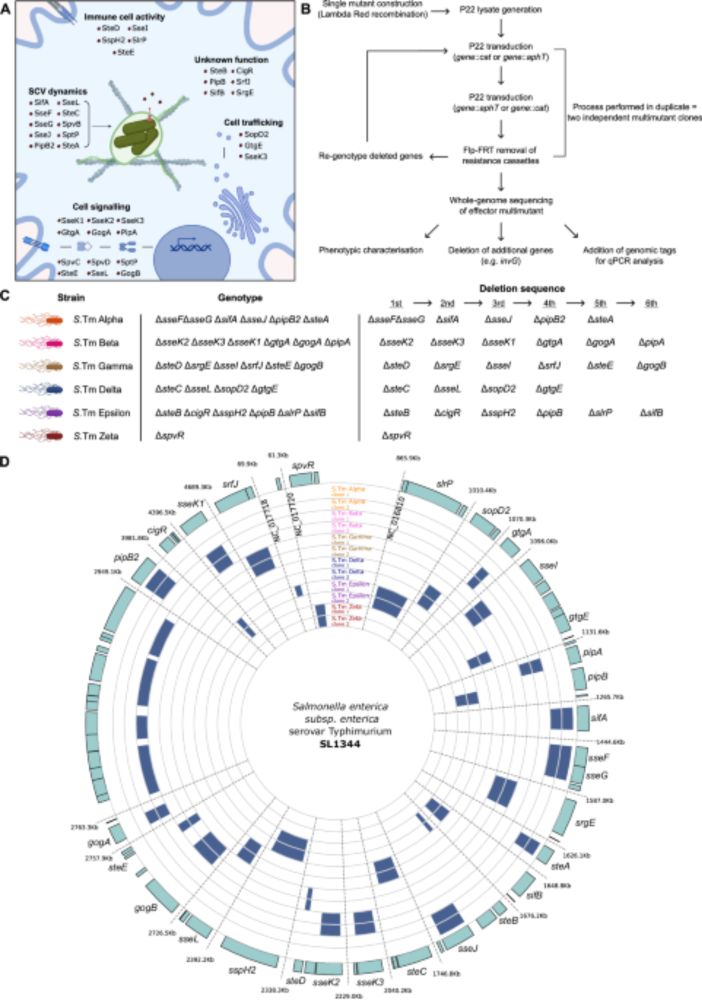
Our new preprint is online! Viruses, bacteria and parasites use effector proteins to evade immunity and rewire host cell pathways. Together with @AlexanderStark8, we wondered if we could systematically map what these effectors, regardless of their origin, do in human cells. 1/8
18.11.2025 15:57 — 👍 49 🔁 21 💬 2 📌 1
Well deserved!!
24.11.2025 10:44 — 👍 3 🔁 0 💬 0 📌 0
So proud of the lab for its achievements - Thank you to the Pettenkofer foundation for recognising our contributions - here’s to some more bacterial effector related fun in the future! @dunnschool.bsky.social
23.11.2025 21:43 — 👍 13 🔁 3 💬 1 📌 1

🚨 Postdoc position in my lab!
A project on protein binder discovery for K6-linked #ubiquitin to investigate their role in infection is available.
📍 DTU, Copenhagen, Denmark
⏰ Deadline: 18 December 2025
Apply here: efzu.fa.em2.oraclecloud.com/hcmUI/Candid...
21.11.2025 16:44 — 👍 7 🔁 14 💬 1 📌 0
⏳Four days to go until #AusUb2025! Check out the video below to hear some conference tips and tricks from our committee chair David Komander (and some potentially controversial interest rankings!?!?).
More interviews to come in the next few days so watch this space 😉
16.11.2025 12:25 — 👍 11 🔁 7 💬 0 📌 0
See you there!
17.11.2025 07:16 — 👍 2 🔁 0 💬 1 📌 0

Photo of the Baylink lab group that attended ASMNW.
ASM NW was wonderful this year! In addition to the great science, this trainee-focused meeting plays such an important role in providing the next generation of scientists, microbiologists, and clinicians an opportunity to learn, network, and share their own research.
🧪🦠
12.11.2025 16:55 — 👍 9 🔁 1 💬 0 📌 0
Can we improve peer review? We think we can! Check out an experiment I helped with as part of @solvingforsci.bsky.social 's mission to make science better.
And if you don't want to read the whole bioRxiv manuscript, here's an overview of the main findings:
solvingfor.org/news-posts-d...
05.11.2025 23:25 — 👍 15 🔁 9 💬 1 📌 1
Non-covalent SUMO interactions with (de)conjugation enzymes
SUMOylation – a protein post-translational modification (PTM) related to ubiquitylation – involves the reversible covalent attachment of the small ubiquitin-like modifier (SUMO) to proteins. During th...
SUMO interactions: the 1st of two reviews which Aanchal (@origichals.bsky.social), El Hadji, and I have recently written on non-covalent interactions of SUMO is now out. The 1st covers interactions with E1, E2, and deSUMOylating enzymes; the 2nd - on interactions with SIMs etc. - will appear soon.
05.11.2025 13:44 — 👍 15 🔁 5 💬 1 📌 1
Have a look at this Tools of the Trade Article I wrote for @natrevmcb.nature.com on decoding #ubiquitin signals inside cells using UbiREAD!
Many thanks to @lisaheinke.bsky.social for the opportunity to write this TotT!
04.11.2025 10:04 — 👍 24 🔁 12 💬 0 📌 1
Independent mechanisms of inflammation and myeloid bias in VEXAS syndrome - Nature
Nature - Independent mechanisms of inflammation and myeloid bias in VEXAS syndrome
🚨Thrilled to share our latest work, published online today
@nature.com in which we decipher mechanisms underlying the enigmatic VEXAS syndrome - a huge team effort
@mskcancercenter.bsky.social led by superstars Varun Narendra + @tandriladas.bsky.social 1/
www.nature.com/articles/s41...
04.11.2025 00:52 — 👍 19 🔁 10 💬 3 📌 0
It's been an amazing year for the new PTM field of #MARUbylation - happy that I could get involved first-hand!
03.11.2025 13:42 — 👍 5 🔁 2 💬 0 📌 0

This October I’m drawing 1 molecule a day inspired by proteins in pdb @rcsbpdb.bsky.social
Day 20/31
Prompt RIVALS
Pdb: 8V27 & 8G6S
Two rival histone modifications on a nucleosome. Ubiquitination of H2BK120 activates genes while H2AK119 represses them.
Next: BLAST
Suggestions?
02.11.2025 03:11 — 👍 55 🔁 10 💬 3 📌 3
At the Department of Biochemistry, University of Oxford, UK. Structural biology. Ubiquitination pathways. elliottlab.web.ox.ac.uk
Postdoc researching ubiquitin biology @CVR in the context of viral infection. Equality, Diversity, and Inclusion (EDI) Advocate. What I say here is my personal opinion.
X: UbcH_Alice
thefletcherlab.co.uk
Group Leader, MRC Laboratory of Molecular Biology & Joint Head of the Division of Protein & Nucleic Acid Chemistry. Senior Executive Editor, Nucleic Acids Research.
Fights like a cow.
taipalelab.org
Assistant Professor at Yonsei University. Trying to Understand Ubiquitin Biochemistry, Molecular Signaling. Formerly @iDikic2 @MPIBP
Bioinformatician @ University of Cambridge
https://github.com/niekwit
keen on reverse transcription | also keen on spliceosomes | cryoEM dabbler
Assistant Member @MSKCC
Formerly post-doc @MIT
Formerly-formerly PhD @MRC_LMB
Formerly formerly-formerly Otago Uni
Kiwi 🥝 🇳🇿
https://wilkinsonlab.bio/
Official account of The Australian Ubiquitin Summit.
LinkedIn - The Australian Ubiquitin Summit
Twitter - @AUSUbiquitin
https://www.lorneubiquitin.org/
Our lab at San Raffaele Scientific Institute & University (@unisr.bsky.social) seeks to dissect the complex dynamics of immune responses to pathogens and tumors
Associate professor at ETH Zurich, studying the cellular consequences of genetic variation. Affiliated with the Swiss Institute of Bioinformatics and a part of the LOOP Zurich.
Assistant Prof. at Stanford & Innovation Investigator at @arcinstitute.org | Studying metabolites and their impact on physiology and disease 🦠🧪
www.arcinstitute.org/labs/levylab
Postdoc @UoD @CeTPD with Alessio Ciulli
Structural & chemical biology in Targeted Protein Degradation
Professor and Chair, Department of Microbiology, University of Chicago. Study the pathogenesis of tuberculosis, and other mycobacterial infections. Opinions my own.
Virginie Hamel & Paul Guichard Lab at University of Geneva
#cryoEM/ET❄️ and #UExM ⚗️ #ExpansionMicroscopy #TeamTomo
Genève, Suisse 🇨🇭
https://mocel.unige.ch/research-groups/guichard-hamel/overv
National Crystallization Center
www.getacrystal.org
The National Crystallization Center is a National Resource (US) funded by NIH NIGMS. We perform crystal-growth screening experiments for biological macromolecules.
PhD student | MRC-UofG Centre for Virus Research 🦠🏴
E3 ligases in innate immunity
(she/her)
Physician scientist fascinated by fungi, studying Valley Fever/Coccidioides. Escape room enthusiast. TBTL ten.
organismal biologist & geneticist | PI at med school in Houston | amazed by microbial superpowers | he/him
#microbiome #Celegans #spacebiology #firstgen 🧫 🦠 🧪 🧬
GS: https://bit.ly/goog-schol-buck-sam
ORCID: 0000-0002-4347-3997
How do cells see, smell, touch, and talk? Postdoc in the Mignot lab @LCB Marseille. Images -> Numbers (with units!). Also into guitars and amps.