Hologic to go private in up to $18.3 billion deal backed by Blackstone, TPG reut.rs/3WUsX37
21.10.2025 13:05 — 👍 6 🔁 6 💬 1 📌 0
@dkaitos.bsky.social
Biotechnologist. Interested in Microbiology, Molecular Biology, IVD Industry, Technology, Automation, AI, Business, Art... 🌍🧪🧫🧬
Hologic to go private in up to $18.3 billion deal backed by Blackstone, TPG reut.rs/3WUsX37
21.10.2025 13:05 — 👍 6 🔁 6 💬 1 📌 0
"Insurance conglomerates, such as UnitedHealthcare and CVS–Aetna, now control physicians, home care, pharmacies, and pharmacy benefit managers (PBMs)."
In @nejm.org today
www.nejm.org/doi/full/10....
🧐 What is TMO planning to buy next? Maybe someone putting together TMO assets with other Life Sciences business on sale?
17.06.2025 16:31 — 👍 2 🔁 0 💬 0 📌 0Colon cancer is on the rise around the world. This new report concludes that early-life exposure to gut bacteria that produces colibactin, which is mutagenic, may be contributing
www.nature.com/articles/s41...
Having scientific advisors can make a big difference to policy making, in the US and worldwide.
An example here is FDR's science advisor Vannevar Bush, who created the 'Two systems' model of scientific innovation 80 years ago.
Chapter 5 for Key trends in AI Science and Medicine. hai.stanford.edu/ai-index/202...
22.04.2025 12:47 — 👍 1 🔁 0 💬 0 📌 0#OnThisDay in 1941 the first patient, Albert Alexander, was treated with Penicillin. This event marked the success of antibiotics and their application in medicine. His story serves as a testament to inspire researchers to develop new life-saving antibiotics in an effort against AMR #KnockingOutAMR
12.02.2025 13:03 — 👍 12 🔁 16 💬 0 📌 1
A portion of a nebula, made of variously-coloured layers of dust clouds. One upper layer is dark reddish dust which is dense and obscures light, in places so dense that it appears black. A middle layer is pale clouds that are thick like curling wisps of smoke. They form a broad bow across the centre of the image. Many small, bright stars lie throughout the nebula, coloured blue, purple or red depending on depth.
🔭 The Universe is a dusty place.
This NASA/ESA Hubble Space Telescope picture shows swirling clouds of gas and dust near the Tarantula Nebula, the most productive star-forming region in the nearby Universe, home to the most massive stars known.

Learning the language of life with A.I.
@science.org
In today's essay, I review the phenomenal progress in foundation models of DNA, RNA, proteins, ligands, cells, their interactions, the Virtual Lab, and the aspiration for the Virtual Cell
www.science.org/doi/10.1126/...
 20.01.2025 21:15 — 👍 0 🔁 0 💬 0 📌 0

Figure 1 Mechanisms of action of key antibiotics for the treatment of multidrug-resistant Gram-negative bacterial infections Several classes of antibiotics are available for the treatment of multidrug-resistant Gram-negative bacterial infections. Their mechanisms of action focus on key aspects of bacterial cell function, such as inhibiting cell wall synthesis (ie, β-lactams and fosfomycin) and function (ie, polymyxins), protein synthesis (ie, aminoglycosides and tetracyclines), folic acid synthesis (ie, trimethoprim and sulphonamides), and DNA replication (ie, fluoroquinolones). Because of increasing antimicrobial resistance, novel antibiotics have been developed to overcome some of these mechanisms; for example, by inhibiting antibiotic modification (ie, β-lactamase inhibitors) or by altering entry pathways (ie, cefiderocol, which enters via iron transporters). DHF=dihydrofolic acid. PABA=para-aminobenzoic acid. THF=tetrahydrofolate.

Figure 2 Diagnostic testing of multidrug-resistant Gram-negative bacteria Diagnosis of multidrug-resistant Gram-negative bacterial infections involves both species identification and antibiotic susceptibility testing. Although clinical microbiology laboratories have undergone automation of these processes and have seen the introduction of proteomic methods, such as MALDI-TOF, delays in turnaround time remain and might affect patient outcomes. New biochemical, molecular (eg, PCR), automated microscopy, and hybridisation-based rapid diagnostics now allow faster detection of antimicrobial resistance, including by testing clinical samples directly. Emerging technologies are seeking to improve both the speed of testing and provide more detailed information regarding the underlying mechanisms of antimicrobial resistance. MALDI-TOF=matrix-assisted laser desorption/ionisation time-of-flight.

Figure 3 Summary of new antibiotic agents for the treatment of multidrug-resistant Gram-negative bacterial infections Green=antibiotic is reliably active in vitro and guideline recommended. Yellow=variable activity; antibiotic might be effective if in vitro susceptibility is shown, clinical data might be lacking to support routine use. Red=not recommended, likely absence of in vitro susceptibility. IV=intravenously. *Administered simultaneously via Y-site administration. †Administration was studied in combination with imipenem–cilastatin.
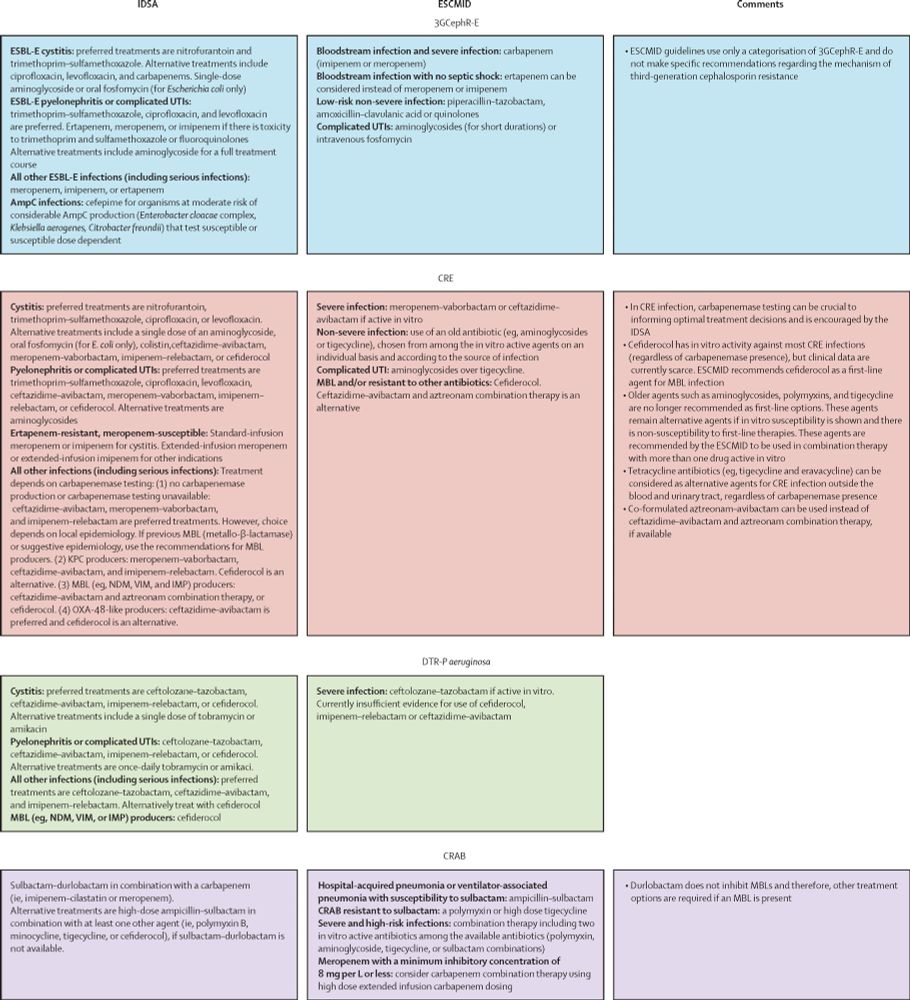
Figure 4 Summary of IDSA and ESCMID guidelines for the treatment of multidrug-resistant Gram-negative bacterial infections 3GCephR-E=third-generation cephalosporin-resistant Enterobacterales. AmpC-E=β-lactamase producing Enterobacterales. CRAB=carbapenem-resistant Acinetobacter baumannii. CRE=carbapenem-resistant Enterobacterales. DTR-P aeruginosa=difficult-to-treat resistant-Pseudomonas aeruginosa. ESBL-E=extended-spectrum β-lactamase-producing Enterobacterales. ESCMID=European Society for Clinical Microbiology and Infectious Diseases. IDSA=Infectious Diseases Society of America. MBL=metallo-β-lactamase. UTI=urinary tract infection.
#IDSky #MedSky required reading:
Multidrug-resistant Gram-negative bacterial infections
Nenad Macesic, Anne-Catrin Uhlemann, Anton Peleg
Review in @thelancet.bsky.social
doi.org/10.1016/S014...

A model image of what our home galaxy, the Milky Way, might look like face-on: as viewed from above the disc of the galaxy, with its spiral arms and bulge in full view. In the centre of the galaxy, the bulge shines as a hazy oval, emitting a faint golden gleam. Starting at the central bulge, several glistening spiral arms coil outwards, creating a perfectly circle-shaped spiral. They give the impression of someone having sprinkled pastel purple glitter on the pitch-black background, in the shape of sparkling, curled-up snakes.

A model image of what our home galaxy, the Milky Way, might look like edge-on, against a pitch-black backdrop. The Milky Way’s disc appears in the centre of the image, as a thin, dark-brown line spanning from left to right, with the hint of a wave in it. The line appears to be etched into a thin glowing layer of silver sand, that makes it look as if it was drawn with a coloured pencil on coarse paper. The bulge of the galaxy sits like a glowing, see-through pearl in the shape of a sphere in the centre of this brown line
The ESA #Gaia mission has delivered the best Milky Way maps to date and taken its last starlight before spacecraft retirement 🔭
www.esa.int/Science_Expl...
Hello Bluesky! New in the neighborhood, following other birds 🎉
15.01.2025 18:08 — 👍 1 🔁 0 💬 0 📌 0