This is an impressively comprehensive website listing organizations and efforts to support in MN:
www.standwithminnesota.com

@karincox.bsky.social
Postdoctoral Scholar, Dept. of Neurobiology, University of Pittsburgh Images: Pittsburghthreerivers, CC BY-SA 4.0 <https://creativecommons.org/licenses/by-sa/4.0>, via Wikimedia Commons https://legacyarttour.org/2010/01/blue-dog-2000-the-year-of-xerox.html
This is an impressively comprehensive website listing organizations and efforts to support in MN:
www.standwithminnesota.com

In 6-OHDA + MitoPark mice: Li et al. (www.nature.com/articles/s41...) report that (1) DBS inhibits STN neurons, reflecting greater drops in pre-synaptic glutamate vs. GABA release, and (2) chemogenetic inhibition of STN replicates the restorative effects of DBS on locomotion and rotarod tests.
10.01.2026 17:26 — 👍 1 🔁 0 💬 0 📌 0New ephys + modeling paper suggesting that lateral inhibition explains paradoxical SNr activation following optogenetic activation of dSPNs:
Synaptic integration and competition in the substantia nigra pars reticulata—An experimental and in silico analysis | PNAS www.pnas.org/doi/full/10....
While these results await empirical validation, they raise interesting questions. To inhibit reflexes, what are the contributions of descending commands vs. local interactions? And do under-controlled reflexes contribute to slow/altered limb trajectories in movement disorders, including PD? (4/4)
25.12.2025 08:25 — 👍 0 🔁 0 💬 0 📌 0(2) Two modeled mechanisms (coordinated activation of α- and γ-motoneurons, or inhibition of γ-motoneurons by α-motoneuron collaterals) can effectively reduce such disruption. (3) However, neither mechanism is, in their words, a panacea -- meaningful disruption remained for some reaches. (3/4)
25.12.2025 08:25 — 👍 0 🔁 0 💬 1 📌 0Niyo et al. ask whether/how the nervous system prevents velocity-dependent stretch reflexes from disrupting voluntary movement. Observations from their model of a macaque arm: (1) Left disinhibited, stretch reflexes would substantially disrupt movements.
(2/4)
Happy Holidays. Here's a 2024 PNAS modeling paper that merits wider awareness:
A computational study of how an α- to γ-motoneurone collateral can mitigate velocity-dependent stretch reflexes during voluntary movement | PNAS www.pnas.org/doi/10.1073/...
(1/4)
![Comment Template
COMMENT SUBMISSION INSTRUCTIONS: All submissions must include the agency name and docket number or RIN for this rulemaking. Please arrange and identify your comments on the regulatory text by subpart and section number; if your comments relate to the supplementary information, please refer to the heading and page number. All comments received will be posted publicly without change, including any personal information provided. To ensure that your comments will be considered, you must submit them on or prior to May 23, 2025 at online to the Federal Register. Before finalizing this rule, OPM will consider all comments within the scope of the regulations received on or before the closing date for comments. OPM may make changes to the final rule after considering the comments received.
COMMENT STARTER: The example below is meant to get you started with your own comment. Feel free to use it with only minimal changes, to go a different direction, or anything in between. Because OPM has to consider each comment, unique comments add value to the process but all comments relevant to the proposed rule and grounded in thoughtful analysis or real experience are helpful.
[DATE]
RE: Public Comment in Response to Improving Performance, Accountability and Responsiveness in the Civil Service [Docket No. OPM–2025–0004]
I am writing to express my deep concern regarding the effort to reclassify specific fe](https://cdn.bsky.app/img/feed_thumbnail/plain/did:plc:et2wciooy67fjldjcvls34c6/bafkreicyl4znsl4b2bs6eoj24pre43elov63wmmx2suinlli2cpsposfyy@jpeg)
Comment Template COMMENT SUBMISSION INSTRUCTIONS: All submissions must include the agency name and docket number or RIN for this rulemaking. Please arrange and identify your comments on the regulatory text by subpart and section number; if your comments relate to the supplementary information, please refer to the heading and page number. All comments received will be posted publicly without change, including any personal information provided. To ensure that your comments will be considered, you must submit them on or prior to May 23, 2025 at online to the Federal Register. Before finalizing this rule, OPM will consider all comments within the scope of the regulations received on or before the closing date for comments. OPM may make changes to the final rule after considering the comments received. COMMENT STARTER: The example below is meant to get you started with your own comment. Feel free to use it with only minimal changes, to go a different direction, or anything in between. Because OPM has to consider each comment, unique comments add value to the process but all comments relevant to the proposed rule and grounded in thoughtful analysis or real experience are helpful. [DATE] RE: Public Comment in Response to Improving Performance, Accountability and Responsiveness in the Civil Service [Docket No. OPM–2025–0004] I am writing to express my deep concern regarding the effort to reclassify specific fe
All right, scientists. 🧪
The Trump administration is trying to break scientific expertise in the civil service. This will affect #NIH program staff. Red 🚨.
It's your job to submit comments by 5/23 saying that's a terrible idea!
This group has info: www.friendsofbls.org/comment-temp...

The notice and COMMENT PERIOD OPENED TODAY AND CLOSES MAY 23.
Anyone who would like to register an objection or comment should go to this page and click on the green “public comment” button at the top:
www.federalregister.gov/documents/20...
6/n

Proud to sign this petition the Pitt leadership…
actionnetwork.org/petitions/de...
Please take a moment to read and sign this excellent letter. Over 3,500 signature so far!
02.04.2025 15:47 — 👍 183 🔁 50 💬 7 📌 1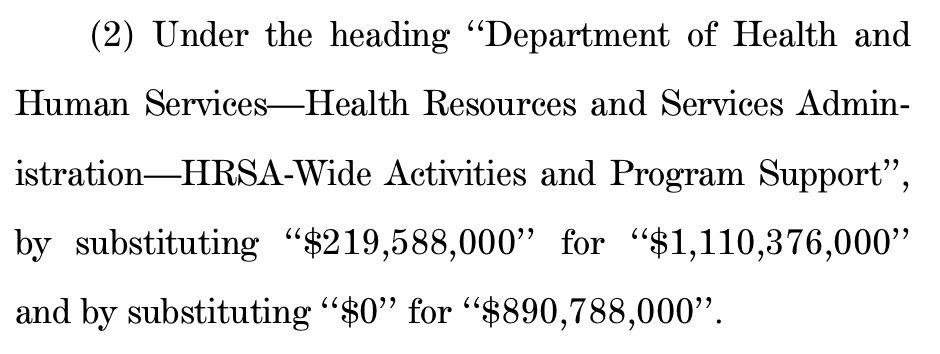
(2) Under the heading ‘‘Department of Health and Human Services—Health Resources and Services Admin12 istration—HRSA-Wide Activities and Program Support’’, by substituting ‘‘$219,588,000’’ for ‘‘$1,110,376,000’’ and by substituting ‘‘$0’’ for ‘‘$890,788,000’’
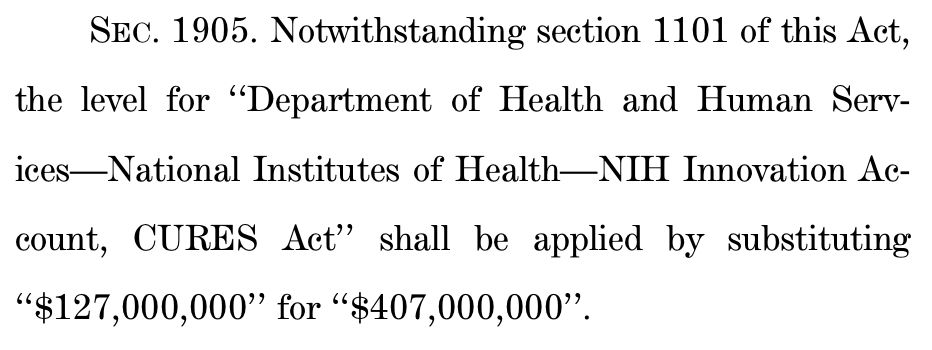
SEC. 1905. Notwithstanding section 1101 of this Act, the level for ‘‘Department of Health and Human Services—National Institutes of Health—NIH Innovation Account, CURES Act’’ shall be applied by substituting ‘‘$127,000,000’’ for ‘‘$407,000,000’’.
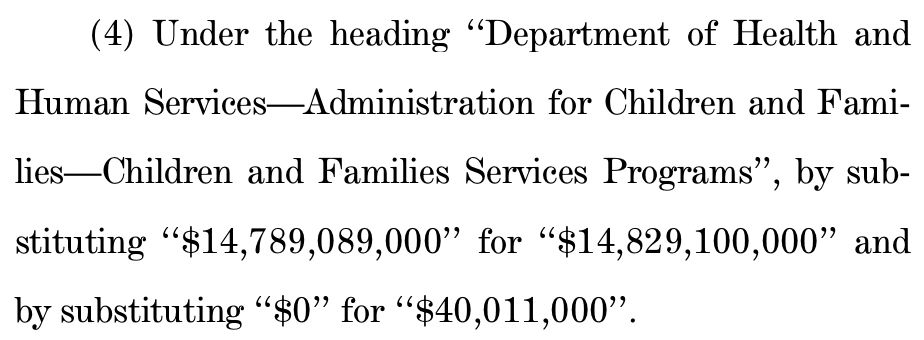
Under the heading ‘‘Department of Health and Human Services—Administration for Children and Families—Children and Families Services Programs’’, by substituting ‘‘$14,789,089,000’’ for ‘‘$14,829,100,000’’ and by substituting ‘‘$0’’ for ‘‘$40,011,000’’
What’s in yesterday's House Continuing Resolution? Major shifts in U.S. health spending you should know about:
HRSA cut by $891 million
NIH CURES Act cut by $280 million
Children & Families Services cut by $40 million
These cuts hit essential services and future innovation. 🧵⬇️
Hearing from NIH intramural people today that the travel ban is not lifted and the external communication ban is not lifted. (More info was initially promised for Feb 1.)
Some exceptions have been carved out for meetings with ongoing collaborators.
But no seminar visits or conferences.
Bad! 🧪
This account is for sharing info with US scientists, both extramural and intramural to NIH, about attacks on science in the US.
Education is power, and we can help advocate for science and medicine together. 💪🧪
We are a team of NIH people. Please ask us questions you might have.