Just had a similar experience at Scientific Reports. We will submit to Meta Psychology, great outlet! open.lnu.se/index.php/me...
26.01.2026 18:59 — 👍 1 🔁 0 💬 1 📌 0
Positive and negative self-esteem are two (or one?) such offenders that I cover in my blog post.
www.the100.ci/2023/06/13/d...
22.01.2026 12:28 — 👍 16 🔁 6 💬 5 📌 1
Scientific Reports is the new Frontiers, from my experience. Low quality control, high publication fees, they have a deadline for reviewers of 10 days.
21.01.2026 19:23 — 👍 8 🔁 4 💬 2 📌 1
Many people, unfortunately, also just don't know how bad it is (one of my colleagues had no clue; now she has and she is angry).
21.01.2026 06:48 — 👍 3 🔁 0 💬 0 📌 0
This is a chance for behavioral science. Moving away from weak online studies, weak experimental manipulations, and moving to studying real behavior in real life. Remember the 60s? Social psychology was real. Asch, Milgram, et al.
09.01.2026 07:34 — 👍 4 🔁 0 💬 0 📌 0


Researchers recently asked Americans what income level other people need in order to live a good life.
A whopping 86% of Americans reported income levels well below what others say they themselves need.
Fascinating!
25.12.2025 21:19 — 👍 81 🔁 24 💬 2 📌 4

Fig. 3. Scatter plots of the synthetic and empirical estimates, validation study (Stage 2). Showing N = 30,135 item-pair correlations, N = 257 scale reliabilities, and N = 1,568 scale-pair correlations for (top) the pretrained SBERT model and (bottom) the fine-tuned SurveyBot3000 model. SBERT = all-mpnet-base-v2 model.

Fig. 4. Prediction error of the synthetic estimates, validation study (Stage 2). Our prediction model allowed the error term to vary freely according to the predictor, the synthetic estimate. The thin-plate splines show that some synthetic estimates were predictably more accurate.

Fig. 5. Accuracy by domain. Accuracy differed across domains. SurveyBot3000 accuracy (colored) was always higher than SBERT accuracy (gray). Results were largely consistent whether accuracy of items was tested (left, circle) within domains or (right, cross) across domains.
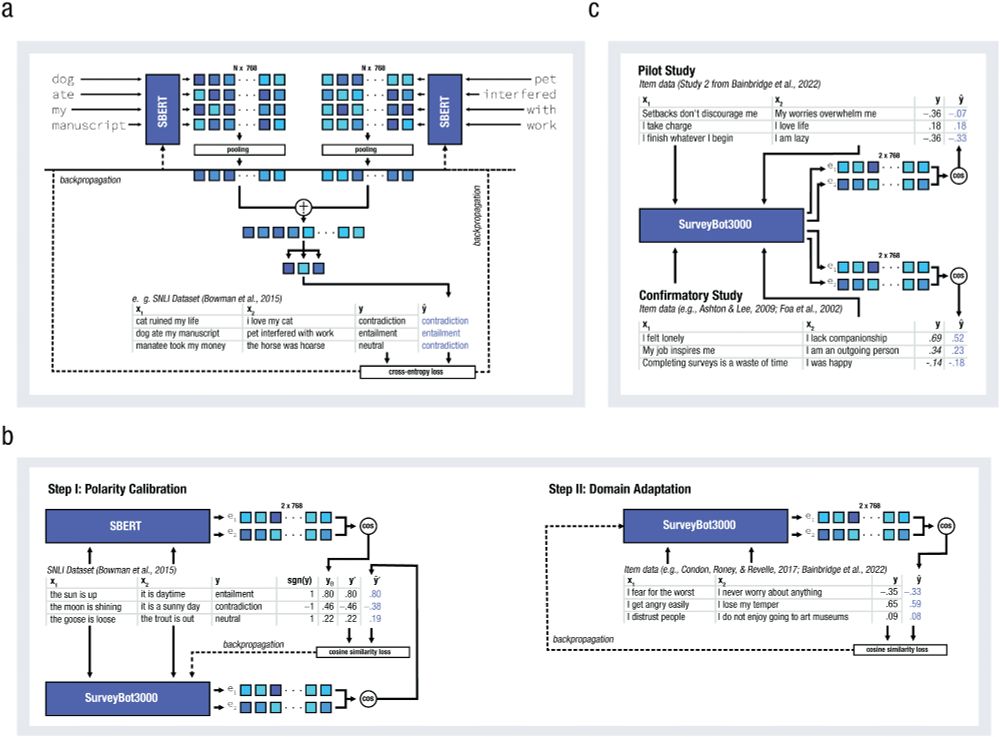
Fig. 1. Multistep training procedure for the SurveyBot3000, which produces synthetic estimates of interitem correlations. (a) Pretraining base model (SBERT). (b) Fine-tuning SurveyBot3000. (c) Validation. SBERT = all-mpnet-base-v2 model.
Finally, @bjoernhommel.bsky.social's and my paper introducing the SurveyBot3000 is officially out in AMPPS. It's a fine-tuned language model that guesstimates correlations between survey items from text alone. Not perfectly, but useful for search, for example.
journals.sagepub.com/doi/10.1177/...
18.12.2025 20:20 — 👍 80 🔁 33 💬 2 📌 6

Mapping the online manipulation economy
A market perspective on digital manipulation may help improve online trust and safety
New paper out in @science.org! We unveil the online manipulation market with the Cambridge Online Trust & Safety Index (COTSI). We show in real time the cost of purchasing fake accounts across every social platform around the world - so they can be held accountable
www.science.org/doi/10.1126/...
11.12.2025 19:05 — 👍 124 🔁 63 💬 4 📌 2

This science sleuth revealed a retraction crisis at Indian universities
Achal Agrawal is part of Nature’s 10, a list of people who shaped science in 2025.
Achal Agrawal is on Nature’s list of 10 people who shaped science in 2025. His work helped change India’s university rankings system to include a penalty for large number of retractions.
www.nature.com/articles/d41...
09.12.2025 17:13 — 👍 42 🔁 15 💬 2 📌 2
🚨STOP, replication time!🚨
Does Feeling “Right” Make the Good More Good (and the Bad More Bad)?
Achar & Lee found that when people experience regulatory fit, moral predispositions get amplified—moral folks act more moral, less moral folks act less moral. Big, exciting claim!
09.12.2025 13:08 — 👍 12 🔁 5 💬 1 📌 0

Can speed cameras make streets safer? Quasi-experimental evidence from New York City | PNAS
Each year, approximately 40,000 people die in vehicle collisions in the United States,
generating $340 billion in economic costs. To make roads saf...
Our new study provides rare causal evidence about NYC’s speed camera program. We find large reductions in collisions (30%) and injuries (16%) near intersections with cameras. www.pnas.org/doi/abs/10.1... @astagoff.bsky.social ky.social @brendenbeck.bsky.social nbeck.bsky.social 🧪
08.12.2025 20:08 — 👍 509 🔁 186 💬 9 📌 33
Does “feeling right”—that is, experiencing regulatory fit—lead us to act more in line with our moral preferences?
With @schildchristoph.bsky.social and @stepf.bsky.social, we conducted a series of the first large-scale, independent close replications in the field of regulatory fit.
05.12.2025 15:33 — 👍 9 🔁 6 💬 1 📌 1

chart of child mortality in history, roughly 48% for all societies across the globe…until the 20th century, where it plummets to 4%
Currently dorking out over this graph about child mortality with my brother. Just mind boggling to take in.
02.12.2025 05:00 — 👍 2497 🔁 974 💬 72 📌 162

Screenshot of SNL's George Washington sketch from 10/28/23 with Nate Bargatze
"We will call the 12th month of the year 'December'... which means 'tenth month.'"
01.12.2025 14:49 — 👍 1324 🔁 240 💬 27 📌 19
Sharp analysis on why 'Why $100,000 Is the New Poor'
www.yesigiveafig.com/p/part-1-my-...
01.12.2025 08:23 — 👍 0 🔁 0 💬 0 📌 0
🚨 SynthNet is out 🚨
Researchers propose new constructs and measures faster than anyone can track. We (@anniria.bsky.social @ruben.the100.ci) built a search engine to check what already exists and help identify redundancies; indexing 74,000 scales from ~31,500 instruments in APA PsycTests. 🧵1/3
26.11.2025 11:42 — 👍 158 🔁 86 💬 3 📌 3
At ZPID we are searching for a tenure track assistant professor for Psychological Metascience in joint appointment with @unitrier.bsky.social preferably someone who has conducted quantitative research in metascience in psychology or related disciplines. Questions? Feel free to contact me personally.
26.11.2025 10:37 — 👍 17 🔁 18 💬 0 📌 2
What a great idea!! Maybe I'll do the same here.
25.11.2025 16:12 — 👍 1 🔁 0 💬 1 📌 0
Doing descriptive work (rather than confirmatory) in the real world with real people in real and rich social situations.
23.11.2025 17:18 — 👍 6 🔁 0 💬 0 📌 0
Among mine was Tankstellenwärter. Haven't tried it though.
23.11.2025 10:27 — 👍 2 🔁 0 💬 1 📌 0
A consulting company here does growth mindset interventions in business here 🤦
23.11.2025 07:42 — 👍 2 🔁 0 💬 1 📌 0
dacking
20.11.2025 14:52 — 👍 2 🔁 0 💬 0 📌 0
From the paper "How is it that a seemingly meaningless scale can pass standard validity tests?"
19.11.2025 14:31 — 👍 2 🔁 0 💬 1 📌 0
I think it's not a spurious finding. I’m a bit skeptical about calling it a “seemingly meaningless scale”. People are sense-making machines, even odd items get meaning. As they show, the scale reflects relationship satisfaction. The Saturn item is actually measuring something.
19.11.2025 14:21 — 👍 2 🔁 0 💬 2 📌 0
The only positive news about this paper is that this development may incentive social scientist to go out and talk to people again
18.11.2025 19:54 — 👍 9 🔁 1 💬 0 📌 0
Y'all. N>3,800. !!!!!!!
Goodness gracious.
12.11.2025 22:49 — 👍 60 🔁 26 💬 6 📌 2
In our rejoinder, we argue 1) Dark terminology isn't used responsibly as BL et al. claim, 2) the term can be replaced with a more sensible and scientific one, 3) data support our position (Stanton et al., 2025), and 4) popularity ≠ importance. @davidchester.bsky.social @drlynam.bsky.social
17.11.2025 21:42 — 👍 29 🔁 13 💬 2 📌 2
I said that this week to my students, we should talk more about food and movies. This unites us.
14.11.2025 17:36 — 👍 1 🔁 0 💬 0 📌 0
Did you by chance measure state boredom?
14.11.2025 17:34 — 👍 0 🔁 0 💬 1 📌 0
Psychological research lab and scientific unit of the Faculty of Philosophy, University of Belgrade. #IndividualDifferences #SocialPsychology #MentalHealth #Metascience 🌐 https://lira.f.bg.ac.rs/en/ 📧 lira@f.bg.ac.rs
Post-doc at the FAIR Institute at NHH. Previously a lecturer at U.C. Berkeley. Studying inequality's consequences. Once upon a time I was an astrophysicist.
Prof. em. for Sociology and Philosphy of Science. University of Mannheim
Methods Nerd │ PCI RR Recommender
Dev Cog Neuroscience │Disability Research
Assist Prof
Open Science Coach
Linköping University 🇸🇪
Views my own
Psychology researcher, studies how well-being and health change as we grow older.
Personality psychologist studying prosocial and (un)ethical behavior · Group leader at MPI-CSL (Freiburg) · ERC-StG KNOW-THYSELF · https://csl.mpg.de/research-groups/personality-identity-and-crime
Psychologist studying cooperation, punishment, and norms.
Assistant professor at the Toulouse School of Economics and Institute for Advanced Study in Toulouse (IAST).
https://catherinemolho.github.io/
ZEW – Leibniz-Zentrum für Europäische Wirtschaftsforschung · GF: Achim Wambach, Claudia von Schuttenbach · Impressum: http://zew.de/impressum
Social psychologist | Goal pursuit, political behavior, well-being | The psychology of maintaining what we have
Associate Professor of Political Science, Aarhus University
I study political elites, institutions, and public opinion in Europe, using experiments and computational methods.
https://romansenninger.github.io/
Peer Community In Psychology is a free and fully transparent preprint recommendation service in the field of Psychology.
https://psych.peercommunityin.org/
Natural Language Processing in Behavioral Science
Postdoctoral Researcher @unileipzig.bsky.social
Personnel Selection & Assessment Technology at magnolia psychometrics https://www.magnolia-psychometrics.com/
Personality Psychology and Psychological Assessment, University of Potsdam
Associate Professor, Deparment of Psychology, Aarhus University
Interested in personality, dishonesty and all things antisocial
Enthusiastic about transparency and open science ☀️
Personality psychology professor.
Edinburgh. Tartu.
Current effort: https://whichjob.me
About psychology:
https://psychologytoday.com/us/blog/people-unexplained
https://personalitypsychologypodcast.com
🎓 Lab of Mitja Back @unimuenster.bsky.social | Personality Psychology & Psychological Assessment
Professor of Personality Psychology at the University of Greifswald
Personality psychologist at Colby College. I study the structure, assessment, development, and outcomes of personality traits and socio-emotional skills.
Psychology, education science, cognitive neuroscience, statistical methods. Prof @uni_tue. Made in Japan. Learning German.