Find out more at probnum2026.github.io
The deadline for Submissions will likely be in early March 2026.
@philipphennig.bsky.social
Professor for AI/ML Methods in Tübingen. Posts about Probabilistic Numerics, Bayesian ML, AI for Science. Computations are data, Algorithms make assumptions.
Find out more at probnum2026.github.io
The deadline for Submissions will likely be in early March 2026.
f you're looking for a place to share your ideas on computation and inference, with likeminded, friendly colleagues who give earnest, technically deep feedback, mark your calendars for 9-11 September 2026, because next year, we're going to Finnland, thanks to Toni Karvonen!
12.09.2025 07:56 — 👍 6 🔁 1 💬 1 📌 0
The very first international conference on Probabilistic Numerics is now over. Huge thanks to @motonobu-kanagawa.bsky.social for hosting us at the French Riviera!
It was amazing to see so many contributed works across Europe. Proceedings at proceedings.mlr.press/v271/.
Read on for what's next!

EurIPS is coming! 📣 Mark your calendar for Dec. 2-7, 2025 in Copenhagen 📅
EurIPS is a community-organized conference where you can present accepted NeurIPS 2025 papers, endorsed by @neuripsconf.bsky.social and @nordicair.bsky.social and is co-developed by @ellis.eu
eurips.cc
Agustinus is hiring! A great place to start a research journey.
05.07.2025 06:54 — 👍 3 🔁 1 💬 0 📌 0
We've written a monograph on Gaussian processes and reproducing kernel methods (with @philipphennig.bsky.social, @sejdino.bsky.social and Bharath Sriperumbudur).
arxiv.org/abs/2506.17366
How is it 2025 and we still don't have established structures for citeable research code, with quality control? This seems like a step in the right direction.
16.04.2025 11:57 — 👍 20 🔁 1 💬 1 📌 1Tired of your open-source ML work not getting the academic recognition it deserves? 🤔 Submit to the first-ever CodeML workshop at #ICML2025! It focuses on new libraries, improvements to established ones, best practices, retrospectives, and more.
codeml-workshop.github.io/codeml2025/
We're all about acceleration! 😉
Watch @priya-kasimbeg.bsky.social & @fsschneider.bsky.social speedrun an explanation of the AlgoPerf benchmark, rules, and results all within a tight 5 minutes for our #ICLR2025 paper video on "Accelerating Neural Network Training". See you in Singapore!
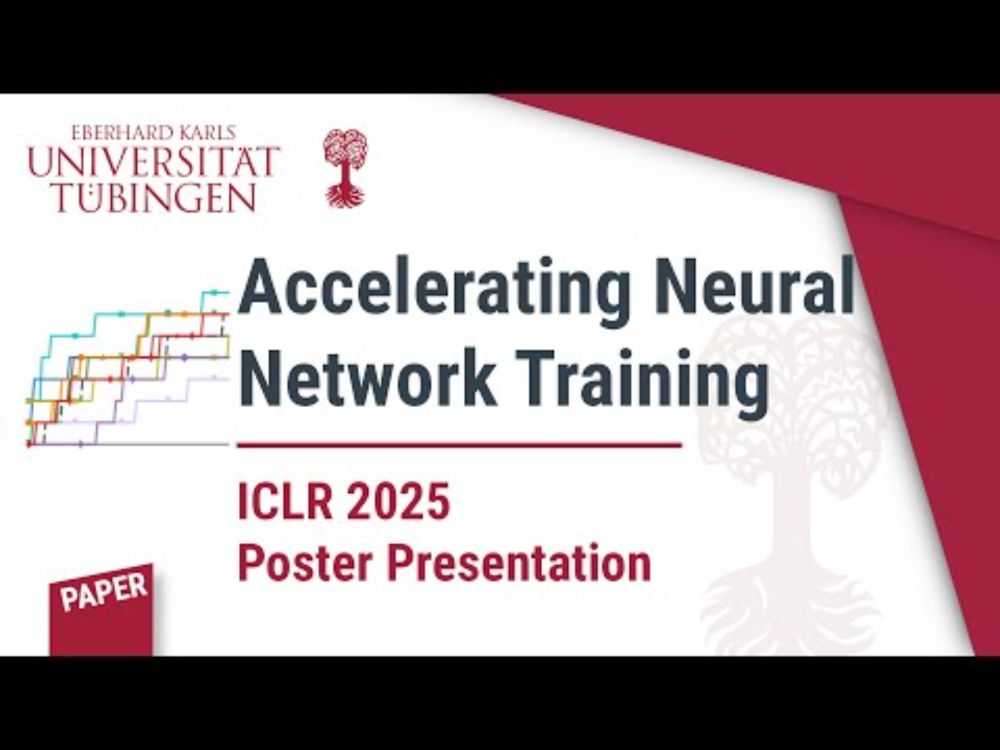
The explainer video: www.youtube.com/watch?v=_yX1...
03.04.2025 11:15 — 👍 7 🔁 2 💬 0 📌 0The set of possible solutions to a linear(ized) PDE matching a discretisation can be used as an informed prior for the nonlinear, exact PDE.
If that sentence makes your head spin, the good news is that @timwei.land has already implemented it all for you in Julia, with full #probnum functionality.
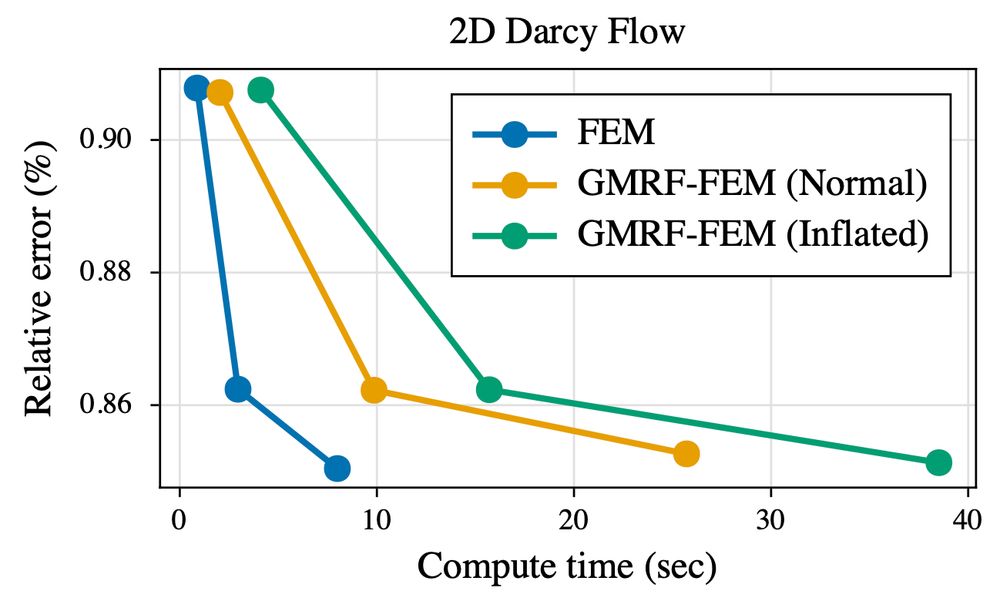
A plot comparing the performance of different methods to numerically solve PDEs. The x-axis depicts the compute time in seconds, the y-axis depicts the relative error to the ground-truth solution in percentage. The graph for the "standard" finite element method has the steepest downward slope and thus the best performance. Our methods based on Gaussian Markov Random Fields achieve the same accuracies as the finite element method, but at slight computational overheads, depicted by their graphs having a slightly flatter slope. For instance, the highest accuracy solves require ~8-9 seconds for FEM and ~25 seconds for our GMRF-based method.
⚙️ Want to simulate physics under uncertainty, at FEM accuracy, without much computational overhead?
Read on to learn about the exciting interplay of stochastic PDEs, Markov structures and sparse linear algebra that make it possible... 🧵 1/8

At the Tübingen AI Center @tuebingen-ai.bsky.social we are offering a permanent lecturer position (research+teaching of basic courses in technical computer science). Those are quite rare in Germany. You need to speak German though. Apply here:
tuebingen.ai/careers/teac...

Job alert: Join Us as a Technology Transfer Project Coordinator!
Would you like to collaborate with Prof. Peter Gehler's team on "Machine Learning in the World"? Check out our open position here: https://buff.ly/3QwIW4p

If you want to start your own research group in AI & machine learning, with access to top resources for research incl. @lumi-supercomputer.eu, generous starting package & professorship affiliation with a university in the world’s happiest country, apply by March 9: www.ellisinstitute.fi/PI-recruit
14.02.2025 11:32 — 👍 11 🔁 11 💬 0 📌 0Good point.
There's a field on the openreview form where you can upload a supplement. Alternatively, you can also add an appendix to the main submission.
We've now updated the website to note this. For camera-ready, we will tune the stylefile a bit to clarify this and harmonize appendices.
Just under a month to the deadline, the first submissions are beginning to arrive.
Looking to share your work on Bayesian Quadrature, ODE-Filters, GP-PDE-solvers, computation-aware deep learning, linear algebra, and beyond, with an audience that cares? Consider submitting your work!
Ah! It's
* 240 pts wide (default height = 240 / golden_ratio, but up to authors)
* computer modern sans serif.
* font size 9pt for axis labels and title, 7pt for ticklabels and legend.
Thanks for pointing this out, I'll expand the stylepack on the webpage with this information.

The stylesheets also automatically sets the font, and font sizes for all parts of the figure!
If your cool kids happen to prefer julia over python, they can instead use @nathanaelbosch.de's port `tueplots.jl` using
TuePlots.SETTINGS[:ProbNum25]
github.com/nathanaelbos...
ProbNum 2025 has its own beautiful style file, developed by @philipphennig.bsky.social ! Enjoy using it if you consider a submission, the deadline of which is the 3rd of March. probnum25.github.io/submissions
17.01.2025 09:06 — 👍 24 🔁 2 💬 0 📌 1a more classic, double column layout, in Computer Modern. Sneaked in A4, though.
But ProbNum25 will be the first conference I know with a stylesheet for figures and plots, thanks to @pnkraemer.bsky.social's `tueplots`. No more fontsize 2 figs!
Interested to hear what people think.
I recently put the style pack for #ProbNum25 on probnum25.github.io.
Designing it was an interesting experience. I was tempted to propose a 16:9 screen-centric layout (who still prints papers?), but I got feedback this wouldn't look "serious". So I went for... (1/2)

Thrilled to share our NeurIPS spotlight on uncertainty disentanglement! ✨ We study how well existing methods disentangle different sources of uncertainty, like epistemic and aleatoric. While all tested methods fail at this task, there are promising avenues ahead. 🧵 👇 1/7
📖: arxiv.org/abs/2402.19460
I made an account here to repost this! Join us for the first ever international conference on probabilistic numerics. We made a style pack and everything.
18.11.2024 16:30 — 👍 32 🔁 7 💬 2 📌 0