New paper out in Plos One !
By integrating group identities and affective polarization in opinion dynamics, we show that out-group intolerance is the main driver of ideological polarization.
doi.org/10.1371/jour...

@avdeville.bsky.social
Post-doc researcher @medialab-scpo.bsky.social. Opinion dynamics, online social media, political science, regulation.
New paper out in Plos One !
By integrating group identities and affective polarization in opinion dynamics, we show that out-group intolerance is the main driver of ideological polarization.
doi.org/10.1371/jour...

Our team just released a comprehensive and accessible review of Signed Networks — two years in the making! Theory, methods, applications, all in one place. Feedback welcome.
arxiv.org/abs/2511.17247
Happy to present at the Computational Social Science satellite, with the recent news this same paper was accepted just a few days ago. For now, you can see the updated preprint here: arxiv.org/abs/2409.13461
04.09.2025 15:20 — 👍 7 🔁 1 💬 0 📌 0New X dataset is out !
A public database with measurements of multidimensional political opinions, activity and popularity for almost a million X users 🔥
Including politicians and media outlets 🌍
Preprint: hal.science/hal-05222448
Data: osf.io/at5q2/
Applications for #WWCS26 are officially OPEN! ❄️
Join us in Mallorca for an unforgettable edition.
Apply now via the link in website 🌐

Earlier this year, a DSA Ad Repository Data Sprint was held at the médialab.
Organised by The Open Institute for Digital Transformations and the project ‘Putting the DSA into Practice’, the event brought together six groups to explore platform transparency from different angles.
Full article 🔽
Also featured in @physicsmagazine.bsky.social 😀
physics.aps.org/articles/v18...
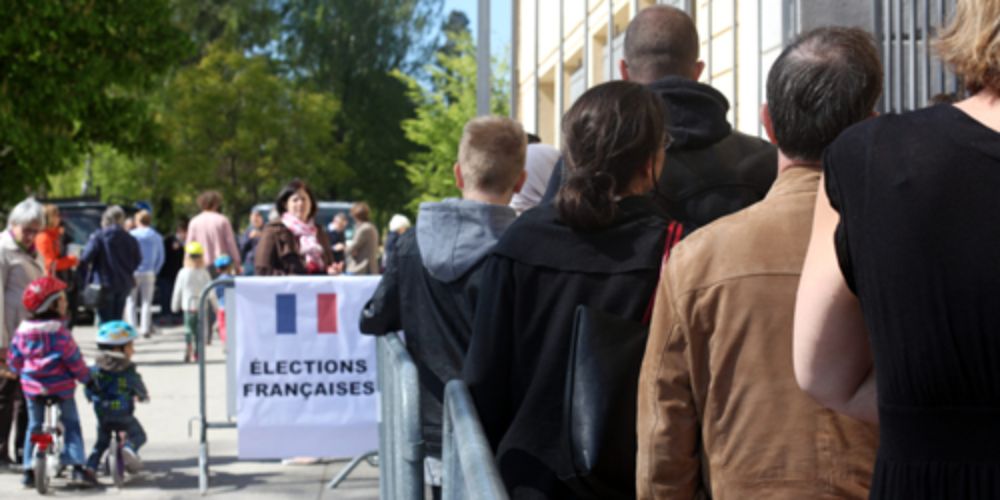
I study a retweet network collected during the 2017 French presidential elections where accounts of political entities are fixed as reference points. I show that in its equilibrium state, the Voter Model correctly identifies ground-truth opinions of more than 92% of the users.
18.06.2025 07:11 — 👍 1 🔁 0 💬 1 📌 0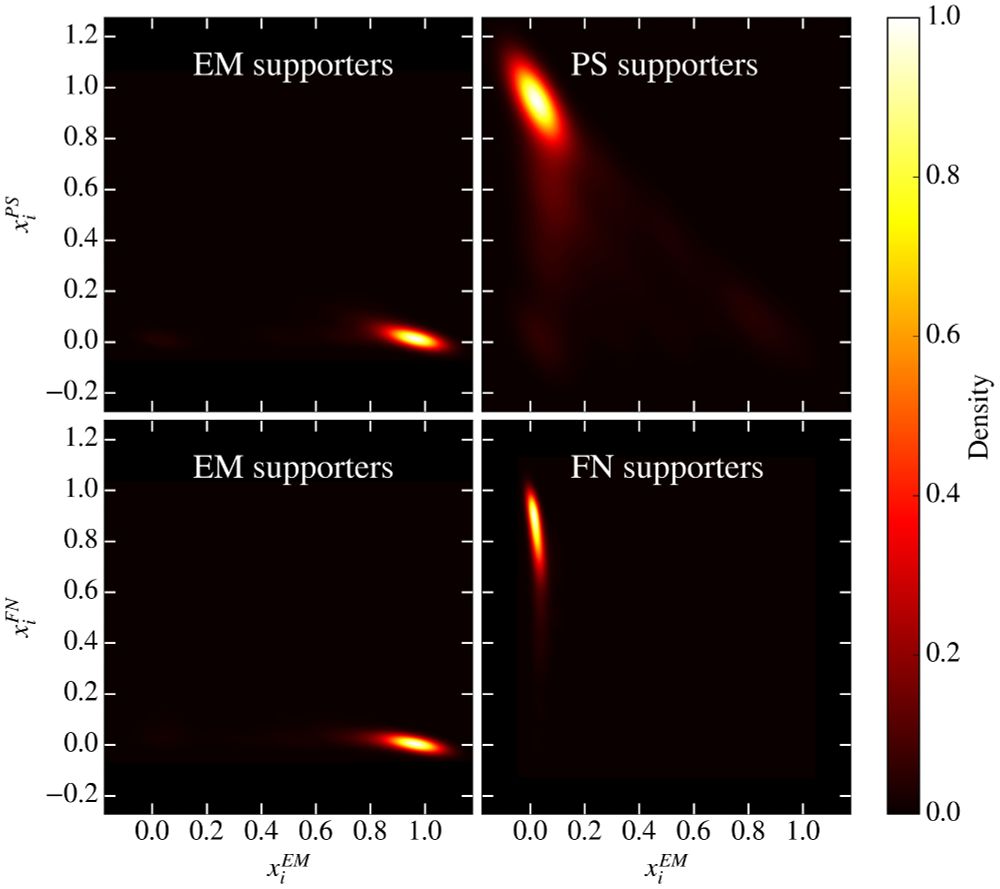
Happy to present my latest article in @physreve.bsky.social
! In this paper, I show that the Voter Model can predict individual opinions in a large, heterogeneous online population.
doi.org/10.1103/Phys...

Ce mercredi à 19h, ne manquez pas la conférence du Centre Internet et Société du @cnrs.fr et du médialab de @sciencespo.bsky.social.
Au programme, des tables rondes animées par @manonberriche.bsky.social et @algoglitch.bsky.social
Inscription : medialab.sciencespo.fr/actu/le-rese...

Ne manquez pas l’intervention de Gabriele de Seta lors du séminaire du mardi 18 mars.
Au programme, un échange autour de la créativité à l’ère de l’intelligence artificielle et une analyse des discours autour du concept.
Plus d’infos : medialab.sciencespo.fr/actu/creativ...
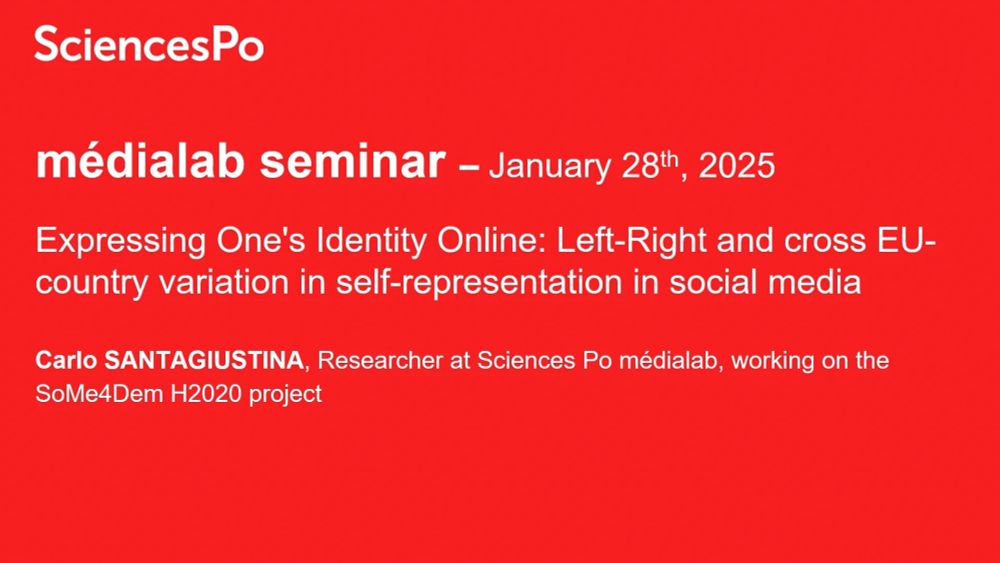
Retrouvez le séminaire "Expressing One's Identity Online: Left-Right and cross EU-country variation in self-representation in social media" avec @santagiustina.bsky.social
Explorez les identités sociopolitiques sur les réseaux sociaux dans 8 pays l'UE.
Disponible sur le compte Vimeo du médialab ⬇️
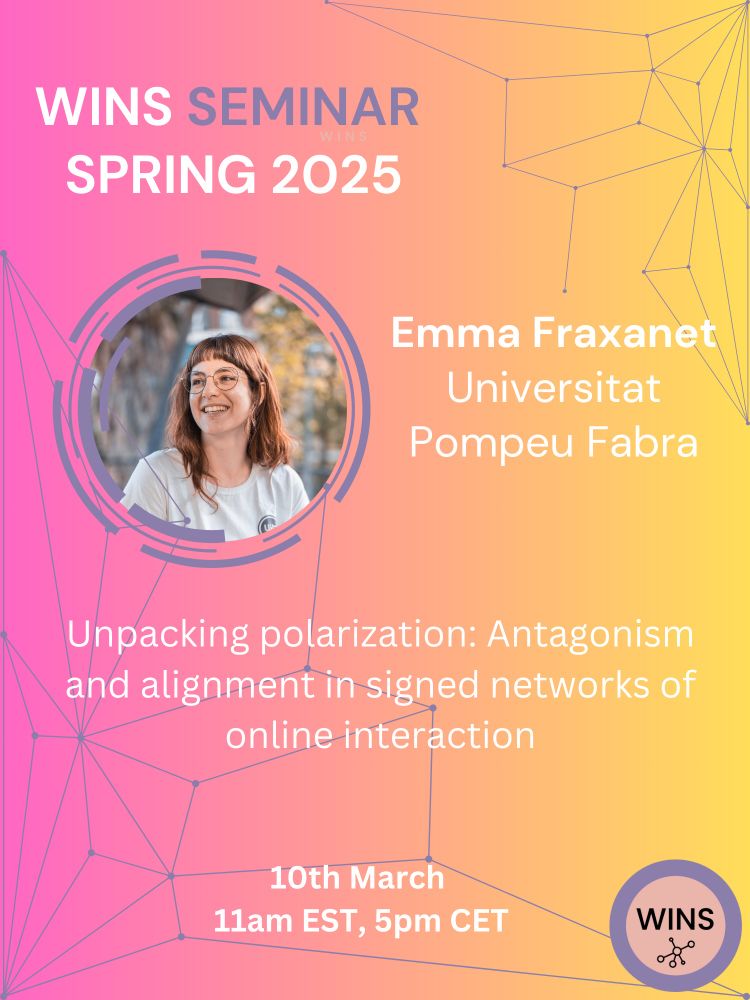
📅Save the date!
Join us next Monday (Mar 10th, 11 AM ET) for our next seminar by @emmafraxanet.bsky.social from Pompeu Fabra University, who will discuss polarization in online communities.
Don't miss out! ✨
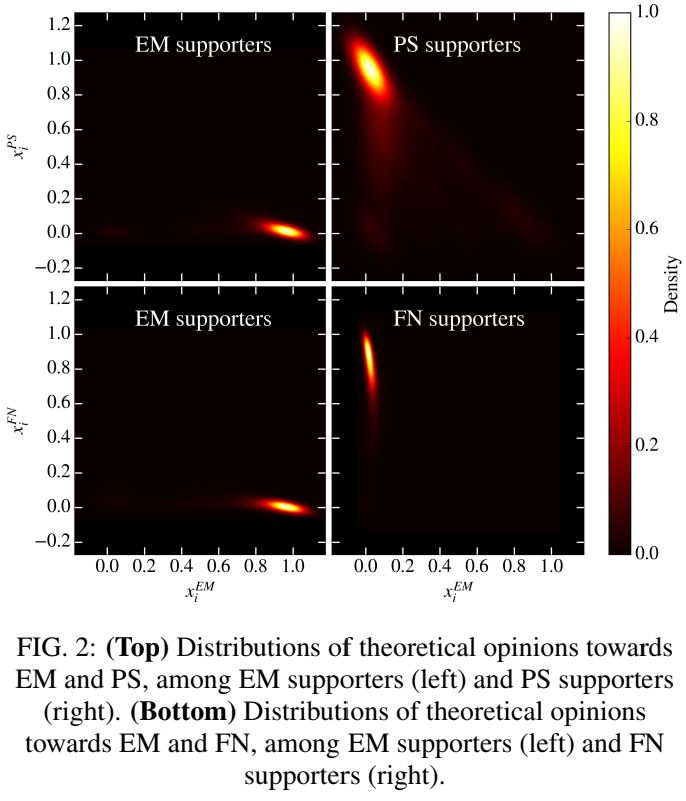
Super proud of this work !
I show that the ubiquitous voter model can effectively predict individual opinions of Twitter users 😎
This marks a new step in the study of the empirical validity of theoretical models for opinion dynamics !
arxiv.org/abs/2501.13215
🚨New paper alert! 🚨 How do echo chambers form in signed networks? 🤔 A new study by @avdeville.bsky.social and myself explores the role of structural balance in shaping information flows and inducing echo chambers. 🧵👇
05.02.2025 16:25 — 👍 9 🔁 2 💬 2 📌 0