Ever wondered how the Dalmatian Dog effect works?
The human brain can quickly learn from a single experience and generalize it to related experiences — an impressive feat so far not matched by AI.
Our new paper in @natcomms.nature.com reveals how this works.
www.nature.com/articles/s41...
04.02.2026 17:00 — 👍 82 🔁 32 💬 2 📌 4
With some trepidation, I'm putting this out into the world:
gershmanlab.com/textbook.html
It's a textbook called Computational Foundations of Cognitive Neuroscience, which I wrote for my class.
My hope is that this will be a living document, continuously improved as I get feedback.
09.01.2026 01:27 — 👍 583 🔁 237 💬 16 📌 10
New on the Archive:
Reydon, Thomas A. C. (2025) The Scope of Evolutionary Thinking. Cambridge University Press, Cambridge. ISBN 9781009619196
https://philsci-archive.pitt.edu/27740/
05.01.2026 14:19 — 👍 0 🔁 2 💬 0 📌 0

COMPARATIVE MUSICOLOGY: Evolution, Universals, and the Science of the World's Music
By Patrick E. Savage
(to published by Oxford University Press in Feb 2026)
Just submitted corrected proofs for my first book!
Publication (open access) is scheduled for late Feb 2026 (but the preprint is already available if you don't want to wait: osf.io/preprints/ps...)
14.12.2025 21:59 — 👍 44 🔁 8 💬 0 📌 1

logo for Philosophical logic that looks like a diamond composed of P and L
However, the real winner here is clearly Philosophical Logic. This logo is just so good.
The lines evoke 80s logic textbooks. That interlocking P and L. Diamond for possibility. Diamond for real open access.
It's a classy logo from a bygone era.
So anyway, support good design and open access.
13.12.2025 00:53 — 👍 17 🔁 2 💬 2 📌 0
OSF
are better-performing face recognition models more human-like? turns out: NO
in terms of how we see/treat different faces as similar/different to each other, there seems to be tradeoff: better models are LESS human-like
so they already work in some 'alien' ways...
osf.io/preprints/ps...
🧠📈🧠🤖🧠💻
10.12.2025 00:34 — 👍 40 🔁 12 💬 2 📌 0

Representational Momentum Transcends Motion
Dillon Plunkett & Jorge Morales (2025) Psychological Science
When we see something that's moving, our memories about it end up projected forward in time: We remember it further along than it was. In a new paper in 𝘗𝘴𝘺𝘤𝘩𝘰𝘭𝘰𝘨𝘪𝘤𝘢𝘭 𝘚𝘤𝘪𝘦𝘯𝘤𝘦, out today and led by @dillonplunkett.bsky.social, we demonstrate that this happens even when there is 𝙣𝙤 𝙢𝙤𝙩𝙞𝙤𝙣 𝙬𝙝𝙖𝙩𝙨𝙤𝙚𝙫𝙚𝙧.🧵
09.12.2025 15:37 — 👍 124 🔁 44 💬 8 📌 5

"I dived deep in the ocean of astronomical theories, true and false, and rescued the precious sunken jewel of true knowledge by the means of the boat of my own intellect."
Quoted in The Golden Road, by William Dalrymple
06.12.2025 13:12 — 👍 23 🔁 4 💬 0 📌 0
In the running for greatest human accomplishment.
02.12.2025 17:14 — 👍 71 🔁 20 💬 1 📌 1
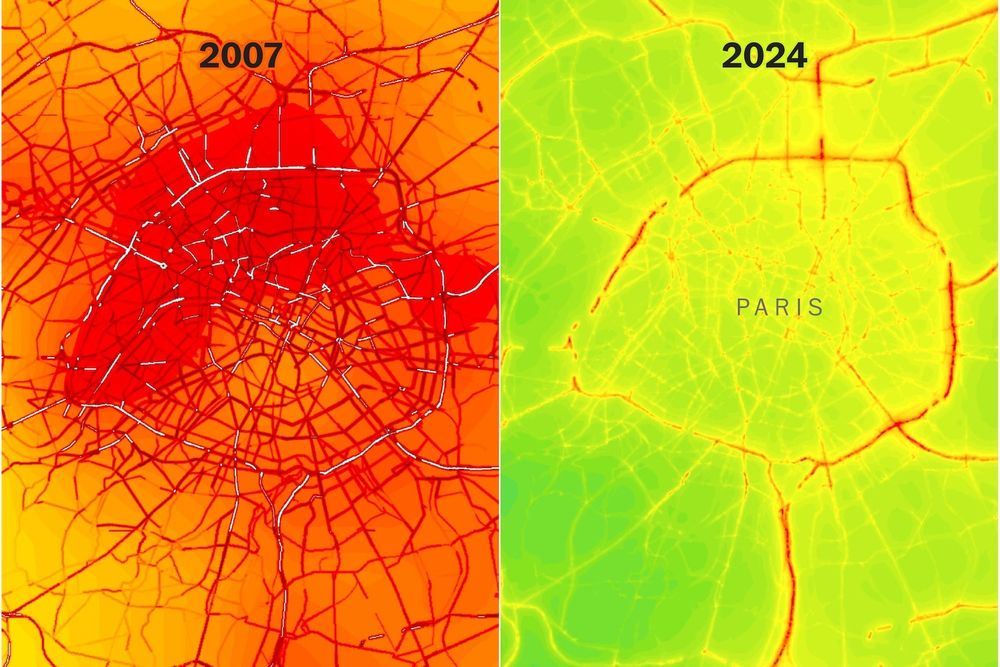
Paris said au revoir to cars. Air pollution maps reveal a dramatic change.
Air pollution fell substantially as the city restricted car traffic and made way for parks and bike lanes.
“Over the past 20 years, Paris has undergone a major physical transformation, trading automotive arteries for bike lanes, adding green spaces and eliminating 50,000 parking spaces.
Part of the payoff has been invisible — in the air itself.”
Leadership, strategy, real action, common sense. #Paris
29.08.2025 16:57 — 👍 4101 🔁 1460 💬 40 📌 159

Can we “see” value? Spatiotopic “visual” adaptation to an imperceptible dimension
In much recent philosophy of mind and cognitive science, repulsive adaptation effects are considered a litmus test — a crucial marker, that distinguis…
Visual adaptation is viewed as a test of whether a feature is represented by the visual system.
In a new paper, Sam Clarke and I push the limits of this test. We show spatially selective, putatively "visual" adaptation to a clearly non-visual dimension: Value!
www.sciencedirect.com/science/arti...
28.08.2025 20:18 — 👍 42 🔁 15 💬 2 📌 1

Book Cover, The Idealized Mind.
The Idealized Mind: From Model-based Science to Cognitive Science -by Prof. Michael D. Kirchhoff, published (Aug 2025) by the MIT Press. #OpenAccess
25.08.2025 10:42 — 👍 2 🔁 0 💬 0 📌 0
Our new paper, “A neural compass in the human brain during naturalistic human navigation” is out in @sfnjournals.bsky.social! First-author @zhenganglu.bsky.social led the charge, with Josh Julian and collaborator @gkaguirre.com.
www.jneurosci.org/content/earl...
19.08.2025 20:29 — 👍 57 🔁 16 💬 1 📌 3

Cognitive bridge between geometric and numerical learning in monkeys | PNAS
Educational research highlights strong developmental links between numerical and spatial
cognition in humans, often shaped by cultural tools like t...
Children build math skills on a “cognitive bridge” between space & number. But where does it come from? Our new study finds monkeys transfer learning and abstractions across geometry & numerosity, revealing the evolutionary roots of basic math development. 🧪🧠
www.pnas.org/doi/10.1073/...
20.08.2025 12:39 — 👍 70 🔁 24 💬 6 📌 2

Auditory object representation in the bat hippocampus
Krishna et al. identify two populations of CA1 neurons that encode allocentric object
location or egocentric object distance but only when bats actively track a moving
target using echolocation. These...
Super excited to share that the first work from my PhD is out in @currentbiology.bsky.social
www.cell.com/current-biol...
We tackle two fundamental questions:
1) How does the brain create a cognitive map solely using auditory information?
2)How does the hippocampus represent a moving object?
14.08.2025 02:53 — 👍 16 🔁 3 💬 0 📌 0
Redirecting
New from Arnold @visnerd.bsky.social lab:
Mental rotation is often regarded as paradigmatic for #mentalimagery. But it turns out people often don't use imagery for mental rotation - & when they do it is often not useful (same viewpoint trials). #visionscience #psychscisky
doi.org/10.1016/j.co...
21.07.2025 00:20 — 👍 32 🔁 6 💬 1 📌 0

Good video panel at MUSE Trento: evolution is complicated! www.muse.it
07.08.2025 12:43 — 👍 2 🔁 2 💬 0 📌 0
While I was in Rotterdam for CogSci '24, I visited the Escher Museum and fell in love with his work all over again. Now, a year later, I'm delighted by this SIGGRAPH paper led by my friend Ana!
(Say what you will about the technical details, you must admit that we came up with the ~perfect~ title.)
05.08.2025 17:41 — 👍 16 🔁 5 💬 0 📌 1
🚨Very happy that my PhD work is now out in @nature.com!
We discovered that evolution, by acting in the midbrain, shifted the threshold to escape in Peromyscus mice, to fine-tune defensive strategies in different environments
www.nature.com/articles/s41...
This was a truly collaborative effort! 🧵⬇️
23.07.2025 15:05 — 👍 475 🔁 103 💬 26 📌 5
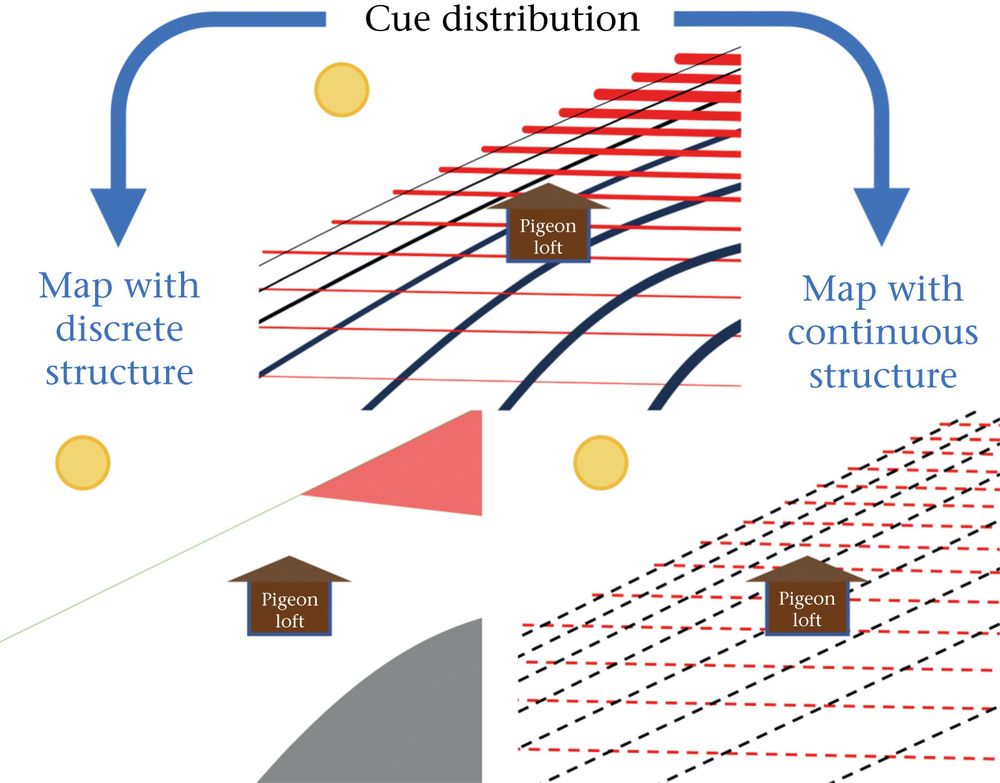
Image description: figure from review titled Map and compass navigation: the mechanism and ontogeny of animal maps. The figure shows how environmental cues can vary in predictable gradients through space, generating unique cue combinations at each location. The second part of this figure shows how animals may respond to these cue combinations, either treating them as discrete cue-location associations, or as continuous gradients. These differences may lead to differences in navigational strategies and performance.
Ever wondered how animals know where they are? Or how they find where they need to be?
The answer is that they have maps and compasses built into their heads! Excited to see this new review of map-and-compass navigation led by Joe Morford out in Animal Behaviour @asab.org
doi.org/10.1016/j.an...
22.07.2025 17:05 — 👍 39 🔁 18 💬 0 📌 1
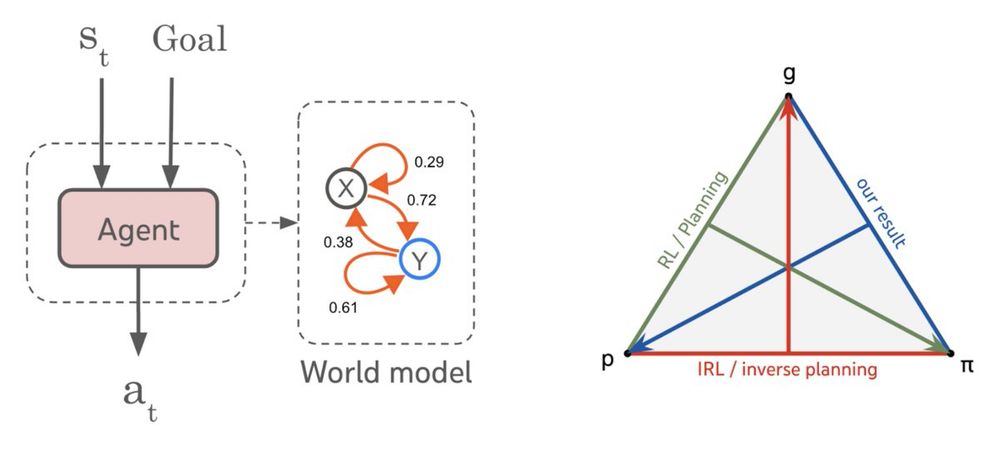
Are world models necessary to achieve human-level agents, or is there a model-free short-cut?
Our new #ICML2025 paper tackles this question from first principles, and finds a surprising answer, agents _are_ world models… 🧵
arxiv.org/abs/2506.01622
04.06.2025 15:48 — 👍 43 🔁 15 💬 2 📌 4
APA PsycNet
Pleased to announce my new open access paper out in Developmental Psychology:
The Development of the “First Thing That Comes to Mind”
with @xphilosopher.bsky.social and @ebonawitz.bsky.social
psycnet.apa.org/fulltext/2026-25569-001.html
#CogSci #PsychSciSki #DevSci
(1/10)
17.06.2025 08:35 — 👍 53 🔁 19 💬 1 📌 1
Trends in
Cognitive Sciences
Review
Core systems of music perception
Samuel A. Mehr 1 ,2 , *
1 School of Psychology, University of
Auckland, Auckland, New Zealand
Human musicality is supported by two distinct systems of representation: one for
tonal perception, which contextualizes pitch input in reference to a hierarchy of
tones; and one for metrical perception, which contextualizes temporal input in reference to a hierarchy of rhythmic groupings. Growing evidence suggests that the two
systems are universal, automatic, encapsulated, and relatively early-developing. But
like speech perception, and unlike several other perceptual systems, they appear to
be uniquely human. The systems of tonal and metrical perception form a foundational structure for musicality that, when combined with the processing of other
acoustical information (e.g., timbre or auditory scenes), and applied in conjunction
with other cognitive domains, yields a human psychology of music.
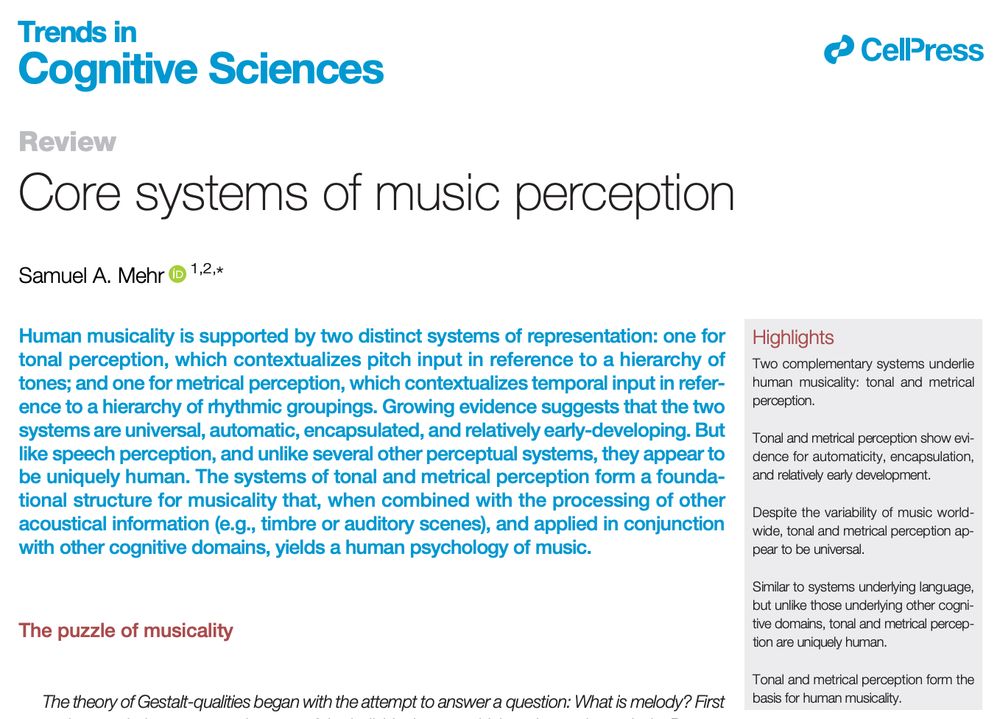
my latest, in Trends in Cognitive Sciences
this review lays out what I think the fundamental specializations are for music perception in humans, namely, the hierarchical processing of pitch and rhythm
or, how our minds turn vibrating air into music
authors.elsevier.com/a/1lG9G_V1r-...
13.06.2025 21:16 — 👍 108 🔁 25 💬 6 📌 1
Anthropologist interested in hunter-gatherer egalitarianism | Asst Prof @BaylorAnthro.bsky.social | Editor-in-Chief, Hunter-Gatherer Research | Spelling errors my own
Philosophy of neuro, psych, and machine learning• researching explanation, modelling, and task design • asst prof at UT El Paso • U Arizona alum.
An official SJDM account. Tag your JDM announcements, conferences, and jobs with @sjdm-tweets.bsky.social
Questions? contact @dggoldst.bsky.social
Professor of Information Engineering and Neuroscience, University of Cambridge
The world's largest professional organization advancing #computing as a science and profession. Also on Mastodon | LinkedIn | Meta | YouTube | Instagram.
Philosopher of Biology interested in Human Evolution 💀🧬🏺• FWO Senior Postdoctoral Fellow at KU Leuven• PhD from DiBio 🧪, University of Padova • Science Writer and Communicator.
🌐 https://sites.google.com/view/andrameneganzin/
Recent Masters degree in Archaeological Practice at Birkbeck, University of London.
Here to share my love of archaeology.
Director of Language & Genetics at Max Planck Institute, Nijmegen.
Tracing the complex connections between genes, brains, speech & language.
Website: https://www.mpi.nl/people/fisher-simon-e
ORCID: https://orcid.org/0000-0002-3132-1996
assoc prof, uc irvine cogsci & LPS: perception+metacognition+subjective experience, fMRI+models+AI
phil sci, education for all
2026: UCI-->UCL!
prez+co-founder, neuromatch.io
fellow, CIFAR brain mind consciousness
meganakpeters.org
she/her💖💜💙views mine
Philosophy professor. My new book is THE SCORE, about true play, the limits of data - and why scoring systems can lead to beautiful games and soul-killing metrics.
learning | neuroethology | basal ganglia | birdsong | decision-making | natural history | Current K99 Postdoc Rich Mooney @Duke | PhD Christina Gremel @UC San Diego
neuroscience and behavior in parrots and songbirds
Simons junior fellow and post-doc at NYU Langone studying vocal communication, PhD MIT brain and cognitive sciences
Mood & Memory researcher with a computational bent. https://www.nicolecrust.com. Science advocate. Prof (UPenn Psych) - on leave as a Simons Pivot Fellow. Author: Elusive Cures. https://press.princeton.edu/books/hardcover/9780691243054/elusive-cures
The official(ish) account of the Auditory-VIsual Speech Association (AVISA) AV 👄 👓 speech references, but mostly what interests me avisa.loria.fr
I'm a wetland ecologist and conservation biologist with the NYS DEC. Obsessed with reptiles, amphibians, spiders, insects, and other creepy crawlies.
Director: @compmusiclab.bsky.social. Rutherford Discovery Fellow @U Auckland. Assoc. Prof. @Keio U. PI @manyvoices.bsky.social. Music, evolution, diversity. He/him. Tangata tiriti.
The Centre for Logic and Philosophy of Science (CLPS) at the Institute of Philosophy (@kuleuvenuniversity.bsky.social) focuses on #logic and #philsci, with a concentration on the philosophies of the special sciences • https://hiw.kuleuven.be/clps #philsky
Dedicated to the advancement of Real Philosophy, For Everyone.
Find lectures and live events on our YouTube channel: https://youtube.com/@TheRoyalInstituteofPhilosophy
Visit us at: https://royalinstitutephilosophy.org/
DFG Priority Program 2411
"Sensing LOOPS: Cortico-subcortical Interactions for Adaptive Sensing"