What other criteria should we use to benchmark processing? Elise also quantified the carbon footprint associated with computation in her PhD thesis.
06.11.2025 00:42 — 👍 0 🔁 0 💬 0 📌 0
Still, we hope our results can help researchers make informed decisions when selecting a processing. And that it can encourage others to evaluate other image processing options (e.g., different software versions, non-default settings).
06.11.2025 00:42 — 👍 0 🔁 0 💬 1 📌 0
Many questions remain. Would we see the same results in other age groups (e.g., ABCD data) or in other databases (we used @ukbiobank.bsky.social)?
06.11.2025 00:42 — 👍 0 🔁 0 💬 1 📌 0

To make things even more complicated, it may also depend on the trait you are interested in. On average FSL VBM does a good job, but for some traits like Alzheimer's disease or maternal smoking, FreeSurfer may yield more significant associations.
06.11.2025 00:42 — 👍 0 🔁 0 💬 1 📌 0

We also demonstrated that each processing step captures a unique signal. So we cannot claim that a single processing (among the ones we considered) is the best. Some are better, but none is perfect.
06.11.2025 00:42 — 👍 0 🔁 0 💬 1 📌 0

Elise's results also confirm that the choices of processing have important consequences on the results, which contributes to the reproducibility crisis. See results below for the same individuals and same trait (maternal smoking around birth - associated regions vary depending on processing)
06.11.2025 00:42 — 👍 0 🔁 0 💬 1 📌 0

I have always wondered if there is a best method/software to process T1w image (at a vertex/voxel wise level). Elise Delzant has some answers in her first published paper from her PhD. She compared FreeSurfer, CAT12 and FSL across several traits and analyses (association, prediction).
06.11.2025 00:42 — 👍 7 🔁 1 💬 1 📌 1
 18.02.2025 10:20 — 👍 0 🔁 0 💬 0 📌 0
@institutducerveau.bsky.social
17.02.2025 22:44 — 👍 0 🔁 0 💬 0 📌 0

Lastly, we showed that the brain-based predictor of Alzheimer's could also predict early AD, mild cognitive impairment, cognition, tau levels or genetic risk. Our predictor is on par with some of the best ones that can predict progression to AD, which could help with early intervention
06.02.2025 11:26 — 👍 1 🔁 0 💬 0 📌 0

Interestingly, the brain regions associated with Alzheimer's, disease progression and cognition overlapped suggesting some of the same regions are implicated. Some regions stand out being associated with many traits.
06.02.2025 11:26 — 👍 1 🔁 0 💬 1 📌 0
We systematically attempted to replicate the results also showed the identified regions could help predict disease, progression and cognition in independent samples.
06.02.2025 11:26 — 👍 0 🔁 0 💬 1 📌 0

We have also estimated that there should be at least 5 times more regions that remain to be identified (difference between the morphometricity and variance currently explained by the identified regions). Even more data will be needed!
06.02.2025 11:26 — 👍 0 🔁 0 💬 1 📌 0
Even better with a GIF (showing the regions with reduced thickness associated with Alzheimer's across the left subcortical structures)! Made with our R package brainMapR. github.com/baptisteCD/b...
06.02.2025 11:26 — 👍 0 🔁 0 💬 1 📌 0
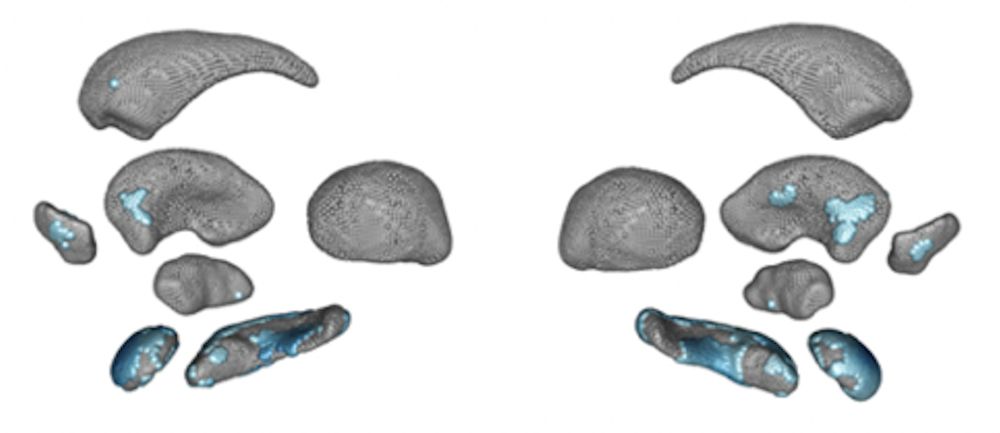
Our high-resolution approach makes it possible to identify sub-regions of the hippocampus (or of the amygdala) that are involved, which can orient research towards specific brain regions/networks or cell populations.
06.02.2025 11:26 — 👍 0 🔁 0 💬 1 📌 0

This is the largest study of its kind in terms of the number of participants (>9,000 subjects from 10 clinical cohorts+ the UK Biobank), and we have identified 103 grey matter regions associated with Alzheimer's, including some in ‘known’ regions, such as the hippocampus.
06.02.2025 11:26 — 👍 0 🔁 0 💬 1 📌 0
At this point, we do not know if the identified drugs or conditions directly cause neurodegenerative disorders or whether they are early symptoms of the disease or reflect more complex aetiology. However, the results could be useful for personalising and accelerating referrals to neurologists.
05.02.2025 11:01 — 👍 0 🔁 0 💬 0 📌 0

Likewise for medical conditions, which are associated with future risk of neurodegenerative disorders.
05.02.2025 11:01 — 👍 0 🔁 0 💬 1 📌 0

Here is a summary of the drug classes, whose frequency of use differs in individuals who are going to receive a neurodegenerative diagnosis within 5-10 years.
05.02.2025 11:01 — 👍 0 🔁 0 💬 1 📌 0
We focused on associations that were consistent across the different countries - hence, they cannot be attributed to specific health systems, bias in the data or the type of medical records (primary, hospital).
05.02.2025 11:01 — 👍 0 🔁 0 💬 1 📌 0
Using medical records from Australia, France, the UK and Sweden, we identified several drug usage, conditions and biomarkers associated up to 10 years before diagnoses.
05.02.2025 11:01 — 👍 0 🔁 0 💬 1 📌 0
CogNeuro Msc @dondersinst.bsky.social | Intern in Neuroimaging x Genetics for Mental Health (Emma Sprooten Lab) | Interested in mental health, gene-environment interplay, and longitudinal models
Postdoc at University of Exeter 🇮🇪🇮🇳🇬🇧 Statistical/Computational analyses using any NGS-based data
Formerly at Sanger institute working on recessive developmental disorders in DDD
Researcher at the University Hospital Bonn/DZNE Bonn, Germany. Interested in structural MRI techniques for imaging the brain’s myelin and iron.
Data person in Seattle - Neuroimaging of Neurodegeneration - he/his
https://danjonpeterson.github.io/
Assistant Professor of Psychiatry, University of Michigan | RP-CNBI | aging, dementia, brain networks, neuromodulation, cognitive neuroscience, emotion | Views are my own
PhD in Physics Applied to Medicine and Biology || Postdoc at UZH || http://bhvieira.github.io
Decoding how the gut thinks 🦠🪱🧠💪
Neuroscientist with interests in
#EnergyMetabolism #EntericNeurons #Fats
@crick.ac.uk @institutducerveau.bsky.social
Assistant Professor in Psychiatry, University of Montreal, CA
💡BRIGHT lab + Co-chair of ENIGMA fMRI and ENIGMA eating disorder
https://t.co/Qzh6wWzp6M
Cognitive neuroscientist at University of Otago - New Zealand. cognitive functioning, mental/neurological health, multimodal neuroimaging and machine learning. https://sites.google.com/view/hamneurolab/home
Wellcome Trust Fellow & Lecturer in Genomics and Ageing @ Queen Mary University of London
Ageing | Frailty | Dementia | Multivariate Genetics | Preventive Medicine 🏳️🌈
Research Development | Grant Writing | ex-Scientist (Cell Division Lab, Mitosis, Cancer, Microscopy) | Bodyboarding | Gold Coast 🇦🇺 |
AndrewBurgessPhD.com
Opinions are my own
Super Talented Wife: vrmorrison.com rosemorrisonartist.com
Postdoc in the Adaptive Dynamical Systems group led by @macshine.bsky.social at The University of Sydney 🧠
I'm probs either biking, hammocking, and/or caffeinating rn ☀️🌻
We are a research facility at the University of Birmingham with the mission to understand what makes a brain healthy, how to maintain health & how to prevent and reverse damage.
www.birmingham.ac.uk/chbh
Posting open access research authored by members of UCL (University College London).
Scientist, Advisor, Head of NERV Lab
Complex systems, Network science, Brain-Computer Interface, Neuroscience
sites.google.com/site/devicofallanifabrizio