A mixed media traditional drawing combining ink linework and dotwork with coloured pencils. Depicts a black-and-white juvenile northern lapwing (Vanellus vanellus) crouched down amid small green and greenish-brown plants.
Reference photo taken by me.
UNI PIN fine liner, black and grey, 1.0, 0.5, 0.1, 0.05, 0.03
KOH-I-NOOR Mondeluz aquarell coloured pencils
December 2025
Close Encounters of the Bird Kind.
A young northern lapwing I accidentally discovered during a wetland field trip. 🐣
#art #illustration #bird #birb #creature #nature #ink #artist #animal #wildlife #pencils #drawing #dinosaur #traditional #lapwing #chick #biodiversity #ornithology #birdart #fluff
31.12.2025 13:00 — 👍 6 🔁 0 💬 0 📌 0

A black-and-white vectorised ink drawing depicting different vertebrates (shark, seahorse, frog, kiwi, cobra, capybara, coelacanth, lungfish)--simplified doodles of silhouettes with white eyes.
--------
Needed some simple illustrations for a vertebrate lecture I'm preparing, so I started doodling. ^^ Might do more in the future just for fun or to use as stickers, badges, and for more complex illustrations where some simple animal art is needed.
You can enjoy these guys staring right into your soul.
UNI PIN fine liner, black, 1.0, 0.5, 0.1, 0.05, 0.03
Vectorised ink drawing
December 2025
A bunch of vertebrate doodles for a lecture. You can enjoy these guys staring right into your soul. 🦈🐟🐍
#art #bird #fish #doodle #nature #ink #artist #animal #wildlife #bw #capybara #turtle #coelacanth #cobra #turtle #snake #kiwi #lungfish #seahorse #shark #frog #cute #snek #creature #critter
07.12.2025 17:35 — 👍 3 🔁 0 💬 0 📌 0

Toxic Beauty by Alopex-Biology on DeviantArt
Yep, I'm the artist behind this and a zoologist, so I can confirm. Wrote more about toxic birds over on my DA: www.deviantart.com/alopex-biolo...
07.12.2025 17:25 — 👍 1 🔁 0 💬 1 📌 0
Yep!
07.12.2025 17:25 — 👍 1 🔁 0 💬 0 📌 0

A mixed media simplified illustration of a magpie looking at a fake nest (a hole on the ground surrounded by grass and containing two quail eggs and a metal teaspoon).
The research behind this one came from Norway (DOI: 10.1098/rsos.250427) and dealt with the fact that birds may protect their nests from magpies and other corvids by bringing foreign objects to their nests. This may seem counterintuitiive, given the common notion of "thieving magpies" drawn to shiny objects. (There's even an opera called The Thieving Magpie /La gazza ladra/. If you're not a fan of opera, you may still know this one from Hergé's Tintin comic books.) However, in reality, magpies lack the innate drive to steal and collect shiny objects (such as silvery teaspoons), and they are, in fact, afraid of them. At least if these objects are novel and unfamiliar (so-called neophobia). On the other hand, magpie-deterring decorations may make the nest more conspicuous to other predators (or habituated corvids) or accidentally hurt the birds in the nest.
Thieving magpie? Think again. A #sciart illustration based on recent research that says nest decoration (e.g. presence of shiny objects) may discourage magpies from predating the nest. 🐣
#art #illustration #bird #creature #doodle #nature #ink #artist #animal #wildlife #bw #drawing #dinosaur #magpie
23.08.2025 18:08 — 👍 7 🔁 0 💬 0 📌 0

A vectorised ink drawing of a Brazilian hylid frog Corythomantis greeningi holding a spiny skull in a Hamlet-like pose. Cartoonish, semi-realistic. This species is one of two described venomous frog species, also known as casque-headed frogs for their rigid, flat skulls.
In biological context, the term venom refers to toxins that are somewhat actively injected (be it by means of fangs, spines, stings, and other pointy body parts) while poisons are ingested or otherwise absorbed into the body of the predator or aggressor that tried biting, licking or touching the poisonous organism in question. (Simplified, it's the "it bites you" vs "you bite it" meme.) In non-scientific context, venoms and poisons may be treated as synonyms or one may be seen as a subtype of the other. Moreover, confusion may stem from faulty translations, for example from Spanish and Portuguese where words of similar spelling have opposite meanings (e.g., veneno means poison).
Now, by the definition above, a typical amphibian is poisonous. However, there are a few species that are both poisonous and venomous. The South American caecilian Siphonops annulatus can deliver a venomous bite (and there are propably more venomous species), and some newts and salamanders (Pleurodeles, Tylotriton, Echinotriton) of Europe and Asia can turn their protruding ribs into toxic needles. In 2015, two Brazilian frogs officially joined the venomous gang. The species in particular are Corythomantis greeningi (depicted) and Aparasphenodon brunoi. The surface of the skull bears many long bony spines (much longer and many more than I drew here) surrounded by glands producing potent toxins. When disturbed, thse frogs may headbutt the predator/aggressor to inject the toxin.
Venomous, or Poisonous, That is the Question. A typical amphibian is poisonous. However, there are few that are both poisonous and venomous, including at least two species of Brazilian frogs with spiny skulls. 🐸
#art #frog #doodle #nature #ink #animal #wildlife #drawing #toxic #venom #skull #poison
17.08.2025 06:52 — 👍 9 🔁 0 💬 1 📌 0

A black-and-white simplified traditional ink drawing of a secretarybird (Sagittarius serpentarius) looking at a comparatively tiny wren (Troglodytes).
The secretarybird is an accipitriform bird of prey--meaning that it's rather closely related to hawks, eagles, or vultures, though not to falcons. (Falconiform birds of prey are close relatives of parrots and songbirds. So a falcon is more closely related to the wren than to the secretarybird.)
You know how you just sometimes wake up and decide to draw a secretarybird? Yeah. The wren sort of just wandered in afterwards. 🦅🐦
#art #illustration #bird #birb #creature #doodle #nature #ink #artist #animal #wildlife #bw #drawing #dinosaur #traditional #lashes #secretarybird #wren #biodiversity
09.08.2025 17:48 — 👍 17 🔁 0 💬 0 📌 0

A black-and-white ink drawing. Realistic headshot portrait of a fence lizard (Sceloporus).
Drew this one together with a tiny Lutzomyia sand fly, a parasite that feeds on these lizards. The sand fly is extremely hard to collect, given its size and habit of staying hidden in burrows of other animals. It serves as a vector of Plasmodium mexicanum (a somewhat close relative of the plasmodia responsible for human malaria), a unique Plasmodium that is not vectored by mosquitoes. Curiously, while the lizard population has been shown to be homogenous over tens of kilometres, the population of P. mexicanum is much less homogenous and much more structured, even though it should--in theory--travel within the lizards or in the tiny fluffy flies swept away by wind. This is apparently not the case, as infected lizards seem to move around less and, more importantly, the flies being hidden in burrows all the time means they don't get passively picked up by air currents. If it wasn't for the parasite (Plasmodium) and knowledge of its population data, this extremely sedentary lifestyle of the sand flies would likely go unnoticed.
UNI PIN fine liner, black, 0.1
May 2022
Fence lizard (Sceloporus) illustration made for a thesis defence some time ago. 🦎
#art #illustration #scientificillustration #lizard #creature #biology #nature #ink #artist #animal #wildlife #bw #scales #drawing #detailed #eye #sceloporus #realistic #traditional #reptile #portrait #stare #hatching
01.05.2025 16:29 — 👍 9 🔁 0 💬 0 📌 0

A black-and-white traditional ink drawing depicting the front part of a velvet worm, one of the less well-known groups of invertebrates.
Velvet worms. Velvety wannabe "caterpillars" with beady eyes and many rotund legs. However, do not let their soft and cute exterior deceive you. The papillae by their mouth can squirt out strings of a glue-like substance at their prey, which, once ensnared, can be easily cut up by the velvet worm's sharp jaws (normally hidden beneath its fleshy lips) and dissolved by its saliva.
If that isn't bizarre enough, know that some species have internal fertilisation by means of spermatophores (little 'packets' of sperm) deposited on the female's body surface. Her own cells then disrupt the body wall and allow the sperm to come through and travel via her hemolymph to her ovaries. The majority of species are viviparous (giving birth to live young), and some even nourish their offspring via a placenta. Pregnancy may last up to 15 months. That's longer than in most mammals!
Velvet worms (Onychophora) are sister to the much more well-known and speciose arthropods (Arthropoda), and also the only recent animal phylum containing no extant marine species.
Also, if you like weird science stories, there's a (completely bonkers and inaccurate) paper that claims caterpillars of insects are not insects per se, but rather the descendants of onychophorans. It's normal that some scientific papers are wrong, though the review process usually weeds out most of them. This one got through a loophole in the system of that particular journal that has since been fixed.
Drawing based on a photograph of Eoperipatus by Melvyn Yeo (CC BY-NC 4.0). Drawn for a study text on invertebrate diversity.
UNI PIN fine liner, black, 0.1, 0.05, 0.03
April 2025
The Cutest Predator
Velvet worms. Plush creatures with beady eyes and rotund legs. Do not let their cute looks deceive you. They are vicious predators armed with sharp jaws and the ability to squirt out a glue-like slime.🐛
#art #illustration #nature #hunter #cute #wildlife #bw #science #ink #animal
30.04.2025 10:43 — 👍 2 🔁 0 💬 0 📌 0

A black-and-white vectorised ink drawing depicting two larger, stylised, carp-like fish with long fins hugging four smaller fish, three of which also have longer fins. The arrangement is reminiscent of the Punnett square used in Mendelian genetics, with a phenotypic ratio of 3 : 1. Based on koi carp genetics where fin length is under the control of one gene, with long fins being dominant.
Fish Family
A small doodle made as an illustration for a text on genetics: the fish family hides a Punnett square with phenotypic ratio 3 : 1. 🐟🐟🐟🐠
#art #illustration #doodle #fish #fins #biology #nature #artist #scales #cute #wildlife #bw #science #family #ink #animal #critter #creature #genetics
03.04.2025 12:41 — 👍 9 🔁 0 💬 0 📌 0
Cute! I love its stare. :D
01.04.2025 17:34 — 👍 1 🔁 0 💬 0 📌 0
Needs to be a bit more grumpy. Just one "Arghhh" isn't enough. xD
01.04.2025 13:54 — 👍 1 🔁 0 💬 0 📌 0
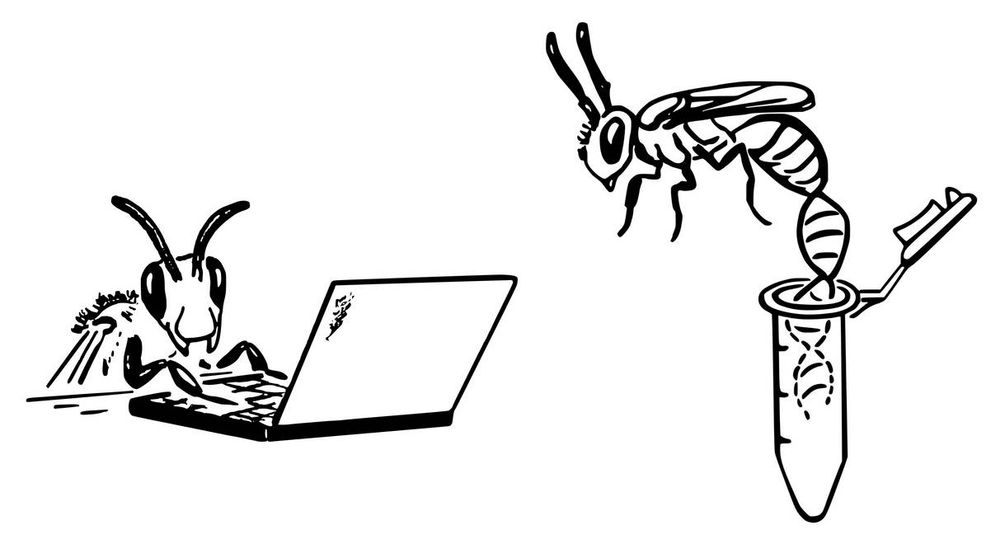
A black-and-white vectorised ink drawing of semi-realistic, semi-cartoonish bees. One on the left sitting at a laptop, another on the right with its abdomen transitioning to a DNA molecule in a microcentrifuge tube.
UNI PIN fine liner, black, 0.1, 0.05, 0.03
September 2024
Bee Science
Just some #bee doodles made for a presentation on bioinformatics and wet laboratory work with bee DNA I used to work on. 🐝🧬
#art #illustration #doodle #bees #insects #biology #nature #artist #pollinator #cute #wildlife #bw #DNA #science #research #lab #laptop #animal #critter #creature
01.04.2025 12:14 — 👍 19 🔁 1 💬 1 📌 0

The image is a coloured pencil drawing depicting two large ground nest entrances with tiny pebbles scattered around. (The result looks a bit like a giant pair of grayish slippers.) Next to the left nest entrance sits a fluffy female tawny mining bee (Andrena fulva) with fiery red hairs. Below her is a more slender, scarcely-haired male with large mandibles. Next to the right nest entrance is a female cuckoo bee, Nomada signata, of a wasp-like appearance and with vibrant red and yellow markings.
A part of a series on obligate brood parasites: animals that leave their offspring in the care of another species. And, of course, parasites cannot exist without their hosts.
The host species in this particular case is the tawny mining bee (Andrena fulva, left, top: female, bottom: male). As the name suggests, this bee likes to dig, and it's one of the many ground-nesting bees. Hence the nest entrance next to the female. When the female leaves her nest, it's the parasite's time to strike. When the host leaves the nest unattended, a female nomada bee, Nomada signata (right), slips into the nest to lay her egg into one of the open nest cells that are currently being provisioned by the host. The eggs are generally small and hidden in the cells to avoid detection, and the hatched larva has giant, sharp mandibles to kill the host larva as well as other parasites in the nest.
Going Cuckoo: another part of my series on parasitic cuckoo bees (right) and their host bees (left). Here both sexes of the host bee and the cuckoo sitting by a ground nest. 🐝
#art #illustration #scientificillustration #bees #insects #biology #nature #pencils #artist #pollinator #pebbles #wildlife
26.03.2025 10:34 — 👍 8 🔁 0 💬 0 📌 0

A black-and-white ink drawing depicting a slightly stylised male ceratioid anglerfish hanging onto a spiky portion of a much larger female (depicted in a cartoon version in the top left corner).
Living in the deep sea brings unique challenges. For example, how do you find a mate if there's nothing but dark, open water for miles on end? Gets only worse if you want to reproduce repeatedly. Deep-sea anglerfish (Ceratioidei) males likely have an excellent sense of smell and can sniff out the females which are oftentimes giant in comparison to the tiny males. In addition, the males have repeatedly evolved intraspecific (within species) parasitism where they attach themselves to the large females. Attachment may be temporary (males clinging to the female with their jaws), or permanent (fusion of the pair, depicted here for Ceratias holboelli). Either one or more males are known to fuse with the female, depending on the species. However, the fusion does not involve the male(s) melding into the female and disappearing. They undergo some changes, as far as preserved specimens can tell, but they remain attached to her body surface like little parasites. The vascular system of the fused pair is assumed continuous, with blood from the female circulating through the male and back. Hard to make definitive conclusion based on preserved fish, though. Such fusion of tissues would be expected to provoke an immune response and rejection, much like the one that may complicate some transplantations in humans or other vertebrates. The trick behind anglerfish immune tolerance seems to stem from the fact that some anglerfish--especially the ones with multi-male permanent attachment--appear to have pretty much abolished their adaptive immune system. The part of the immune system that's responsible for producing antibodies and for "glancing" into many cell types in the body to get rid of viral infections.
Partly freehanded, partly redrawn from a paper by Pietsch (2005).
Attachment Issues
For some #anglerfish, attachment is not forbidden. A male #fish for #InternationalWomen'sDay? He is actually tiny and fused to a huge female to keep her close in the depths. Their immune system appears mostly abolished to allow this 🐟❤️🐟
#art #illustration #ink #biology #nature #bw
08.03.2025 15:36 — 👍 7 🔁 0 💬 0 📌 0

An inverted drawing (my first one ever!)--black background, depicting a white ink linework of an Asian orb-weaver spider and an ensnared male firefly Abscondita terminalis. The male's abdomen flashes with a greenish yellow light.
Many firefly species use their bioluminescent lanterns during courtship. Some of these predatory beetles, such as female fireflies of the North American genus Photuris, mimic the flashing of females of a different genus Photinus. Their signals attract Photinus males, only for the femme fatale Photuris female to eat them.
Other fireflies can fall prey to such false signals as well: A recent study on Asian spiders (Araneus ventricosus) and fireflies (Abscondita terminalis) shows that once ensnared in the spider's web and being bitten and wrapped by the spider, male fireflies change their behaviour, possibly due to the spider's venom and/or specific handling. The male's flashing pattern becomes more female-like, attracting additional males to the spider's web. The authors of the study propose that the spider actively manipulates the fireflies, as the change in behaviour occurs only when the spider repeatedly bites and wraps the male in its web. Non-firefly prey and fireflies with blackened lanterns are simply eaten without the repeated handling. However, it's best to wait for further studies to confirm these findings and clarify the extent of the manipulation.
Based on a study recently published in Current Biology (Fu et al.: Spiders manipulate and exploit bioluminescent signals of fireflies, 2024, DOI: 10.1016/j.cub.2024.07.011). A photographic figure by Xinhua Fu from the original paper served as a reference.
A Flashy Snack
A spider and a male firefly. The captured male changes the flashing of his lantern to resemble that of female fireflies. A potential manipulation. Attracts more males. 🕸️✨
#art #illustration #inverted #insect #biology #nature #ink #pencil #artist #wildlife #spider #firefly #light #web
03.03.2025 09:16 — 👍 6 🔁 1 💬 0 📌 0
That's a lot of scales to go! :D
01.03.2025 11:10 — 👍 1 🔁 0 💬 0 📌 0

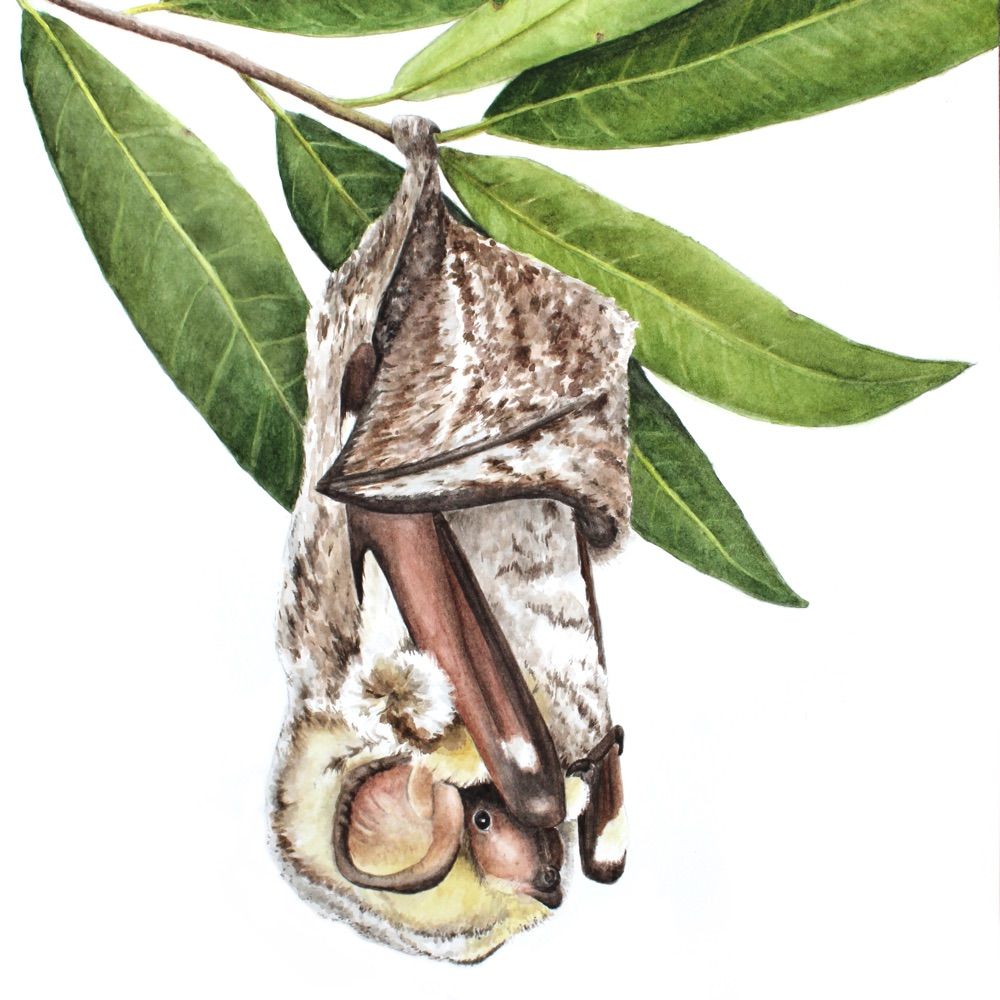
A black-and-white realistic ink drawing of a resting bent-wing bat (Miniopterus). It's been a long while, but I believe this was done with a photograph from BatsLife by Rollin Verlinde serving as the main reference, especially for ear shape and such.
Just a cute, fluffy bent-wing bat sketch made for a thesis defence some time ago. 🦇
#art #illustration #scientificillustration #bat #creature #biology #nature #ink #artist #animal #wildlife #bw #fur #drawing #cute #fluffy #miniopterus #wings #realistic #traditional #mammal #smile #vectorised #claws
01.03.2025 09:39 — 👍 15 🔁 0 💬 0 📌 0

A traditional ink drawing with digitally added colours. Depicts a termite soldier (Prorhinotermes simplex) and protein structure in ribbon model predicted by AlphaFold2. The protein in question is an enzyme from the depicted species. This particular image served as an illustration for a column in the Faculty of Science’s Popular Science (Charles University) about a recent paper on how the "Evolution of Linoleic Acid Biosynthesis Paved the Way for Ecological Success of Termites" (That's the actual title of the paper. Macháček et al. 2023, DOI: 10.1093/molbev/msad087). Drawing based on a photograph by Jan Šobotník and figures from the original paper.
Many Facets of Biology
Molecules, evolution, organisms. Sometimes you can focus on it all at the same time, such as when exploring the biochemical basis of termites' ecological success. 🐜🧪🧬
#art #illustration #science #insect #biology #nature #ink #artist #animal #evolution #mixed #termite #colour
27.02.2025 19:38 — 👍 6 🔁 0 💬 0 📌 0

A black-and-white ink sketch of a realistic vertebrate eye surrounded by fur. A small roundworm (nematode) slithers over the eye surface while a fly sits on the lower eyelid. The nematode is an eyeworm species Thelazia callipaeda that parasitises the surface of eyes and orbital cavities of vertebrates (various carnivores, humans etc.). In Europe, the worm is vectored by Phortica variegata, a small fly related to the rather well-known fruit fly Drosophila melanogaster. (The textbook model fly beloved by geneticists.) Interestingly, only male P. variegata vector the worm from one host to the next, as they feed on the animal's tears. Tear-feeding in females is unknown. The eyeworm has invaded Europe rather recently and is still spreading.
Tear Drinkers
Vertebrate eye parasites: a nematode living on the eye surface and its vector, a small fly related to the model fruit fly Drosophila. Only male flies are tear-feeding. 👁️💦🦟
#art #illustration #scientificillustration #eye #insect #biology #nature #ink #artist #animal #wildlife #bw #fur
24.02.2025 09:59 — 👍 10 🔁 0 💬 0 📌 0

A coloured pencil drawing depicting two different bee species going about their daily lives. On the left is one of the more colourful mining bees, female Andrena hattorfiana as she collects pollen from a scabious flower. If the bee itself wasn't colourful enough, the pollen of scabious is soft pastel pink. (Yes, not all polen is yellow!) The associated cuckoo bee species of A. hattorfiana is the armed nomad bee (Nomada armata, right). Here depicted in a typical sleeping/resting position: clutching a piece of leaf or stem in its mandibles and hanging off the plant. Many bees (not just cuckoo bees) make it through nights or rainy weather in this pose.
Going Cuckoo: one fourth of my series on parasitic cuckoo bees (right), their host bees (left) and various aspects of their lives: here resting and polination, respectively. 🐝
#art #illustration #scientificillustration #bees #insects #biology #nature #pencils #artist #pollination #flower #wildlife
21.02.2025 15:04 — 👍 13 🔁 0 💬 0 📌 0
I simply adore the iridescent feathers! :) I reckon a part of the charm of some corvids is the fact that they can be black or black-and-white and really colourful at the same time.
17.02.2025 15:33 — 👍 1 🔁 0 💬 0 📌 0

A black-and-white ink drawing depicting a large, bi-lobed sphere made up of a web of arteries and veins. The sphere is a yolk sac enveloping and nourishing a chicken embryo.
The drawing is based on another piece of art, Eduard d'Alton's illustration accompanying Pander's monography on chicken embryology (Beiträge zur Entwickelungsgeschichte des Hühnchens im Eye) from 1817.
Web of Life: Developmental biology illustration of a chicken embryo with a large yolk sac. The intricate web that you see are yolk sac arteries and veins. Based on d'Alton's work from 1817. 🐣
#art #illustration #scientificillustration #bird #birds #science #chicken #biology #nature #vintage #ink
17.02.2025 14:59 — 👍 9 🔁 0 💬 0 📌 0
Neat perspective!
16.02.2025 12:18 — 👍 2 🔁 0 💬 1 📌 0

A traditional ink and coloured pencil drawing of an oriolid bird, the hooded pitohui, sporting a vibrant combination of orange and black feathers. The bird seems slightly agitated as somebody is holding it by the legs. Drawing based on photos by J. Dumbacher, a biologist actively involved in research of these fascinating birds.
Toxic Beauty: one of the few poisonous birds in the world, the hooded pitohui (Pitohui dichrous) from New Guinea. Has the same toxins as some poison dart frogs. Drawing based on photos by J. Dumbacher. Drawn for an essay on bird toxicity.
#art #illustration #scientificillustration #birds #science
16.02.2025 11:48 — 👍 9 🔁 1 💬 1 📌 1

Coloured pencil drawing of a blueish larval deep sea fish. Ornate body plan.
A fancy larval cusk-eel (genus Lamprogrammus), adult in the bottom right. Inverted drawing made for @sciencecharles.bsky.social's Science is Beautiful 2024 competition. Based on photographs by J. Milisen and S. Kovacs as well as images from FishBase. 🐟
More on DA: www.deviantart.com/alopex-biolo...
14.02.2025 12:28 — 👍 2 🔁 0 💬 0 📌 0

The logo of Alopex-Biology. A silhouette of a fox's head over the letter "A".
Thought that today might be a good day to throw one more fox into the waters of Bluesky. (I know for certain that I'm not the first "alopex" here, haha.)
More biology- and science-related content coming after I acquaint myself with this site a bit better.
06.02.2025 18:13 — 👍 2 🔁 0 💬 0 📌 0
Artist and wildlife biologist
Shop: https://loraroameart.etsy.com
Let´s talk about the nature science! 🤘
International Society for the study of beetles.
Publisher of The Coleopterists Bulletin
Reposts/likes≠endorsement
I am a hard working science illustrator and photographer living on Mount Desert Island. California to Maine. The ocean is my home♥️. Living on stolen Wabanaki land.
I'm a Scottish artist, painting and drawing nature: landscape, birds, insects, animals and flowers. You will find my work at 'The Wee Owl Studio' on Folksy. Here's a link to my shop and more:
https://linktr.ee/The.Wee.Owl.Studio
*sorry no DMs
I repost & support all #Art #ArtWork #Artists #Photographers & other #Creatives ♡☆ From an artist for artists ♡☆ I follow back all creative accounts (SFW) ✩ #BskyArt #Artist #ArtSky #FineArt #Photography ✩✼:*•.
Global Art Community ✩。:*•.★✼☆
✨ Abby Lee Kosonen
✏️ Freelance Animator & Animal Artist
📍 Finland Immigrant / USA Born
⚡️ Hireable
🎨 linktr.ee/bingybongo
I just really love shapes. I love it when things are shapes. And I love it even more when shapes are things
(Molecular model printer @3dmoleculardesigns.bsky.social, former rodent botherer, perennial cell enjoyer)
Artists for your Skyline!
For more info, click the link pinned to the top of each feed. Or visit bsky.art
(not affiliated with Bluesky PBLLC)
The Biodiversity Heritage Library contains thousands of historical illustrations of flora and fauna. This unaffiliated bot shares random images from the collection.
Institute of Organic Chemistry and Biochemistry of the Czech Academy of Sciences
#iocbprague #biochem #science #akademieved #research #phd ❤️⚗️
Entomologist, hydrobiologist, ecologist and conservationist at Faculty of Science @JihoceskaUni and Institute of Entomology
@BiologyCentre. Opinions are my own.
Public scientific institution, part of the Czech Academy of Sciences. Research in molecular, structure and cell biology, immunology, genomics and bioinformatics.
Professor at Charles University, Faculty of Science (Dept. Zoology) - @sciencecharles.bsky.social, Bioinformatics, Chemical Ecology, Olfaction, Great guitarist - at some point in the future 🐀🐁🐀🐁 🎸
https://www.researchgate.net/profile/Pavel-Stopka-2
The Department of Ecology, CU, unites researchers, teachers and students interested in the sciences of ecology and evolution across the Tree of Life. | @sciencecharles.bsky.social
Akademie věd České republiky je organizační složka státu sdružující vědecké ústavy v České republice zabývající se převážně základním výzkumem.
www.avcr.cz/
physical and computational chemist with interest in photochemistry, radiation chemistry and X-ray technologies
Tropical ecologist, community ecologist, and entomologist at
@sciencecharles.bsky.social and Biology Centre Czech Academy of Science; head of Insect Community Ecology Group (https://www.insect-communities.cz/)
playful scientist
cynical biologist
nerdy nerd & teacher
professor de La Mancha
admiring humanity, curiosity & Yossarian
Lord of Sealand
husband & father
citizen of Prague & peasant of Bohemia
Fish evolutionary biologist focused on sensory systems (not only). Ass. Prof. at Charles Uni in Prague. Fish Evolution research group at Dpt. of Zoology.