Huge thanks to mentors Zenas Chao & Hirokazu Takahashi, and collaborators Tomoyo Shiramatsu-Isoguchi, Felix Kern & Kenichi Ohki!
@utokyoofficial.bsky.social WPI-IRCN
@plosbiology.org
paper again:
doi.org/10.1371/jour...

@yaronamit.bsky.social
Neuroscientist Studying auditory prediction Project researcher @ IRCN, University of Tokyo ,Japan
Huge thanks to mentors Zenas Chao & Hirokazu Takahashi, and collaborators Tomoyo Shiramatsu-Isoguchi, Felix Kern & Kenichi Ohki!
@utokyoofficial.bsky.social WPI-IRCN
@plosbiology.org
paper again:
doi.org/10.1371/jour...
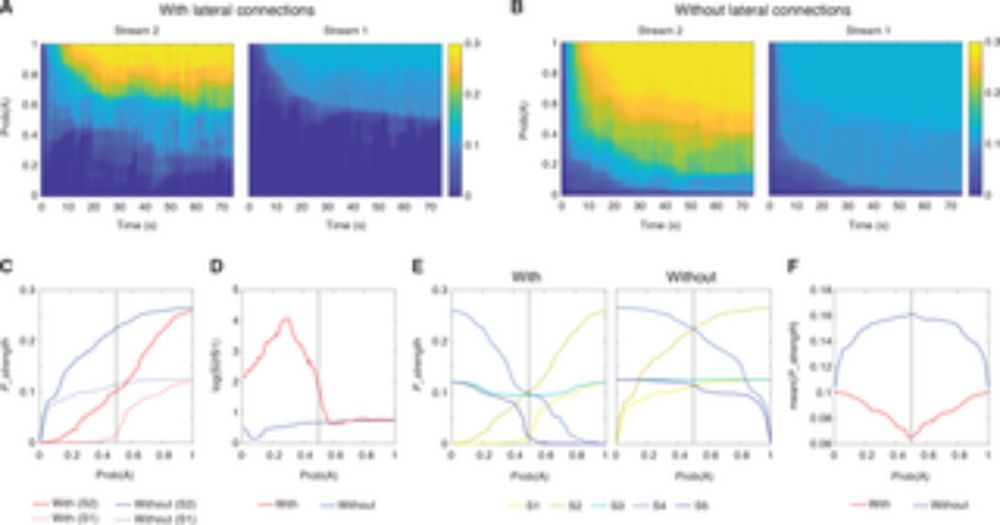
Our circuit model explains these results. Lateral interactions between prediction-error neurons cause unexpected tones to suppress neighboring predictions, sharpening each neuron's predictive field and making omission coding more precise and efficient.
10.07.2025 04:38 — 👍 1 🔁 0 💬 1 📌 0A key asymmetry reveals the mechanism:
📌 Receptive field: responds to both tones when heard
📌 Predictive field: fires only when one specific tone is omitted
Same neuron — opposite selectivity for presence vs absence.
This confidence built up over time:
🔹 Early in the sequence, gaps triggered little or no response
🔹 After repeated exposure to the target tone, the same gap evoked strong firing
This suggests the brain gradually accumulates statistical regularities to form stable expectations.
Omission responses tracked the target tone’s probability:
🔹 Gap in a sequence where the target tone was 90 % of items → strong firing
🔹 Gap in a sequence where the target tone was 10 % → weak or no firing
This shows predictions are feature-specific and confidence-graded.
These are “Probability-Encoding Omission Neurons” (PEONs)
Their omission responses act as prediction error signals:
The stronger the expectation for this specific tone, the stronger the firing when that tone fails to appear.
Two-tone sequences were played with occasional silent gaps (5% omissions). Many of these neurons responded to both tones when present. ~13% also fired on gaps, but only when they occurred in a sequence dominated by one specific tone.
10.07.2025 04:38 — 👍 1 🔁 0 💬 1 📌 0
New
@plosbiology.org
paper:
doi.org/10.1371/jour...
We found neurons in rat auditory cortex that signal narrow predictions for specific tones.
Using omissions as a probe, we show that some neurons show frequency-specific expectations despite responding broadly to actual sounds. 🧵

Left: Experimental design featuring eight conditions with two distinct tones (A and B) and a 5% omission rate, presented in random order. Each condition comprised 1,000 stimulus items, varying the probability of Tones A and B to achieve different predictability levels. Top right: Example of a neuron that responds to tones but not to omissions. The raster plot shows spikes (black dots) with time (ms) on the x-axis and trials on the y-axis. The PSTH displays firing rate over time, with tone stimuli (blue shading) and omissions (gray shading). The black line represents the firing rate, the red line shows omission responses, and the green line indicates the omission baseline. Bottom right: Example of a neuron that selectively responds to the omission of specific tones. The same representation is used as in top right.
The sound of silence? @yaronamit.bsky.social &co show how #neurons encoding negative #PredictionErrors in the #AuditorySystem compute the omission of sounds in a predictable tone sequence (incl asymmetry between bottom-up receptive field & top-down predictive field @plosbiology.org 🧪 plos.io/4n61zeq
19.06.2025 08:45 — 👍 5 🔁 2 💬 0 📌 0