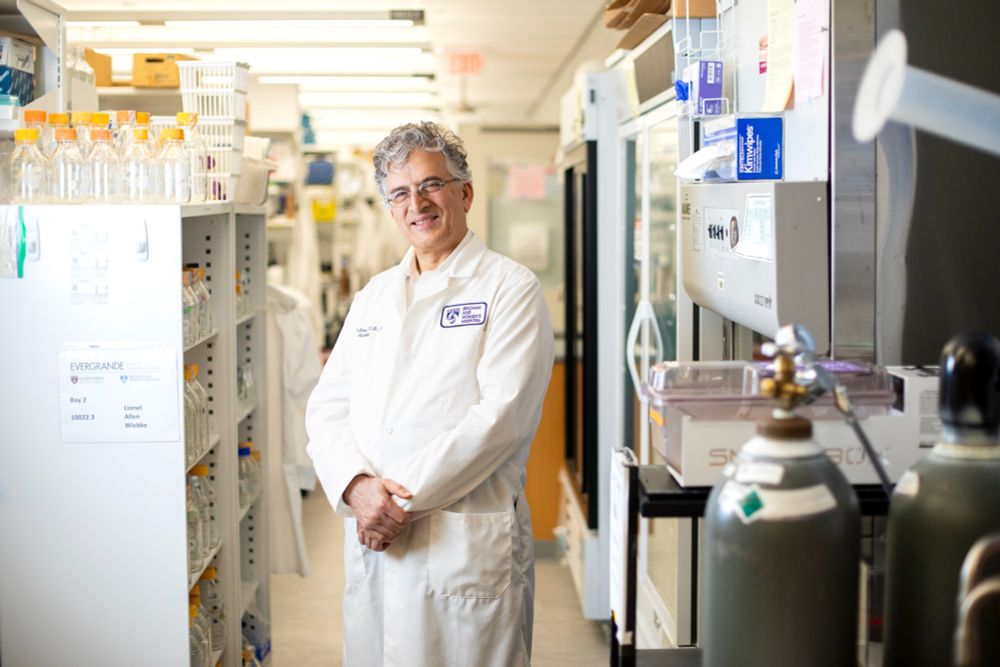
Our research on how the immune checkpoint TIM-3 regulates microglia & Alzheimer's disease highlighted in the @harvard.edu Gazette 👇
🧪
news.harvard.edu/gazette/stor...

@pouryany.bsky.social
Comp bio | Networks | Noncoding RNAs | Neurodegeneration. Scientist @HarvardMed. UNCcharlotte Alum.
Our research on how the immune checkpoint TIM-3 regulates microglia & Alzheimer's disease highlighted in the @harvard.edu Gazette 👇
🧪
news.harvard.edu/gazette/stor...
This is a really cool study. Congratulations
04.04.2025 01:52 — 👍 1 🔁 0 💬 0 📌 0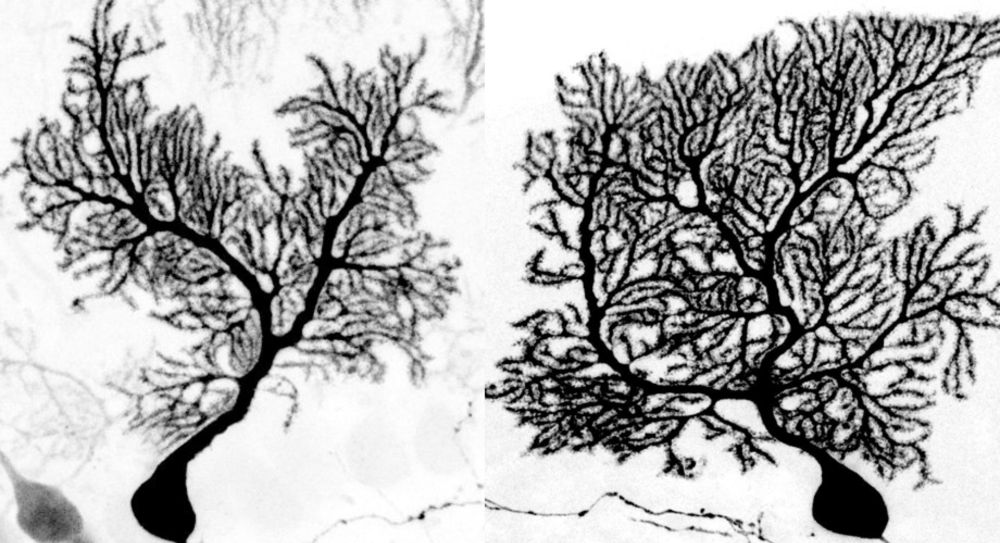
The Lipp Lab (@lippilab.bsky.social) has uncovered how microRNAs guide the development of Purkinje cells—rare neurons tied to movement and autism.
Published in Neuron, a @cellpress.bsky.social journal, the study maps how precise timing and gene regulation shape these cells’ identity and structure.
If you’re attending #adpd2025 drop by to hear about our latest research on #Alzheimers drug target discovery
Title: Bringing precision modeling to Alzheimer's Disease.
Fri, 04.04.2025 | 18:40 - 19:40 | Hall C
#adpd2025 insights into the Alzheimer’s continuum. 4/4/25 @19:25 @pouryany.bsky.social will present our new approach to discovering validated targets for AD therapy
03.04.2025 07:17 — 👍 2 🔁 2 💬 0 📌 1Labeling your axes and then explaining them slowly is perhaps the biggest bang for the buck you can get for making your slides more understandable.
12.03.2025 16:38 — 👍 179 🔁 44 💬 5 📌 1
p38 MAPK-MK2 inhibitors (e.g. losmapimod) show new promises in treating Alzheimer's disease. Today @cp-neuron.bsky.social www.cell.com/neuron/fullt...
23.01.2025 00:32 — 👍 2 🔁 1 💬 0 📌 0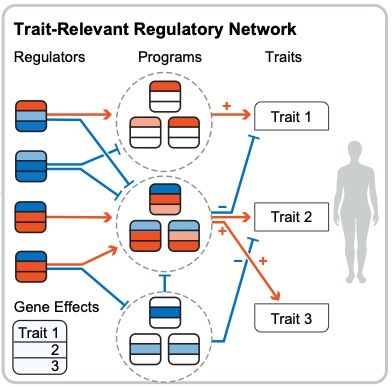
Modern GWAS can identify 1000s of significant hits but it can be hard to turn this into biological insight. What key cellular functions link genetic variation to disease?
I'm very excited to present our new work combining associations and Perturb-seq to build interpretable causal graphs! A 🧵

Elderly woman hands are steady with resistance and resilience to Alzheimer's disease
What are the molecular and cellular hallmarks of resilience and resistance to Alzheimer's Disease? Awesome discoveries with @pouryany.bsky.social @isabelscst.bsky.social We’re growing our team—deliver translation with omics!
#cureAlzheimersFund #Postdoc
shorturl.at/bGyUqhife hidelab.net
Many thanks to our funders: National Institute on Aging (NIA), CureAlzheimer's Fund, Beth Israel Deaconess Medical Center.
11/n
Shout out to Carles Boix, Sarah Morgan, Hansruedi Mathys, Dmitry Prokopenko, Bartholomew White, Larisa Soto, Giulia Pegoraro, Saloni Shah, Athanasios Ploumakis, Nikolas Kalavros, David Bennett, Christoph Lange, Doo Yeon Kim, Lars Bertram, Li-Huei Tsai, Manolis Kellis, and Rudolph Tanzi.
10/n
We welcome your comments and feedback!
It really took a village over many years to make this work happen. First and foremost, thanks to Isabel's @isabelscst.bsky.social leadership, persistence, and vision.
9/n
we found a population of MEF2C+ATP8B1+RELN+ excitatory neurons with increased proportions in resilience and significant depletion in AD. In resilient subjects, these neurons uniquely maintained cellular communication with neurons through neurotrophin and angiopoietin signaling pathways.
8/n
Distinct roles for excitatory and inhibitory neurons in resilience/resistance: Using a snRNA seq cohort of AD brains and leveraging genes associated with rare genetic variants of AD, we found subtypes of somatostatin+ inhibitory neurons to be associated with resistance and vulnerability to AD.
7/n
Most of the tissue level changes of gene expression were observed between AD and resilience and were concordantly dysregulated between AD vs healthy. Comparison of AD polygenic risk scores confirmed resilience as an intermediate stage between AD and healthy conditions.
6/n
Resilience is a sustained presymptomatic stage of AD rather than a distinct trajectory. Surprisingly, only two genes showed differential expression between resilience and healthy subjects in a post-mortem brain autopsy cohort: GFAP and KLF4.
5/n
What we found was distinct roles for excitatory and inhibitory neurons in resilience and resistance to AD.
Some of our findings👇
4/n
We asked how brain cell populations and their distinct molecular functions contribute to describing resilience. We integrated evidence from bulk RNA sequencing, rare variant genetics, single-nuclei RNA seq, and immunofluorescent imaging.
#RNASeq #SingleCell
3/n
Many aged individuals show resilience to AD by maintaining healthy cognition despite having advanced AD pathology. Understanding the biological mechanisms of resilience could lead to the development of much-needed new approaches to combat the disease.
#AlzheimersResearch #Bioinformatics
2/n

New preprint alert!
Check out our manuscript on molecular and cellular hallmarks of resilience and resistance to Alzheimer's Disease (AD) led by @isabelscst.bsky.social and myself from @winhide.bsky.social's Lab.
Paper link: doi.org/10.1101/2025...
#Alzheimers #Genomics #Aging
Details 👇
1/n
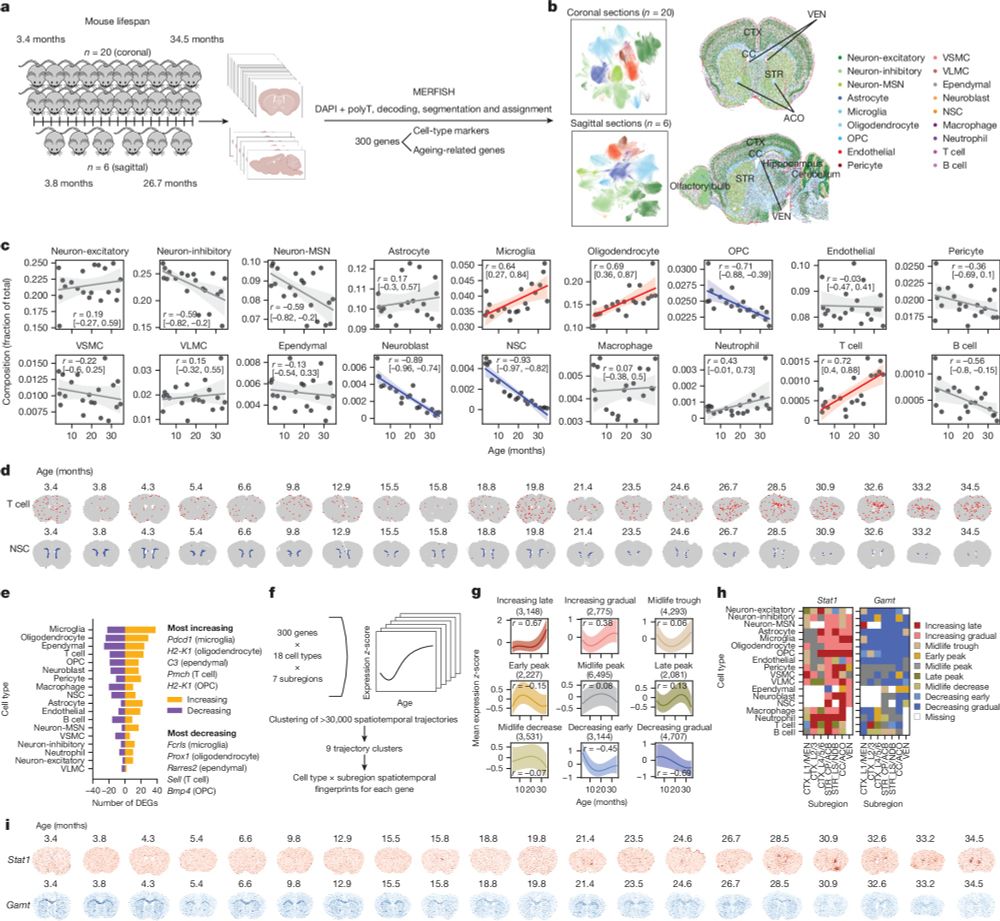
Thrilled to see this paper out!! 🧪
Spatial transcriptomics of brain aging and 'spatial aging clocks' identify cells that have pro-aging or pro-rejuvenating effects on their neighbors!
Huge CONGRATS to Eric Sun and all authors! Fantastic collaboration with @jameszou.bsky.social!
rdcu.be/d33uQ 🧵

Interleukin-23 receptor as a biomarker for aging and potential link to senolytic therapy
www.nature.com/articles/s43...
Check out our recent work in Neuron! Our platform helps derisk preclinical to clinical translation by precisely pinning down models that recapitulate pathogenic functions in Alzheimer’s disease brains. Feel free to dm if you are interested in knowing more.
06.12.2024 22:21 — 👍 2 🔁 0 💬 0 📌 0
Today was a great day! Our paper on using an AI platform for cell-free RNA liquid biopsy is finally published in Nature Communications! Huge thanks to our amazing team at @exai.bio for making this happen! The code is open-source and readily available.
www.nature.com/articles/s41...

Figure 1 from https://www.nature.com/articles/44565/figures/1: Figure 1: Non-negative matrix factorization (NMF) learns a parts-based representation of faces, whereas vector quantization (VQ) and principal components analysis (PCA) learn holistic representations.
On the topic of non-negative matrix factorization (NMF, implemented in #RcppML among other #RStats 📦 s)
the #NSF paper by Townes & Engelhart citation #7 was great! 💯 (@lahuuki.bsky.social journal club 📹🔜!)
www.nature.com/articles/445... published in 1999 shows how NMF gets face elements unlike PCA
Just gonna put up some hashtag to find peeps. #genomics #bioinformatics #singlecell #Alzheimer’s #systemsbiology #compbio #omics
19.11.2024 03:15 — 👍 2 🔁 0 💬 0 📌 0