😂 both versions can be equally accurate.
21.05.2025 20:22 — 👍 2 🔁 0 💬 0 📌 0
How microRNAs act as a “blueprint” for the developing brain
The Lipp Lab (@lippilab.bsky.social) has uncovered how microRNAs guide the development of Purkinje cells—rare neurons tied to movement and autism.
Published in Neuron, a @cellpress.bsky.social journal, the study maps how precise timing and gene regulation shape these cells’ identity and structure.
03.04.2025 18:24 — 👍 22 🔁 3 💬 0 📌 1
If anyone is unable to fully access the paper with the link above, please use this one: authors.elsevier.com/c/1ksln3BtfH...
02.04.2025 19:27 — 👍 0 🔁 0 💬 0 📌 0

a cat sitting on its hind legs with the words thank you written below it
ALT: a cat sitting on its hind legs with the words thank you written below it
And of course, a HUGE thank you to the whole team who made this possible! Special shoutout to Yao (co-first author & SAP-seq god), Jess (bioinformatics guru), Marwan (Lippi lab mouse whisperer) and our fearless visionary leaders Ian and Giordano.
02.04.2025 19:27 — 👍 2 🔁 0 💬 0 📌 0
We greatly appreciate the support provided by the DNC vivarium staff, the core services at @scripps.edu, and @eclipsebio.bsky.social! Thank you to our editor and reviewers for their constructive feedback and a smooth, collaborative review process that helped strengthen the paper.
02.04.2025 19:27 — 👍 2 🔁 0 💬 1 📌 0
We think that our findings are just the tip of the iceberg, and we hope that DD-T6B, SAP-seq and our approach of dissecting miRNA-target networks can contribute to future miRNA research! Also, many exciting projects brewing in the lab on development, neural plasticity and aging. 👀
02.04.2025 19:27 — 👍 2 🔁 0 💬 1 📌 0
Importantly, studying miRNA-target networks in developing PCs is highly relevant for understanding neurodevelopmental disorders, such as autism spectrum disorder, where PCs are particularly vulnerable. Thank you to @autismspeaks.org for supporting this project!
02.04.2025 19:27 — 👍 3 🔁 0 💬 1 📌 0
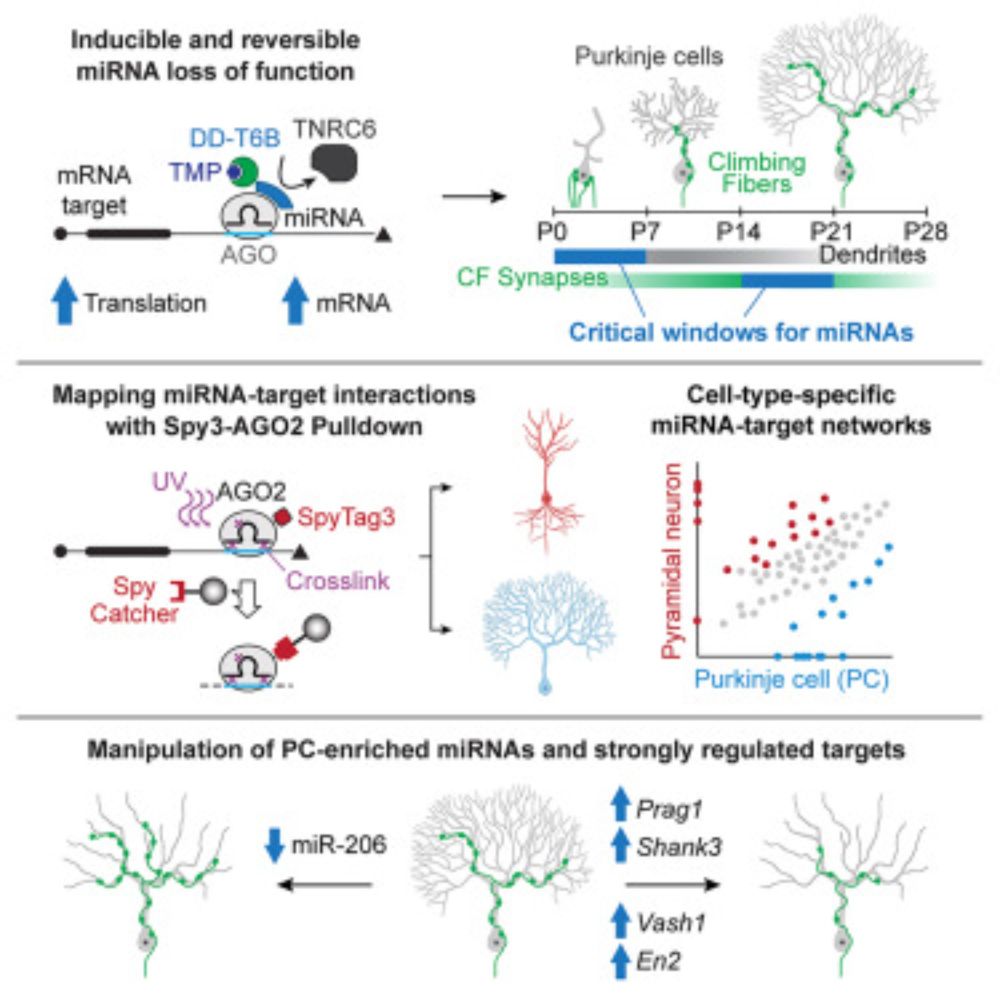
Our findings suggest that adding cell type-specific layers of post-transcriptional regulation on shared transcriptomes can give rise to distinct structural features. Notably, it seems that the PC miRNA-target network acts as a brake on programs that limit dendritogenesis.
02.04.2025 19:27 — 👍 2 🔁 0 💬 1 📌 0

Finally, we investigated select targets that were more regulated by miRNAs in PCs compared to PNs. Strikingly, we found that repression of Prag1, Vash1, Shank3 and En2 is critical for PC dendritic and CF synaptic development.
02.04.2025 19:27 — 👍 2 🔁 0 💬 1 📌 0

We then compared the miRNA-target networks of PCs vs pyramidal neurons (PNs) and found subsets of targets similarly expressed in both but differentially targeted by miRNAs in PCs or PNs, hinting at transcription-independent post-transcriptional programs instructing development.
02.04.2025 19:27 — 👍 2 🔁 0 💬 1 📌 0
Intriguingly, we found the PC-specific miR-206 to be necessary and sufficient for elaborate dendritic arborization, a characteristic feature of PCs . We also found roles for miR-206 and miR-133 in CF synaptogenesis!
02.04.2025 19:27 — 👍 2 🔁 0 💬 1 📌 0

Yao and Ian developed a new method SAP-seq, which allowed us to map miRNA-target networks in rare cells like PCs for the first time! 🤯 With maps from developing PCs, we asked how PC-specific miRNAs and targets might instruct its unique dendritic arborization and CF synapses.
02.04.2025 19:27 — 👍 2 🔁 0 💬 1 📌 0
To get into the underlying mechanisms, we started a great collaboration with Ian MacRae’s lab at Scripps. We developed and characterized a conditional SpyTag3-AGO2 knock-in mouse line that is minimally disruptive to AGO2 function.
02.04.2025 19:27 — 👍 1 🔁 0 💬 1 📌 0

Curious about the “when” of miRNA function, we developed an inducible and reversible version (DD-T6B), which allowed us to identify critical windows of miRNA regulation for PC dendritic vs CF synapses (without the confounding factor of cell death caused by extended miRNA loss)
02.04.2025 19:27 — 👍 2 🔁 0 💬 1 📌 0
So, we repurposed the peptide T6B (from the Meister lab) for neurons to induce fast miRNA loss of function and found that contrary to prior KO studies, miRNAs are critical for PC dendritic development and climbing fiber (CF) synapse formation. (See the paper for in-depth characterization of T6B)
02.04.2025 19:27 — 👍 1 🔁 0 💬 1 📌 0

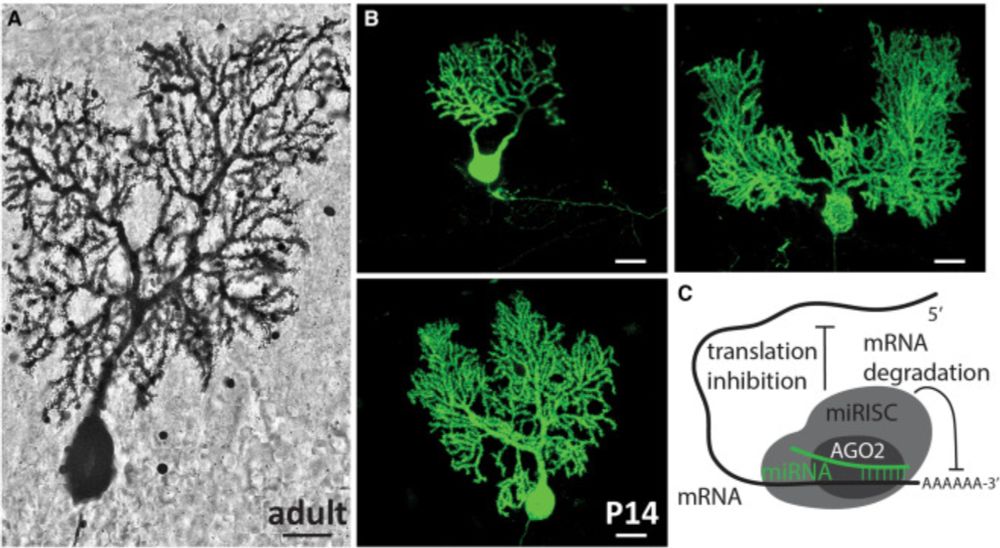
During my PhD, I became fascinated with Purkinje cell (PC) dendritic trees and wanted to understand if/how miRNAs were regulating its growth. Digging through the literature we realized that existing tools for miRNAs were just not sensitive enough to access PC development. 🤔
02.04.2025 19:27 — 👍 4 🔁 0 💬 1 📌 0
MicroRNA mechanisms instructing Purkinje cell specification
Zolboot et al. introduce DD-T6B and SAP-seq, methods for investigating microRNA function
with enhanced spatiotemporal resolution, and identify Purkinje cell-specific microRNAs
and targets instructing ...
✨So happy to see part of my PhD work with @lippilab.bsky.social out today in @cp-neuron.bsky.social! ✨
We developed new tools to study microRNA-target networks with greater spatial and temporal resolution and found neuronal subtype- and developmental stage-specific roles:
02.04.2025 19:27 — 👍 28 🔁 6 💬 4 📌 1
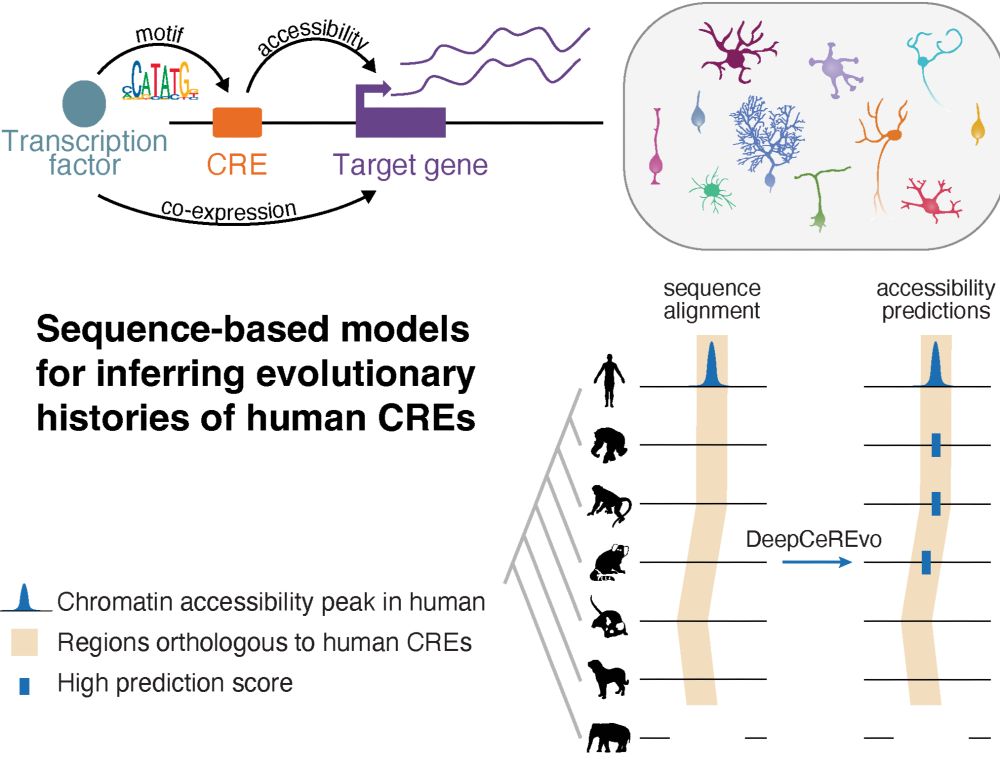
How does gene regulation shape brain evolution? Our new preprint dives into this question in the context of mammalian cerebellum development! rb.gy/dbcxjz
Led by @ioansarr.bsky.social, @marisepp.bsky.social and @tyamadat.bsky.social, in collaboration with @steinaerts.bsky.social
16.03.2025 10:31 — 👍 192 🔁 70 💬 4 📌 7

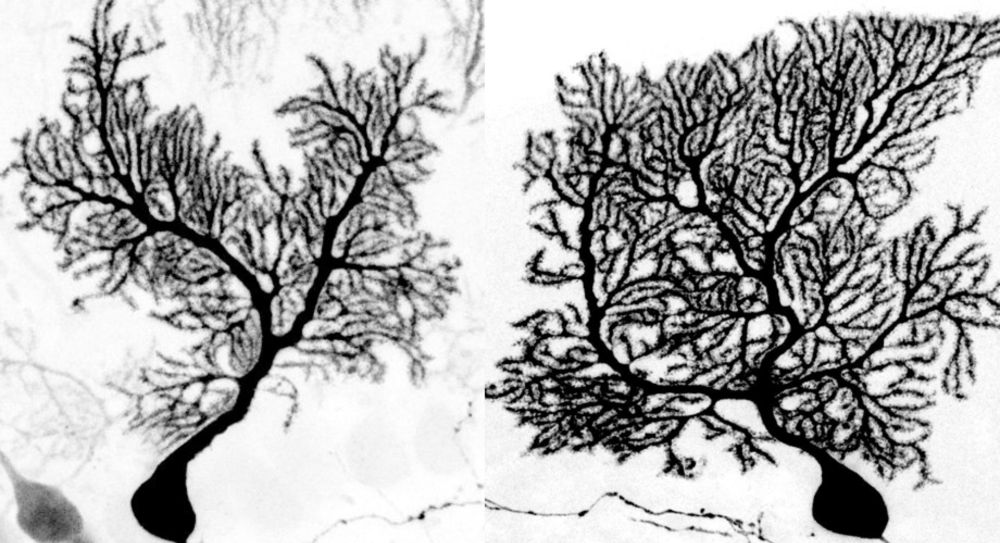
Purkinje cell sparsely labeled with GFP
Using my first post as an excuse to share one of my favorite images of a sparsely labeled Purkinje cell. I have the fortune of studying these beautiful neurons - specifically how microRNAs contribute to their remarkable dendritic arborization.
🧠🔬👩🏻🔬
#cerebellum #neurons #purkinjecell
21.11.2024 19:49 — 👍 7 🔁 0 💬 0 📌 0
Hello, I’m a postdoc at Scripps Research in San Diego and a fan of your night science podcast. This sounds exciting! I would love to learn more about your events and what you are envisioning for Postdoc Night Science and potentially help kick it off here in SD!
19.11.2024 07:22 — 👍 1 🔁 0 💬 1 📌 0
West Coast Biotech & Life Sciences Reporter for Stat News. Stanford Immunology PhD & UCSC SciCom alum. Tips? jonathan.wosen@statnews.com. Signal: jwosen.27
Professor, eEF1A2/neurological disorders. Mostly talks about research, EDI (tries hard to be a good ally) but sometimes veers off into crafts and photos of Scotland. She/her, views own.
Associate professor at Scripps Research. Studying mechanisms of neuronal gene expression, with a focus on non-coding RNA
Postdoc at Scripps Research. Incoming assistant professor at Northwestern University. Investigating body-brain communication.
Candidate for New Jersey's 12th Congressional District. SamForNJ.org.
Neurosciencer, democracy reform studier, plotter of data by hand as first step. At Princeton too. Long-form essays at samwang.substack.com.
Neuron publishes ground-breaking research papers, reviews & commentary across neuroscience and is a premier intellectual forum for the neuroscience community.
https://www.cell.com/neuron/home
Geneticist whose lab does experimental evolution, using yeast as a model. Because being a footballer was never going to work out, due to lack of talent.
PI of SGD and CGD
ORCID: 0000-0002-1692-4983
Postdoc, Scripps Research. Alumnus Scripps Research CA, TIFR Mumbai, Panjab University Chandigarh. Innate Behaviors/Systems Neuro/Psychiatry. Likely drinking chai in lab.
Building neurotech to study how genes and physiology impact brain function 🧬 🧠 Associate Professor, Scripps Research | Freeman Hrabowski Scholar, HHMI
Assistant professor @scrippsresearch. Immunologist. Interested in how cellular networks shape immunity and tissue functions. (she/her). http://themendozalab.org
Postdoc at University of Pavia.
Interested in cerebellar synaptic transmission and plasticity in health and disease.
#cerebellum #neurophysiology #patchclamp #STDP
Evo-Devo neurobiologist | Associate Prof. at Institute of Genomics, University of Tartu | SFARI Fellow | EMBO Installation Grantee | Cerebellum development: how it evolved and how it goes wrong
Neuroscientist, Professor, Head of Laboratory of Developmental Neurobiology, Rockefeller University
Editorial team of Nature Reviews Drug Discovery
www.nature.com/nrd
Nature Communications is an open access journal publishing high-quality research in all areas of the biological, physical, chemical, clinical, social, and Earth sciences.
www.nature.com/ncomms/
News, commentary and research coverage from the international monthly journal publishing the highest quality of work in all areas of neuroscience.
https://www.nature.com/neuro/
A scientific journal publishing cutting-edge methods, tools, analyses, resources, reviews, news and commentary, supporting life sciences research. Posts by the editors.
Nature Genetics is a monthly journal publishing high impact research in genetics and genomics. Part of @natureportfolio.bsky.social
Repost/like=interesting/relevant, not necessarily endorsement.
Our research group is interested in the molecular and cellular origins and evolution of vertebrate organs. Tweets by Henrik, usually in the name of our group.
home.kaessmannlab.org