By "memory" you mean long-term perception?
28.11.2025 16:49 — 👍 0 🔁 0 💬 1 📌 0
Humans, of course, are the ultimate allosteric devices, almost infinitely reconfigurable.
28.11.2025 12:38 — 👍 0 🔁 0 💬 0 📌 0
It appears that Rider used the prospective WCC sale funds as collateral for loans that funded operating deficits. The money they got from the sale repaid those loans. So there's nothing left.
11.11.2025 17:04 — 👍 3 🔁 0 💬 0 📌 0
I doubt von Neumann would agree that DNA sequences are computer code. As he wrote in TSRA, "by axiomatizing automata in this manner, one has thrown half of the problem out of the window, and it may be the more important half." It's the stuff that can't be formalized that's interesting.
25.10.2025 12:13 — 👍 0 🔁 0 💬 1 📌 0
I continue to think the the more interesting question is "how does language acquire children?"
27.06.2025 13:03 — 👍 5 🔁 1 💬 1 📌 0
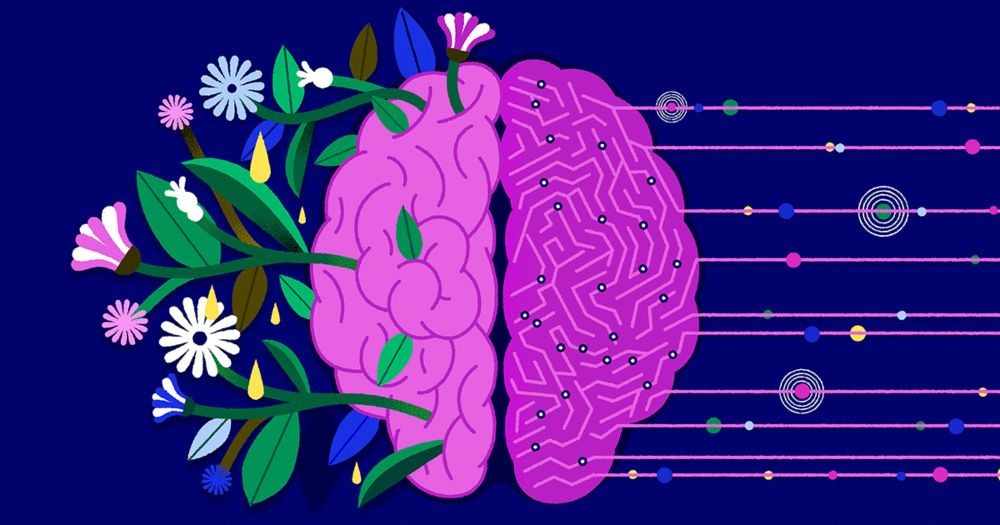
AI Is Nothing Like a Brain, and That’s OK | Quanta Magazine
The brain’s astounding cellular diversity and networked complexity could show how to make AI better.
"A maggot knows things about the outside world in a way that no computer does." Read @yaseminsaplakoglu.bsky.social fun + fascinating feature: AI Is Nothing Like a Brain, and That’s OK www.quantamagazine.org/ai-is-nothin...
30.04.2025 14:33 — 👍 8 🔁 5 💬 2 📌 0

Going thru some old journals and found this amazing TOC. Pattee, Rosen, Richerson & Boyd, Goodwin, Tullock....all in one place. Journal of Social & Biological Structures 1:2 (April 1978). Pretty sure this is the first Pattee paper I read.
30.03.2025 16:30 — 👍 2 🔁 0 💬 0 📌 0
How do you simulate a brain in any detail with a simple digital (or even quantum) computer? "Making a connection" in the brain is not just "information processing." It's physical. There is no workable "software" driving the mind. It is the "hardware" that is messy and unique, and constantly changing
13.03.2025 04:11 — 👍 9 🔁 4 💬 0 📌 0
However, in the biological world, an awful lot of information is transmitted via sequences.
10.03.2025 22:54 — 👍 1 🔁 0 💬 0 📌 0
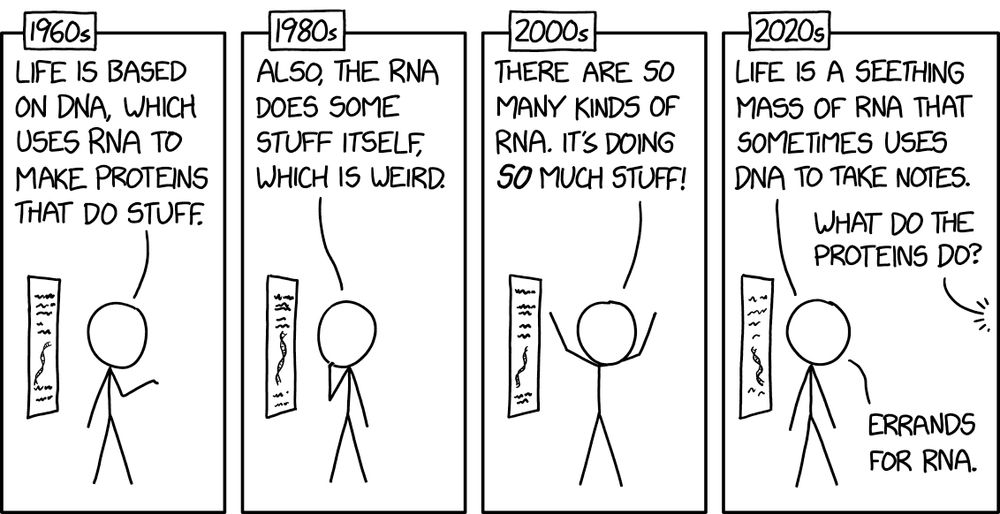
RNA xkcd.com/3056
26.02.2025 14:58 — 👍 17901 🔁 2568 💬 155 📌 171
To begin to grasp pleiotropy one only needs a child with Fragile X Syndrome.
20.02.2025 17:46 — 👍 2 🔁 0 💬 0 📌 0
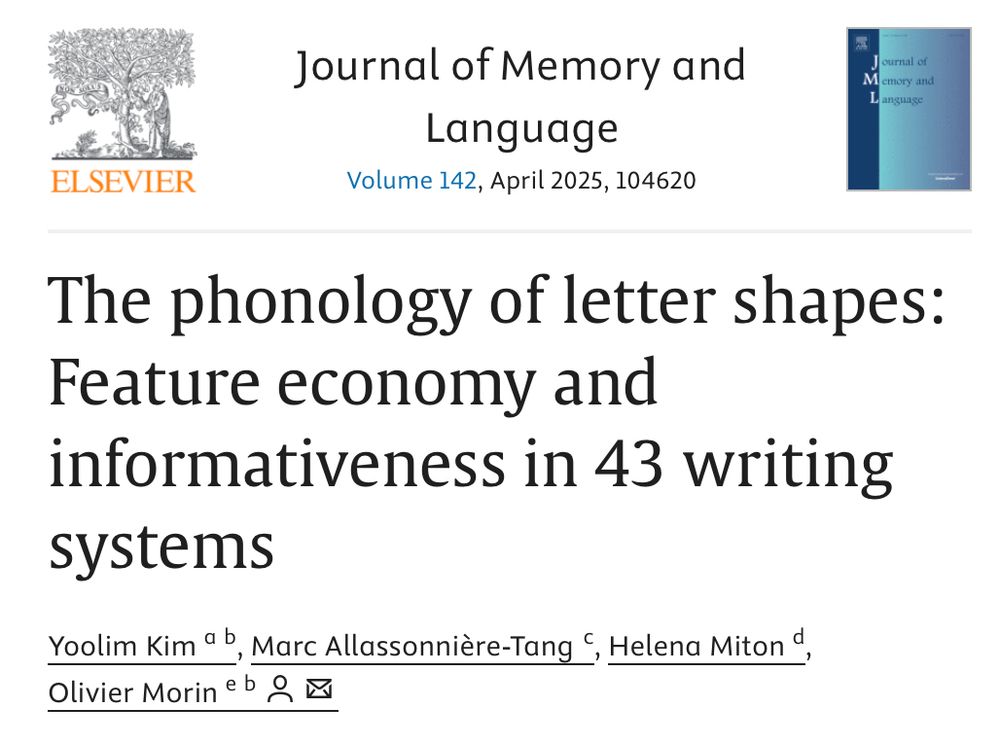
🚨 New paper! 🚨 by Yoolim Kim, @helenamiton.bsky.social, Marc Allassonnière Tang, & myself, in Journal of Memory and Language. We tried to do for letter shapes what phonologists did for speech sounds. doi.org/10.1016/j.jm... A 🧵 (1/14)
19.02.2025 15:55 — 👍 49 🔁 16 💬 1 📌 2
DNA and text are not two different things. They are two different examples of one sort of thing.
20.02.2025 00:38 — 👍 0 🔁 0 💬 0 📌 0
The huddle is rate-independent. There is no relationship between the length of the huddle and the length of the play. The huddle could be half or twice as long without changing the rate of the play. The play is rate-dependent. Slight changes in rate have a large impact on the outcome of the play.
10.02.2025 12:29 — 👍 0 🔁 0 💬 0 📌 0
The game of American football is an example of 1-dimensional sequences constraining 3-dimensional behavior. The huddle is an exchange of sequences in the form of speech. These constrain the dynamical behavior of players in the subsequent play. Once the play commences the dynamics take over.
10.02.2025 12:28 — 👍 0 🔁 0 💬 1 📌 0
Sequences will be sequences.
05.02.2025 17:14 — 👍 0 🔁 0 💬 0 📌 0
They may regret not selling it when they could.
28.01.2025 17:38 — 👍 0 🔁 0 💬 0 📌 0
If it is universally nonreactive then it is lawful in the Pattee sense. @vanessaseifert.bsky.social
24.01.2025 17:20 — 👍 1 🔁 0 💬 0 📌 0
When Pattee says rules are local he means "not universal." Are there situations in which they do not hold? Not a chemist but I wonder whether there are extremes of temperature, pressure, radiation, etc. in which gold can become reactive. If so, "gold is nonreactive" is more of a rule than a law.
24.01.2025 17:18 — 👍 1 🔁 0 💬 1 📌 0
I get that. The question of where to draw the line still troubles me. Embodied contributions to behavior are a fine test case. Does a single cell possess (exhibit?) cognition? A dragonfly? Or do you need language or mathematics or code? Also, what is the relationship of cognition to affordances?
15.01.2025 16:12 — 👍 0 🔁 0 💬 1 📌 0
Well, if we're trolling for first principles here, here's a naive question: What does the concept of "cognition" (however defined) actually buy us? Can we get along without it? And if not, what are the underlying assumptions that support that?
15.01.2025 15:13 — 👍 1 🔁 1 💬 2 📌 0
That would be Charles Bennett. Sometimes you get Dennett on the brain, I know.
12.01.2025 16:31 — 👍 1 🔁 0 💬 0 📌 0
As Howard Pattee wrote in 1982: "Cells do not have feet or ears, but they have motility and irritability, which are basic functions of feet and ears....I suggest that brain-level psychologies are not likely to converge until we have some agreement on the foundations of cell psychology."
11.01.2025 12:29 — 👍 2 🔁 1 💬 0 📌 0
I only met Rosen once, at a General Systems meeting in Washington in the 1980s (introduction arranged by Howard Pattee). Rosen and Pattee (and Ludwig von Bertalanffy) collaborated when they were at the Center for Theoretical Biology at SUNY Buffalo in the early 70s. They were complementary thinkers.
10.01.2025 11:27 — 👍 3 🔁 1 💬 0 📌 0
Robert Rosen - Biologist
Robert Rosen was a leading theoretical biologist in the tradition of relational biology, making important contributions to the understanding of living systems.
I've just been told about this website collecting the works, published and unpublished, of Robert Rosen, who was a profound thinker on all kinds of issues, especially in the life sciences. Seems like a great resource.
www.rosenlife.org
10.01.2025 10:09 — 👍 50 🔁 13 💬 0 📌 1
No one else comes close as an influence on my thinking on evolution, complexity, self-organization, symbol sequences vs. dynamics, the whole lot really.
05.01.2025 18:47 — 👍 2 🔁 0 💬 0 📌 0
Evolutionary Biologist, herpetologist, paleontologist | Assistant/term Professor at University of San Francisco | I like to catch salamanders
Journal devoted to theoretical advances in the fields of biology and cognition, with an emphasis on the conceptual integration of #EvoDevo approaches. Published by @kli.ac.at
springer.com/journal/13752
PhD candidate at the evolutionary modelling Group at KU Leuven (@vandenberglab.bsky.social)
Professor @KULeuven - evolutionary biology, theoretical biology & biostatistics (#Rstats). Social insects & microorganisms. Social evolution, self organisation, chemical ecology, statistical machine learning. https://bio.kuleuven.be/eeb/tw/research
At the evolutionary modelling group at KU Leuven (Belgium) we study evolutionary dynamics in all its forms, whether it’s robustness, persistence, plasticity, or the evolution of language and culture. If it evolves we probably tried to model it!
CNRS Research Director / Ethologist / Ants & Slime Molds / Author of Moi Le #Blob & L'odyssée des #Fourmis/ Les #champignons de l'apocalypse / @Univ_Toulouse @CNRS_Toulouse
CTO of Technology & Society at Google, working on fundamental AI research and exploring the nature and origins of intelligence.
Reporter at The Transmitter | PhD, Neuroscience from UPenn 🧠 | Prev: Science, The Open Notebook & ‘21 AAAS Mass Media Fellow at STAT News | Boricua 🇵🇷
Professor Emeritus (University of Manchester), writes on biology, history of science & French Resistance. Biography of Francis Crick, out in Nov 2025.
Link to publications: https://orcid.org/0000-0002-8258-4913
The home of #WildflowerHour: 8-9pm every Sunday.
Wild Flowers you find across Britain & Ireland in the last week.
The biggest cheerleader for our wild plants!
Posts by @botanybeck.bsky.social
https://wildflowerhouruk.weebly.com/
Head of Molecular Psychiatry and Neurodegeneration Laboratory at Heinrich Heine University of Düsseldorf, Germany. Transmission and co-evolution mechanisms for brain function from the molecular to the individual/organismal level.
Candidate for NJ Assembly- 32nd District. Housing is a human right. Wonk making it work. Theater nerd. 🐈⬛ 🐈
https://www.katiebrennanfornj.com/
Sports media news, analysis, and commentary. Part of Comeback Media. All our links: https://awfulannouncing.start.page.
Writer, tabletop & Warhammer dork, queer person, imminent PhD (enaction, ecological psych, language, interaction). Yes that's actually Nessie
Founder & PI @aial.ie. Assistant Professor of AI, School of Computer Science & Statistics, @tcddublin.bsky.social
AI accountability, AI audits & evaluation, critical data studies. Cognitive scientist by training. Ethiopian in Ireland. She/her
Long time student of the mind sciences.
Doing the baseball things at @MLB dot com.
BBWAA. NYC. BU. NJ. Sometimes I play the bass. Go @njdevils.
Here only for serious stuff on:
#AI #Archaeology #Art #Biology #CognitiveScience #ComplexSystems #Farsi #History #Neuroscience #Poetry #Politics #SciFi #SouthAsia #Urdu
Interested in cognition and artificial intelligence. Research Scientist at Google DeepMind. Previously cognitive science at Stanford. Posts are mine.
lampinen.github.io
Evolutionary biologist (Multicellularity & social evolution). Prof. at Georgia Tech & Director of the QBioS PhD program.
https://ratclifflab.biosci.gatech.edu/