Acetylcholine reflects uncertainty during hidden state inference
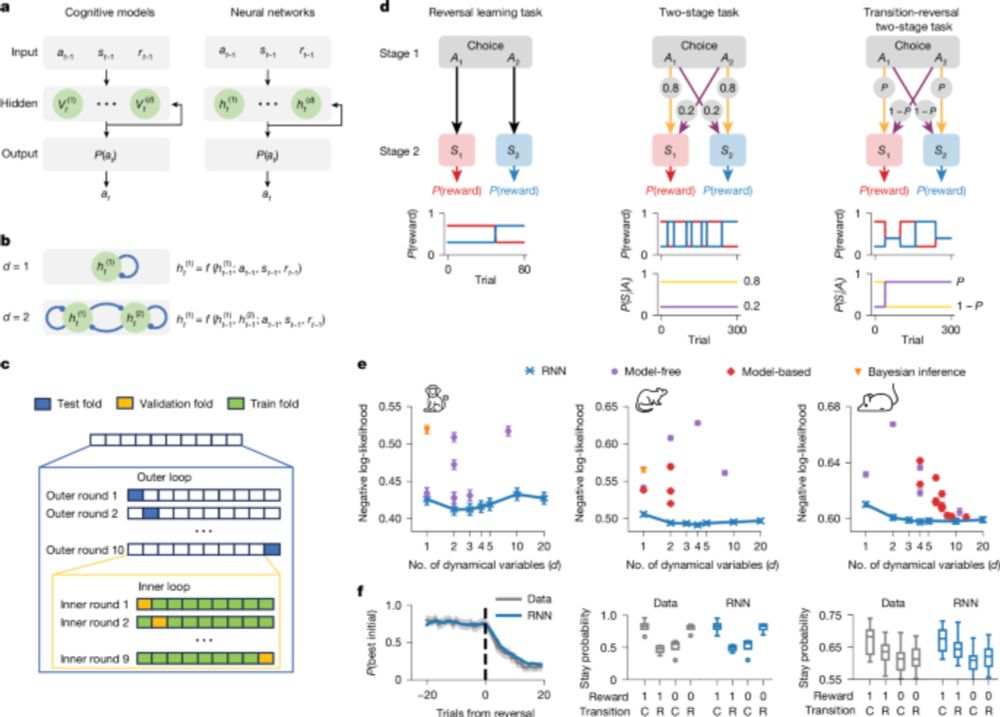
To act adaptively, animals must infer features of the environment that cannot be observed directly, such as which option is currently rewarding, or which context they are in. These internal estimates,...
Congrats to Ella for her new paper! She asked a really interesting question about how the brain represents uncertainty during hidden state inference, and in a lovely crossover with theoretical work, she shows that in mice, acetylcholine dynamics play a crucial role. www.biorxiv.org/content/10.1...
14.11.2025 09:57 — 👍 62 🔁 12 💬 3 📌 1

Contents of visual predictions oscillate at alpha frequencies
Predictions of future events have a major impact on how we process sensory signals. However, it remains unclear how the brain keeps predictions online in anticipation of future inputs. Here, we combin...
@dotproduct.bsky.social's first first author paper is finally out in @sfnjournals.bsky.social! Her findings show that content-specific predictions fluctuate with alpha frequencies, suggesting a more specific role for alpha oscillations than we may have thought. With @jhaarsma.bsky.social. 🧠🟦 🧠🤖
21.10.2025 11:05 — 👍 94 🔁 38 💬 4 📌 2

Motivation as Neural Context for Adaptive Learning and Memory Formation
Our memories shape our perception of the world and guide adaptive behavior. Rather than a veridical record of experiences, memory is selective. An accumulating body of work suggests that motivational ...
How does motivation shape learning and memory? In a new review w @ralisonadcock.bsky.social, we propose that under different motivational ‘moods', neuromodulators set distinct neural contexts to determine information processing and memory formation.
doi.org/10.1146/annu...
#psychscisky #neuroskyence
13.10.2025 04:09 — 👍 53 🔁 18 💬 1 📌 0

Principles for proper peer review
For all the knucklehead reviewers out there.
Principles for proper peer review - Earl K. Miller
jocnf.pubpub.org/pub/qag76ip8...
#neuroscience
06.10.2025 19:59 — 👍 69 🔁 24 💬 1 📌 4
Our #sEEG study is now published in Nature Communications: rdcu.be/eIkoG! 🧠
Key finding: We discovered neural evidence accumulation for visual perception that's independent of report preparation—recorded from >3000 channels across 3 experiments!
#Neuroscience #Consciousness #OpenAccess
29.09.2025 15:27 — 👍 37 🔁 15 💬 0 📌 2


Curious about the human ability to extract regularities from sensory input (i.e., “statistical learning”) and individual differences therein? #CognitiveScience #Learning
Our #Consensus paper presents the collective insights of 27 researchers worldwide 🌎 💬 🌍 💬 🌏 💬:
🔗 doi.org/10.31234/osf...
24.09.2025 08:02 — 👍 22 🔁 14 💬 1 📌 1
We are hiring for several research positions for this grant, starting early next year. Please reach out if you're interested!
More details on the jobs here: devcompsy.org/wp-content/u...
24.07.2025 06:46 — 👍 25 🔁 25 💬 0 📌 0

Two flagship papers from the International Brain Laboratory, now out in @Nature.com:
🧠 Brain-wide map of neural activity during complex behaviour: doi.org/10.1038/s41586-025-09235-0
🧠 Brain-wide representations of prior information in mouse decision-making: doi.org/10.1038/s41586-025-09226-1 +
03.09.2025 16:22 — 👍 123 🔁 69 💬 2 📌 12
Catecholamines like dopamine and norepinephrine are key in processing info and making decisions. Our study shows these neuromodulators reduce the impact of past choices on current decisions, leading to less biased perceptual judgments. Exciting implications for brain science! #Neuroscience
05.09.2025 08:05 — 👍 1 🔁 0 💬 0 📌 0
🧠✨ Exciting new research alert! ✨🧠
Did you know that catecholamines can reduce choice history biases in perceptual decision-making? 🧐🔍
Paper: journals.plos.org/plosbiology/...
With @donnerlab.bsky.social and @swammerdamuva.bsky.social
05.09.2025 08:05 — 👍 22 🔁 8 💬 1 📌 0
Ok, but the ones I linked here are also near-threshold auditory detection. Curious to see your results at some point. :-)
27.08.2025 16:34 — 👍 0 🔁 0 💬 0 📌 0
Some recent examples of phasic and tonic variations in pupil size predicting choice behavior about auditory stimuli:
- https://pubmed.ncbi.nlm.nih.gov/26074005/
- https://pubmed.ncbi.nlm.nih.gov/32543372/
- https://pubmed.ncbi.nlm.nih.gov/39151432/
- https://pubmed.ncbi.nlm.nih.gov/38277436/
27.08.2025 12:47 — 👍 1 🔁 0 💬 1 📌 0
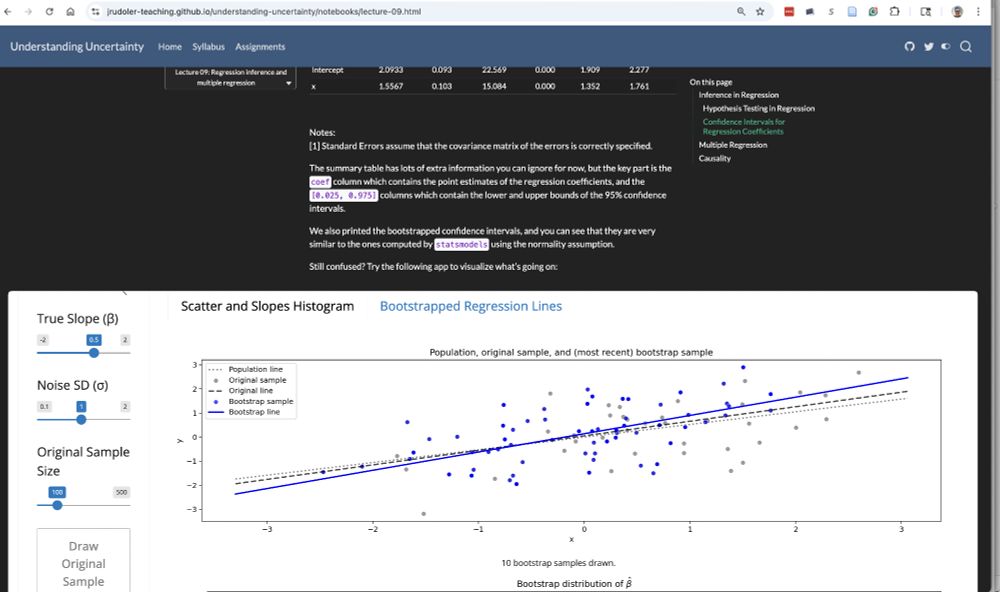
Its a new term and a lot of us are preparing their lectures. I am a huge fan of online ways of teaching. And my student Joey Rudoler @jrudoler.bsky.social made a great online stats course. Shiny app and all. Modern take on stats. Thought some of you may appreciate.
31.07.2025 19:19 — 👍 37 🔁 5 💬 1 📌 1
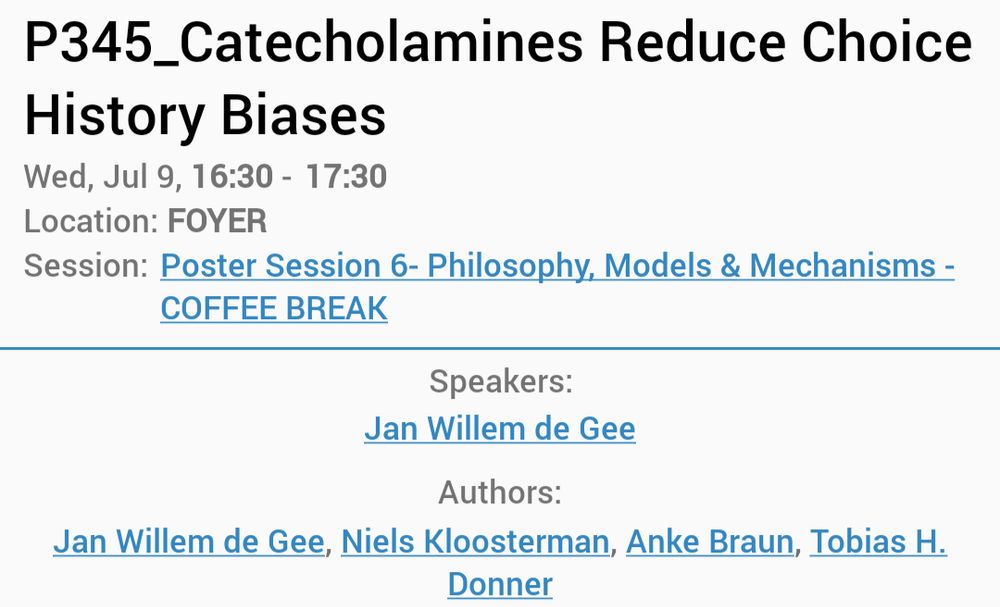
Are you at @assc28.bsky.social #ASSC28? On Wednesday I will present a poster on the causal relationship between choice history biases and catecholamines (noradrenaline / dopamine). With @donnerlab.bsky.social et al.
07.07.2025 09:09 — 👍 10 🔁 4 💬 0 📌 0
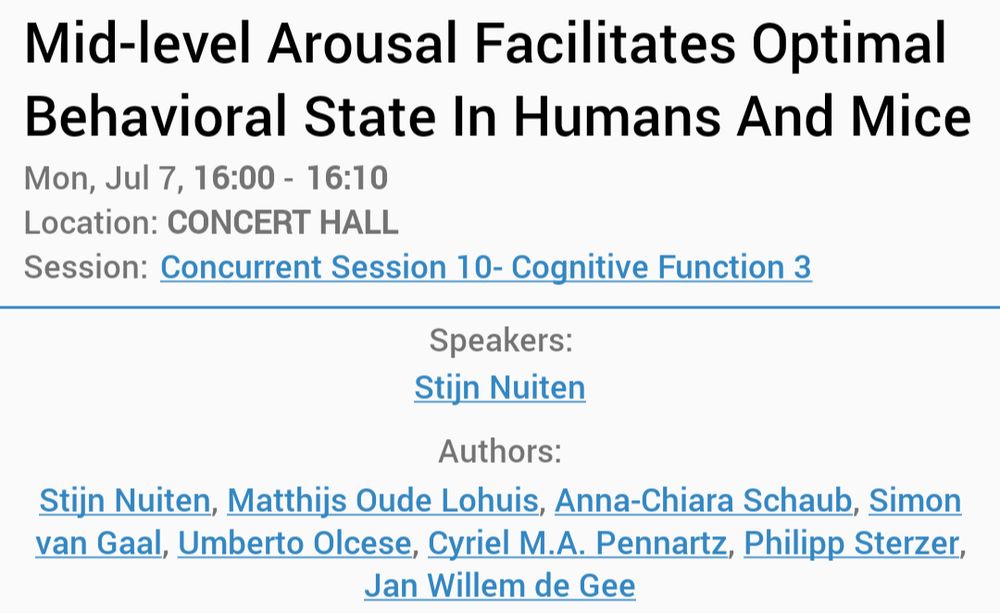
Are you at @assc28.bsky.social #ASSC28? Later, @stijnnuiten.bsky.social will present exciting cross-species results on the interaction between latent behavioral states, pupil-linked arousal, and V1 activity. Great collab w/ @psterzer.bsky.social @svangaal.bsky.social @pennartz.bsky.social et al.
07.07.2025 09:05 — 👍 10 🔁 4 💬 0 📌 0
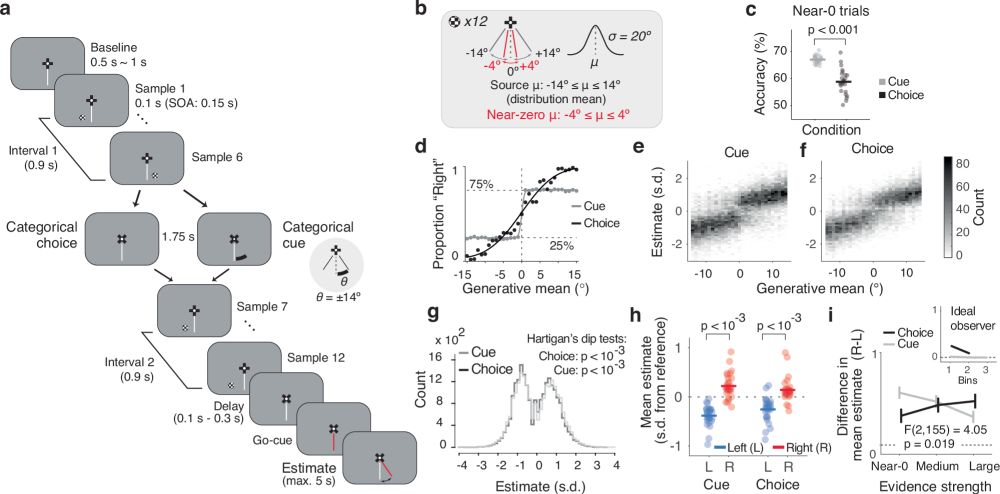
Confirmation bias through selective readout of information encoded in human parietal cortex
Nature Communications - People often discard incoming information when it contradicts their pre-existing beliefs about the world. Here, the authors show that this discarded information is precisely...
1/ New paper by Hame Park, (@AraziAyelet), Bharath Talluri, Marco Celotto, Stefano Panzeri, Alan Stocker & Tobias Donner published in Nature Communications – “Confirmation Bias through Selective Readout of Information Encoded in Human Parietal Cortex”: rdcu.be/etlR7. Here is a summary:
27.06.2025 13:35 — 👍 38 🔁 20 💬 1 📌 0
Social Psychology Prof at University of Amsterdam. Prejudice & social cognition using experimental, computational, neuro, & AI approaches.
🧠🔬 Amsterdam Neuroscience is the research institute for neuroscience of Amsterdam UMC, VU Amsterdam and the University of Amsterdam. Our researchers and clinicians join forces in the field of fundamental, translational and clinical research.
UCL neuroscientist investigating the neural basis of contextual decision making. Views are my own.
Prof @uclnpp
lab website: www.macaskilllab.com
UCL profile: https://profiles.ucl.ac.uk/5194
also @macaskillaf@fediscience.org
Human Intracranial Cognitive Neuroscience & Neurology at Yale University, previously at the University of Tuebingen. www.helfrich-lab.com Views are by own.
https://mcnlab.uchicago.edu/
How brain neural nets do computations; we aim to understand differences in brain wiring, using lasers and neuro-AI.
Lab head, NIH. Prev: media policy for democracypolicy.network.
linktr.ee/markhisted
Pers. views
neuro posts: 🧠 /🧪
Research group @Ghent University.
Our research focuses on the cognitive science of learning and language.
Assoc Prof, St. Jude Children's Research Hospital, neural circuits/norepinephrine, mom, sewist
Faculty of Science- Universiteit van Amsterdam
Neuroscience Editor and Section Manager at PLOS Biology #OpenScience
How does the brain work and what's happening when things go wrong?
PhD candidate Cognitive and Systems Neuroscience
- SILS Amsterdam
Researching neural correlates of (visual) consciousness
Research Group leader @Max Planck Institute of Psychiatry
Systems Neuroscience
Postdoctoral researcher in clinical neuroscience @UPK Basel, psychologist
https://translat-psych.medizin.unibas.ch/en/
Assistant Professor of Philosophy of Neuroscience at University of Amsterdam
Dad, husband, President, citizen. barackobama.com