Last call for postdoctoral applications to join my group at University of Toronto. Feel free to reach out if you want to learn more about the position.
09.01.2026 22:09 — 👍 5 🔁 6 💬 0 📌 0
Postdoctoral Job Opportunity! I am hiring a postdoc to join my group next fall. Many possible research directions in theoretical biophysics and nonequilibrium statistical mechanics. See the posting linked below for details — apply by Jan 15th for full consideration.
22.12.2025 14:03 — 👍 9 🔁 8 💬 0 📌 1
Finally, thanks to Yale's Department of Physics and Quantitative Biology Institute, and the Natural Sciences and Engineering Research Council of Canada (NSERC) for supporting our work!
17.12.2025 16:57 — 👍 1 🔁 0 💬 0 📌 0
The non-Markovian dynamics of biological systems arise from coarse-graining the underlying fundamental physics to produce simplified descriptions. Going forward, our work paves the way to study how non-Markovian dynamics emerge through coarse-graining across scales. Stay tuned!
17.12.2025 16:57 — 👍 3 🔁 0 💬 1 📌 0
This is roughly the timescale biologists have identified as the length of the fly’s working memory for both odor sensing and navigation, which we’ve detected using only recorded behavior data! This hints that memory is the main driving factor for the fly’s non-Markovian behavior.
17.12.2025 16:57 — 👍 0 🔁 0 💬 1 📌 0

We then turn to biological data, 400,000 minutes of recorded fruit fly behavior with 10ms time resolution. Our most intriguing result: we discover a unique timescale that maximizes how much information the fly’s past behavior holds about its future behavior, about 7 seconds.
17.12.2025 16:57 — 👍 0 🔁 0 💬 1 📌 0

We first explore analytically-tractable minimal models for non-Markovian dynamics. This lets us build intuition for the highly counterintuitive behavior of non-Markovian dynamics with long-range history dependence. E.g.: autocorrelations can fail to reflect true dependencies!
17.12.2025 16:57 — 👍 1 🔁 0 💬 1 📌 0

We develop new information-theoretic tools to
1. Quantify how strongly the dynamics of biological systems depend on their past.
2. Decompose this dependence into contributions from different parts of the past, quantifying the information you gain by learning each past state.
17.12.2025 16:57 — 👍 0 🔁 0 💬 1 📌 0

arxiv.org/abs/2512.13933
arxiv.org/abs/2512.13936
The fundamental laws of physics are Markovian: the next state of a physical system depends only on its current state. Biology, however, is often non-Markovian: the next state can depend on states arbitrarily far back into the past.
17.12.2025 16:57 — 👍 0 🔁 0 💬 1 📌 0

Excited to share two final preprints for the year:
“Decomposing Non-Markovian History Dependence”,
and
“Tractable Model for Tunable Non-Markovian Dynamics”.
Both with chriswlynn.bsky.social.
17.12.2025 16:57 — 👍 2 🔁 0 💬 1 📌 0
This is roughly the timescale biologists have identified as the length of the fly’s working memory for both odor sensing and navigation, which we’ve detected using only recorded behavior data! This hints that memory is the main driving factor for the fly’s non-Markovian behavior.
17.12.2025 16:54 — 👍 0 🔁 0 💬 0 📌 0
We then turn to biological data, 400,000 minutes of recorded fruit fly behavior with 10ms time resolution. Our most intriguing result: we discover a unique timescale that maximizes how much information the fly’s past behavior holds about its future behavior, about 7 seconds.
17.12.2025 16:54 — 👍 0 🔁 0 💬 1 📌 0
We first explore analytically-tractable minimal models for non-Markovian dynamics. This lets us build intuition for the highly counterintuitive behavior of non-Markovian dynamics with long-range history dependence. E.g.: autocorrelations can fail to reflect true dependencies!
17.12.2025 16:54 — 👍 0 🔁 0 💬 1 📌 0
We develop new information-theoretic tools to
1. Quantify how strongly the dynamics of biological systems depend on their past.
2. Decompose this dependence into contributions from different parts of the past, quantifying the information you gain by learning each past state.
17.12.2025 16:54 — 👍 0 🔁 0 💬 1 📌 0
arxiv.org/abs/2512.13933
arxiv.org/abs/2512.13936
The fundamental laws of physics are Markovian: the next state of a physical system depends only on its current state. Biology, however, is often non-Markovian: the next state can depend on states arbitrarily far back into the past.
17.12.2025 16:54 — 👍 0 🔁 0 💬 1 📌 0

Johann du Buisson, Jannik Ehrich, mleighton.bsky.social, davidasivak.bsky.social, and John Bechhoefer introduce a one-coordinate test that infers heat flow to flag “demonic” operation. In kinesin simulations tuned to experiments, the motor grows more demon-like as active fluctuations rise.
27.09.2025 15:00 — 👍 2 🔁 2 💬 1 📌 0
Our recent work (elifesciences.org/articles/104...) combines theory and experiments (by Alex Papagiannakis and Christine Jacobs-Wagner) to understand how chromosome segregation is coupled to growth in E coli. We demonstrate that the nonequilibrium dynamics of polysomes may play a key role.
07.07.2025 14:02 — 👍 3 🔁 1 💬 1 📌 0
Thanks to NSERC, the Canada Research Chairs program, and @sfuphysics.bsky.social for supporting our research! Special thanks to @mitacscanada.bsky.social for funding Julian’s time as a visiting researcher in the Sivak Group last Summer.
17.06.2025 16:18 — 👍 1 🔁 0 💬 0 📌 0


Over the voltage range typical of a neuronal action potential, at low voltages the pump exhibits Maxwell-demon behavior and high efficiency, while at high voltages the pump instead operates as a conventional engine and achieves higher turnover at the cost of lower efficiency.
17.06.2025 16:18 — 👍 1 🔁 0 💬 1 📌 0
Remarkably, we find that sodium-potassium pumps can exhibit Maxwell-demon behavior, supporting internal information flow that enables the ion-transporting subsystem to leverage thermal fluctuations to produce useful electrochemical work.
17.06.2025 16:18 — 👍 1 🔁 0 💬 1 📌 0

We study sodium potassium pumps through the lens of bipartite stochastic thermodynamics, identifying and computing energy and information flows between the ATP-consuming and ion-transporting parts of these machines.
17.06.2025 16:18 — 👍 2 🔁 0 💬 1 📌 0
These pumps are nanoscale molecular machines that consume chemical energy to transport ions across membranes into, out of, and within cells. They are essential both for maintaining cellular homeostasis, and for propagating electrical signals in neurons.
17.06.2025 16:18 — 👍 2 🔁 0 💬 1 📌 0
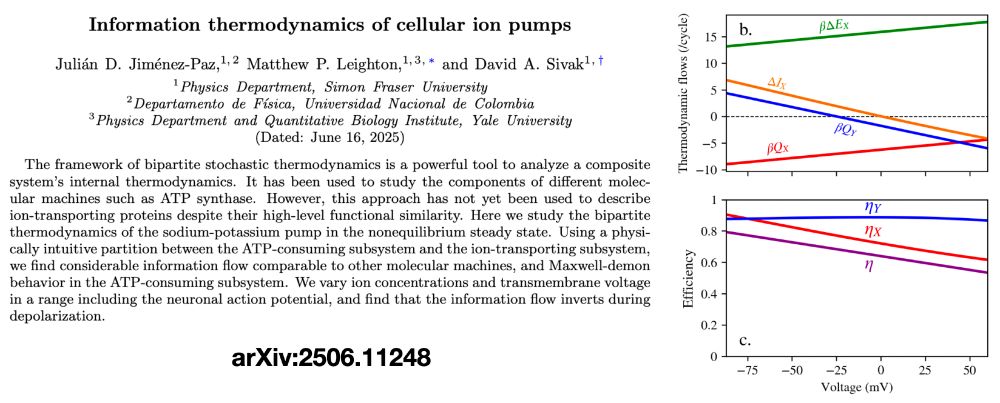
New preprint out today: “Information Thermodynamics of Cellular Ion Pumps”. Led by talented undergraduate student Julián Jiménez-Paz, and working with @davidasivak.bsky.social, we explore the thermodynamics of cellular ion pumps like the sodium-potassium pump.
arxiv.org/abs/2506.11248
17.06.2025 16:18 — 👍 2 🔁 1 💬 1 📌 0
Canada Excellence Research Chairs offer $4-8M over eight years to build a world-class research focus.
09.06.2025 16:32 — 👍 1 🔁 1 💬 1 📌 0
Interested in coarse-graining, irreversibility, or neural activity in the hippocampus?
If so, check out our new preprint exploring how maximizing the irreversibility preserved from microscopic dynamics leads to interpretable coarse-grained descriptions of biological systems!
05.06.2025 18:23 — 👍 5 🔁 1 💬 0 📌 0
Postdoc Ad
Postdoc opportunity!
Join us in heavenly Vancouver (Canada) to develop fundamental nonequilibrium stat mech, thermo, and info theory applied to biomolecular machines and in close collaboration with experiment.
Details: www.sfu.ca/physics/siva...
02.06.2025 15:11 — 👍 4 🔁 4 💬 0 📌 2

We explore the free energy transduction strategies used by various evolved biological molecular machines in different contexts, and suggest possible design principles we might learn from them to help guide the engineering of synthetic nanomachines.
07.05.2025 13:17 — 👍 0 🔁 0 💬 1 📌 0

We focus on flows of energy and information between the components of biological machines, and highlight several possible engine configurations. One intriguing example: an “information engine” mode where one subsystem uses information to harvest heat energy from its environment.
07.05.2025 13:17 — 👍 0 🔁 0 💬 1 📌 0
ELBE postdoc fellow @ CSBD MPI-PKS MPI-CBG, Dresden
Working at the interface between statistical physics and living systems
shilingliang.com
Biophysicist working at the edge of single cell biology, machine learning, and statistical-mechanics. Postdoc in Yogesh Goyal's lab at Northwestern; PhD in biophysics, UC Berkeley; BS in math and physics, CWRU.
I lead the Dynamics and Neural Systems Group at the School of Physics, the University of Sydney.
We develop time series tools & physical models to understand the dynamics of complex (usually neural) systems.
Also: @bendfulcher@fediscience.org
Assistant Professor of Physics at WashU working in areas of biophysics and soft matter.
Schmidt AI in Science Postdoctoral Fellow at U. Chicago
theoretical & computational soft matter, biophysics, machine learning
jordanshivers.github.io
Statistical physics of the brain 🧠 & other complex systems 🦠 | Asst Prof of Physics & QBio at Yale
X: @ChrisWLynn
Lab: lynnlab.yale.edu/
Research Scientist at the Flatiron Institute | biological temperature sensors 🌡️ cryo-EM 🔬computational biophysics 👩🏼💻
Postdoc @rockefeller. Making cryoEM into a tool for RNA biophysics one molecule at a time.
PhD candidate & Harold W. Dodds Fellow @Princeton | statistical mechanics & theoretical biophysics | previously @IBMResearch @Peking University @Rice University
https://qiweiyuu.github.io/
Professor & Canada Research Chair @SFUPhysics
Nonequilibrium statistical biophysics
Research Fellow at the Flatiron Institute. Incoming Assistant Professor of Physics at University of Toronto 2026 | Previously: IBM Research, Cornell Physics | Statistical mechanics, theoretical biophysics, dynamical systems
davidhathcock.github.io
A chemist who adiabatically joined the dark side of physics -- they have nonequilibrium thermodynamics! Postdoc at Northwestern University.
"If one does not expect it, one will not find out the unexpected;
It is not to be tracked down and no path leads us to it."
slimemoldtimemold.com
patreon.com/slimemoldtimemold
Evolutionary biologist (Multicellularity & social evolution). Prof. at Georgia Tech & Director of the QBioS PhD program.
https://ratclifflab.biosci.gatech.edu/
Physics and biology of microbial communities. Structure, function, evolution. Center for the Physics of Evolving Systems. Dept. of Ecology and Evolution. UChicago. @NITMB, @CLS. kuehnlab.org
Physics faculty at U Chicago. Work on biology, physics and whatever else is interesting.
Professor Université de Montréal, Physics of Living Systems, Machine Learning, etc…
https://www.francoisresearch.org/
Chancellor's Distinguished Professor of Physics, UCSD. Interested in everything.
Theoretical physicist researching condensed & living matter, fluid mechanics, statistical mechanics. Bad at staying in my lane.
https://guava.physics.ucsd.edu/~nigel/