Let those amongst us who have not hoodwinked or bamboozled our fellow man/woman on a dirigible, zeppelin or airship cast the first stones…
10.02.2026 06:26 — 👍 1 🔁 0 💬 0 📌 0
YouTube video by The Daily Show
Trump Defends Racist Obama Meme & MAGA Rages Over Bad Bunny’s Spanish Halftime Show | The Daily Show
This guy is killing it now. youtu.be/vfpQbv7CmeE?...
10.02.2026 06:24 — 👍 0 🔁 0 💬 0 📌 0
Why is it that none of these “elites”can spell? These emails all read like a 12 year olds text messages to their bros
09.02.2026 07:56 — 👍 1 🔁 0 💬 0 📌 0
Maybe it’s one of those programs like the LSD exposure in the 50s and 60s that’s meant to test their ability to remain calm under extremely unpleasant circumstances
07.02.2026 17:09 — 👍 3 🔁 0 💬 0 📌 0
*** over 100 years ago ;)
07.02.2026 16:12 — 👍 6 🔁 0 💬 0 📌 0
And to this day journalists have to drag PIs out of the office to put on lab coats and hold beakers with colorful liquids of unknown origins 😂
07.02.2026 16:00 — 👍 13 🔁 0 💬 1 📌 0
I think I’d want to see evidence of genetic lineage if I got such a thing to review. Guilt by association seems a bit fluffy given all we have learned about the history of tumors 😀
07.02.2026 10:13 — 👍 0 🔁 0 💬 1 📌 0
How do people identify “dormant” cells without genetics? And are we certain that a recurrent cancer isn’t actually the birth of a new cancer from a preneoplastic clonal expansion that gave rise to the initial cancer?
07.02.2026 09:49 — 👍 0 🔁 0 💬 1 📌 0
Not something you see in textbooks very often: tripolar mitosis.
07.02.2026 08:00 — 👍 1555 🔁 269 💬 50 📌 21


A near-complete map of human cytosolic degrons and their relevance for disease
We measured degron potency of >200,000 30-residue tiles from >5,000 human proteins, and trained a model to predict degrons from sequence
Led by @vvouts.bsky.social in @rhp-lab.bsky.social
doi.org/10.1126/scia...
07.02.2026 07:41 — 👍 53 🔁 17 💬 0 📌 0
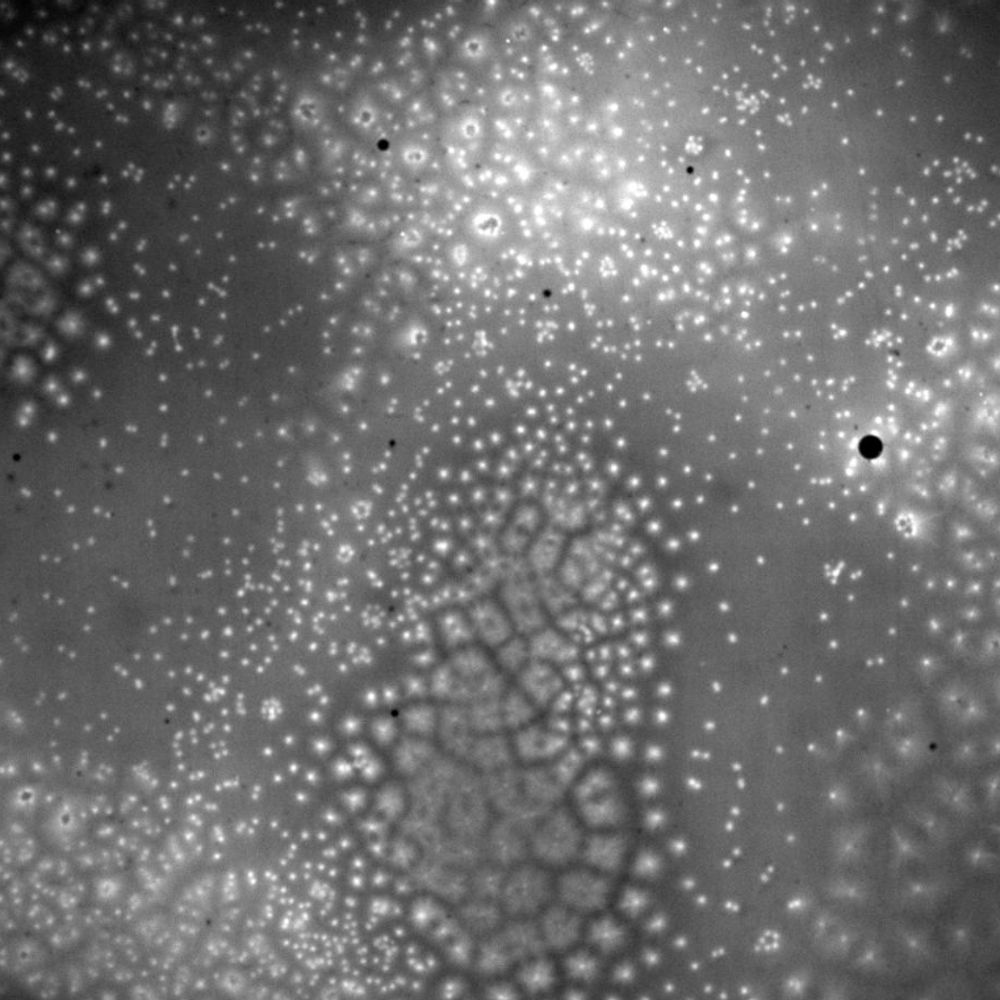
Oh I’ve seen these in dishes of senescent RPE1! Figured it was shedding of cellular contents which maintained some level of protein and rna?!
05.02.2026 16:39 — 👍 1 🔁 0 💬 0 📌 0
(It’s a Biobank not a zoo but hey I wouldn’t put it past them)
05.02.2026 08:09 — 👍 0 🔁 0 💬 0 📌 0
Skiing in Kosovo not bad!
03.02.2026 12:26 — 👍 3 🔁 0 💬 0 📌 0
Except he normally files bankruptcy and refuses to pay his contractors.. let’s see if he can pull that here
31.01.2026 16:59 — 👍 0 🔁 0 💬 0 📌 0
This literally can be said of anything this man has touched since 1980…
31.01.2026 16:50 — 👍 0 🔁 0 💬 1 📌 0
Haha I do!! I’ve avoided AI. Hoping the trend passes 🤣🥹
30.01.2026 09:05 — 👍 0 🔁 0 💬 1 📌 0
And yet it feels like there’s too many papers to read 😂
30.01.2026 08:43 — 👍 1 🔁 0 💬 1 📌 0

Wise words Melania
30.01.2026 06:20 — 👍 0 🔁 0 💬 0 📌 0
Haha well that’s where I think it’s complicated.
30.01.2026 06:17 — 👍 0 🔁 0 💬 0 📌 0
Really excited to share our new paper in @nature.com! We uncovered how a physical instability of the cytoplasm coupled with the cell cycle drives cytoplasmic partitioning in early embryos #zebrafish #drosophila. Read more in this🧵 www.nature.com/articles/s41... 🤩
@poldresden.bsky.social @mpi-cbg.de
28.01.2026 16:10 — 👍 173 🔁 51 💬 3 📌 8
Oh I know don’t worry ;)
28.01.2026 13:27 — 👍 1 🔁 0 💬 1 📌 0
You should grab up Paolo machiarini while you’re at it 🤣
28.01.2026 12:33 — 👍 1 🔁 0 💬 1 📌 0
This article is now freely available to everyone in PubMed!
www.ncbi.nlm.nih.gov/pmc/articles...
27.01.2026 12:12 — 👍 2 🔁 2 💬 0 📌 0
Cancer biologist, environment and cancer, guitarist, would-be evolutionary molecular biologist, bread baker, sometimes coder, amateur photographer, professional microscopist, & gardener. Lab site: https://blogs.dal.ca/dellairelab/
Scientist at Boston Children's Hospital, Professor at Harvard Medical School, Husband, Father
Ph.D. student at KTH researching statistical methods, deep generative models, spatial transcriptomics and scRNA-seq. https://okviman.github.io/
🧫 ↔️ 🧫 cell communication, 🧬 mol tools, 🧠 🪰computational anatomy. PhD @Karolinska ➡️ postdoc @CSHL ➡️ PI @scilifelab/@UU_University
https://www.furthlab.xyz/
AI engineer. Previously co-founder and CTO at WatchMouse. Building https://paperzilla.ai
We combine soft matter physics, biophysics and cell biology to uncover physical principles of cellular organization @ Cluster of Excellence Physics of Life, Dresden
Research group leader and lecturer in pharmacology at King's College London: kcl.ac.uk/people/simon-cleary
Studying lung immunology with new imaging techniques to enable improvements in respiratory medicine.
Tinkering with atoms, bits, and pixels at the University of Regensburg, Germany.
Yak shaver and award-winning procrastinator.
Also on https://hci.social/@RaphaelWimmer and Twitter
Posting with no discernable pattern about Pittsburgh, MLB, PWHL, and music from metal to barbershop
I work in genomics and might even post about that too
This profile used to be my real name but no longer
He/him. Recovering academic. Bioinformatics and data science expert, working on influenza evolution and cancer genetics and Bayesian/pragmatic approaches to statistics. Now living in Spain and exploring a new life in Asturias. Crypto = instant block.
Metascientist @ uidaho. I work at the intersection of behavioral sciences, statistics, and philosophy. Love thinking and talking about science. Post lots of cat and food pics. Allergic to unsolicited advice.
Computational Biologist for CG-TIC, a collaboration between University of Cambridge and GSK. Wrangling Chronic Kidney Disease data: omics & Electronic Health Records
PhD Student, MRC Biostatistics Unit
University of Cambridge
Gates Cambridge Scholar
Bioinformatics, genetics, single-cell, statistics
Australian 🇦🇺
Graduate student researching ALS, transposable elements & gene regulation at NYU Langone.
🔍 Actively searching for postdoc & industry research roles.
www.linkedin.com/in/isobelbolger
Cell biologist, biochemist, orienteer, mum. Seriously excited about MAPs (mechanochemistry.org/Straube/) and maps (orienteering.sport).
Some parasites, some immunology, some disappointing football
Investigative journalism in the public interest. Headlines and (sometimes literal) receipts.
Send us tips: propublica.org/tips
visuals editor at ProPublica 🦂
probably headbanging
www.cengizyar.com
🇲🇽Assoc. Prof. @UniTartu | Fmr. Postdoc @MayoClinic | PhD @Cambridge_Uni | BSc @Quimica_UNAM | Senior Lead, Data Science @Proekspert
Machine Learning, AI, Molecular Design, Biomolecular modeling,
https://hermes.chem.ut.ee/~alfx