A big thanks also to my long-time collaborator and friend @denysbiriukov.bsky.social, who served as an internal peer-reviewer for the simulation part of the work ☺️
14.05.2025 09:33 — 👍 7 🔁 2 💬 0 📌 0
The work became possible thanks to
@iocbprague.bsky.social, @ceitec.eu, and collaborators from #EPFL and Gdansk.
01.05.2025 21:06 — 👍 3 🔁 0 💬 0 📌 0
Even at ultra-low concentrations, hyaluronan engages in multivalent, dynamic, and selective interactions—precisely the kind of behavior expected of the glycocalyx, largely shaped by hyaluronan.
01.05.2025 20:42 — 👍 1 🔁 0 💬 1 📌 0
🚨 Preprint alert! 🚨
We showed the transient binding and supramolecular complexation between hyaluronan and polypeptides using a suite of techniques (NMR, SHS, DLS, and MD) across a broad concentration range, including *for the first time* the submicromolar regime.
01.05.2025 20:42 — 👍 5 🔁 1 💬 1 📌 0
🇺🇦
28.02.2025 18:56 — 👍 2 🔁 0 💬 0 📌 0
I’m intentionally not including links or names. Instead, I challenge you to reflect on what might unfold in Europe and its neighboring regions in the near future.
28.02.2025 18:56 — 👍 0 🔁 0 💬 1 📌 0
If you usually avoid political discussions and only follow global events passively (or not at all) I still encourage you to catch up on recent developments, especially those of the past few weeks and today. Share your thoughts with friends, colleagues, or anyone in your circle.
28.02.2025 18:56 — 👍 1 🔁 0 💬 2 📌 0
CHARMM-GUI
🚨 All right, since this is a place of sanity now, let’s kick things off with an open PhD position in my team to work on simulating glycans and their interactions. If you’re passionate about computational biophysics and glycobiology, go ahead and apply! Any shares would be greatly appreciated. 🙃
27.02.2025 19:48 — 👍 15 🔁 16 💬 1 📌 0
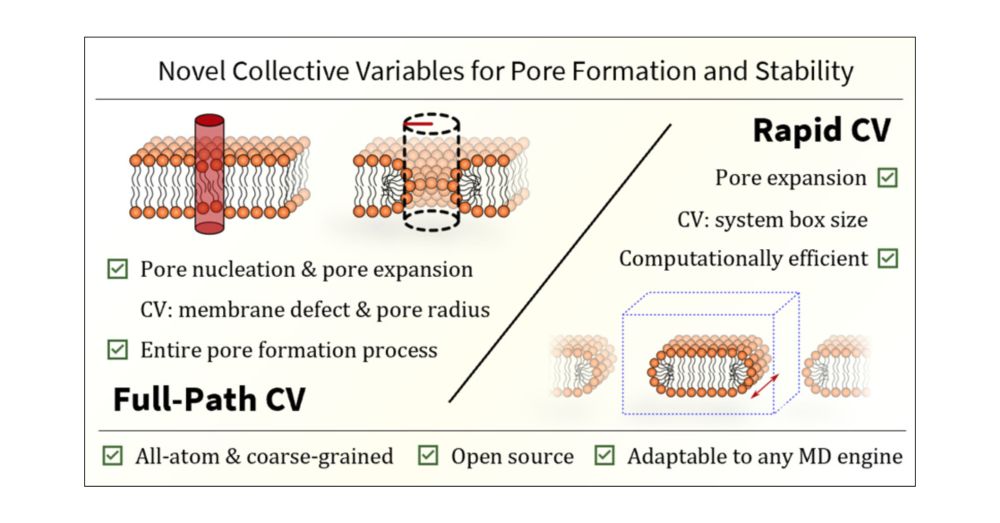
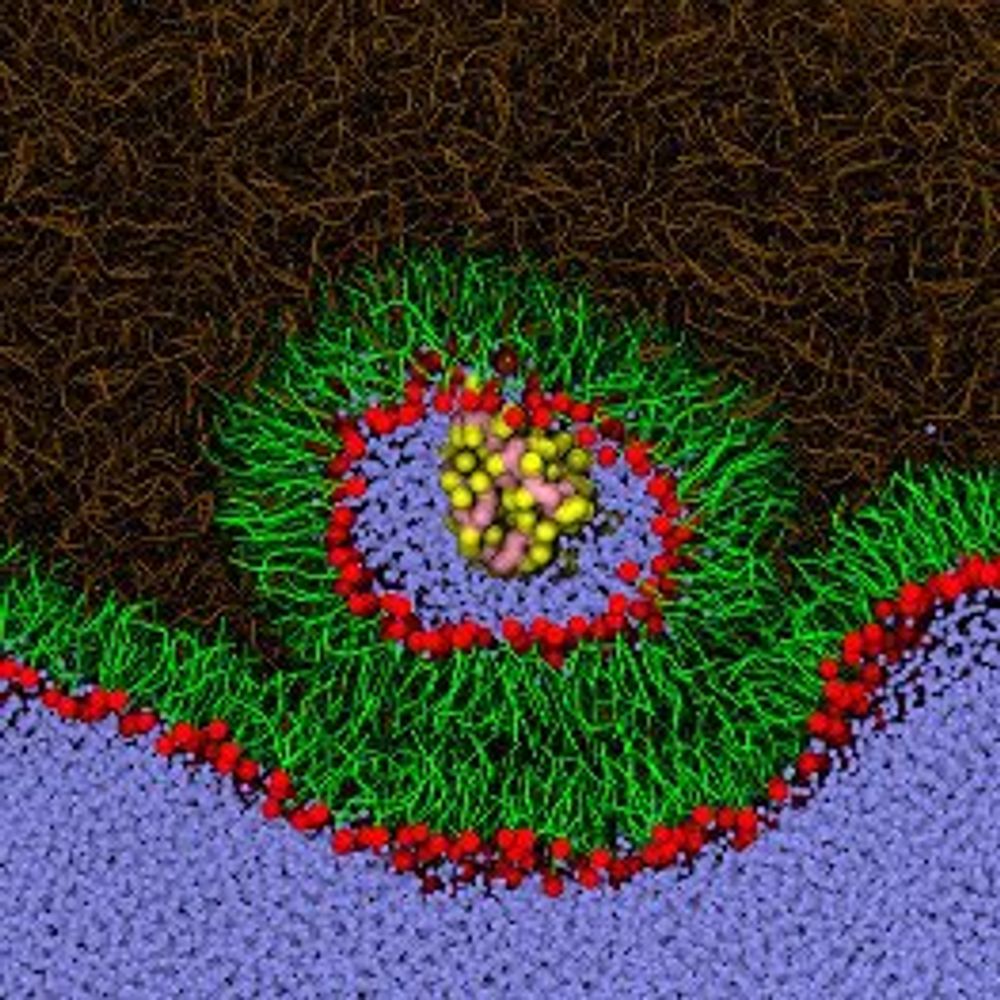
Free Energy of Membrane Pore Formation and Stability from Molecular Dynamics Simulations
Understanding the molecular mechanisms of pore formation is crucial for elucidating fundamental biological processes and developing therapeutic strategies, such as the design of drug delivery systems and antimicrobial agents. Although experimental methods can provide valuable information, they often lack the temporal and spatial resolution necessary to fully capture the dynamic stages of pore formation. In this study, we present two novel collective variables (CVs) designed to characterize membrane pore behavior, particularly its energetics, through molecular dynamics (MD) simulations. The first CV─termed Full-Path─effectively tracks both the nucleation and expansion phases of pore formation. The second CV─called Rapid─is tailored to accurately assess pore expansion in the limit of large pores, providing quick and reliable method for evaluating membrane line tension under various conditions. Our results clearly demonstrate that the line tension predictions from both our CVs are in excellent agreement. Moreover, these predictions align qualitatively with available experimental data. Specifically, they reflect higher line tension of 1-palmitoyl-2-oleoyl-sn-glycero-3-phosphocholine (POPC) membranes containing 1-palmitoyl-2-oleoyl-sn-glycero-3-phospho-l-serine (POPS) lipids compared to pure POPC, the decrease in line tension of POPC vesicles as the 1-palmitoyl-2-oleoyl-sn-glycero-3-phosphoglycerol (POPG) content increases, and higher line tension when ionic concentration is increased. Notably, these experimental trends are accurately captured only by the all-atom CHARMM36 and prosECCo75 force fields. In contrast, the all-atom Slipids force field, along with the coarse-grained Martini 2.2, Martini 2.2 polarizable, and Martini 3 models, show varying degrees of agreement with experiments. Our developed CVs can be adapted to various MD simulation engines for studying pore formation, with potential implications in membrane biophysics. They are also applicable to simulations involving external agents, offering an efficient alternative to existing methodologies.
Third, Tim and @denysbiriukov.bsky.social presented new collective variables to study the energetics of lipid membrane pores.
pubs.acs.org/doi/10.1021/...
Good job!
14.01.2025 16:55 — 👍 2 🔁 1 💬 0 📌 0
PhD Candidate @ Lehigh University
Radek Marek Lab at CEITEC, Masaryk University
Structure of Biosystems and Molecular Materials
(NMR spectroscopy, DFT, metallodrugs, supramolecular interactions, noncanonical DNA)
Computational biophysics and other amenities...
"More thinking and less pipetting"
Research group at the intersection of structural bioinformatics 🧬 and machine learning 🤖. Developing http://prankweb.cz, http://apoholo.cz, https://rnacentral.org/r2dt
Lab: bioinformatics.cuni.cz/cusbg
Heads: @davhox.bsky.social & @majek.bsky.social
Postdoc - Computational Chemistry - Rutgers University, D. York’s Lab - Nucleic Acids 🧬
Assistant Professor in Pharmacology at University of Bristol | GPCRs and ion channels | molecular modelling and simulation | drugs and lipids
Computational Chemist | Researcher at IOCB Prague 🇨🇿
I specialize in quantum chemistry and computational drug design. Alumnus of Charles University & Palacký University. Former postdoc at the Italian Institute of Technology & Marie Curie (IF) Fellow.
Public scientific institution, part of the Czech Academy of Sciences. Research in molecular, structure and cell biology, immunology, genomics and bioinformatics.
Faculty of Science, University of South Bohemia, Czechia
Professor of Theoretical Chemistry @sorbonne-universite.fr & Head @lct-umr7616.bsky.social| Co-Founder & CSO @qubit-pharma.bsky.social (My Views) |
https://piquemalresearch.com | https://tinker-hp.org
NIVB je platforma sdružující vědecká pracoviště, které se zabývají viry a bakteriemi.
Projekt je financován Evropskou unií – Next Generation EU
LX22NPO5103
Institute of Organic Chemistry and Biochemistry of the Czech Academy of Sciences
#iocbprague #biochem #science #akademieved #research #phd ❤️⚗️
Nature Portfolio’s high-quality products and services across the life, physical, chemical and applied sciences is dedicated to serving the scientific community.
An open-access @natureportfolio.bsky.social journal publishing high quality primary research, reviews and commentary in all areas of the biological sciences since 2018.
https://www.nature.com/commsbio/
Nature Communications is an open access journal publishing high-quality research in all areas of the biological, physical, chemical, clinical, social, and Earth sciences.
www.nature.com/ncomms/
P-: 🛰️
Postdoc @plevkalab.blsk.social @CEITEC_Brno
#Phages #Structuralbiology #SinCienciaNoHayFuturo
Science communicator @CEITEC Masaryk University in Brno, Czech Republic & place branding enthusiast