Seeking expressions of interest from researchers abroad for a Canada Impact+ Research Chair ($1M/year × 8 + up to $6M CFI) in AI-enabled antibiotic discovery and/or AMR, phage & phage-based derivatives. Email me a short vision, CV, and 3–5 key papers. Deadline: March 10, 2026 (Intake 2: June 15).
07.01.2026 01:19 — 👍 6 🔁 11 💬 0 📌 0

Une piste prometteuse pour augmenter l’efficacité des antibiotiques
Les aminosides sont des antibiotiques efficaces contre de très nombreuses bactéries telles que Escherichia coli, Pseudomonas aeruginosa ou Staphylococcus aureus. Mais jusqu’à présent, personne ne sava...
🦠💊 L’Institut @pasteur.fr vient de publier un communiqué de presse sur nos récents travaux, qui décrivent une nouvelle piste pour augmenter l’efficacité des antibiotiques. #Pasteurdon #Recherche #Science #AMR
Merci à toutes celles et ceux qui ont contribué.
📘 English version coming soon!
31.10.2025 10:37 — 👍 28 🔁 16 💬 0 📌 1
Many thanks to all those involved, including Jeffrey Liang, who stayed in our lab for several months, our own Charles Bernard and, of course, @fredoleroux.bsky.social and the usual suspects @agencerecherche.bsky.social @erc.europa.eu @cnrsbiologie.bsky.social @pasteur.fr @umontreal.ca etc
14.10.2025 16:07 — 👍 3 🔁 1 💬 0 📌 0
Two intensive sampling periods of oyster-associated vibrio and their phage, 4 years apart, and many surprises. Despite being washed by the Atlantic, wide tides, and vibrio (almost?) disappearing most of the year, we can find the exact same virulent phages 4 years later (down to 0 SNP)! preprint👇
14.10.2025 16:07 — 👍 39 🔁 19 💬 1 📌 1
And thank you so much Pauline!!! It was very cool to see you again with other 'old' conference friends, looking forward to see you again @ Roscoff 2026/Monod conference/virus evolution ;-)?
22.08.2025 14:10 — 👍 2 🔁 0 💬 0 📌 0

👉 Next stop: Montréal! 🇨🇦 Thrilled to join the Canada Society of Microbiology (CSM) conference, June 17-20. Science, community, and reconnecting with old friends — can’t wait!
09.06.2025 17:30 — 👍 7 🔁 2 💬 2 📌 0
The study involves our microbiologist @fredoleroux.bsky.social, whom we profiled in late 2023 as a new hire and Canada Excellence in Research Chair: nouvelles.umontreal.ca/en/article/2...
09.06.2025 16:19 — 👍 11 🔁 5 💬 0 📌 0


Allo Montreal, 11 juin –18H au café La brassée:
"Des sphères aux spirales, des extrémophiles aux probiotiques: plongez dans l’univers fascinant des bactéries ! "
Appéro- Science, qui dit mieux? #cinqascience #5ascience
29.05.2025 02:32 — 👍 1 🔁 1 💬 0 📌 0

commemorating pride from the clinical microbiology lab
01.06.2025 19:27 — 👍 56 🔁 13 💬 1 📌 0
Allo Montreal, 11 juin –18H au café La brassée:
"Des sphères aux spirales, des extrémophiles aux probiotiques: plongez dans l’univers fascinant des bactéries ! "
Appéro- Science, qui dit mieux? #cinqascience #5ascience
29.05.2025 02:32 — 👍 1 🔁 1 💬 0 📌 0
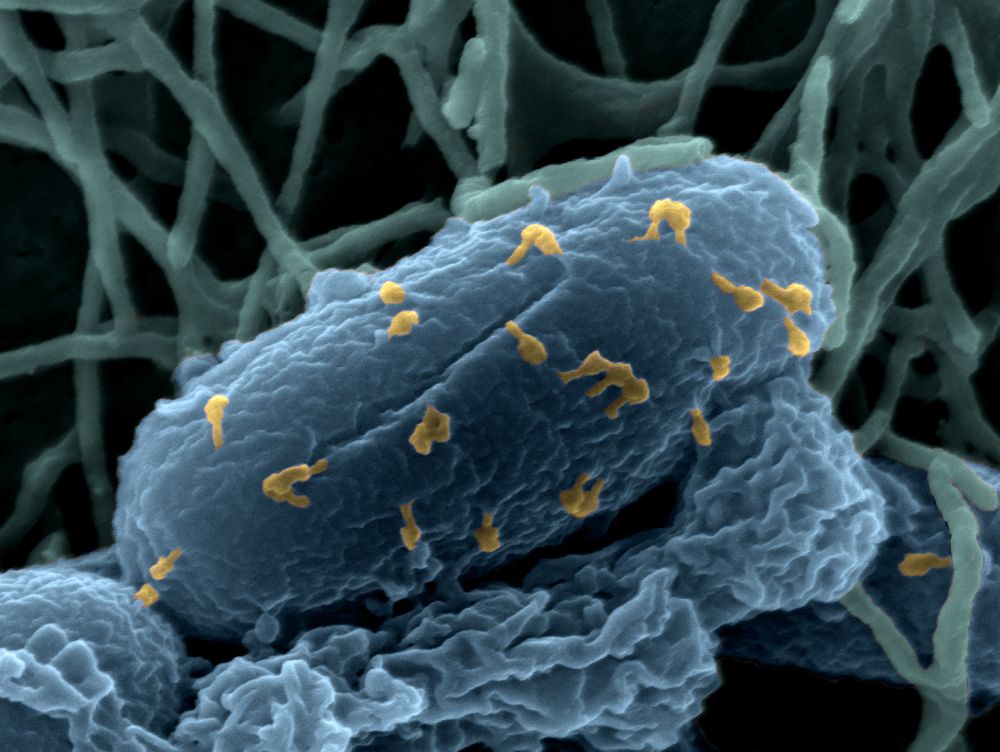
Bacteriophages infecting an Escherichia coli bacterium.
Credit: Institut Pasteur/Chantal Le Bouguénec (Pathogenic Gram-Positive Bacteria Biology Unit) and Laurent Debarbieux (Molecular Biology of the Gene in Extremophiles Unit). Imaging by Perrine Bomme, Ultrastructural Microscopy Platform. Colorization by Jean-Marc Panaud.
🧬 Bacteria fight both antibiotics and viruses with the same genetic tool: integrons!
New study (Institut Pasteur, CNRS, Université Paris Cité & Montréal): ~10% of gene cassettes may defend against phages.
🛠️ One step closer to smarter therapies.
🔗 www.pasteur.fr/en/research-...
22.05.2025 08:04 — 👍 25 🔁 7 💬 1 📌 1
Congratulation Mélanie, so cool story on phage defense and pathogen evolution in real life!
23.05.2025 11:12 — 👍 3 🔁 1 💬 1 📌 0

Allo Montréal, prochain Cinq à Science, 14 mai, le microbiote intestinal par Corinne Maurice, mc Gills 🙂
13.05.2025 00:16 — 👍 1 🔁 0 💬 0 📌 0
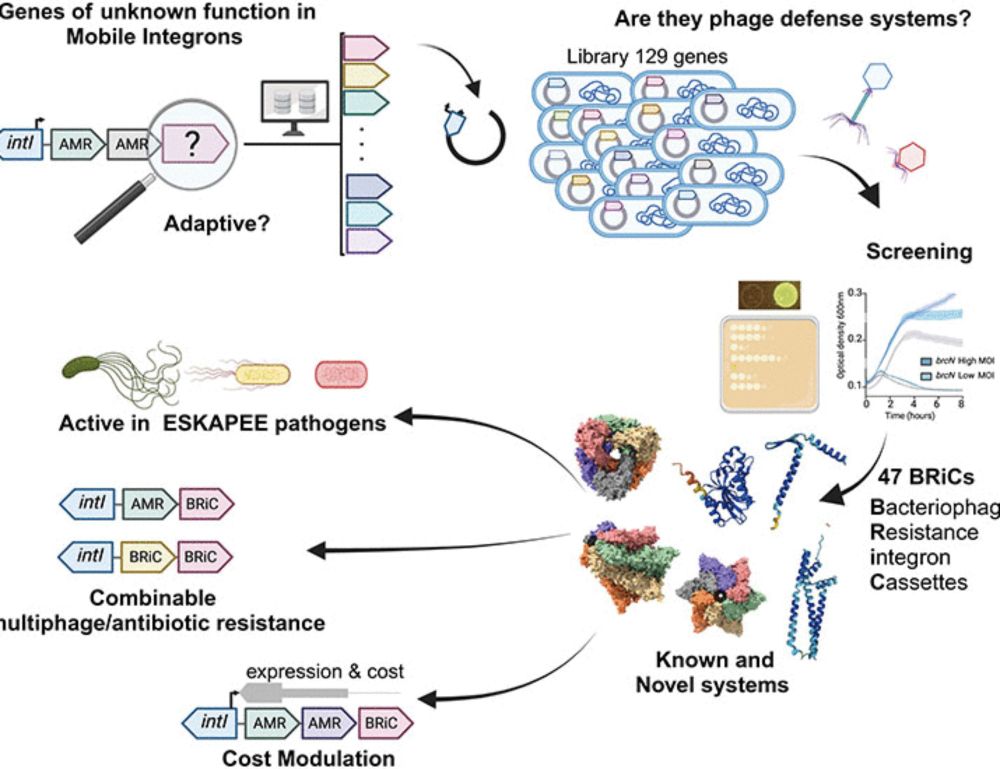
Mobile integrons encode phage defense systems
Integrons are bacterial genetic elements that capture, stockpile, and modulate the expression of genes encoded in integron cassettes. Mobile integrons (MIs) are borne on plasmids, acting as a vehicle ...
Have also a look at our back-to-back study for mobile integrons by Nicolas Kieffer from @jaescudero.bsky.social group !
www.science.org/doi/10.1126/...
+ a similar story in V. parahaemolyticus by @landongetz.bsky.social from @themaxwelllab.bsky.social
www.nature.com/articles/s41...
09.05.2025 11:41 — 👍 11 🔁 6 💬 1 📌 0
An enormous thanks for the great co-first author @eloilittner.bsky.social and for our supervisors @celineloot.bsky.social @epcrocha.bsky.social @amazeld.bsky.social @fredoleroux.bsky.social. Many thanks to all co-authors !!
09.05.2025 11:41 — 👍 6 🔁 2 💬 1 📌 0
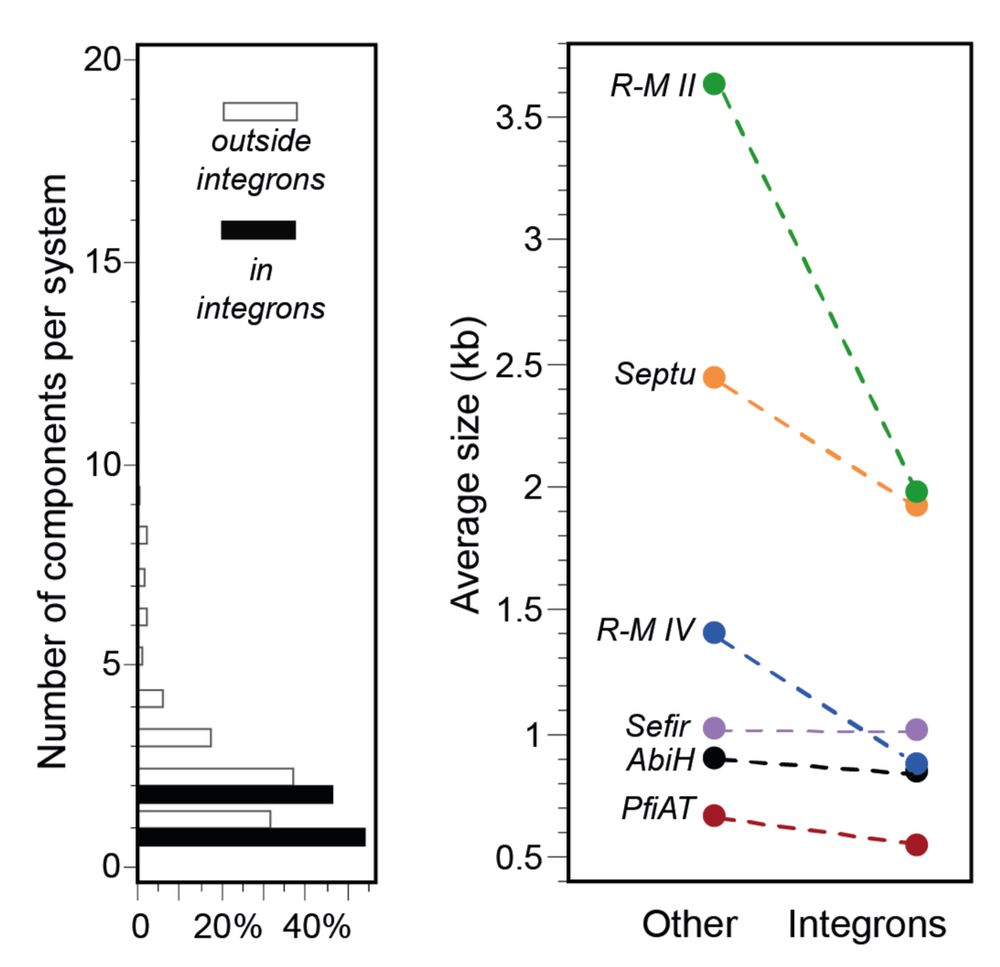
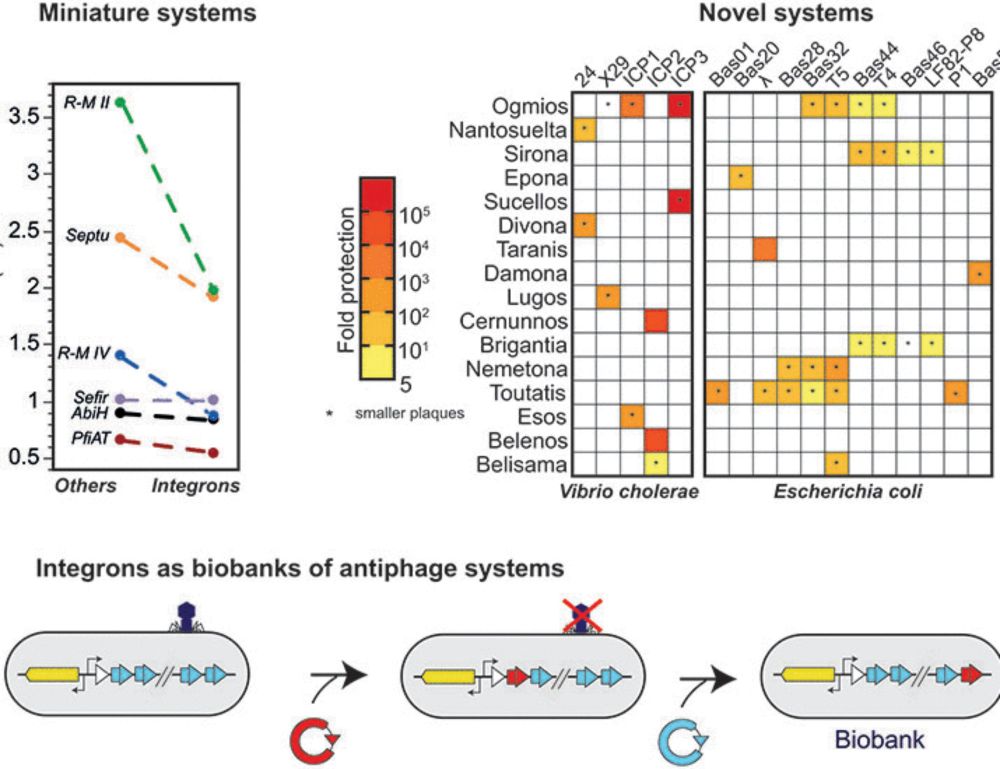
On the bioinformatic side, eloilittner.bsky.social found a diverse arsenal of anti-phage defenses in SCIs. Strikingly, systems in integrons are always compact (< 3 genes), and smaller than their homologs outside integrons (likely due to cassette size constraints)
09.05.2025 11:41 — 👍 2 🔁 2 💬 1 📌 0
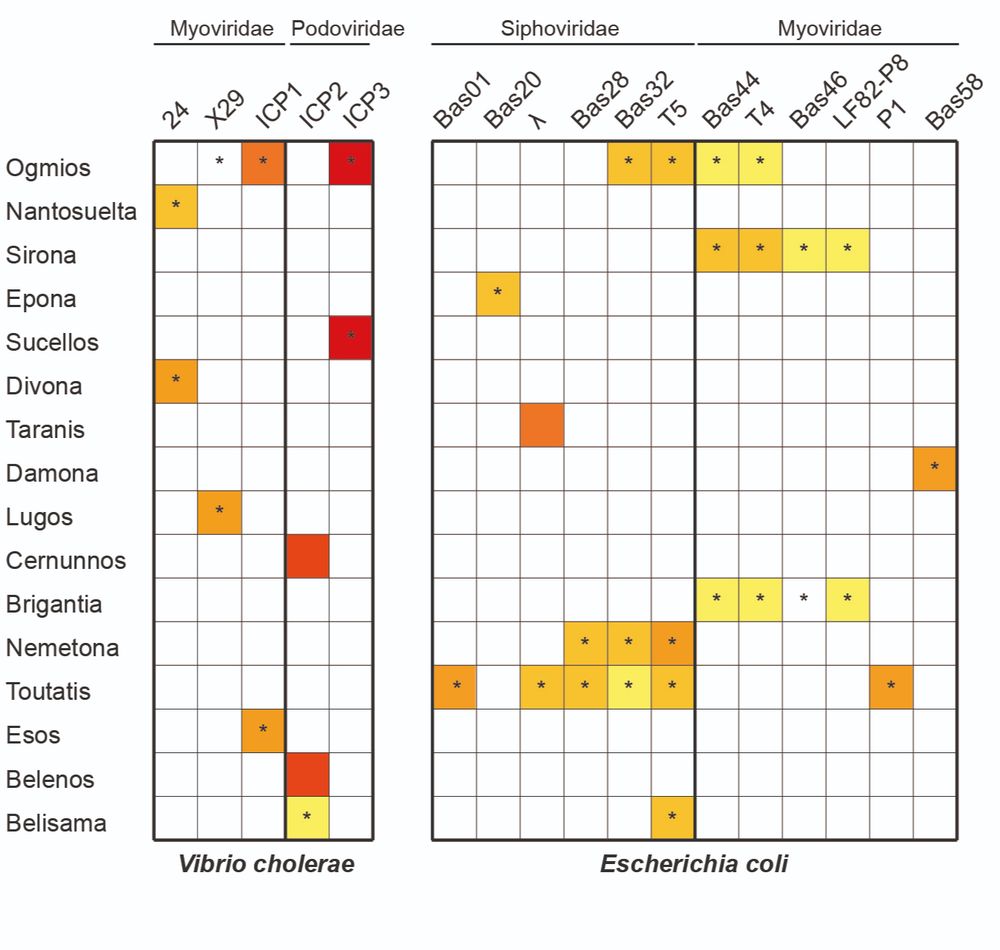
The integron of our favorite model Vibrio cholerae was mostly “dark matter” as most cassettes had no known role. We found this intriguing and cloned 88 cassettes, testing them for phage resistance. We found 16 defensive cassettes and named the systems after gallic mythology
09.05.2025 11:41 — 👍 2 🔁 2 💬 1 📌 0
Habemus paper! Our story on integron-encoded anti-phage defenses is now out in @science.org! 16 new systems, small versions of known ones, and a lot more in this highly-collaborative study.
Many thanks to everyone involved, especially my supervisor @epcrocha.bsky.social
bsky.app/profile/bapt...
09.05.2025 11:51 — 👍 33 🔁 18 💬 2 📌 1
Pas de recul. / No retreat.
Pas de silence. / No silence.
Pas de haine chez nous. / No hate here.
🇨🇦 Liberté, justice, solidarité. / 🇨🇦 Freedom, justice, solidarity.
Résistons ensemble! ✊ / Let’s resist together! ✊
#CanadaLibre #DefendDemocracy #LoveWins
29.04.2025 02:38 — 👍 3 🔁 0 💬 0 📌 0
Application deadline: May 27, 2025
24.04.2025 22:32 — 👍 0 🔁 0 💬 0 📌 0

Launch of the 2025 postdoctoral fellowship competition
The BIC is proud to launch its first Postdoctoral Fellowship competition. Applications are open from now until May 27, 2025.
🚨 Postdoc Alert!
Join my lab @ Montréal’s Faculty of Medicine via the 2025 CIB Fellowship Competition 🧬
Project: “The Paradox of Parasitism” – bioinformatics + marine parasite evolution
💸 $63,819/yr + full benefits (2 yrs)
Apply 👉 cibmontreal.ca/en/news/laun...
24.04.2025 22:31 — 👍 2 🔁 1 💬 1 📌 0
Asst. Prof. at Copenhagen University. Excited about phages, plasmids, and bacterial immunity!👨🔬🔬 https://pinillaredondolab.com/
Group leader.
HGT in bacterial pathogens. Acinetobacter, Legionella. Natural transformation. AMR. MGEs.
Centre International de Recherche en Infectiologie
School of Microbiology and APC Microbiome Ireland, University College Cork 🇮🇪
Microbial Ecology | Microbial Evolution | Gut Microbiome
Microbiologist, Assistant Professor @univamu, PI at @LISM
https://lism.imm.cnrs.fr/team/molecular-transport-across-the-bacterial-cell-enveloppe/
PhD in Biology (Génétique et Génomique)
Evolution of integrons, in the lab of @epcrocha.bsky.social, Microbial evolutionary genomics @pasteur.fr
@EPFL and @Polytechnique alumni
Assistant Prof in Dept Oral Biology, School of Dental Medicine
@UBuffalo | #phages marine2mouths oceans2oral seas2saliva | @MIT @WHOI alum | kauffmanlab.org
PhD student - PGB lab - Institut Pasteur | integrons, bacterial immunity
Prof. and Head of Phage-host interactions (Phi) lab. Phage defences, counter-defences, CRISPR-Cas, toxin-antitoxin. FRSNZ / James Cook Fellow
We study DNA replication and genome integrity || live-cell single-molecule microscopy || Bacteria || Budding-yeast || mammalian cells
We are at the @biomcgill.bsky.social, @mcgill.ca
https://reyes-lamothe.lab.mcgill.ca
Head of teaching lab, department of microbiology and immunology, university of Montreal
Microbiologist, interested in pathogen-host-microbiota interactions #Women'sHealth
PhD in Microbiology. Post-doctoral position at ETH Zurich
Scientific interest :To explore mechanistic foundations of phage-bacteria interactions
Associate Professor, MIT
Still thinking about the 10^9 mutations generated in your microbiome today.
Website: http://lieberman.science
Microbiologist, drosophila genetics, gut-microbe interactions, immuno metabolism, ID Physician
Postdoc at Université de Montréal
Protein engineer fascinated by phages
PhD from ETH Zurich on endolysin engineering
Hobby photographer in love with the Arctic
Professor at Montpellier University, IHPE Lab, France.
http://ihpe.univ-perp.fr/ihpe-charriere-guillaume/
Curious and interested in many aspects of phagocyte biology, vibrios, amoebae, oysters, host-pathogen co-evolution, and comparative immunology.
Bioinformatics team in microbial genomics and metabolism at Genoscope. Developer of the MicroScope platform (http://mage.genoscope.cns.fr/microscope)
labgem.genoscope.cns.fr
Evry, France
On se retrouve autour d’un verre, on écoute une présentation, puis on échange de manière informelle. Une initiative de @umontreal.ca . Lien: https://tinyurl.com/4t7nvz6y