Friends at @wr-dsb.bsky.social created a terrific video in support of destreaming and the real positive impacts that it is already making on students and communities.
www.youtube.com/watch?v=mmwU...
@gparekh.bsky.social
Writer. Researcher. All things public education, access, and disability studies.
Friends at @wr-dsb.bsky.social created a terrific video in support of destreaming and the real positive impacts that it is already making on students and communities.
www.youtube.com/watch?v=mmwU...

Image: Cover of ‘The Nowhere Places’ by Susan Leland
Who doesn’t love a Halifax-based family drama? Always fun to read about old haunts from new perspectives.
#BookSky #NSAuthors

A photo of the novel ‘Small things like these’ by Claire Keegan.
Had the chance to read this gem of a novel over the holidays. A small story with a profound impact. #booksky #goodreads
27.12.2024 03:44 — 👍 9 🔁 0 💬 1 📌 0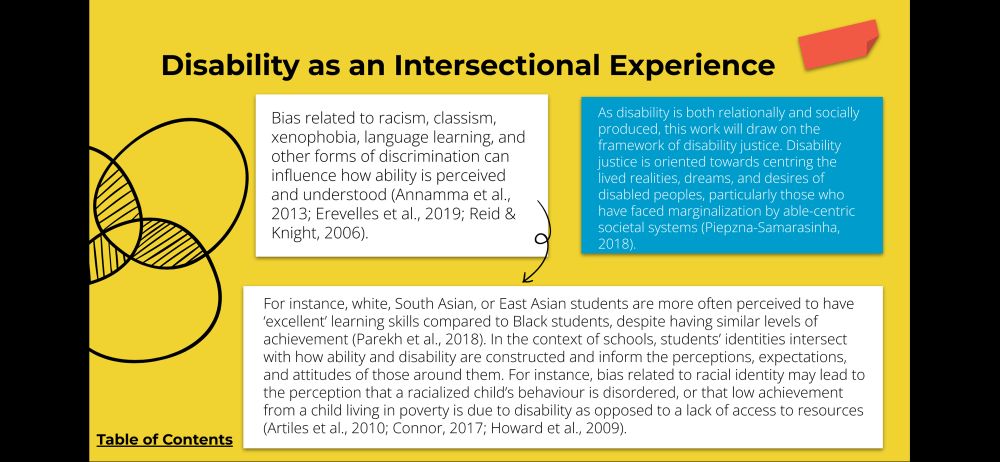
Disability as an Intersectional Experience Bias related to racism, classism, xenophobia, language learning, and other forms of discrimination can influence how ability is perceived and understood (Annamma et al., 2013; Erevelles et al., 2019; Reid & Knight, 2006). As disability is both relationally and socially produced, this work will draw on the framework of disability justice. Disability justice is oriented towards centring the lived realities, dreams, and desires of disabled peoples, particularly those who have faced marginalization by able-centric societal systems (Piepzna-Samarasinha, 2018). For instance, white, South Asian, or East Asian students are more often perceived to have “excellent” learning skills compared to Black students, despite having similar levels of achievement (Parekh et al., 2018). In the context of schools, students' identities intersect with how ability and disability are constructed and inform the perceptions, expectations, and attitudes of those around them. For instance, bias related to racial identity may lead to the perception that a racialized child's behaviour is disordered, or that low achievement from a child living in poverty is due to disability as opposed to a lack of access to resources (Artiles et al., 2010; Connor, 2017; Howard et al., 2009).
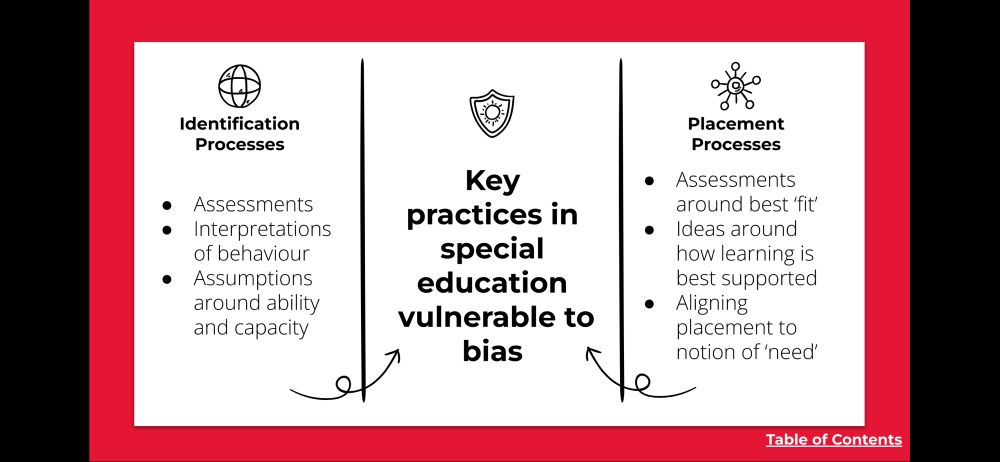
Key practices in special education vulnerable to bias: Identification Processes Assessments Interpretations of behaviour Assumptions around ability and capacity Placement Processes Assessments around best 'fit' Ideas around how learning is best supported Aligning placement to notion of 'need'
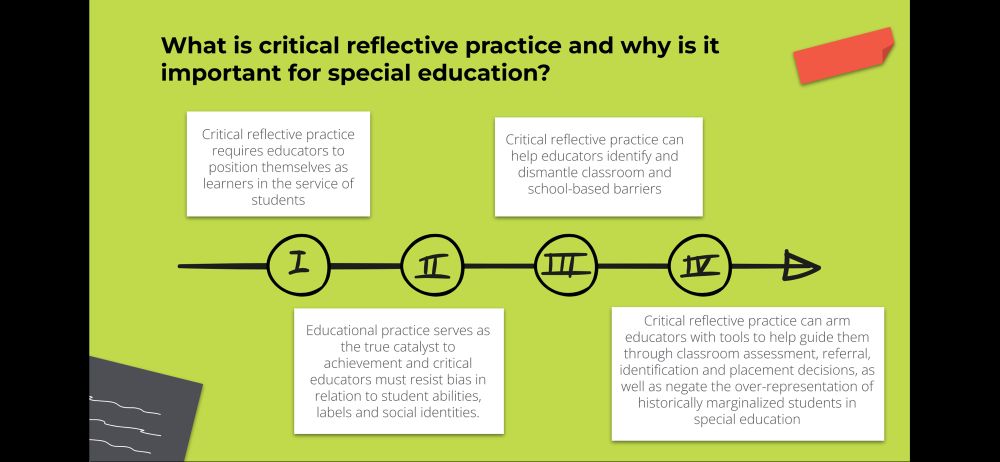
What is critical reflective practice and why is it important for special education? Critical reflective practice requires educators to position themselves as learners in the service of students Educational practice serves as the true catalyst to achievement and critical educators must resist bias in relation to student abilities, labels and social identities. Critical reflective practice can help educators identify and dismantle classroom and school-based barriers Critical reflective practice can arm educators with tools to help guide them through classroom assessment, referral, identification and placement decisions, as well as negate the over-representation of historically marginalized students in special education
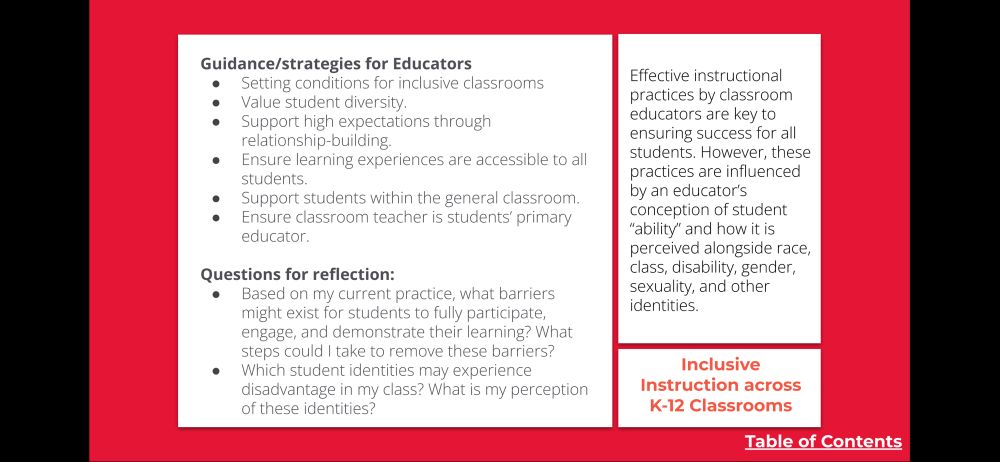
Inclusive Instruction across K-12 Classrooms: Effective instructional practices by classroom educators are key to ensuring success for all students. However, these practices are influenced by an educator's conception of student "ability" and how it is perceived alongside race, class, disability, gender, sexuality, and other identities. Guidance/strategies for Educators Setting conditions for inclusive classrooms • Value student diversity. • Support high expectations through relationship-building. • Ensure learning experiences are accessible to all students. • Support students within the general classroom. • Ensure classroom teacher is students' primary educator. Questions for reflection: • Based on my current practice, what barriers might exist for students to fully participate, engage, and demonstrate their learning? What steps could I take to remove these barriers? • Which student identities may experience disadvantage in my class? What is my perception of these identities?
Now that @gparekh.bsky.social is here, I want to share her “Equity and Human Rights in Special Education: Critical Reflective Practice Guide,” which offers educators strategies to reduce the negative effects of bias & racism in decisions around special education.
www.criticalreflectivepractice.com
Thanks, @mrjasonto.com! It was great to collaborate on this guide!
03.12.2024 02:04 — 👍 1 🔁 0 💬 0 📌 0