Dear Friends of the MBL,
I am reaching out with news about the Marine Biological Laboratory's relationship with the University of Chicago. Today, MBL and the University of Chicago announced that, following a 12-year affiliation, MBL will once again be a fully independent organization, effective June 30, 2026. MBL will continue to collaborate closely with the University of Chicago across education, research and graduate training, with the University of Chicago remaining one of MBL's valued academic partners.
The University has made extraordinary programmatic, leadership, and financial contributions to the MBL. University leaders, including presidents and provosts, served as active members of the Board of Trustees. We are grateful for this support and look forward to continued academic collaboration. This partnership has fueled significant research collaborations and publications, as well as joint programs established around common research themes. Examples of these include the MBL/University of Chicago Graduate Research Fellowship Program and scientific collaborations that resulted in the development of innovative instruments, enabling high-resolution, three-dimensional visualization of cells and tissues.
The outlook for an independent MBL is bright. For example, our efforts in recent years have significantly raised the ambitions of MBL's fundraising. In August of 2025, the Marine Biological Laboratory received an unrestricted gift of $25 million from MBL alumnus Mark Terasaki, the largest private contribution in our 137-year history. Additional substantial funding has been received for graduate training, named positions, facilities, courses, faculty hires, scholarships, and lectureships. Together, these extraordinary investments reflect our donors' confidence in MBL's mission and future and strengthen our financial foundation as we move forward. They build on a commitment MBL made in 2023 to achieve financial self-sufficiency, supported by the expansion of our Bo…

MBL's existing academic programs and collaborations with the University of Chicago are expected to continue as before, including research collaborations, participation by University of Chicago undergraduate and graduate students, and University of Chicago-affiliated courses and programs. The academic links that we have built over the last 12 years will serve both institutions well in the future. There are no significant changes to MBL's budget, staffing levels or operations and MBL will retain full ownership of its endowment. University of Chicago representatives will step down from the MBL Board of Trustees in June 2026, which will otherwise remain the same.
I am deeply grateful for your continued engagement and belief in MBL. Your support and connection to this institution make this next chapter possible, and I look forward to sharing more in the weeks ahead as we continue our work together.
With appreciation,
Nipam H. Patel, Director
Marine Biological Laboratory
Interesting news: The Marine Biological Labs at Woods Hole (MBL) is once again becoming an independent institution. University of Chicago will remain a partner, but only one of many. MBL is an amazing place for science and science training and I hope it will thrive in this new status.
04.02.2026 20:34 — 👍 19 🔁 8 💬 0 📌 0
Excited to share my first PhD preprint! w/ Sören Kannegieser and @anna-stoeckl.bsky.social @insect-vision.bsky.social
We investigated how hawkmoths coordinate lateralized sensory and motor control for appendage guidance, revealing similar control principles to vertebrates doi.org/10.64898/202...
02.02.2026 10:27 — 👍 49 🔁 12 💬 0 📌 1

The first paper from the lab is now out in Science Advances: Multimodal social context modulates larval behavior in Drosophila
www.science.org/doi/10.1126/...
We find that fly larvae keep their distance to conspecifics in the absence of food, enjoy reading! @cbehav.bsky.social @uni-konstanz.de
02.02.2026 20:31 — 👍 70 🔁 32 💬 6 📌 0

Several fly larvae are crawling on an agar surface.
The second paper from the lab is now available on bioRxiv: www.biorxiv.org/content/10.6...
We discovered that cannibalistic behavior in fly larvae is social-context dependent. Larval groups avoid dead conspecifics; individuals show high attraction. They only do it when no one is watching 😉
21.01.2026 12:29 — 👍 43 🔁 24 💬 2 📌 2
ScienceDirect.com | Science, health and medical journals, full text articles and books.
New paper from the lab, led by @ronjabigge.bsky.social, in collaboration with Kentaro Arikawa. We reconcile contrast and spatial processing functions of lamina monopolar cells by integrating 3D morphology, connectivity and neurophysiology in the hummingbird hawkmoth. tinyurl.com/mvnh3325
For more 👇
19.01.2026 14:19 — 👍 17 🔁 9 💬 1 📌 0

Why does life explore so few of the forms it could possibly take? Using fractal descriptors, this #scienceadvances paper shows that Earth’s biosphere clusters around simple shapes, reflecting deep evolutionary constraints. @artemyte.bsky.social @manlius.bsky.social www.science.org/doi/pdf/10.1...
11.01.2026 13:22 — 👍 228 🔁 74 💬 5 📌 6
Fun! Link to original research: www.sciencedirect.com/science/arti...
09.01.2026 17:27 — 👍 8 🔁 4 💬 0 📌 0
With some trepidation, I'm putting this out into the world:
gershmanlab.com/textbook.html
It's a textbook called Computational Foundations of Cognitive Neuroscience, which I wrote for my class.
My hope is that this will be a living document, continuously improved as I get feedback.
09.01.2026 01:27 — 👍 581 🔁 237 💬 16 📌 10
Gregor Mendel spent seven to eight years crossing and scoring tens of thousands of pea plants. In contemporary terms, this is known as “a postdoc”
21.12.2025 15:04 — 👍 102 🔁 9 💬 6 📌 0
Can biological tissues "learn"? Our new preprint shows that epithelial tissues exhibit emergent behaviors akin to unsupervised learning. Local tension remodeling allows cell networks to store long-range memory and program global elasticity properties.
Read more here: www.biorxiv.org/content/10.6...
20.12.2025 15:56 — 👍 31 🔁 8 💬 0 📌 0
Really excited to see this great work published! It was an honor and unforgettable experience to be part of this joint effort in @scottvedwards.bsky.social lab!
13.12.2025 20:13 — 👍 7 🔁 1 💬 0 📌 0

Congratulations to the lab's first PhD student @maxcapelle.bsky.social for defending his PhD last week! Max not only helped shape the lab from day one, but also made outstanding scientific achievements, which have laid the foundation for future research. Wishing him all the best 🥳
02.12.2025 14:40 — 👍 21 🔁 2 💬 0 📌 1
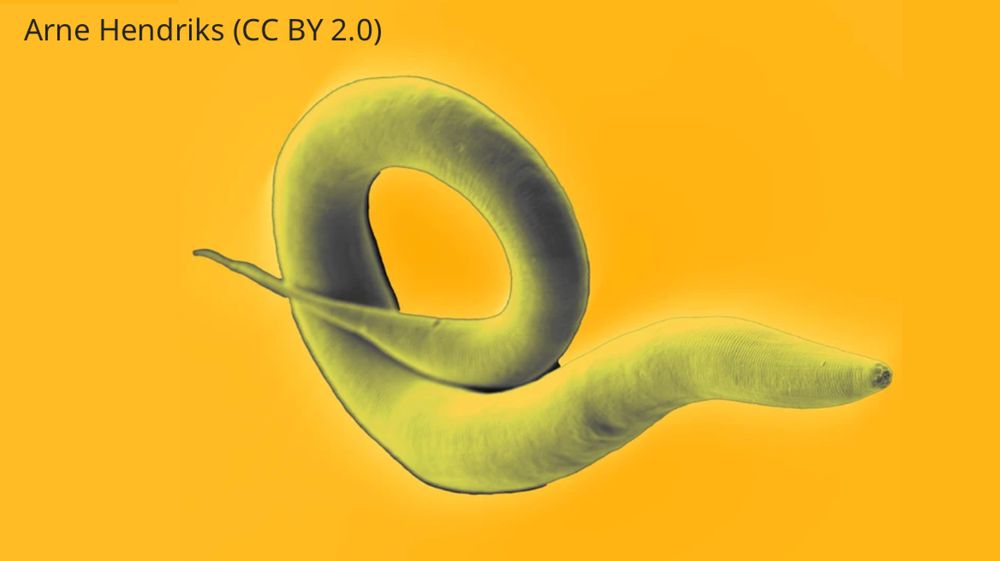
Transgenerational Epigenetic Inheritance
Please enable JavaScript to proceed.
Transgenerational Epigenetic Inheritance: Twists and turns in the story of learned avoidance
Evidence that learned avoidance of a pathogenic bacterium can be transmitted to future generations in C. elegans is growing.
🔗
29.11.2025 23:44 — 👍 9 🔁 5 💬 0 📌 0
CeDNe: A multi-scale computational framework for modeling structure-function relationships in the C. elegans nervous system https://www.biorxiv.org/content/10.1101/2025.11.03.683805v1
05.11.2025 08:15 — 👍 5 🔁 1 💬 0 📌 0
sure, if you enjoy the horrifying limits of human perception
25.10.2025 12:22 — 👍 36 🔁 13 💬 3 📌 0

Behavioral and circuit principles of temperature gradient navigation
Behavioral thermoregulation is critical for survival across animals. Balakrishnan
and Haesemeyer discover that thermoregulatory behavior in larval zebrafish is organized
into longer-term swim modes. T...
Out now in @currentbiology.bsky.social led by Kaarthik A Balakrishnan: We identify medullary circuits that represent the valence of thermal stimuli and control both long-term strategies of cold-avoidance and short term hot avoidance behaviors to enable thermoregulation. www.cell.com/current-biol...
24.10.2025 14:57 — 👍 12 🔁 9 💬 0 📌 0
one of the cool things about rock climbing as a hobby is that you gradually lose the ability to be recognized by fingerprint scanners
29.09.2025 17:17 — 👍 638 🔁 31 💬 36 📌 1

a black and white dog is sitting on a couch with its tongue sticking out .
ALT: a black and white dog is sitting on a couch with its tongue sticking out .
👁️The retina — strikingly conserved across vertebrates, but an oddity among bilaterians!
So how did it evolve?
With @mikebok.bsky.social, @neurofishh.bsky.social and @denilsson.bsky.social, we argue that retinal complexity may 𝑝𝑟𝑒𝑑𝑎𝑡𝑒 𝑡ℎ𝑒 𝑒𝑦𝑒 𝑖𝑡𝑠𝑒𝑙𝑓.
www.biorxiv.org/content/10.1...
1/n
12.09.2025 12:58 — 👍 51 🔁 23 💬 2 📌 3

Congratulations to Anna Stöckl receiving the prestigious Walther-Arndt award from the German Zoological Society. #dzg2025 @anna-stoeckl.bsky.social 🥳🥂
11.09.2025 17:34 — 👍 27 🔁 3 💬 1 📌 3
Multiplexing behavioral signals in sensory representations https://www.biorxiv.org/content/10.1101/2025.09.04.674251v1
05.09.2025 07:15 — 👍 6 🔁 1 💬 0 📌 0
Amazing work on bee photoreceptors by my good friend @gkolyfetis.bsky.social!
03.09.2025 18:38 — 👍 1 🔁 0 💬 0 📌 0

How do brains make decisions when faced with multiple, potentially conflicting cues? In our latest preprint, we show how #zebrafish use an additive strategy and process multiple visual features through anatomically distinct parallel pathways tinyurl.com/mvkn8em9 Thread 👇
25.08.2025 09:02 — 👍 15 🔁 6 💬 7 📌 0
It’s surreal to think that every neuron and synapse in the fly brain + cord that was dissected almost five years ago (the photo’s still on the lab slack!) is now just a click away on Codex codex.flywire.ai?dataset=banc. This wouldn’t have been possible without the incredible team behind it!
05.08.2025 18:38 — 👍 35 🔁 9 💬 1 📌 1
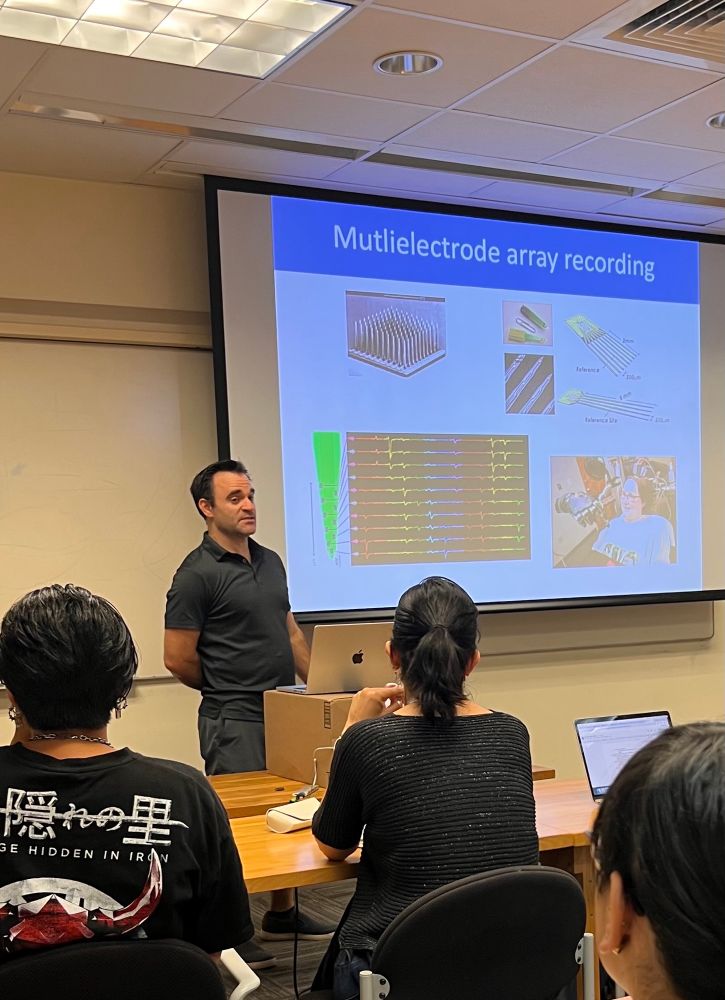
Hillel Adesnik lecturing in the MBL Visual Neuroscience course. Clear as a bell, as usual.
11.08.2025 13:31 — 👍 8 🔁 1 💬 0 📌 0
Max Planck Group leader exploring the evolution of behaviour using comparative nematode species at the MPI for Neurobiology of Behavior in Bonn (jlightfootlab.org).
Neuroscientist, working on connectomics & cognition. EMBO Postdoctoral Fellow @ FMI Basel 🇨🇭
An International Journal for Theory, History and Foundations of Science is a non-profit editorial venture. It is a diamond open-access journal.
🔗: https://ojs.ehu.eus/index.php/THEORIA/index
Team Leader at the Paris Brain Institute.
Organ to organ nodes. Brain within a body.
Picower Professor of Neuroscience @ MIT
Cognitive neuroscience, executive brain functions, consciousness, and bass guitar. You know, the good stuff.
ekmillerlab.mit.edu
Co-founder, Neuroblox
https://www.neuroblox.ai/
Neuroscientist
https://scholar.google.com/citations?user=1-OkubgAAAAJ
On the job market
Mexican Historian & Philosopher of Biology • Postdoctoral Fellow at @theramseylab.bsky.social (@clpskuleuven.bsky.social) • Book Reviews Editor for @jgps.bsky.social • https://www.alejandrofabregastejeda.com • #PhilSci #HistSTM #philsky • Escribo y edito
Behavioural ecologist @ University of Bristol, interested in the rules and mechanisms of behavioural/ecological interactions in a whole host of different systems. Easily distracted.
webby stuff: www.seanrands.com
Group Leader at @neuropsi.bsky.social _ Paris Saclay University. Starting April 2026. Studying brain development and evolution in sharks and other creatures 🦈 🧠#embryo2014 #ERCCoG. Get in touch if you are interested in joining the lab!
Life scientist.
Head of EMBO Membership & Elections and Courses & Workshops @embo.org #EMBOevents
previously: Editor at Molecular Systems Biology, EMBO Press
Views my own
International Max Planck Research School for Quantitative Behaviour, Ecology and Evolution from lab to field (IMPRS-QBEE)
group leader @ HHMIJanelia, #neuroscience + AI 🔬 #cellpose | diversity and open-science for better science | Ⓥ | she/her | https://mouseland.github.io
Theor/Comp Neuroscientist (postdoc)
Prev @TU Munich
Stochastic&nonlin. dynamics @TU Berlin&@MPIDS
Learning dynamics, plasticity&geometry of representations
https://dimitra-maoutsa.github.io
https://dimitra-maoutsa.github.io/M-Dims-Blog
Theoretical neuroscientist interested in brain-body interactions and evolution of adaptive behavior. Associate Professor at Scripps Research Institute in San Diego.
Assistant professor at Tel-Aviv University. Likes to confuse tiny fish and watch their brains.
Studying how balance develops, functions, and fails at NYU Langone. http://www.schoppiklab.com .
"And worse I may be yet: the worst is not so long as we can say, 'This is the worst.’” -- King Lear (Act IV Scene I)
Award-winning home tank for all things zebrafish! Learn more about us and our Slack tankspace at our website: linktr.ee/zebrafishrock
Neuroscience & functional ultrasound imaging. Vision and brain states. Professor at University Medical Center Göttingen. https://brainwidenetworks.uni-goettingen.de/ Co-Spokesperson, EKFZ Center for Optogenetic Therapies. https://ekfz.uni-goettingen.de/en/
Neuroscientist - my lab studies circuits of thermoregulatory behaviors using the humble zebrafish as a model.
https://www.thermofish.org/
https://soundcloud.com/toramonki
Group leader at Leibniz Institute for Neuroscience | Feminist | Working with amazing zebrafish |.. still in love with honeybees