🚨 New working paper!
How well do people predict the results of studies?
@sdellavi.bsky.social and I leverage data from the first 100 studies to have been posted on the SSPP, containing 1,482 key questions, on which over 50,000 forecasts were placed. Some surprising results below.... 🧵👇
24.11.2025 15:43 — 👍 94 🔁 42 💬 2 📌 2

Information-Guided Identification of Training Data Imprint in (Proprietary) Large Language Models
High-quality training data has proven crucial for developing performant large language models (LLMs). However, commercial LLM providers disclose few, if any, details about the data used for training. ...
Want to know what training data has been memorized by models like GPT-4?
We propose information-guided probes, a method to uncover memorization evidence in *completely black-box* models,
without requiring access to
🙅♀️ Model weights
🙅♀️ Training data
🙅♀️ Token probabilities 🧵 (1/5)
21.03.2025 19:08 — 👍 97 🔁 27 💬 4 📌 8
I’ve been referring people (esp social science/psych PhD students) to this blog post for years. The headline and opening paragraph are all you really need.
30.04.2025 04:00 — 👍 66 🔁 16 💬 4 📌 1
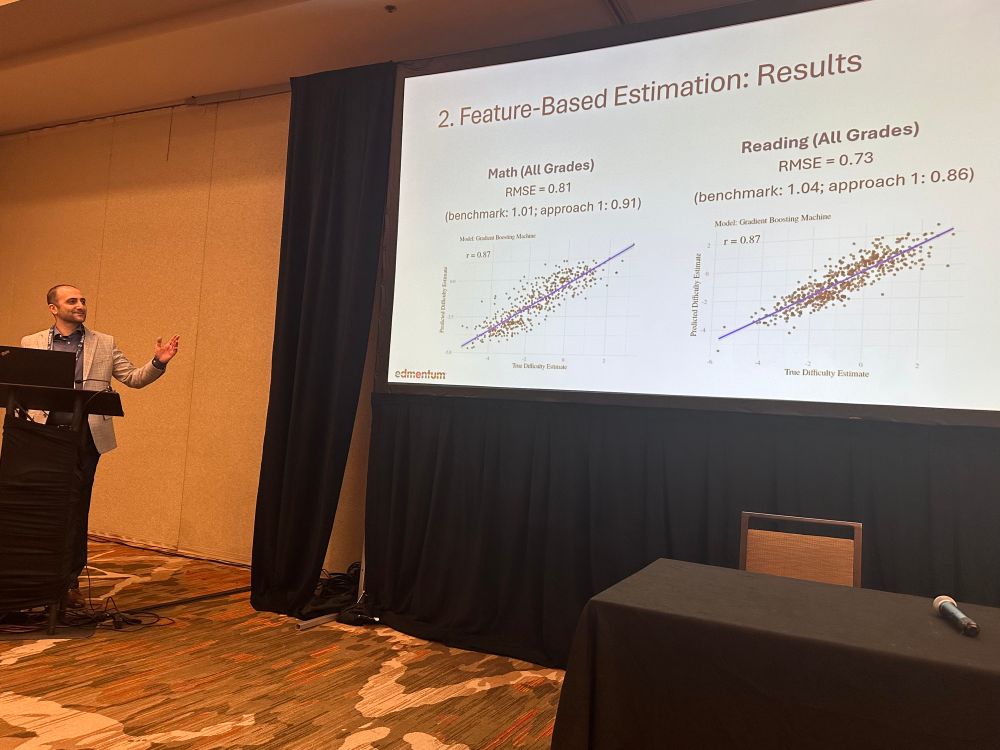
Had a great time presenting our work on LLM-based item difficulty estimation at #NCME .
If you’re in Denver and would like to discuss measurement research or just catchup in the next couple of days, let me know 😊
25.04.2025 20:34 — 👍 2 🔁 0 💬 0 📌 0
Fantastic, thoughtful work! 👏👏
18.04.2025 16:32 — 👍 0 🔁 0 💬 0 📌 0
We are excited about the potential of these methods to support more efficient item development in education. In the preprint, we provide a seven-step workflow for testing professionals who would want to implement a similar item difficulty estimation approach with their item pool. (🧵8/9)
17.04.2025 02:35 — 👍 0 🔁 0 💬 1 📌 0
The feature-based approach presumably benefits from the language model’s extraction of multiple cognitive and linguistic dimensions that an ensemble tree-based algorithm then “learns” to weight in ways that maximize prediction accuracy. (🧵7/9)
17.04.2025 02:35 — 👍 0 🔁 0 💬 1 📌 0
The modest performance of direct LLM estimates in some instances, and the more robust performance of feature-based methods, hints that LLMs can add value, but that this value is maximized when the model is “nudged” or structured via psychometric frameworks. (🧵6/9)
17.04.2025 02:34 — 👍 0 🔁 0 💬 1 📌 0
The results are promising, especially for the feature-based approach which performed considerably better than the dummy regressor benchmarks and the direct estimation approach. (🧵5/9)
17.04.2025 02:34 — 👍 0 🔁 0 💬 1 📌 0
In the second approach, we use the LLM to extract cognitive and linguistic features from each item. We then train tree-based machine learning models (i.e., random forest and gradient boosting machines) to estimate item difficulty based on the features. (🧵4/9)
17.04.2025 02:34 — 👍 0 🔁 0 💬 1 📌 0
In the first approach, we use a direct estimation method that prompted the LLM to assign a single difficulty rating to each item based on qualitatively informed criteria. (🧵3/9)
17.04.2025 02:34 — 👍 0 🔁 0 💬 1 📌 0
Field-testing assessment items to estimate difficulty can be both costly and time-consuming. In this research, we evaluate two LLM-based approaches to predict item difficulty for K-5 mathematics and reading assessments based on item content. (🧵2/9)
17.04.2025 02:34 — 👍 0 🔁 0 💬 1 📌 0

Wooden Shoe Tulip Festival
📍Portland, Oregon 🇺🇲
10.04.2025 13:30 — 👍 19428 🔁 1993 💬 398 📌 129

A yellow street sign in Japanese with three black flying through the sky. Below is text that says ネコ飛出し注意 (neko tobidashi chūi) Means “watch for cats darting out”
ネコ飛出し注意 (neko tobidashi chūi) Means “watch for cats darting out” and I love this sign.
07.04.2025 03:16 — 👍 8029 🔁 2159 💬 96 📌 122
A tricky thing about modern society is that no one has any idea when they don’t die.
Like, the number of lives saved by controlling air pollution in America is probably over 200,000 per year, but the number of people who think their life was saved by controlling air pollution is zero.
07.04.2025 04:13 — 👍 63140 🔁 13063 💬 1085 📌 583
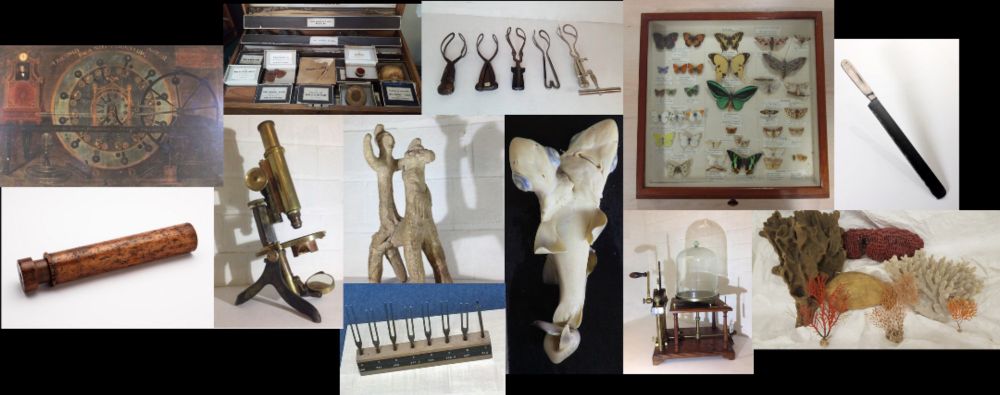
HPS in 20 objects
This resource was produced by academics from the Centre for History and Philosophy of Science at the University of Leeds, where we have our Museum filled with artefacts that tell a stories about the H
Did you know: our researchers have developed a suite of resources for A-Level students and teachers? "History & Philosophy of Science in 20 Objects" draws on an incredible array of items from our own collection ft. prompts, questions, videos and more! sway.cloud.microsoft/cEekCFBF5CGF... #histsci
04.04.2025 09:25 — 👍 30 🔁 12 💬 1 📌 2
@mohammadatari.bsky.social @mdehghani.bsky.social can you help?
28.02.2025 22:05 — 👍 2 🔁 0 💬 1 📌 0
Congrats 👏🏽🎉. Very well-deserved! 😊
28.02.2025 16:59 — 👍 1 🔁 0 💬 1 📌 0
rough (like uff in buff)
cough (like off in scoff)
drought (like ow in cow)
though (like o in no)
thought (like aw in saw)
through (like oo in woo)
Enough.
25.02.2025 15:13 — 👍 1735 🔁 260 💬 99 📌 38
Hello to all my friends at SPSP seeing this message in a hallway or lobby as you hope you are staring at your phone with enough noticeable intensity to avoid having to interact with anyone
21.02.2025 03:09 — 👍 46 🔁 4 💬 1 📌 0
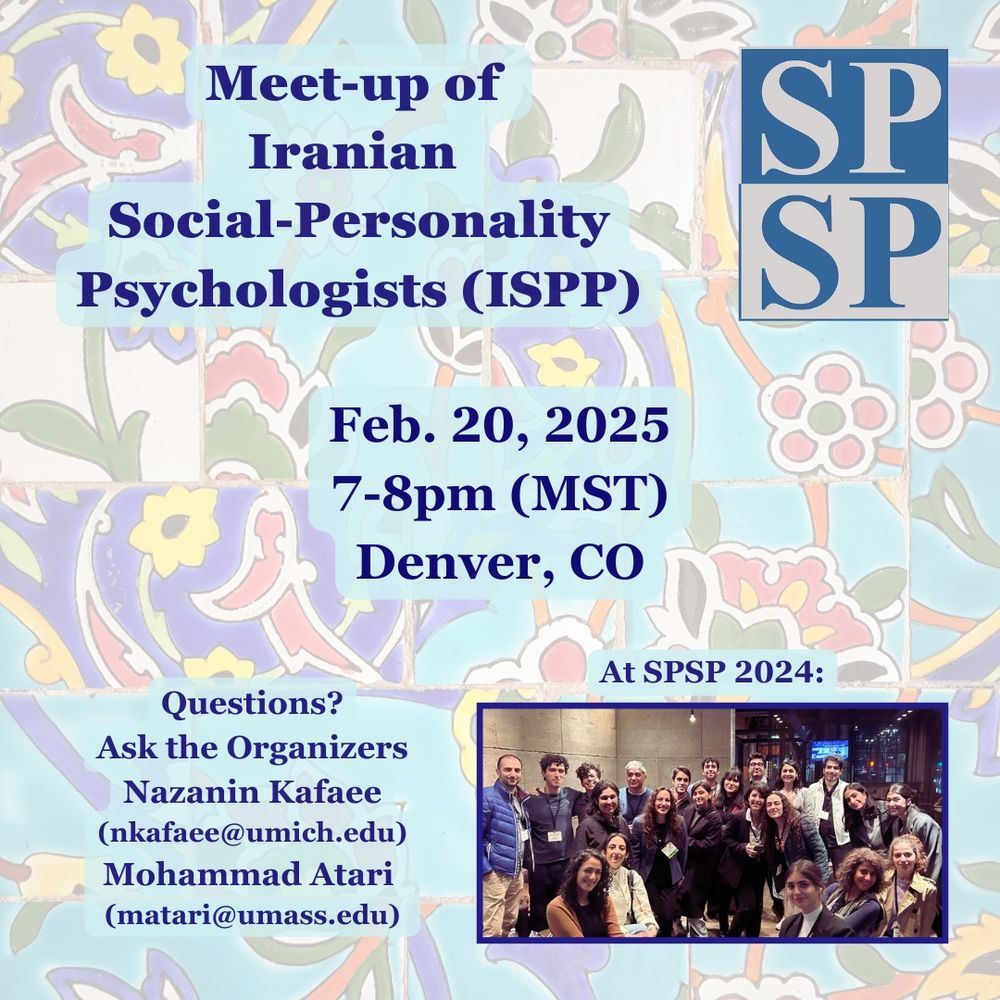
Some of us have been meeting up at SPSP for the last few years. This year marks our fifth gathering. Email one of us if you want to join! Location TBD.
@mdehghani.bsky.social @drsanaz.bsky.social @simine.com @dorsaamir.bsky.social
13.02.2025 15:33 — 👍 9 🔁 3 💬 0 📌 0
XY problem - Wikipedia
My husband just inadvertently inspired one of the simplest, most relatable XY problem¹ demos I've seen.
He asked if I could buy unscented TP 🧻 next time I grocery shop.
Knowing he had been getting a cold, I probed: when does the scent become a problem?
[1/3]
¹ en.m.wikipedia.org/wiki/XY_prob...
05.02.2025 16:01 — 👍 170 🔁 14 💬 59 📌 3
...to examine the differences bet. justified and unjustified anger. No matter how we analyze it, these two variants have differences across cognitive, affective, moral, and relational dimensions. These findings have significant implications for theories of anger and intervention strategies.
03.02.2025 02:59 — 👍 0 🔁 0 💬 0 📌 0
I’ll share a more detailed thread on this work later, but for now, I’m excited to share this preprint with the Blsky community! In this research, we used a range of methodologies including thematic analysis, closed- and open-vocabulary analyses (e.g., LIWC, topic modeling), and prototype approach...
03.02.2025 02:56 — 👍 2 🔁 0 💬 1 📌 0
Lots of useful info in this thread if you are backing up public data (whether at OSF or elsewhere)
31.01.2025 20:06 — 👍 15 🔁 4 💬 1 📌 0
I'm a faculty at CSU Stan, I'm interested in #rstats #healthyAging #quartoPub #python #statistics. I might share content related to quantitative methods from a diverse number of fields.
Ph.D Candidate @ Iscte-University Institute of Lisbon, Portugal
social psychology ~ psychological & sociocultural adaptation ~ forced displacement ~ refugees ~ #phdlife ~ travels ~ vipassana ~ vegan
Lived in 🇲🇾🇦🇺🇨🇦🇺🇸🇬🇧🇸🇬🇷🇸🇵🇹🇩🇪
www.linglingtai.com
A husband, father, actor, director, & a climate justice advocate with an eye out for a better, brighter, cleaner, & more hopeful future for all of us.
Co-Creating Ireland's Public Involvement in Open Research Roadmap
ENGAGED is building a national roadmap to shape public involvement in open research in Ireland. We believe that research can and does play an important role in tackling societal challenges.
Research Fellow, University of Oxford
Theology, philosophy, ethics, politics, environmental humanities
Associate Director @LSRIOxford
Anglican Priest
https://www.theology.ox.ac.uk/people/revd-dr-timothy-howles
History and Philosophy of Science, Cognitive Science,Experimental Philosophy, distinguished Prof at Pitt, Director of the Center for Philosophy of Science
Professor of Computational Cognitive Science | @AI_Radboud | @Iris@scholar.social on 🦣 | http://cognitionandintractability.com | she/they 🏳️🌈
Associate Prof. of Behavioral Science and Director of the IBT @HSGStGallen
#mobilesensing, #dailybehavior, #personality, #machinelearning, #explainableAI
Gender Scholar
Researching (a)sexualities, health communication, masculinities, contraception/safer sex, repro health, climate crisis, IR, peace/conflict studies, utopias/dystopias, mental health, media, history,..
https://orcid.org/0009-0009-7802-2721
A collection of fine philosophical and literary quotations. Curated by @suliqyre.com
philosophybits.com
📚Book lover & whatnot📚
BarnesandNoble.com
Cozy random passages from Arnold Lobel's Frog and Toad books. Posts auto-delete.
The Junior Researcher Programme provides opportunities for early career researchers in behavioural sciences from all around the globe!
https://jrp.pscholars.org/
Historikerin, Autorin, Professorin am Historischen Seminar der Universität Zürich
Webseite an der UZH: https://www.hist.uzh.ch/de/fachbereiche/neuzeit/lehrstuehle/dommann.html
Persönlliche Webseite: https://monikadommann.ch/
Sharing means not endorsement
Licensed clinical psychologist | PhD candidate | Anxiety disorders | PTSD | CBT | PE | MCT
Norwegian center for violence and traumatic stress studies • University of Oslo
PhD candidate in neuroscience @ Center for Sleep & Consciousness UW-Madison
Asst Prof at Johns Hopkins Cognitive Science • Director of the Group for Language and Intelligence (GLINT) ✨• Interested in all things language, cognition, and AI
jennhu.github.io
Developmental psychologist, gender critical, lefty, the Bay area (the rainy one in England). Views my own and those of the Supreme Court, not my employer.
Assistant professor of political science. I think about identity, stigma, race, and politics more than any normal person should. Lover of life. Pro-democracy.
People should dance more.
Not Hakeem Jeffries, the Minority Leader.
Physicist Turned Psychologist | Senior Researcher in #STEMed | Meta-Analysis Nerd | https://d-miller.github.io/
Also posts about 🧪 science funding to focus my attention.
Personal account. I don’t speak for my employer or any other orgs.