Flyer for a Donation Call where there was a lost of 16 grad school app fee waiver partners this year, totaling $8,250 in waived fees for aspiring scientists gone, that is 110 applications that may never be submitted.
Last year, we helped 100 students save $31K in grad school app fees, giving students from underserved communities the freedom to apply widely.
This year we lost 16 partners = $8.2K setback = 110 fewer dreams.
🎓 You can change that.
💸 Donate to open 110 new doors.
givebutter.com/supportCL
13.10.2025 19:17 — 👍 14 🔁 13 💬 0 📌 1
As a Científico Latino mentee, I cannot express how crucial this program was during my PhD application process, especially as a first-generation low income student. I highly recommend those interested in applying to graduate programs to apply!
23.04.2025 04:51 — 👍 4 🔁 1 💬 0 📌 0
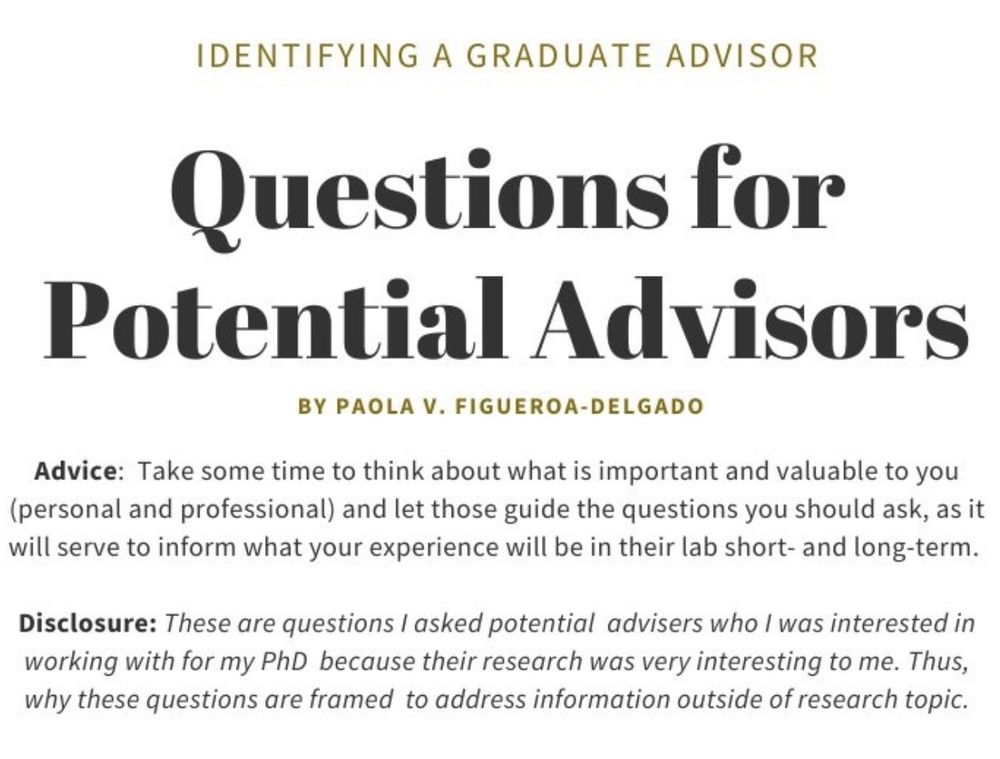
IDENTIFYING A GRADUATE ADVISOR
Questions for Potential Advisors
BY PAOLA V. FIGUEROA-DELGADO
Advice: Take some time to think about what is important and valuable to you (personal and professional) and let those guide the questions you should ask, as it will serve to inform what your experience will be in their lab short- and long-term.
Disclosure: These are questions I asked potential advisers who I was interested in working with for my PhD because their research was very interesting to me. Thus, why these questions are framed to address information outside of research topic.
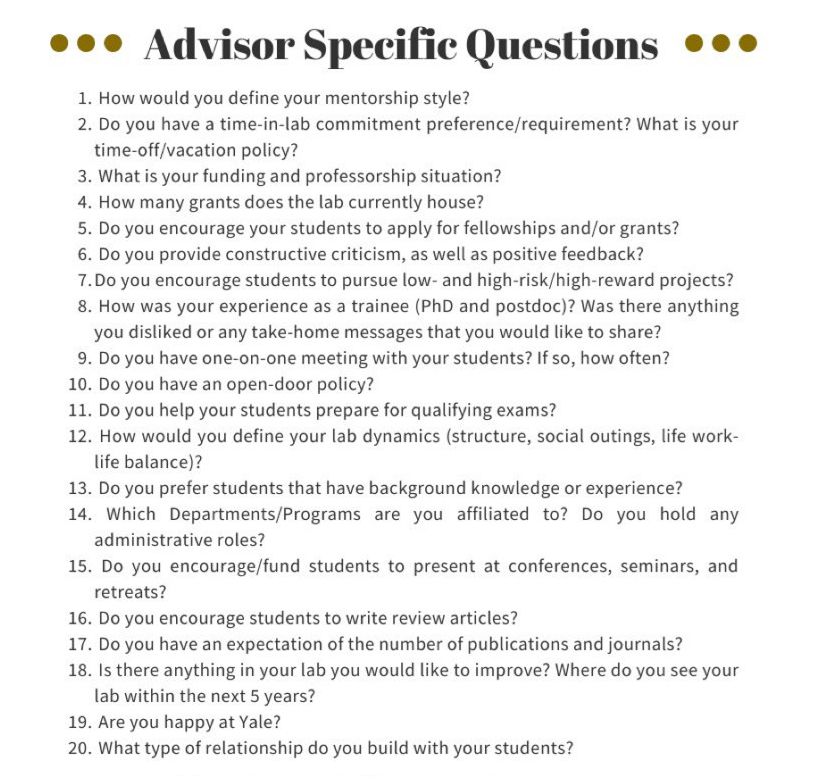
... Advisor Specific Questions ...
1. How would you define your mentorship style?
2. Do you have a time-in-lab commitment preference/requirement? What is your time-off/vacation policy?
3. What is your funding and professorship situation?
4. How many grants does the lab currently house?
5. Do you encourage your students to apply for fellowships and/or grants?
6. Do you provide constructive criticism, as well as positive feedback?
7. Do you encourage students to pursue low- and high-risk/high-reward projects?
8. How was your experience as a trainee (PhD and postdoc)? Was there anything you disliked or any take-home messages that you would like to share?
9. Do you have one-on-one meeting with your students? If so, how often?
10. Do you have an open-door policy?
11. Do you help your students prepare for qualifying exams?
12. How would you define your lab dynamics (structure, social outings, life work- life balance)?
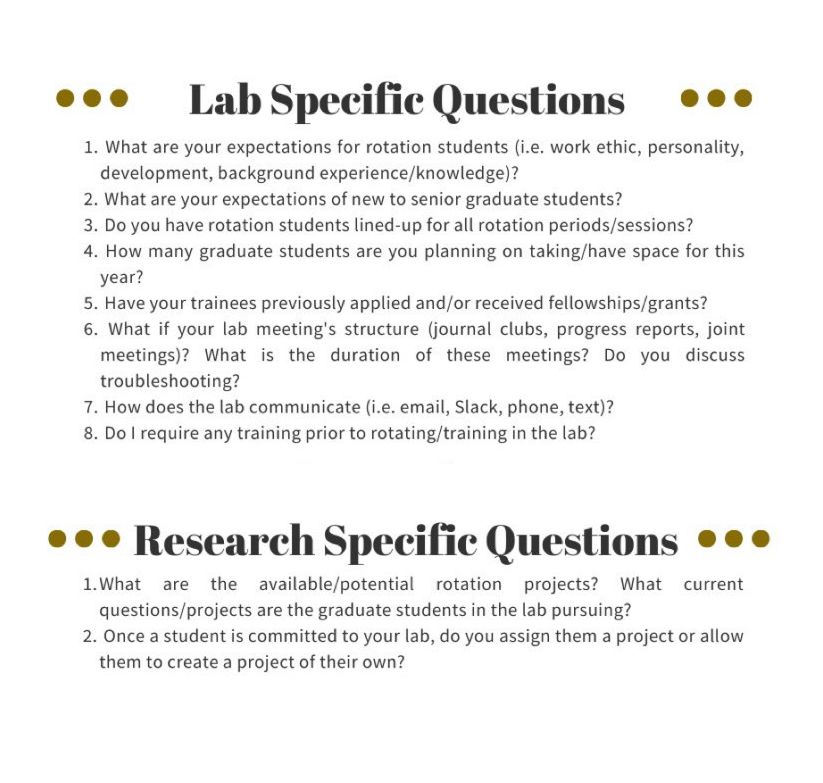
Lab Specific Questions
1. What are your expectations for rotation students (i.e. work ethic, personality, development, background experience/knowledge)?
2. What are your expectations of new to senior graduate students?
3. Do you have rotation students lined-up for all rotation periods/sessions?
4. How many graduate students are you planning on taking/have space for this year?
5. Have your trainees previously applied and/or received fellowships/grants? 6. What if your lab meeting's structure (journal clubs, progress reports, joint meetings)? What is the duration of these meetings? Do you discuss troubleshooting?
7. How does the lab communicate (i.e. email, Slack, phone, text)?
8. Do I require any training prior to rotating/training in the lab?
💡 Choosing a grad school advisor is one of the most important decisions you'll make on your academic journey. 🧠💼
✨ Read the full article by Paola Figueroa-Delgado: cientificolatino.com/post/questio...
12.12.2024 22:08 — 👍 8 🔁 8 💬 0 📌 1