win-win-win! ⚡⚡⚡
13.02.2026 18:40 — 👍 1 🔁 0 💬 0 📌 0
Absolutely we do! Best way to hold them accountable is to buy EVs built by other companies. Of course, I'd love to see them held accountable in other ways, too.
13.02.2026 17:54 — 👍 1 🔁 0 💬 1 📌 0
yup!
But U.S. gasoline consumption peaked in 2019, and it's never coming back. That does give me some hope.
However, Big Oil will delay the switch to cleaner fuels as much as they can, which is terrible for everyone except them.
13.02.2026 17:42 — 👍 1 🔁 0 💬 1 📌 0
It could not be any more clear that our government works for Big Oil. This will hurt people, shorten lifespans, and cause billions of dollars in health care costs. It will also cost several more billions in environmental and property damage.
Big Oil gets even richer, while you pay the price.
13.02.2026 16:24 — 👍 12 🔁 7 💬 2 📌 0
Yes, it's plenty. We do charge at home. I work at a ski area and it takes about an hour and a half of March sunshine on our roof to power a round trip to work. I think that's amazing.
12.02.2026 14:29 — 👍 1 🔁 0 💬 0 📌 0
No. Gas mileage is one way to measure efficiency.
The reason behind any given gas mileage figure is because of the operating efficiency of the vehicle.
If you wanted to compare EVs and ICE using distance traveled/units of energy you would get this exact same result.
12.02.2026 14:27 — 👍 2 🔁 0 💬 1 📌 0
300 miles, on average
12.02.2026 05:52 — 👍 1 🔁 0 💬 1 📌 0
I do, but that's thankfully not a prerequisite for understanding them.
12.02.2026 04:59 — 👍 1 🔁 0 💬 1 📌 0
Sadly, you are not correct. No regular gasoline ICE cars get an efficiency anywhere near that high.
Your example is a hybrid engine. It's making electricity, not turning a crankshaft.
12.02.2026 04:34 — 👍 2 🔁 0 💬 1 📌 0
Ah, got it. All the Bad Things you ascribe to heavy EVs are reserved only for EVs. An ICE car that is equally heavy (but pollutes way way more!) is just fine.
Thanks for making it so clear you're making a bad faith argument.
12.02.2026 01:30 — 👍 5 🔁 0 💬 1 📌 0
Whooo, nice! I live in a red state, so we don't get any extra incentives. OTOH, our solar array offsets some very dirty energy so that part is a big win for us.
Way to go in donating your old car! 🫡
12.02.2026 00:16 — 👍 1 🔁 0 💬 0 📌 0
Ah, I see. So now you're just talking about the many downsides of big cars. I agree. Big cars are terrible, and it does not matter what type of drivetrain they have. Let's make rules that encourage smaller cars, all around. 👍
12.02.2026 00:07 — 👍 2 🔁 0 💬 1 📌 0
Niiice! That is an awesome car, and you have a beautifully clean energy supply. Win win!
We have the sister car, Kia EV6, and a roof full of solar panels. Happy times.
12.02.2026 00:04 — 👍 1 🔁 0 💬 1 📌 0
ICE vehicles suffer the exact same problems, though. Both types of vehicles are inefficient at extreme temps. EVs are still much more efficient in every scenario.
12.02.2026 00:01 — 👍 0 🔁 0 💬 0 📌 0
Note that the diagram specifically says gasoline, not diesel. The numbers are correct. 🙂
11.02.2026 23:59 — 👍 1 🔁 0 💬 0 📌 0
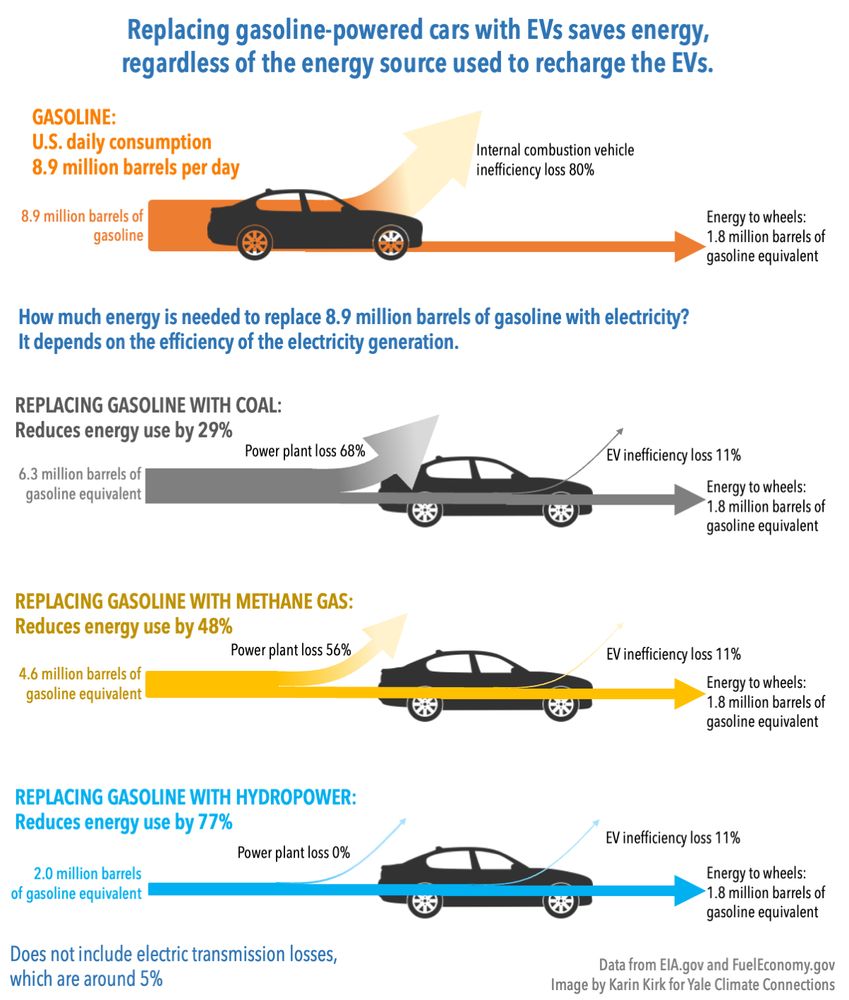
Here you go! This diagram shows you how the efficiency changes depending on the source of electricity.
yaleclimateconnections.org/2024/01/elec...
11.02.2026 23:57 — 👍 4 🔁 0 💬 1 📌 0
Sure, but then 80% of that gasoline is wasted.
It doesn't matter that much what the energy density of gasoline is, considering that the majority of it ends up being useless in terms of moving you down the road. It might be dense energy, but it's still wasted energy.
11.02.2026 23:53 — 👍 1 🔁 0 💬 1 📌 0
Yeah, this is a common reply, but how energy dense is gasoline when you consider that 80% of it is wasted? Turns out, the density of the energy doesn't add up to all that much when you factor in how little of that energy actually propels you down the road.
11.02.2026 23:49 — 👍 5 🔁 0 💬 0 📌 0
haha, it's ok! I always learn from them. Often it helps me find my next topics to work on.
11.02.2026 23:46 — 👍 1 🔁 0 💬 0 📌 0
Yeah, some utilities offer a great deal on that. Others don't give any discount at all. YMMV, as they say.
In my case, I took a quick approach to use statewide data, rather than delving into every utility in the U.S. Certainly it can be done, but that's a much bigger scale of research effort.
11.02.2026 23:45 — 👍 0 🔁 0 💬 1 📌 0
I write a lot of articles for a lot of different audiences. If you don't agree with the framing on this one, that's really ok w/ me.
80% of your gas money is wasted and you get absolutely nothing for it. Maybe that framing is better for you?
11.02.2026 23:20 — 👍 1 🔁 0 💬 1 📌 0

Screenshot that reads:
Besides lowering emissions and fighting climate change, using less energy overall is a win for land use, air and water pollution, and environmental justice, while also lowering the cost of driving for everyone.
Efficiency is a beautiful thing.
Efficiency is exactly the same as gas mileage.
Here's the closing sentiment of this article. There are many ways to frame efficiency as a win. Cost is one of them, for sure!
(I've also written articles focused entirely on cost savings of EVs, such as yaleclimateconnections.org/2024/01/gaso...)
11.02.2026 23:16 — 👍 3 🔁 0 💬 3 📌 0

Yes! Exactly.
Here's a map (yes, I made this one too) that shows the price of home charging an EV in each state, put in terms of the price of a gallon of gasoline.
It's so much cheaper!
Source article and data: yaleclimateconnections.org/2024/01/gaso...
11.02.2026 23:11 — 👍 2 🔁 0 💬 1 📌 0
Most people don't love things that are wasteful or inefficient, or polluting. It makes tremendous practical difference – just as you said – in terms of cost.
80% of your gas money is going up in smoke, basically.
EVs really change the equation, and in a good way. People seem to like knowing that.
11.02.2026 23:02 — 👍 2 🔁 0 💬 2 📌 0

Electrifying transportation reduces emissions AND saves massive amounts of energy » Yale Climate Connections
Electric vehicles are far more energy-efficient than traditional internal combustion vehicles.
Ah yes, you are right it's not in that article, it's in another article cited by that article.
yaleclimateconnections.org/2022/08/elec...
And the original data source is here:
www.fueleconomy.gov/feg/atv.shtml
Hope that helps - happy to answer any follow-ups!
11.02.2026 22:40 — 👍 5 🔁 1 💬 1 📌 0
I mean, if you're gonna do a sniff test, at least sniff with some accuracy.
Renewables were 24% of the U.S. grid in Oct 2025, the most recent month of data from EIA.gov.
It really isn't that hard to estimate things!
11.02.2026 22:37 — 👍 1 🔁 0 💬 1 📌 0
Thank you Zamafir! These are my most infamous diagrams yet, and I do love how they make the rounds so reliably.
Though I wish people linked to the article and/or the related diagram that shows various electricity sources, because that helps clear up many of the questions that inevitably come up.
11.02.2026 22:08 — 👍 1 🔁 0 💬 1 📌 0
The answers actually are not that hard!
Also, it doesn't take nearly 8 years to break even with the battery production. It's closer to 2 years, but it depends on the energy sources used in battery production and the energy sources used to charge the car.
11.02.2026 22:00 — 👍 2 🔁 0 💬 1 📌 0

Electric vehicles use half the energy of gas-powered vehicles » Yale Climate Connections
They’re just much more efficient.
Well, that's the difference between a snapshot of a topic vs reading a whole article. Want a single quick takeaway? Look at a diagram. Want a deeper dive? Read an article. Both types of communication are useful.
But I would def prefer that this diagram not get posted without a link to more info.
11.02.2026 21:54 — 👍 1 🔁 0 💬 0 📌 0
A new type of journalism in the Pacific Northwest.
https://westernedgemedia.substack.com/
Owned by no one.
Operated by @leahsottile.bsky.social & @ryanjhaas.bsky.social.
Email us story ideas: hellowesternedge@gmail.com
Painter, sculptor and potter. Glacier National Park is my emphasis subject where my gallery/studio/home is near.
Slava Ukraini 🇺🇦
Guitarist, occasional song-writer, longtime Dem. Support democracy, the rule of law, science, women's rights, and be kind. Kindness and empathy are strengths, not weaknesses. 🚫DMs - I MEAN IT 🚫Crypto 🚫Porn #TheResistance 💙💙💙💙 #BlueCrew 🇺🇦🇮🇪
Your neighbors in Bozeman. Non-partisan. Against Project 2025; hard no on authoritarianism/fascism; big yes to humans, our rights, democracy, standing with anyone affected/endangered under the current regime.
Environment reporter for VeriteNews.org & Grist.org • Covering climate change, energy, pollution, wildlife, Gulf of Mexico, Louisiana's disappearing coast • Past: Times-Picayune, Ted Scripps fellow, Kitsap Sun
https://muckrack.com/tristan-baurick
Proud Liberal 💙 Vote Blue and Save Democracy 💙 Serve as a Trustee for local public library - we must have a literate and educated society. Pro-Choice and Resister. Anti fascism. Traveler - believe there is joy in the journey. DM=Block
Seismologist, investigates the Andes and subduction zones, currently complexly affiliated with St. Louis University and looking for new projects.
Replies to my geoscience posts that include ChatGPT content get hidden and get your account blocked.
AAAS Honorary Fellow & STP Alumn; Sci pol & diplomacy, ed & com; EJ & SJ; wildlife endocrinology & physio.; marine mammal biol.; environmental tox & disruption; systems change; conservation standards. Posts solely reflect my own opinions. she/her/hers
@theunpopulist.net
Election law and policy, liberalism and democracy, and occasional pugs.
posts autodelete; posts my own views | she/elle
🎧http://MeteorSciComm.org & Meteor #SciComm podcast
📖Teaching & Mentoring Science Writers (From UChicago Press)
✒🎨 https://schoolofgoodtrouble.substack.com
🎓Prof of Practic
Ex-professor of engineering/chemistry & healthcare technology R&D professional. Native New Englander self-transplanted to PNW. Hiker/climber & climate-conscious gardener. Boston sports fan(atic). Cultivator & purveyor of a cornucopia of interests.
Data & science enthusiast with a passion for health research, creativity, and technology. Not a doctor.
#Democracy #Data #Health #Science #RStats #SQL #DWH #LLM #SciFi #Movies #Origami #Art #Creativity #Archery #Gardening #Swimming
Opinions are mine.
Ensuring political appointees serve the public interest.
https://therevolvingdoorproject.org/
Read more of our work at http://revolvingdoorproject.substack.com and http://hackwatch.us
Follow:
Twitter/Post @RevolvingDoorDC
FB/IG: RevolvingDoorProject
Ecologist & Geographer @ ecosystems.psu.edu | Writer | Editor of @briefecology.bsky.social & @rottingleafmag.bsky.social | DSA Organizer
https://www.briefecology.com/
Mom/GM/Humum to Boz&Lola/advocate for kids/ ❤️lit,flowers,travel,📷 /retired HS teacher/MEd,MSW /Theater
🌊 Photos mine unless reposts. NO PROFiLE,NO POSTS=BLOCK .
You gotta get up pretty early in the morning to outsmart the Macho Man.
Milwaukeean. I wrote Health Justice Now, a book about Medicare for All and beyond. https://error.malware-virus.biz
Infrequent health policy newsletter: buttondown.com/error
Professor, researcher, musician: mountain glaciers, snow, water, weather, climate change, remote sensing, community adaptation, and EDI in science.
www.moshlab.org
Living in Lheidlih T’enneh territory
(he/him/il/anti-fascist)
Founding editor of Energy Flux — the home of fiercely independent energy market analysis
Free newsletter: www.EnergyFlux.news
Director of Teacher Programming, The Center for Climate Change Education at PRI
Co-author of The Teacher-Friendly Guide to Climate Change
Deputizer of climate communicators
Thinks we should talk more about fire
https://climate.earthathome.org/