Redirecting
📢 New research on #grassland #restoration!
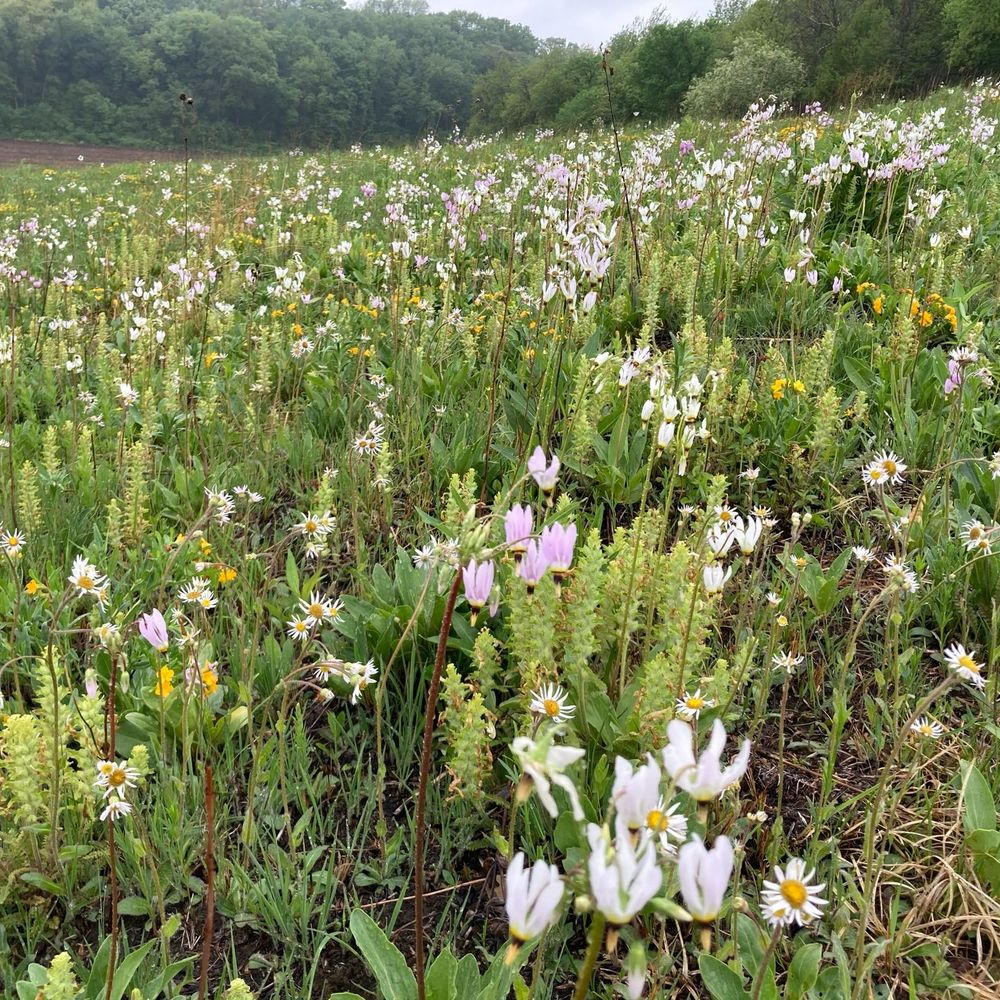
🌱 13-year study shows that dense sowing of the native grass Festuca valesiaca can suppress weeds in the short term, but slows down regeneration toward natural loess steppe in later stages.
👉 doi.org/10.1016/j.ge...
10.02.2026 12:50 — 👍 1 🔁 0 💬 1 📌 0


Congratulations to Alida Hábenczyus, who successfully defended her doctoral dissertation! 🎉 We wish her a fruitful and successful research career, which she can begin as a research fellow of the MTA-SZTE Applied Ecology Research Group. 💚🌱
03.02.2026 18:12 — 👍 1 🔁 0 💬 1 📌 0
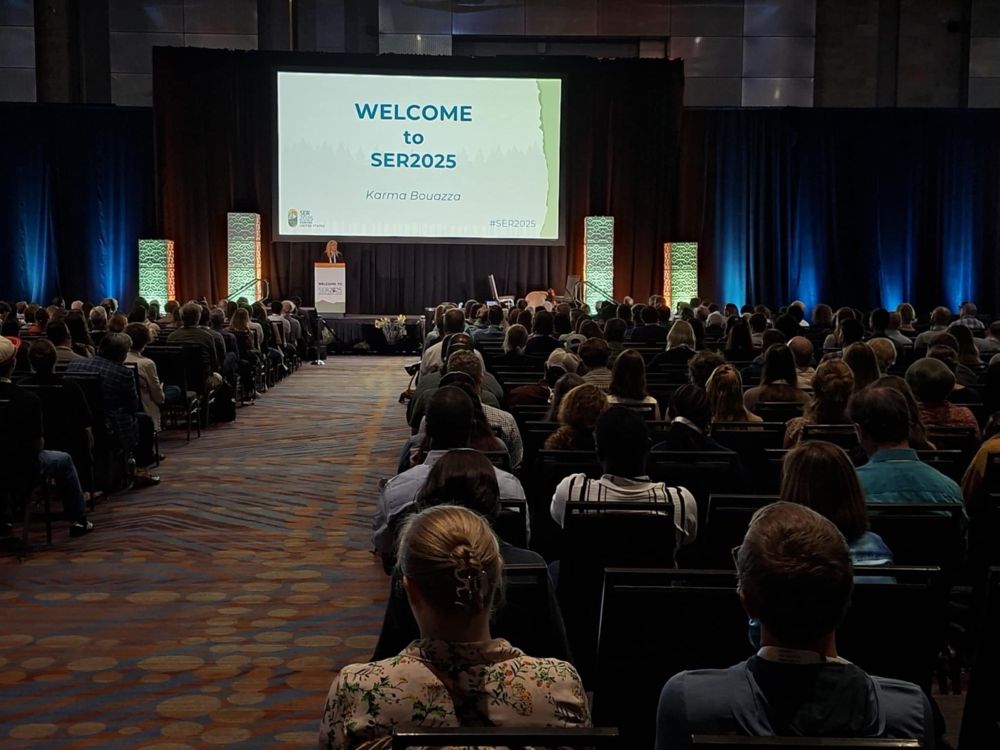
#EcosystemRestoration can’t stop climate change, but it helps us adapt and preserve biodiversity! 🌿
Hear Csaba’s talk at #SER2025 in Denver!
📍 Mineral Ballroom D | 🕥 Oct 4, 10:45
02.10.2025 12:06 — 👍 2 🔁 0 💬 0 📌 0

Contrasting trait-based assembly mechanisms on different trophic levels: ants and plants on wood-pastures - Oecologia
Complex landscapes (i.e., those harboring multiple habitat types at immediate spatial proximity) are highly relevant to both applied and theoretical ecological research, yet the mechanisms shaping functional trait distributions and diversity metrics across trophic levels in these systems remain poorly understood. To address this knowledge gap, we used wood-pastures as a model system and focused on two prominent groups occupying different trophic levels: plants and ants. We sampled three Central-European wood-pastures, with all four encompassed habitat types (grasslands, solitary trees, forest edges, and forests; 48 sites in total). Our results revealed significant differences in taxonomic and functional composition for both groups among the different habitat types of wood-pastures. However, the underlying mechanisms driving these patterns differed between plants and ants. Based on RLQ and fourth-corner analyses, heterogeneity in environmental conditions mainly influenced plant functional trait distributions. In contrast, ant diversity metrics and trait distributions were strongly linked to vegetation characteristics and habitat structure, and were only indirectly influenced by local microclimate, as shown by path analyses. These highlight that while mapping the increased environmental heterogeneity of complex landscapes, the main mechanisms shaping functional composition and diversity metrics might differ for organisms at different trophic levels (i.e., predominantly environmental filtering for plants and interspecific competition for ants). Consequently, the patterns and peaks of taxonomic and functional diversity do not necessarily coincide for different organisms in complex landscapes, emphasizing that conservation initiatives should focus on the system as a whole, rather than individual habitat types, to maximize biodiversity conservation.
Complex landscapes host diverse life, but not all organisms respond identicall!
In wood-pastures, plants are filtered by the environment, while ants by vegetation and habitat structure.🌿🐜
Conservation must target the whole system.
New paper by our collegaues⤵️:
link.springer.com/article/10.1...
30.09.2025 22:18 — 👍 2 🔁 1 💬 0 📌 0

Kurgans can act as refuges for rare weeds!🌿
With colleagues from ‘Lendület’ Seed Ecology Research Group, we found that these out-of-production sites provide key habitats for many rare weed species – shaped by geographical position, soils & vegetation recovery.🌱
www.sciencedirect.com/science/arti...
07.09.2025 09:53 — 👍 8 🔁 3 💬 1 📌 0
Neither #TreePlanting nor a more inclusive #EcosystemRestoration can significantly reduce atmospheric CO2 concentrations. Global strategies should focus on #ClimateChange ADAPTATION (not mitigtion), #Biodiversity conservation and human well-being. 🌱
Check out our paper in @natgeosci.nature.com ‼️👇🏻
05.09.2025 13:56 — 👍 3 🔁 1 💬 0 📌 0
Aotearoa based Restoration/Applied Ecologist.
Skateboarding, punk rock and plants.
iNaturalist enthusiast https://inaturalist.nz/observations?place_id=any&user_id=andymckay&verifiable=any
🌳 Botanist | Vegetation ecologist
🌿 Editor-in-Chief of Vegetation Ecology and Diversity (VED)
📚 Senior researcher @University of Siena, Italy
🔎 https://www.gianmariabonari.com/
Restoration ecologist
Head of the Restoration Ecology Group of HUN-REN Centre for Ecological Research
Invasive species, particularly plants, especially in freshwater...
🇿🇦Senior Lecturer (Asst. Prof), Univ of Stirling🏴
Makeup artist turned field girl.
Coffee? always! ☕
Joined by #NinjaTheStaffie
insta: @drzpattison
https://zarahsinthefield.com/
Lecturer at University of Barcelona | Plants, Arthropods, Soils, Global Change, from communities to ecosystem functioning.
Biologist & entomologist 🐝🪰, advocate for #womenInEcology, protector of pollinators, Diptera enthusiast, nature lover🌿, and always a friend
Biodiversity scientist, focused mainly on pollinators and their interactions with plants. Author of 'Pollinators & Pollination: Nature and Society' (Pelagic 2021) and 'Birds & Flowers: An Intimate 50 Million Year Relationship' (Pelagic 2024).
Dr. rer.nat., ecologist, working on biodiversity 🌷🐝🦋 and pest control in agricultural landscapes 🌽🐛🐞
postdoc @uni-wuerzburg.de,
born at 354 ppm, part-time tiger beetle taxonomist, curator @inaturalist.bsky.social, japanophile 🍙🗾🇯🇵, https://linktr.ee/fboetzl
Arthropod ecology in different ecosystems. (Functional) diversity, community composition, trophic niches, plant-animal interactions, temporal & spatial patterns
Postdoc|agroecologist|landscape ecologist @_SLU working on the resilience of biocontrol 🪲🐞 | previously investigating biodiversity conservation 🐥🪲🐜🕷️🐝🦋🦠🐛 and ecosystem services 🌱 in smallholder farms 🐢 #firstgen
https://linktr.ee/CassyVogel
Postdoc at Ghent University. Interested in sustainable agriculture and applied ecology 🌻🍒🐝
PhD in Biology 🐦🌍🦅 | Urban Ecology, Plastic Pollution & Wildlife Conservation | PI of the Study and Conservation of Biodiversity Research Group.
Kiwi interested in grassland biodiversity, plant evolutionary ecology, biogeography & all things botanical. I also hike & sew. Currently a postdoc at @wslresearch.bsky.social
Ecologist and scientist interested in biodiversity, conservation and ecosystem functioning. Working as an Assistant Prof. at Wageningen University
Academic. Ecologist. Research, teaching and outreach. I know a bit about butterflies, pollinators, plants and grasslands, and about nature in general. I work at Swedish University of Agricultural Sciences, but all opinions are my own.
Associate professor in plant & soil ecology at University of Saskatchewan. Grassland ecology enthusiast
Ecologist of Midwestern fire-dependent ecosystems & volunteer land steward @ Mukwonago River Oak Barrens. Opinions mine. Among them is the need to stop viewing grasslands, savannas, & woodlands through a productivist lens. Ban AI. He/Him
Grassland Ecologist in England trying hard to save nature in an official capacity, annoying some in the process. Fungi, insects, plants fanboy, indie music, Green and sometimes, loud lefty, union geyser, politics, football, cycling & tofu. 🍄🍄🟫
Ecologist (PhD) | experimental ecology | ecological forecasting | alpine plants | steering committee member @ https://euro-ecoforecast.wordpress.com/
Website: https://billurbektas.github.io/