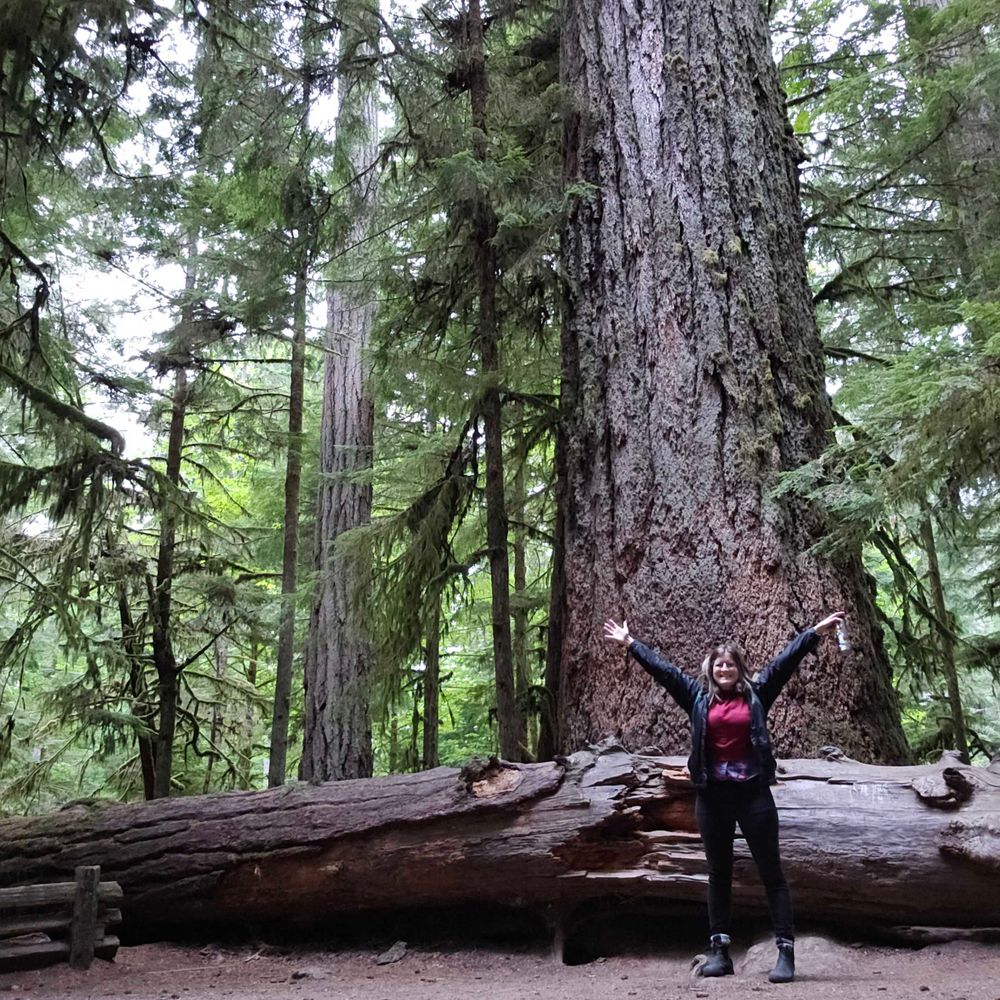
That’s how we officially kick off the semester in my research lab—with ambitious goals, beautiful human beings and delicious tamales!
Check out our new lab page here:
climaysociedad.atmosfera.unam.mx/hub-ecosiste...

@bbastien.bsky.social
Interdisciplinary climate change scientist and communicator • National Geographic Explorer ⛰️ • Assistant Professor at UNAM 🇲🇽
That’s how we officially kick off the semester in my research lab—with ambitious goals, beautiful human beings and delicious tamales!
Check out our new lab page here:
climaysociedad.atmosfera.unam.mx/hub-ecosiste...

New paper with Francisco Estrada!
This is a paper on termination shock risk and the governance challenge of deploying solar geoengineering when international coordination is so hard to achieve.
Paper: iopscience.iop.org/article/10.1...
New Scientist: www.newscientist.com/article/2513...

Climate change has an impact on the oceans, which in turn affects humanity, including our economy. In this recent paper, we quantify these impacts www.nature.com/articles/s41..., led by @bbastien.bsky.social with @francescogranella.bsky.social @maxtav.bsky.social
within @sparccle.bsky.social project

My Neighbor, the Ocean
🔍 Behind the Paper: 'My Neighbor, the Ocean.' 🌊 The system that regulates the planet’s climate barely appeared in climate policy calculations. Not because it had been “wrong” before, but because it had been incomplete.🔗 Read more here: bit.ly/49NXSo4. @bbastien.bsky.social #ClimateChange
21.01.2026 16:00 — 👍 0 🔁 1 💬 0 📌 0
The social cost of carbon (SCC), a crucial indicator for #climatechange policy, has largely overlooked the significant economic and societal benefits provided by oceans, often referred to as 'blue capital'.
www.nature.com/articles/s41...

RESEARCH: Accounting for ocean impacts nearly doubles the social cost of carbon. Co-authored by Dr. William Cheung @ubccoru.bsky.social @solvingfcb.org
www.nature.com/articles/s41...

🌊 Accounting for ocean impacts nearly doubles the social cost of carbon
By factoring in impacts on corals, mangroves, fisheries, & ports, the 2020 blue social cost of carbon jumps to $48/ton CO2-almost doubling traditional estimates. Protecting “blue capital” matters
www.nature.com/articles/s41...

Accounting for ocean impacts nearly doubles the social cost of carbon www.nature.com/articles/s41... #jcampubs 🌊
15.01.2026 13:55 — 👍 17 🔁 15 💬 0 📌 0Huge thanks to an amazing team of brilliant coauthors: Aburto, Brander, Cheung, Emmerling, Free, Granella, Tavoni, Verschuur, and, of course, Kate Ricke, who believed in this project.
@scrippsocean.bsky.social

Most of these damages come from non-market values: nutrition, coastal protection, and the existence value of marine ecosystems — not just market losses.
15.01.2026 12:20 — 👍 1 🔁 1 💬 1 📌 0
Our central estimate is $48 per ton of CO₂ (2020 USD) — which roughly doubles the SCC of the model without ocean damages. But here is a fuller comparison using other discount rates and baseline damage functions.
15.01.2026 12:20 — 👍 0 🔁 0 💬 1 📌 0We integrate ocean science + economics into a country-explicit IAM (RICE50+) to estimate the blue SCC — the welfare impacts of climate change on corals, mangroves, fisheries & mariculture, and ports.
15.01.2026 12:20 — 👍 3 🔁 0 💬 1 📌 0
The Social Cost of Carbon for the Oceans is out today in Nature Climate Change.
www.nature.com/articles/s41...
Until now, ocean damages have been largely missing from SCC estimates used in climate policy.
Solar radiation management looks most attractive precisely when governance is weakest — and that’s exactly when it’s most likely to fail. Check out our new paper in Environmental Research: Climate
iopscience.iop.org/article/10.1...

Projections indicate that rising ocean temperatures could offset anticipated gains in global mangrove restoration by 2100, resulting in significant ecosystem and economic losses, especially in Asia. doi.org/g92dsh
03.09.2025 09:46 — 👍 1 🔁 1 💬 0 📌 0
About 150,000 hectares (580 sq. mi.) of mangrove ecosystems, vital for coastal protection, habitat creation, carbon storage, and water quality, will be lost by the end of the century due to #climatechange, with Asia bearing nearly two-thirds of these losses.
oceanographicmagazine.com/news/warming...


Figures looked weird, so sharing again!
03.09.2025 17:46 — 👍 0 🔁 0 💬 0 📌 0
Press Release here: scripps.ucsd.edu/news/ocean-w...
03.09.2025 13:54 — 👍 1 🔁 1 💬 1 📌 0By 2100, foregone benefits = 28B USD/year.
But uneven:
Asia 64% of losses
Middle East and Africa 18%
LatAm & Caribbean 12%
OECD 3%
Climate damages ecosystems broadly, but people don’t bear losses equally.
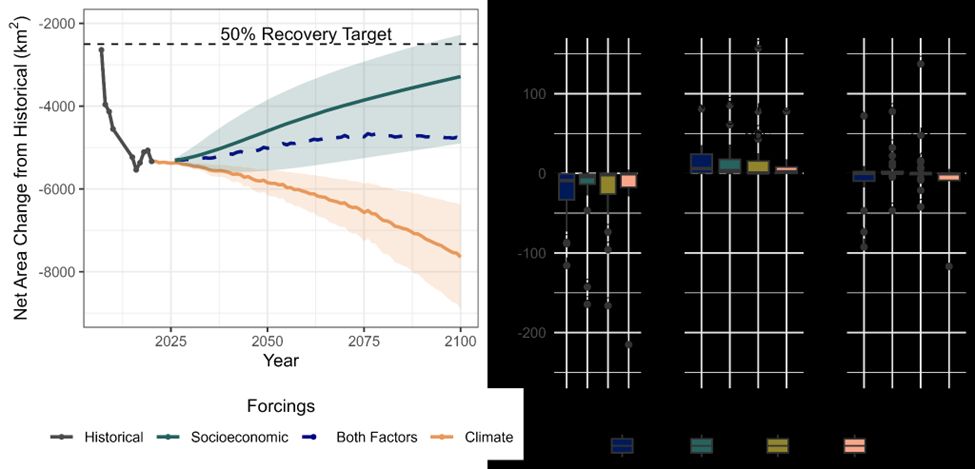
Together:
🌍 Socioeconomics push toward recovery.
🔥 Warming oceans stall or reverse progress.
Without climate change, mangroves could recover to global restoration targets. With warming, we lose ~150,000 ha by 2100.

Temperature matters too.
Warming helps colder sites expand. But beyond a threshold, heat damages dominate.
We identified sea surface temp of the hottest month (SSTh) as the strongest signal.
This Figure shows the marginal effect of both drivers
We find a Kuznets-like pattern: at low GDP, mangroves are often lost (deforestation/land-use change). Beyond a development threshold, protection strengthens and mangrove cover recovers. Socioeconomic growth can support conservation—but only after that threshold is crossed.
03.09.2025 13:54 — 👍 0 🔁 0 💬 1 📌 0
Mangroves protect coasts, store carbon & sustain fisheries. Using global data (1996–2020), we mapped mangrove extent & tracked how it responds to climate & socioeconomic drivers. Each point = 1° grid cell with mangroves.
03.09.2025 13:54 — 👍 0 🔁 0 💬 1 📌 0New paper out! We looked at how warming oceans & socioeconomic change shape the future of mangroves worldwide. @ioppublishing.bsky.social
TLDR: Climate change could stall restoration efforts & deepen global inequalities.
Paper: iopscience.iop.org/article/10.1...

I'm pleased to announce our newest paper published at Scientific Data, where we establish a framework for generating fast, custom SRM scenarios. This will allow us to develop probabilístic regional and global impact studies of geoengineering interventions.
www.nature.com/articles/s41...

After months held up in customs, @paulkelleher.net 's book finally made it to me. Now riding along with me on the Mexico City metro.
07.08.2025 15:33 — 👍 6 🔁 0 💬 1 📌 1Claim: "Water vapor is a greenhouse gas!"
Reality: Yes, and there's more of it in a warmer atmosphere
-"CO2 is plant food!"
-pretty hard to eat when you're on fire
-"Climate has changed before!"
-We know, we told you that
-"Scientists don't know everything!"
- doesn't mean we know *nothing*


New paper!
Polycrisis isn’t a series of mistakes — it’s a tangled web of crises we navigate through increasingly rough terrain.
www.cambridge.org/core/journal...
Polycrisis isn’t a series of mistakes — it’s a tangled web of crises we navigate through increasingly rough terrain.
In this study, we compile a global database and analyze the co-occurrence of shocks, the building blocks of crisis, from 1970 to today.
www.cambridge.org/core/journal...
Very happy to be an AERE Scholar this year! I'm looking forward to contributing meaningfully to the field.
14.07.2025 16:43 — 👍 2 🔁 0 💬 0 📌 0